The QM points and fees limits for 2026 are 3% of the total loan amount for a loan of $137,958 or more, $4,139 from $82,775, 5% from $27,592, $1,380 from $17,245, and 8% below that. A loan whose counted points and fees exceed its limit cannot be a qualified mortgage under Regulation Z, and for loans made since 2021 no refund rescues it after closing. Testing the limit means getting three things right: which tier the loan falls into, the "total loan amount" the percentage applies to, and which charges count. The last one turns on whether discount points were bona fide. Botminds' Loan Compliance Testing runs the arithmetic on every closed loan, and where the answer depends on that question it sends the loan to a compliance tester with the evidence needed to answer it.
One loan, two answers: the Whitcombe points-and-fees test
3.69%
points and fees with the 1.25 discount points counted: over the limit
3.00%
the QM limit for a loan amount of $137,958 or more in 2026
2.38%
points and fees if the points are bona fide and excluded
0.570
points by which the undiscounted rate, 6.990%, exceeds APOR, 6.420%
What is the QM points and fees limit for 2026?
It is 3% of the total loan amount for loans of $137,958 or more, with flat-dollar and higher-percentage limits for smaller loans. A covered transaction "is not a qualified mortgage unless the transaction's total points and fees ... do not exceed" the limit for its size (12 CFR 1026.43(e)(3)(i)). The regulation writes the limits at their original values and indexes them to the CPI-U each January. For 2026 the CFPB published: "3 percent of the total loan amount for a loan greater than or equal to $137,958; $4,139 for a loan amount greater than or equal to $82,775 but less than $137,958; 5 percent of the total loan amount for a loan greater than or equal to $27,592 but less than $82,775; $1,380 for a loan amount greater than or equal to $17,245 but less than $27,592; and 8 percent of the total loan amount for a loan amount less than $17,245" (90 FR, 15 December 2025).
QM points-and-fees limits for loans consummated in 2026
| Loan amount (the note) | Limit on points and fees | Applied to |
|---|---|---|
| $137,958 or more | 3% | Total loan amount |
| $82,775 to $137,957 | $4,139 | A flat dollar cap |
| $27,592 to $82,774 | 5% | Total loan amount |
| $17,245 to $27,591 | $1,380 | A flat dollar cap |
| Under $17,245 | 8% | Total loan amount |
The dollar tiers exist because a percentage of a small loan is too little to cover a lender's fixed costs. They also make the boundaries behave oddly: a $130,000 loan may carry $4,139 whatever its total loan amount, while a $140,000 loan may carry 3% of a total loan amount that is likely to be below $140,000, about the same. Near a tier boundary, a test that puts the loan in the wrong tier gets every later step wrong.
How do you calculate QM points and fees? The note picks the tier, the total loan amount sets the cap
Use the note amount to choose the tier, then apply the tier's percentage to the total loan amount, not to the note. The commentary is explicit: "A creditor must determine which category the loan falls into based on the face amount of the note", but "for categories with a percentage limit, the creditor must apply the allowable points and fees percentage to the 'total loan amount,' which may be different than the loan amount" (comment 43(e)(3)(i)-2, Supplement I to Part 1026). The total loan amount is the amount financed under §1026.18(b), less any points and fees that were financed (comment 32(b)(4)(i)-1).
The difference is not cosmetic. Dividing by the note understates the percentage, because the note is larger than the total loan amount whenever prepaid finance charges were paid at closing. On the Whitcombe loan the note is $412,000 and the amount financed, rebuilt from the file, is $395,276.73. The borrower paid the points and fees in cash at closing, so none were financed and the total loan amount equals the amount financed. Three per cent of it is $11,858.30, about $500 less room than 3% of the note would suggest.
The Whitcombe test, step by step
| Step | Figure | Why |
|---|---|---|
| 1. Pick the tier | Note $412,000 ≥ $137,958 | The note amount places the loan in the 3% tier for 2026 |
| 2. Find the total loan amount | $395,276.73 | Amount financed under §1026.18(b), less financed points and fees (none here) |
| 3. Set the cap | 3% × $395,276.73 = $11,858.30 | The most the loan may carry and still be a qualified mortgage |
| 4. Count points and fees | $14,570 with the points; $9,420 without | Over the cap with the points; $2,438.30 under it without them |
A second trap is the amount financed itself. On the Whitcombe loan the Closing Disclosure showed an amount financed of $401,576.73, because the loan system had coded the discount points and a lock-extension fee as paid by the seller. A points-and-fees test that took the disclosed figure would have divided by the wrong number as well as counting the wrong fees. The test has to rebuild the amount financed from the fees the borrower actually paid, the same rebuild the APR tolerance test relies on.
What counts in the QM points and fees test?
Broadly, every finance charge the borrower pays other than interest, plus loan originator compensation and some charges the finance charge leaves out. §1026.32(b)(1) builds the count from the finance charge under §1026.4(a) and (b), then removes interest, government mortgage insurance premiums, some private mortgage insurance, bona fide third-party charges "not retained by the creditor, loan originator, or an affiliate of either", and qualifying bona fide discount points (12 CFR 1026.32(b)(1)(i)).
It then adds what the finance charge does not hold. Compensation paid to a loan originator counts when it "can be attributed to that transaction at the time the interest rate is set", except compensation a creditor pays its own employee or a broker pays its own staff (§1026.32(b)(1)(ii)). The real-estate charges of §1026.4(c)(7), such as title and appraisal fees, which the finance charge excludes, come back in unless the charge is reasonable, the creditor receives no compensation from it, and it is not paid to an affiliate (§1026.32(b)(1)(iii)). Credit insurance premiums and the maximum prepayment penalty are counted too (§1026.32(b)(1)(iv)–(v)).
The Whitcombe loan's charges, sorted for the QM test
| Charge | Amount | Counted? | Why |
|---|---|---|---|
| Origination, broker, processing and underwriting fees, lock extension | $9,420 | Yes | Finance charges kept by the creditor or the broker |
| Discount points, 1.25 | $5,150 | Only if not bona fide | Excludable if bona fide and the undiscounted rate is within 1 point of APOR |
| Appraisal, credit report, title (third party) | $2,632 | No | Reasonable third-party charges, no creditor compensation, no affiliate |
What are bona fide discount points?
A bona fide discount point is 1% of the loan amount, paid by the borrower, that buys a reduction in the rate at a price consistent with established industry practice. The regulation's words: "an amount equal to 1 percent of the loan amount paid by the consumer that reduces the interest rate ... based on a calculation that is consistent with established industry practices for determining the amount of reduction in the interest rate ... appropriate for the amount of discount points paid" (12 CFR 1026.32(b)(3)).
The commentary names the evidence that meets the standard. A creditor "may rely on pricing in the to-be-announced (TBA) market for mortgage-backed securities" to show the reduction matches what it could expect to receive in the secondary market, or show that its pricing follows Fannie Mae or Freddie Mac guidelines for bona fide reductions. Its worked example is a guideline that requires "at least a 25 basis point reduction in the interest rate" per point (comment 32(b)(3)(i)-1, Supplement I). On the Whitcombe loan 1.25 points took the rate from 6.990% to 6.625%, 36.5 basis points, or about 29 per point.
Two conditions in the definition are easy to miss. The borrower must have paid the points: seller-paid and lender-paid points are not the borrower's discount points. And the reduction must be real: a "point" that bought no rate, or less rate than the lender's own sheet charges for, is a fee by another name and counts in full.
Are bona fide discount points excluded from points and fees? It depends on the distance from APOR
Yes, but only within two bands measured from the average prime offer rate. Up to two bona fide points can be excluded "if the interest rate without any discount does not exceed ... the average prime offer rate ... by more than one percentage point". If none was excluded on that basis, up to one point can be excluded when the undiscounted rate is no more than two points above APOR (§1026.32(b)(1)(i)(E), (F)). Beyond two points, every point counts.
How much of the discount can be excluded depends on the undiscounted rate's distance from APOR
The commentary's own examples mark the edges. A borrower who locks at 6% on 1 May 2014, discounted from 6.5% with two points, against an APOR of 5.5%, may have both points excluded, because the undiscounted rate is exactly one point over. A borrower who pays four points to go from 7% to 6% against an APOR of 5% may have one excluded (comments 32(b)(1)(i)(E)-3 and (F)-2). The APOR to use is the one for a comparable transaction "as of the date the discounted interest rate for the transaction is set", usually the lock date, not the closing date (comment 32(b)(1)(i)(E)-2).
For the Whitcombe loan the bands give three outcomes. Excluding all 1.25 points leaves $9,420, or 2.38%: a pass. Had the undiscounted rate been 1.2 points over APOR, only one point, $4,120, could come out, leaving $10,450, or 2.64%: still a pass. Had it been more than two points over, the full $14,570 would count, 3.69%, and the loan would not be a qualified mortgage.
Why a rule cannot settle bona fide points from the loan file
Everything in the test is arithmetic on figures in the file except one: whether the points bought the rate down at the lender's price. The Closing Disclosure shows the points and the rate; it does not show the trade between them. Only the rate sheet in force at the lock does, and rate sheets live in pricing systems and email, not in the closing package.
A rule could assume points are bona fide whenever they are labelled discount points. That rule would pass loans it ought to question, because the label is exactly what an examiner or a loan buyer will test. A rule that assumed the opposite would fail every loan with points near the limit and bury testers in false fails. The honest design computes both outcomes, names the evidence that would decide, and leaves the decision to a person. In the sample bank's August run, 41 tests in the higher-priced and high-cost family ended as reviews for a tester.
Bona fide is a fact about the rate sheet, not the disclosure. A test can compute both answers; only the evidence picks one.
How a tester settles bona fide discount points
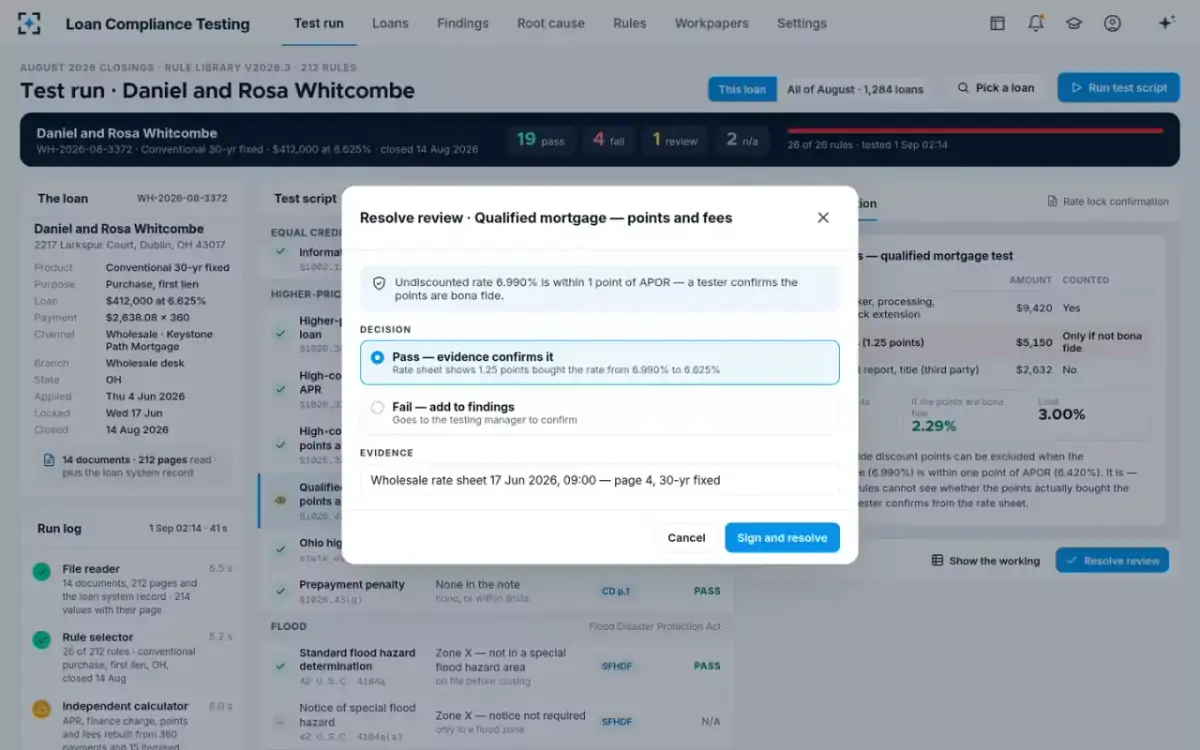
With one document and a short set of checks. In the sample bank, the tester opened the wholesale rate sheet of 17 June 2026, the day the Whitcombe loan was locked, and found on page 4 the 30-year fixed price grid: 1.25 points took the rate from 6.990% to 6.625%. She chose "Pass — evidence confirms it", named the sheet and page, and signed. Had the grid not supported the trade, she would have chosen fail, and the result would have gone to the testing manager to confirm as a finding.
Settling a bona fide discount point review
- Find the rate sheet in force at the lock
The sheet, date and time the price came from, for the product and lock period on the loan.
- Read the undiscounted rate and the price of the reduction
The rate available with no discount, and how many points the grid charges for the rate the borrower got.
- Check the points match the grid
The points paid should equal what the grid charges for that reduction, consistent with TBA pricing or agency guidelines.
- Check the borrower paid them
Seller-paid or lender-paid points are not the borrower's discount points; the Closing Disclosure and the loan system must agree on the payer.
- Place the undiscounted rate against the lock-date APOR
Within one point: up to two points excluded. Within two: up to one. Beyond: none.
- Name the evidence and sign
The document, page and time, so an auditor or a loan buyer can re-perform the decision from the same page.
Resolving the review in Loan Compliance Testing: decision, evidence, signature
Is there a cure if a qualified mortgage exceeds the points and fees limit?
Not for loans made today. Regulation Z once let a creditor or assignee keep QM status by refunding the excess, with interest, within 210 days after consummation, but that cure applies only to "covered transactions consummated on or before January 10, 2021" (12 CFR 1026.43(e)(3)(iii)). A 2026 loan that exceeds its limit is not a qualified mortgage, whatever is refunded later.
That changes when the test has to run. A points-and-fees excess found after closing cannot be repaired; it can only be priced, disclosed to a buyer, or held in portfolio without the protection a QM carries. So the pre-closing test matters most, and the post-closing test earns its keep by finding the cause, such as a fee coded to the wrong payer or broker compensation counted wrongly, before the next loan closes on it. How the five agents divide the work shows where that recomputation happens.
What else rides on the same figures: HPML, high-cost and the QM safe harbor
The same counts and the same recomputed APR feed four other pricing tests. A General QM loses its status if its APR exceeds APOR by 2.25 or more percentage points on a first lien of $137,958 or more in 2026 (90 FR, 15 December 2025). A QM that is a "higher-priced covered transaction", with an APR at least 1.5 points over APOR on a first lien, is only "presumed to comply" with the ability-to-repay rule, a presumption a borrower can rebut; one below that line gets the safe harbor (§1026.43(b)(4), (e)(1)).
The higher-priced mortgage loan test of §1026.35(a)(1) uses the same 1.5-point line for escrow and appraisal requirements, and the high-cost test of §1026.32(a) uses the same points-and-fees definition at 5% of the total loan amount for loans of $27,592 or more in 2026, or an APR more than 6.5 points over APOR on a first lien. On the Whitcombe loan the recomputed APR of 7.031% sits 0.611 over APOR, under every line, and even the full $14,570 is 3.69% of the total loan amount, under the high-cost 5%. A loan whose disclosed APR is understated, as this one was, can sit on the wrong side of a pricing line on paper and the right side in fact, so each of these tests must use the recomputed figure.
Five pricing lines, one set of figures
| Test | 2026 line (first lien) | Whitcombe loan |
|---|---|---|
| QM points and fees, §1026.43(e)(3) | 3% of total loan amount | 3.69% counted, 2.38% if bona fide |
| General QM price, §1026.43(e)(2)(vi) | APR 2.25 points or more over APOR | 0.611 over: within |
| QM safe harbor, §1026.43(b)(4) | APR under 1.5 points over APOR | 0.611 over: safe harbor |
| Higher-priced mortgage loan, §1026.35 | APR 1.5 points or more over APOR | Not higher-priced |
| High-cost mortgage, §1026.32(a) | APR over 6.5 points, or points and fees over 5% | Not high-cost |
Who decides bona fide points, and why it matters to a loan buyer
A tester decides, signs and names the page; a fail goes to the testing manager to confirm. That separation is what lets a secondary-market or due diligence reviewer, re-testing the loan before buying it, follow the same evidence to the same answer. A QM status that rests on an unexplained exclusion of points is the kind of result a buyer reopens, because the ability-to-repay protection the buyer is paying for depends on it. Who does compliance testing in a bank describes the seats around that decision, and the Loan Compliance Testing page follows the same loan through its full test script.
Questions people ask
What is the total loan amount for QM points and fees?
It is the amount financed under §1026.18(b), less any points and fees that were financed into the loan (comment 32(b)(4)(i)-1). It is usually smaller than the note amount, which only decides the tier. On a $412,000 note with $16,723.27 of prepaid finance charges paid in cash, it is $395,276.73.
Does excluding bona fide discount points change the APR?
No. Discount points paid by the borrower are finance charges whether or not they are bona fide, so they stay in the APR and the finance charge. The exclusion applies only to the points-and-fees count.
Which APOR applies to bona fide discount points?
The APOR for a comparable transaction as of the date the discounted rate was set, which for most loans is the lock date (comment 32(b)(1)(i)(E)-2). A test that uses the closing date's APOR can reach a different answer when rates moved between lock and closing.
Is the points and fees test the same for HOEPA high-cost loans?
The definition of points and fees and the bona fide discount point exclusions are the same. The limit differs: 5% of the total loan amount for loans of $27,592 or more in 2026, or $1,380 for smaller loans.
Does loan originator compensation count in QM points and fees?
Compensation paid to a mortgage broker counts, whether the borrower or the creditor pays it, when it can be tied to the loan at the time the rate is set. What a creditor pays its own employee loan officer does not count (§1026.32(b)(1)(ii)), which is why the same fee schedule can pass in retail and fail in wholesale.