A rate lock extension fee is the price a lender charges to hold a locked interest rate past its original expiry, usually quoted as a fraction of a point for a number of days. Under the TRID rule, who pays it depends on why the lock needed extending. If the borrower asks for the extension, that is a borrower-requested revision, and the lender may put its usual extension fee on a revised Loan Estimate within three business days; the commentary limits the reset to "no more than the rate lock extension fee charged by the creditor in its usual course of business". If the lock ran out because the lender's own processing ran late, none of the six reasons for revision applies, the fee cannot be passed on, and the lender absorbs it. Either way, nothing else on that revised Loan Estimate may reset because of the extension. For a disclosure desk, the question is evidence: who asked, and when. Botminds' TRID Fee Tolerance Monitoring reads the lock events and the emails behind them and judges each extension before the revised Loan Estimate goes out.
A lock extension resets one fee, not the form
Borrower asks to extend: $760 of increases on the revised Loan Estimate
- Extension fee at the usual price: resets ($400) · 53%
- Title fees: still measured against the original ($210) · 28%
- Re-inspection: needs its own reason ($150) · 19%
Lender’s delay causes the extension: same $760
- Extension fee: no reason applies, the lender pays ($400) · 53%
- Title fees ($210) · 28%
- Re-inspection ($150) · 19%
Who pays a rate lock extension fee?
The borrower, if the borrower caused the extension and the lender re-discloses in time; the lender in every other case. The rule does not say who pays in so many words. It says which increases the lender may measure against a revised estimate. A borrower who asks to move the closing date, or who is slow to provide documents and asks for more time, has requested a revision to the settlement, which is one of the six reasons: "The consumer requests revisions to the credit terms or the settlement that cause an estimated charge to increase" (12 CFR 1026.19(e)(3)(iv)(C)). The extension fee is then a new charge the revised Loan Estimate may carry.
An underwriting queue, a late appraisal the lender ordered, or a condition the lender forgot to request is not a borrower request and not a changed circumstance. The extension fee is a charge paid to the lender, so it sits in the zero-tolerance bucket; without a valid reason it can only be charged at its original estimate, which is usually nothing. Lenders who waive the fee in those cases are not being generous. They are declining to charge an amount they would have to refund.
Is a rate lock extension a changed circumstance?
Not usually. It is most often a borrower-requested revision, which is a separate reason with the same effect. It can rest on a changed circumstance when something outside anyone's control, or new information specific to the loan, delays the closing: the commentary's examples include a title insurer that goes out of business during underwriting and a neighbour who files a boundary claim (comment 19(e)(3)(iv)(A)-2). A delay of that kind can justify the extension fee, because the extension is what the event caused.
The distinction that matters is not the label but the cause, and the cause has to be in the file. A note that says "extension: borrower" is the same kind of claim the CFPB's examiners rejected for rush appraisals, when the documentation showed the lender had made the request. The changed-circumstance rule in plain words sets out what each reason needs.
What can change on a revised Loan Estimate after a lock extension?
The extension fee, at the lender's usual price, and nothing else because of it. The commentary is specific: "if a consumer requests a rate lock extension, then the revised disclosures on which a creditor relies … may reflect a new rate lock extension fee, but the fee may be no more than the rate lock extension fee charged by the creditor in its usual course of business, and the creditor may not rely on changes to other charges unrelated to the rate lock extension" (comment 19(e)(3)(iv)-2).
Two consequences follow. A lender that charges one borrower more than its usual rate for the same extension resets only the usual rate; the excess is still measured against the original estimate. And the revised Loan Estimate must still show every other charge on the best information available, but those other charges keep their old baseline: the commentary says increases in charges unrelated to the extension "may not be used for the purposes of determining good faith" (comment 19(e)(3)(iv)-5). A title fee that crept up on the same form needs its own reason.
Two extensions with the same fee, and different answers
The borrower asked for more time: A revision the borrower requested, (e)(3)(iv)(C)
The lender’s process ran late: None of the six
The borrower asked for more time: The borrower’s request, dated, in their own words
The lender’s process ran late: The lock confirmation and the reason for the delay, which is the lender’s
The borrower asked for more time: The extension fee, up to the lender’s usual price
The lender’s process ran late: Nothing
The borrower asked for more time: Revised Loan Estimate within three business days of the request
The lender’s process ran late: Not applicable: there is nothing to reset
The borrower asked for more time: The fee is measured against the revised estimate
The lender’s process ran late: Any fee charged is measured against the original estimate, and the excess refunded
Can a lender charge a relock fee?
It can charge whatever its pricing says; what it can pass on under TRID depends, again, on why the lock lapsed. When the rate was floating on the Loan Estimate and the borrower later locks, the rule requires a revised Loan Estimate within three business days of the lock, showing the new points, lender credits and other rate-dependent charges (12 CFR 1026.19(e)(3)(iv)(D)). Those are then measured against the revised figures.
A relock after a lapse is a different situation. If the borrower chose to let the lock expire, or asked to delay closing past it, the worse price that follows is a consequence of the borrower's request. If the lender's own delay let the lock lapse, the relock cost is the lender's, for the same reason the extension fee would have been. A relock after the Closing Disclosure has gone out cannot use a revised Loan Estimate at all: the lender corrects the Closing Disclosure, and if the change makes the APR inaccurate, the borrower gets a new three-business-day wait (comment 19(e)(3)(iv)(D)-2).
Lender credits after a lock change
A lock change that reduces a lender credit is an increased charge to the borrower. The CFPB's FAQ is direct: "Lender credits may decrease only if there is an accompanying changed circumstance or other triggering event … and the creditor provides the consumer with a revised estimate within three business days of receiving information sufficient to establish that the changed circumstance or other triggering event has occurred" (CFPB TRID FAQs, "Can lender credits change?").
This is where extensions get expensive without anyone noticing. A lender that funds the extension by trimming the credit it promised has charged the borrower the extension in another column. If the borrower requested the extension and the revised Loan Estimate went out in time, that may be allowed, up to the usual fee. If not, the lost credit is a zero-tolerance increase. The three TRID tolerance buckets explains why credits sit in zero, in reverse.
What does a late closing cost the lender?
The gap between what the lender could have passed on and what it ends up absorbing, line by line. A late file costs in four ways, and only the first is the extension fee itself.
What a late file costs the lender, term by term
Extension fee
usual fee, if the delay was the lender’s
No reason for revision applies, so the fee is measured against the original estimate.
Priced from the lender’s own extension sheet
Lost lender credit
credit on the Loan Estimate − credit at closing
A smaller credit is an increased charge, unless a valid reason was re-disclosed in time.
From the lock and pricing history
Rate-dependent charges
new points − baseline points
If a relock moves the points and no valid reason was re-disclosed within three business days, the increase stays with the lender.
From the lock desk
Other fees that rode along
each increase without its own reason
Fees that rose on the same revised Loan Estimate are still measured against their old baseline.
From the fee comparison
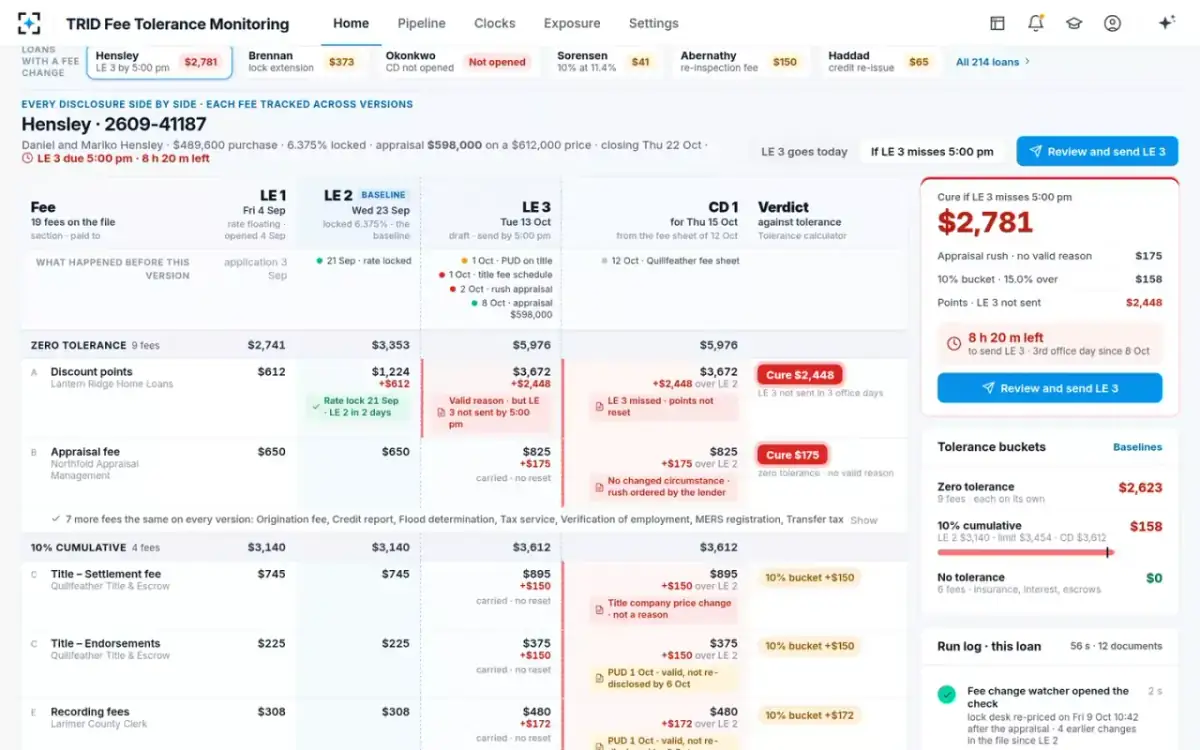
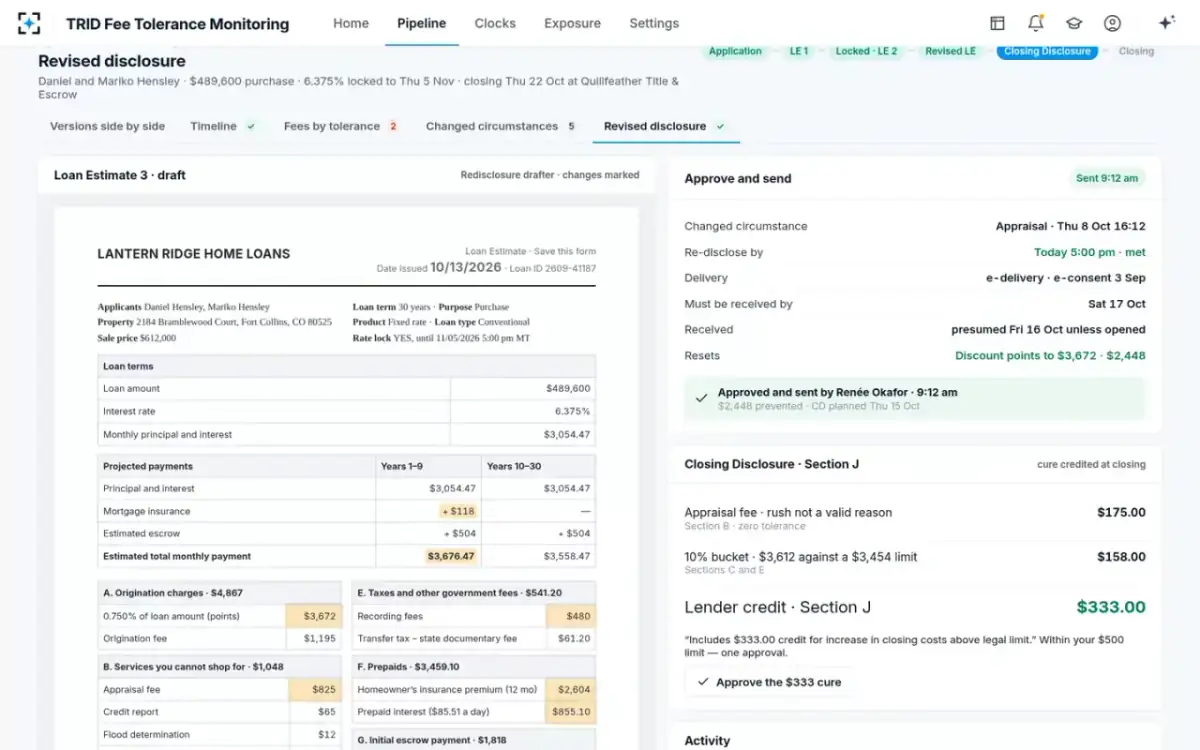
The third term is usually the largest, and the solution's sample loan shows why. On the fictional Hensley purchase, a $489,600 loan locked at 6.375%, a low appraisal moved the loan-to-value ratio from 80.00% to 81.87% and the price of the locked rate from 0.250 to 0.750 points: $2,448 more in discount points. The appraisal was a valid reason. If the revised Loan Estimate went out by 5:00 pm on the third office day, the points reset. If it missed by an hour, the $2,448 became the lender's, on top of $333 owed for other fees, $2,781 in all. Nothing about the loan changed between those outcomes except the time on the send.
Miss the clock and the points become the lender's
Discount points: the largest zero-tolerance line on the file
Discount points are a charge paid to the lender, so they are zero tolerance, and since 2021 they have grown into the biggest upfront cost many borrowers pay. Federal Reserve Bank of Philadelphia researchers estimate that "borrowers' out-of-pocket upfront costs for getting a home purchase mortgage rose nearly 33 percent from 2021 to 2023, to almost $6,500", and that "the main driver of this increase has been rising payments of 'discount points,' as opposed to other types of lender fees and third-party fees" (Bhutta and Lambie-Hanson, FRB Philadelphia DP 24-01).
More loans carry more than a point, so each lock change moves more money
When points are larger, every lock, extension and relock moves more money in the zero-tolerance bucket, and every missed three-day window costs more. The interest rate itself changed between the first Loan Estimate and the last Closing Disclosure on about 8% of loans in the CFPB's 2016–17 data, but the APR changed on more than 40% (CFPB Data Point, 2020): pricing moves far more often than the headline rate.
Where TRID Fee Tolerance Monitoring fits
The solution's fee change watcher opens a check when the lock desk locks, extends or re-prices a loan, and logs the time. The changed-circumstance judge reads what is behind the event, the borrower's email, the lock confirmation, the processor's note, and decides whether the extension rests on a borrower request, a changed circumstance or the lender's own delay. The tolerance calculator limits the reset to the lender's usual extension fee and keeps every other fee on the form at its own baseline. The clock keeper counts the three business days.
The desk accepts or overrides each judgement, and approves and sends the revised Loan Estimate the drafter prepares; the agents never send, change a fee, move a closing or contact the borrower. On the sample pipeline, a second loan, the Brennans', shows the routine case: a lock extension with a revised Loan Estimate due by 5:00 pm the same day and $373 at stake if it slips. When an amount does end up owed, the refund mechanics are covered in why a loan must be tested before day 60. The difference between a lock's expiry and the Loan Estimate's own is in how long a Loan Estimate is good for. The full solution is on the TRID Fee Tolerance Monitoring page.
Sent at 9:12 am: the points reset, and the rest planned as a credit
Questions people ask
Can a rate lock extension fee be waived?
Lenders can always choose not to charge it. When the extension is caused by the lender's own delay, waiving it is usually the only lawful outcome under TRID, because no reason for revision would let the fee be passed on.
Where does a rate lock extension fee go on the Closing Disclosure?
As a charge paid to the lender, it appears with the origination charges in section A of Loan Costs, and on a revised Loan Estimate in the same section. If it is not allowed, any amount charged is refunded, usually as a lender credit.
How is a rate lock extension fee calculated?
Lenders usually price it as a fraction of a point for a set number of days, from their own rate sheets. For TRID, the amount that can be reset is capped at the fee the lender charges in its usual course of business, so the price sheet itself is part of the evidence.
Does a lock extension restart the Closing Disclosure waiting period?
Not by itself. Only an inaccurate APR, a change of loan product or an added prepayment penalty restarts the three-business-day wait. An extension fee large enough to push the APR outside its tolerance would.
Can the borrower be charged for an extension caused by the appraisal?
Only if the delay was not the lender's doing. An appraisal the lender ordered late is the lender's delay; an appraisal held up by something specific to the property, such as access the seller refused, may be a changed circumstance, with the evidence on file.