A TRID tolerance calculator compares the fees on a Closing Disclosure with the fees on a Loan Estimate, sorts them into the zero, 10% and unlimited buckets, and works out any amount over tolerance. Spreadsheets, loan origination systems and disclosure software all offer one, and the arithmetic is the easy part. The hard part is the input: for each fee, which Loan Estimate is the baseline? That depends on when each change became known, whether the reason was valid, whether the increase went no further than the reason, and whether the revised disclosure went out within three business days. Those are the four things the official commentary says a lender must be able to document, and a calculator that is given only the documents' figures cannot know them. Botminds' TRID Fee Tolerance Monitoring is built as a trace rather than a calculator: six agents follow every fee change from the moment it is known to the disclosure that reflects it, and the disclosure desk decides each one.
Here is what that trace looks like on one sample loan, with fictional people, before the arithmetic.
One loan, traced: every change, its deadline and what it costs if missed
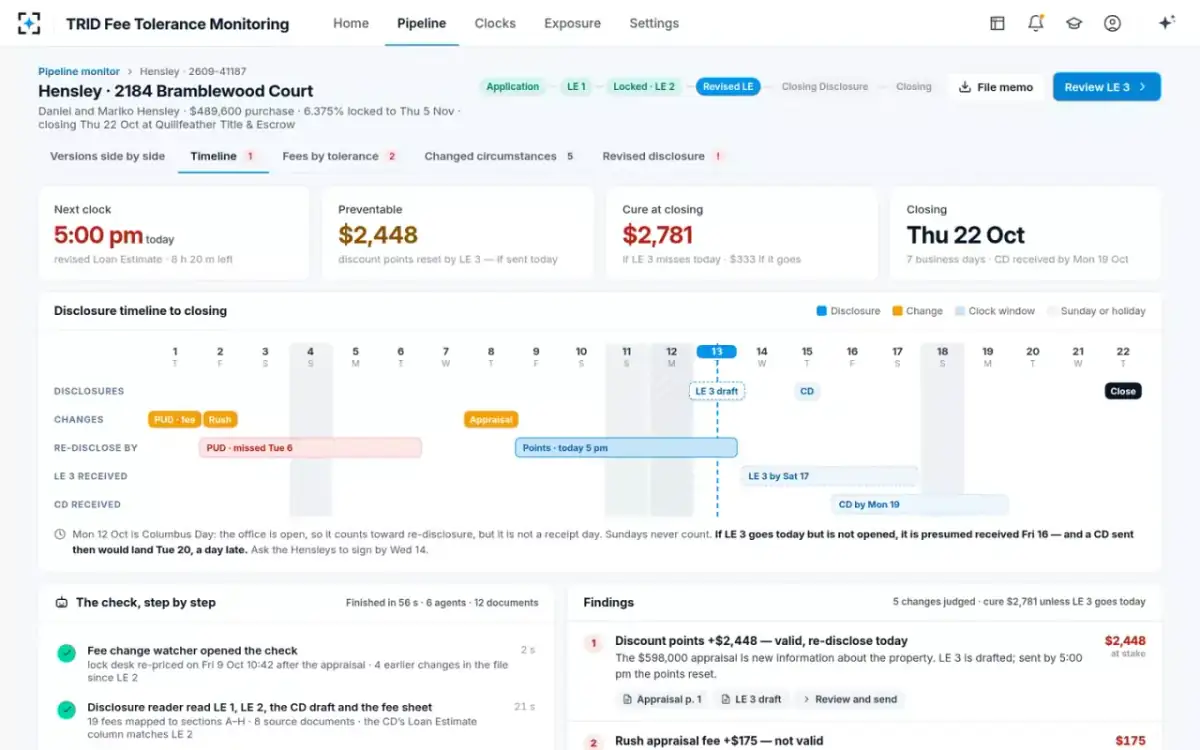
Look at the two windows. The planned unit development was a valid reason, but its window closed on 6 October with no revised Loan Estimate, so its fees stay at the old baseline. The appraisal's window is still open until 5:00 pm today.
Is there a TRID tolerance calculator?
Many. Three kinds come up when a desk looks for one. Spreadsheets list the fees by section, assign a bucket to each, and compare two columns. Loan origination and disclosure software do the same comparison inside the file, usually against the most recent Loan Estimate, and compute a cure for the Closing Disclosure. Post-closing compliance testing engines run the full tolerance, APR and finance-charge tests on a closed file, months later; that work is covered in what agents check in a closed loan file.
All three answer the same question: by how much does the closing figure exceed the baseline? None of them, on its own, can answer the question before it: is that Loan Estimate the right baseline for this fee? A spreadsheet takes the baseline as an input. A loan system usually assumes the latest Loan Estimate is the baseline for everything on it. Both are wrong whenever a revised Loan Estimate carried an increase it was not entitled to reset.
How do you calculate the 10 percent tolerance in a calculator?
Total the 10% group on the baseline Loan Estimate, multiply by 1.10, and compare the same group's total on the Closing Disclosure; the excess over that limit is what is owed. The group is tested as one sum, and a fee left off the Loan Estimate still counts at closing. Which fees belong in each TRID tolerance bucket sets out the sorting that comes first.
The baseline is where calculators go wrong, and the commentary has two examples that a column comparison cannot handle. In the first, an unreleased lien adds title work worth 5% of the 10% group. The lien is a valid changed circumstance, and the lender issues a revised Loan Estimate anyway. But "the actual title fees of $500 may not be compared to the revised title fees of $500; they must be compared to the originally estimated title fees of $400 because the changed circumstance did not cause the sum of all costs subject to the 10 percent tolerance category to increase by more than 10 percent" (comment 19(e)(3)(iv)(A)-1.ii). A calculator that trusts the latest Loan Estimate will show the fee as within tolerance.
In the second, two changes three weeks apart, of 5% and 6%, cross the 10% line only together, and the three-business-day clock starts when the second one arrives, not the first (comment 19(e)(4)(i)-1.ii). A calculator that does not know when each change arrived cannot say whether the revised Loan Estimate was on time.
What a calculator answers, and what a trace adds
A tolerance calculator: How far is the closing figure over the baseline?
A trace of each fee change: Which baseline applies to this fee, and why?
A tolerance calculator: Two sets of figures, and a bucket for each fee
A trace of each fee change: Every version of the Loan Estimate and Closing Disclosure, fee sheets, lock events, invoices, notes and emails
A tolerance calculator: Not known
A trace of each fee change: Logged with the time the lender first had enough information
A tolerance calculator: Assumed if a revised Loan Estimate exists
A trace of each fee change: Judged against the six reasons and the evidence, for a person to accept
A tolerance calculator: Not checked, or checked on one calendar
A trace of each fee change: Re-disclosure on office days, receipt on every day but Sundays and holidays
A tolerance calculator: An amount
A trace of each fee change: The original estimate, the reason, its effect on cost, the limit on the increase and the timing
What does a tolerance calculator miss?
It misses everything that happened between the documents. The commentary's documentation rule asks the lender to show the original estimate, explain the reason for the revision and how it affected costs, show that the increase went only as far as the reason caused, and show that the timing rule was met (comment 19(e)(3)(iv)-3). Only the first of the four is a figure on a form. The reason sits in a note or an email, its effect in an invoice or a pricing sheet, and the timing in two dates nobody typed into the calculator: when the lender knew, and when the revised disclosure went out.
It also misses the reverse charges. A lender credit that shrinks on a revised Loan Estimate after a lock is an increased charge to the borrower, allowed only with a valid reason and a timely revision. A calculator that lists credits on a separate line, or not at all, will not see the problem. And it misses the fee that changed bucket because the borrower chose a different provider, which only the written provider list can settle.
Examiners describe what strong lenders do instead. A Federal Reserve examiner wrote in 2019 that institutions with strong TRID compliance run secondary reviews before consummation, either across the whole Loan Estimate and Closing Disclosure or focused on the riskiest items, which she listed as tolerance charges, APRs and finance charges (Consumer Compliance Outlook, First Issue 2019). A review before closing is only as good as the dates and reasons it can see.
How do you track fee changes between the LE and the CD?
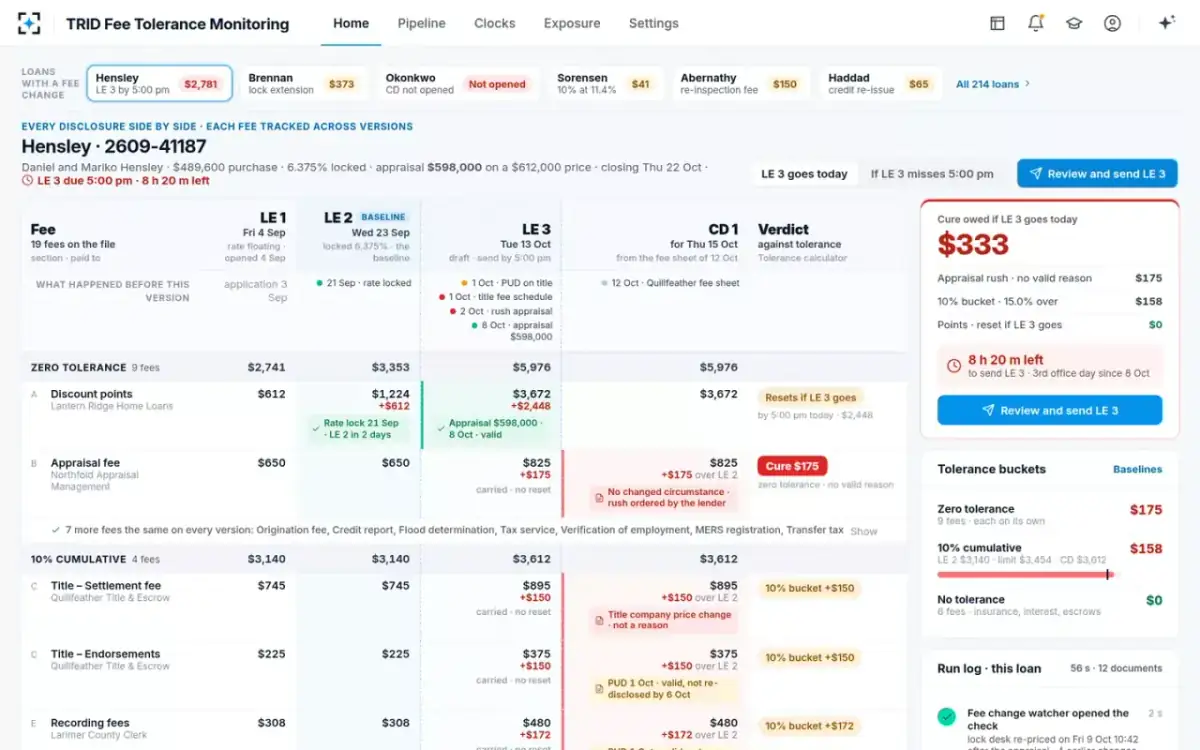
Lay every version side by side, fee by fee, and mark what happened between each pair. A table with the Loan Estimates and the Closing Disclosure as columns and the fees as rows, grouped by bucket, shows each move; a marker on each column says which event preceded that version (a lock, an appraisal, a title commitment). The comparison is then not CD against LE, but each fee against the version that is entitled to be its baseline.
The CD itself already carries a version of this table. Its "Calculating Cash to Close" section compares the Loan Estimate with the final figures in a "Did This Change?" column, and Federal Reserve examiners noted "several instances in which lenders did not accurately complete the Did This Change? column" (Consumer Compliance Outlook, 2019). A tracking table built from the documents gives the desk the same comparison a week earlier, with the reasons attached.
One loan, traced step by step
Take the sample loan in the solution's fictional pipeline: Daniel and Mariko Hensley, a $489,600 loan on a $612,000 purchase at Lantern Ridge Home Loans, closing Thursday 22 October 2026. When the lock desk re-priced the loan on Friday 9 October, the fee change watcher opened a check. Six agents compared 19 fees across the four versions on file and judged five changes in 56 seconds. Here is the trace.
Five changes on the Hensley loan: when each was known, and what it means
| Change | Known | Re-disclose by | What happened | Judgement |
|---|---|---|---|---|
| Rate locked: points $612 to $1,224 | Mon 21 Sep | Thu 24 Sep | Loan Estimate 2 sent Wed 23 Sep | Valid and on time: the points reset; Loan Estimate 2 becomes their baseline |
| Planned unit development on the title commitment: endorsements +$150 | Thu 1 Oct | Tue 6 Oct | No revised Loan Estimate | Valid but too late: the endorsements stay at the old figure in the 10% group |
| Settlement agent’s new fee schedule: settlement fee +$150 | Thu 1 Oct | — | No revised Loan Estimate | Judged not a reason: a general price change, not news about this loan |
| Rush appraisal: fee $650 to $825 | Fri 2 Oct | Wed 7 Oct | No revised Loan Estimate | Not valid: the loan officer asked for the rush. Zero tolerance: $175 owed |
| Appraisal at $598,000: points $1,224 to $3,672 | Thu 8 Oct | Tue 13 Oct, 5:00 pm | Loan Estimate 3 sent Tue 13 Oct, 9:12 am | Valid and on time: the points reset; $2,448 not owed |
The trace changes the answer, not just the paperwork. A calculator comparing the Closing Disclosure draft with Loan Estimate 3 would have passed the appraisal fee, because the rush was on the revised form, and missed the 10% group because it would have measured it against figures it was not entitled to. Measured against the right baselines, $333 is owed and $2,448 is avoided by sending one revised Loan Estimate before the 5:00 pm cut-off.
The sample run, in numbers
12
documents read: four disclosure versions, the fee sheet, lock events, invoices, the title commitment, notes and emails
19
fees mapped to their section and line on every version
5
changes judged, each with the time it became known
56s
for the six agents to finish, before the desk reviews
How do you document a changed circumstance date?
By the document that made the reason knowable, and its time stamp. For an appraisal, that is the time the report was received, not when someone read it; for a lock, the lock confirmation; for a title issue, the commitment's arrival. The rule counts three business days from "receiving information sufficient to establish" the reason (12 CFR 1026.19(e)(4)(i)), so the date that matters is the one an examiner can see on the evidence, not the one in the desk's task list.
One exception needs its own paper. If the lender doubts a low appraisal and orders a second, the clock starts with the second report, but only if the lender kept records of its doubts at the time. The documentation that goes with each kind of change is set out in what an examiner needs to see in a changed circumstance form.
What to look for in a TRID tolerance calculator
Whether you are choosing a spreadsheet template, a feature in your disclosure software or a separate monitor, test it on a loan where you already know the answer: one with a lock, a late reason and a fee that should not have reset. These are the questions that separate the arithmetic from the judgement.
Eight questions to ask of any TRID tolerance calculator
- Which Loan Estimate does it use as the baseline, fee by fee?
If the answer is "the latest one", it will pass increases that were never entitled to reset.
- Does it know when each change became known?
Without the date, it cannot test the three-business-day rule or the two-changes example.
- Does it test the 10% group in total, including omitted fees?
A fee missing from the Loan Estimate enters the closing total against nothing.
- How does it decide the bucket for shoppable services?
From the written provider list and the provider actually used, not from the fee name.
- Does it treat a smaller lender credit as an increased charge?
Credits belong in the zero-tolerance comparison, in reverse.
- Does it count on two calendars?
Office days for sending; every day but Sundays and federal holidays for receipt.
- Does it show its working?
Each amount should trace to a page and line, and each judgement to the evidence behind it.
- Who decides?
A tool can recommend whether a reason is valid. A named person should accept or override, with a reason on file.
Where a trace does not fit
TRID Fee Tolerance Monitoring is a pre-closing tool. It does not test APR and finance-charge accuracy on closed loans, which belongs to post-closing compliance testing, and it does not produce the official Loan Estimate or Closing Disclosure, which the lender's disclosure software still generates. Its redisclosure drafter prepares a revised Loan Estimate and the cure for the desk to approve; the agents never send a disclosure, change a fee, move a closing or contact a borrower.
It needs read access to what the desk already uses: every disclosure version, fee worksheets and settlement fee sheets, lock events, appraisal and title orders and invoices, change notes and email, and delivery and receipt dates. Some of its judgements are readings rather than rules. Treating a settlement agent's general price rise as no reason at all is the judge's reading of the definition, which the desk can override with a written reason and the compliance officer's approval. The CFPB's 2017 examinations found violations as basic as a missing provider list; no tool replaces the policy behind the form. The full solution is on the TRID Fee Tolerance Monitoring page.
Every version side by side, each increase tied to its reason
Questions people ask
Is there a free TRID tolerance calculator?
Spreadsheet templates are widely shared, and most disclosure systems include a comparison. They work for the arithmetic once you have chosen the right baseline for each fee. Check whether yours tests the 10% group in total and treats lower lender credits as increases.
Can a tolerance calculator decide if a changed circumstance is valid?
Not from figures alone. Validity depends on what happened, who caused it and when the lender knew, which sits in notes, emails and invoices. A tool can read that evidence and recommend; a person should decide and sign.
Should the tolerance check run before or after closing?
Both, for different reasons. Before closing, a missed reason can still be re-disclosed in time and a cure planned. After closing, testing confirms the file and catches what slipped through, within the 60-day refund window.
How do you calculate a tolerance cure?
For zero-tolerance fees, the cure is each increase over its baseline; for the 10% group, the amount by which the closing total exceeds 110% of the baseline total. The total is refunded, usually as a lender credit on the Closing Disclosure, no later than 60 days after consummation.
What is the difference between tolerance and APR accuracy?
Tolerance compares closing costs with the Loan Estimate's good-faith estimates. APR accuracy compares the disclosed APR with the actual one within 1/8 of a percentage point for a regular loan, and an inaccurate APR on the Closing Disclosure restarts the three-business-day wait.