A repair escrow holdback is money held back at closing, from the loan proceeds or a borrower deposit, to pay for specific repairs that a property condition assessment or an environmental remediation plan says the property needs, and released only as the work is verified. On commercial and multifamily loans the agency benchmark is that the escrow "should be at least 125%" of the estimated cost, because the estimate is an opinion made before anyone has bid the job. An escrow sized at 100%, or left out because the repair was buried on page 34 of a 186-page report, turns a known defect into an unfunded one on the bank's collateral. Botminds' Third-Party Report Review reads the property condition, Phase I, zoning and seismic reports for a loan together, pulls every immediate repair and remediation cost to its page, and drafts the escrows at the bank's percentage for the credit officer to approve. (Searches for this term often mean the residential holdback used on home loans; this guide is about commercial real estate and multifamily lending.)
The agency numbers behind a repair escrow
125%
of the estimated cost: the minimum Fannie Mae says a repair or remediation escrow should hold
60days
to complete life safety repairs after origination on an acquisition
6months
to complete critical repairs, sooner if the consultant says so
12months
to complete deferred maintenance
What is a repair escrow holdback? Money set aside at closing for named repairs
It is a custodial account funded at closing for repairs listed in the loan agreement, each with a deadline, and paid out to the borrower or its contractors as each item is completed and checked. Fannie Mae defines its version, the Completion/Repair Escrow, as a "custodial account funded on the Mortgage Loan Origination Date for Completion/Repairs or capital improvements per the Loan Documents", and the repairs as those "identified per the Property Condition Assessment" and required by the repair schedule (Guide §405 glossary).
Three features separate it from other money a lender holds. It is tied to named items, not a general cushion. It is funded once, at closing, rather than monthly. And it ends: when the listed repairs are done and verified, the balance goes back to the borrower. A replacement reserve, by contrast, is a monthly deposit for future capital items over the life of the loan, and the two are easy to confuse because the same PCA feeds both.
Why 125%? What the cushion covers
The 25% covers the distance between a consultant's opinion of probable cost and what a contractor will actually charge, months later, for work nobody has opened up yet. Fannie Mae states the size as guidance for both kinds of escrow: "The amount funded into the Completion/Repair Escrow on the Mortgage Loan Origination Date should be at least 125% of the estimated cost of the required Completion/Repairs", and the same words for "the estimated cost of the Remediation Plan" after an environmental finding (Guide §504.02).
The cushion exists because the estimate has known gaps. A PCA prices what the field observer could see in a non-invasive walk-through; Fannie Mae's instructions say the observer "is not required to perform diagnostic testing" (Form 4099 §3.2). The estimate is in today's dollars, while the work may be done in month eleven. And the sample PCA behind this guide, like many, says plainly that its "costs are opinions of probable cost in 2026 dollars and do not include contingency". The 25% is the contingency the report left out.
How a repair escrow is built from a PCA
Immediate repairs
Σ life safety + critical + deferred maintenance
From the PCA's immediate repairs table, every line, regardless of the borrower's planned work
PCA consultant
Remediation plan
Environmental professional's cost estimate
Added when a Phase I or Phase II finding needs remediation
Environmental professional
Cushion
× 1.25 (or the bank's percentage)
Covers estimate error, hidden conditions and timing
Lender policy
Released or waived
− items verified complete before closing
Only with receipts and confirmation of payment in full
Lender
How much is a repair escrow? One sample loan, worked through
It is the sum of the immediate repairs and any remediation estimate, times the escrow percentage. Take a fictional sample loan as it runs through Third-Party Report Review: Arroyo Vista Marketplace, a grocery-anchored shopping centre in Ontario, California, financed with a $24,750,000 acquisition loan. Its PCA lists $412,600 of immediate repairs, and its seismic assessment prices a wall-anchorage retrofit for one building at $184,000.
Escrows at closing on the sample loan, line by line
| Item | Estimate | At 125% | Source |
|---|---|---|---|
| Immediate repairs: fire alarm, sprinkler certification, accessibility, paving, roof over five suites | $412,600 | $515,750 | PCA Table 1 |
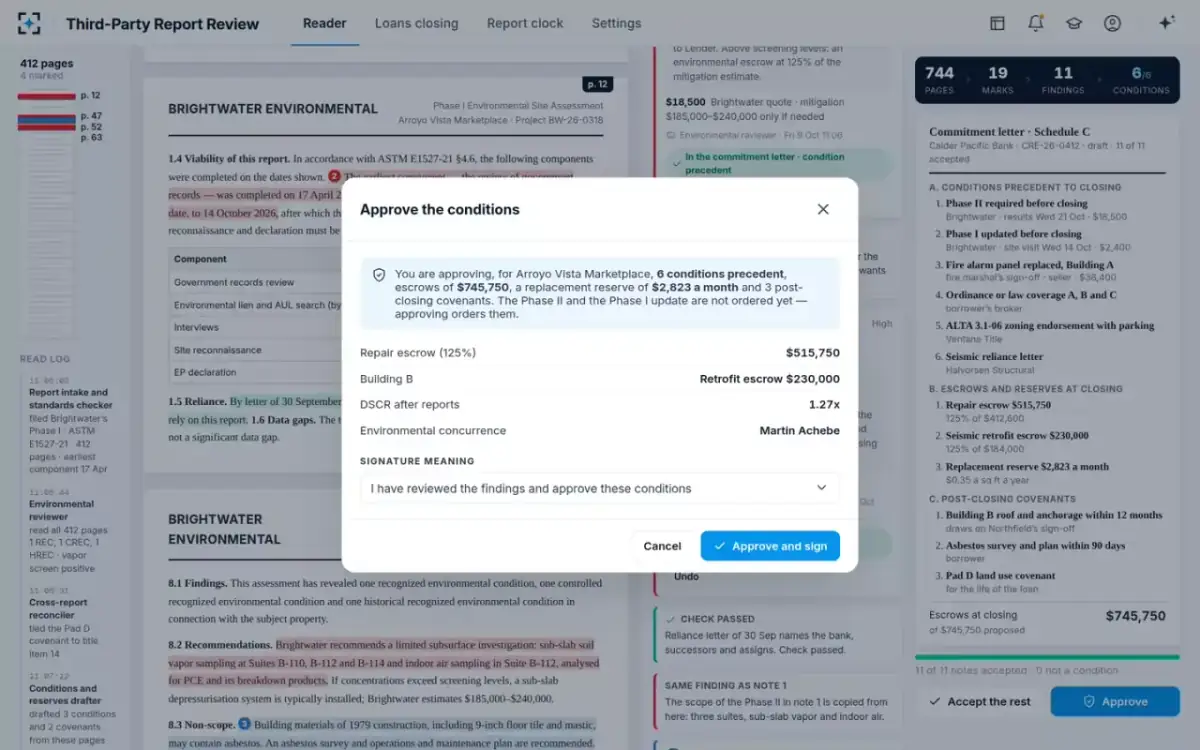
| Building B wall-to-roof anchorage retrofit | $184,000 | $230,000 | Seismic assessment p. 21 |
| Environmental mitigation, only if the Phase II finds vapor above screening levels | $185,000 to $240,000 | $231,250 to $300,000 | Phase I recommendations and the Phase II results |
| Escrows at closing, before the Phase II result | $596,600 | $745,750 | Repair and retrofit lines |
The table shows the escrow's real job. Three of the five PCA items are ordinary; the roof and the retrofit sit on the same building, and the retrofit is cheapest done with the re-roof, which is why the sample bank funds both and schedules them together. The environmental line shows the hardest case: an escrow that cannot be sized until a test result arrives, and that could add up to $300,000 more if it comes back badly. A closing scheduled two days after the Phase II results has no slack for a surprise, and the conditions say so.
What an under-sized escrow costs the lender
It costs the lender the gap between the money held and the cost of the work, on a property the lender is relying on as collateral. When an escrow runs dry, the borrower still owes the work under the loan agreement, but the lender's remedies (a demand, a default, a negotiation) are slower and less certain than money already in an account. Meanwhile the defect stays in the building.
The same overrun against two escrows: 100% leaves a gap, 125% absorbs it
Escrow at 100%: $412,600 held, work costs $495,120
- Paid from the escrow, $412,600 · 83%
- Unfunded, $82,520 · 17%
Escrow at 125%: $515,750 held, work costs $495,120
- Paid from the escrow, $495,120 · 96%
- Returned to borrower, $20,630 · 4%
The cost is not only arithmetic. An unfinished roof over five suites lets water into tenant spaces, which shows up later as rent concessions and lost renewals. An unfinished accessibility repair is an open compliance item. And an unfunded remediation is the worst case, because environmental liability is an exposure the OCC says can exceed the property itself: failure to comply with environmental laws "can generate significant liability to a bank that is greater than the value of the collateral", a risk the bank "most often undertakes ... at origination" (OCC, Commercial Real Estate Lending, pp. 14–15).
The other way to under-size an escrow is to miss the item altogether. A repair on page 34 that never reaches the repair schedule has no escrow, no deadline and no verification. Fannie Mae closes that door by requiring every immediate repair on both the PCA's schedule and the lender's required repair schedule "regardless of the Borrower's planned CAPEX" (Fannie Mae PCA FAQ). The checklist for finding them is in the property condition assessment checklist.
When can a lender fund less than the full escrow?
Fannie Mae allows it when the borrower can pay for the repairs itself, with a written promise in place of the money. "You may choose not to fund the Completion/Repair Escrow entirely if you determine the Borrower has the financial capacity to fully address all Completion/Repairs in the PCA," the Guide says, but then the lender "must obtain written assurances from the Borrower in the Multifamily Loan Agreement that all necessary Completion/Repairs will be completed within a stated period of time" (Guide §405.02).
That trade swaps cash for credit risk. It suits a well-capitalised sponsor with a modest repair list; it suits less well an acquisition that is already stretching the borrower's equity, which is when repairs are most likely to slip. Either way the verification duty does not change: Fannie Mae requires the lender to confirm the work was done "whether the Completion/Repair Escrow was funded or not".
Replacement reserve vs repair escrow: two accounts from one report
The repair escrow pays for today's problems once; the replacement reserve saves monthly for tomorrow's. Both come from the PCA, and a reviewer has to keep an item from sitting in both.
Replacement reserve vs repair escrow
Repair escrow: Immediate repairs and any remediation plan: life safety, critical, deferred maintenance.
Replacement reserve: Capital items expected to wear out over the loan term plus two years: roofs, HVAC, paving cycles.
Repair escrow: Once, at closing, at 125% of the estimate.
Replacement reserve: Monthly, from the PCA's capital table, inflated at 3% a year.
Repair escrow: The required repair schedule.
Replacement reserve: The replacement reserve schedule.
Repair escrow: Cash at closing; no effect on net cash flow.
Replacement reserve: Lowers net cash flow and debt service coverage every year.
Repair escrow: When the listed repairs are verified complete.
Replacement reserve: At payoff; draws are made as items are replaced.
On the sample loan, the reserve is the line that moves the underwriting. The PCA's capital table averages $33,880 a year, or $0.35 a square foot; underwriting had carried $0.15. The monthly reserve becomes $2,823, net cash flow falls by $19,360, and the debt service coverage ratio moves from 1.28x to 1.27x. The escrow, $745,750 at closing, does not touch that ratio at all.
Releasing the holdback: verification before money moves
Money leaves the escrow when the work is confirmed, not when the invoice arrives. Fannie Mae's rule is that the lender "must verify that the Borrower has made all required Completion/Repairs ... during your Property inspections before the required completion date" (Guide §405.04). Banks typically pair the inspection with paid invoices and a sign-off from whoever is qualified to give one.
The sign-off should match the item. On the sample loan, the fire alarm panel's share of the escrow releases on the fire marshal's sign-off, because a passed functional test is the only evidence that the life safety problem is gone. The Building B roof and its wall anchorage, scheduled as one job within 12 months, draw on the property condition consultant's sign-off. Writing the evidence into the condition at closing, rather than negotiating it at the first draw request, is most of what makes a holdback easy to administer.
Approving the escrows: every line sized at 125% and tied to its report
Sizing escrows in Third-Party Report Review
In the solution, the property condition reviewer extracts every immediate repair and checks that the table's total ties to its lines; it never edits the engineer's cost opinion. The conditions and reserves drafter applies the bank's escrow percentage (125% by default, or 110% or 150% if policy says so), drafts life safety items as repaired before closing where the bank's policy requires it, and shows the effect of the replacement reserve on net cash flow and debt service coverage. Each escrow line cites the report page it came from.
What it will not do is decide. The drafter cannot waive an escrow or mark a repair "not a condition"; a person can, with a written reason and the chief credit officer's approval. Environmental escrows wait for the environmental risk manager's concurrence. The figure that matters to a credit officer is not the drafting speed but whether every repair in every report reached the commitment letter, and on the sample loan's four reports that came to 11 findings, 6 conditions precedent and 3 covenants. The seismic retrofit, and why insuring the building instead does not fix the risk under agency rules, is covered in Fannie Mae seismic requirements.
Questions people ask
What is a repair escrow agreement?
It is the part of the loan documents that lists the required repairs, their deadlines, the escrow amount and how money is released. In Fannie Mae's documents it is the Completion/Repair Schedule to the Multifamily Loan Agreement, which records the borrower's agreement to fund the escrow and perform the repairs, and the disbursement terms.
What are Fannie Mae's repair escrow requirements?
The escrow "should be at least 125%" of the estimated cost of the required repairs, and of any remediation plan. Life safety repairs must be completed within 60 days after origination on an acquisition, critical repairs within 6 months and deferred maintenance within 12 (Guide §405 and §504.02).
Are life safety items escrowed?
Fannie Mae says lenders "should consider requiring an escrow deposit (for at least 125% of estimated costs)" for them, alongside the 60-day deadline on acquisitions. Many banks go further and require life safety items fixed before closing, as the sample bank in Third-Party Report Review does.
What happens to the money left in a repair escrow?
Once every listed repair is verified complete, the remaining balance is normally released to the borrower under the escrow terms. On the sample loan, a 20% overrun would still leave $20,630 of a 125% escrow unspent.
Can repairs done before closing come out of the escrow?
Yes, if the lender can confirm the work was done and paid for in full. Fannie Mae's FAQ lets the lender exclude those items from the escrow and note it in its approval memo, while the repairs stay listed on the required repair schedule.