Fannie Mae's seismic requirements apply to multifamily properties in areas where the ground shaking expected once in 475 years reaches 0.15g or more: the lender completes a structural risk questionnaire, obtains a seismic risk assessment if a risk factor appears, and confirms that every income-producing building has a scenario expected loss (SEL) of 20% or less. Any building above 40% makes the loan ineligible, and the Guide adds a sentence that surprises many borrowers: "Earthquake insurance does not mitigate seismic risk." The work is hard because a seismic report gives a loss for each building and for the property as a whole, and the whole can pass while one building fails. Botminds' Third-Party Report Review reads the seismic assessment alongside the Phase I, property condition and zoning reports, tests each building and the aggregate against the limit, and drafts the retrofit as a loan condition for the credit officer to decide. Many banks apply the same numbers to their own commercial loans, which is how the sample loan on this page uses them.
Fannie Mae's seismic numbers
0.15g
peak ground acceleration that makes a site high seismic risk
20%
maximum scenario expected loss for every income-producing building
40%
above this SEL on any building, the loan cannot be delivered
12months
the seismic risk assessment must be dated within, before the commitment
What are Fannie Mae's seismic requirements? From the hazard map to the loan
They are a sequence of five tests, each of which can end the loan. The lender looks up the site's peak ground acceleration, screens the buildings for structural risk factors, orders a seismic risk assessment where one is found, checks every building's loss against 20% and 40%, and agrees mitigants with Fannie Mae for any building over the line.
Fannie Mae's seismic rule, step by step
| Step | What the Guide requires | What ends the loan |
|---|---|---|
| 1. Hazard at the site | Assess the peak ground acceleration (PGA) before rate lock; a site at 0.15g or more, on USGS data at 10% in 50 years, is high seismic risk | Nothing on its own: it decides whether the next steps apply |
| 2. Structural risk screen | Complete Form 4099.C, the structural risk questionnaire, for a high-risk site | PGA of 0.15g or more plus an unretrofitted unreinforced masonry building, or a building on a slope over 30 degrees |
| 3. Seismic risk assessment | A Level 1 assessment to ASTM E2026 and E2557, with SEL and SUL, dated within 12 months before the commitment, if a structural risk factor is found | No assessment, or one older than 12 months at commitment |
| 4. Acceptable risk | Every income-producing building, and any building that supports amenities, at SEL of 20% or less and meeting ASTM E2026 stability requirements | Any building with an SEL above 40% |
| 5. Mitigants | For any building above 20%, or with a stability issue, agree acceptable mitigants with Fannie Mae's multifamily insurance team | No agreed mitigant |
Two details in the table catch people out. The 0.15g threshold is a property of the site, not the building, so a new building in a high-hazard area still goes through the screen. And the 12-month window runs to the commitment date, not the closing, which makes the seismic report one of the longer-lived reports in a closing set, unlike a Phase I whose fieldwork expires after 180 days, as how long a Phase 1 ESA is good for explains.
When is a seismic risk assessment required?
Under Fannie Mae's rules, a seismic risk assessment is required when a property in a high seismic risk area shows a structural risk factor on the Form 4099.C questionnaire. The property condition consultant usually makes the first call: Fannie Mae's PCA instructions require the consultant to state whether the property sits at a PGA of 0.15g or more, using USGS data, and to complete the structural risk questionnaire if it does (Form 4099 §4.5.A).
The assessment itself must follow two ASTM documents: E2026, the guide for seismic risk assessment of buildings, which "requires loss estimations for each improvement on the Property, and a total aggregate loss estimation for the entire Property", and E2557, the practice for probable maximum loss evaluations. Both are tied to the same event: "The SEL, SUL, building stability, and site stability conclusions must be determined using the 10% in 50-year exceedance probability (the 475-year return period)."
SEL vs SUL: what the two seismic loss numbers mean
The SEL is the expected loss to a building from the design-level earthquake, as a share of what it would cost to replace; the SUL is a deliberately pessimistic estimate of the same loss. Both describe one scenario, the shaking with a 10% chance of being exceeded in 50 years, so they differ in confidence, not in the earthquake.
SEL vs SUL, and the older term probable maximum loss
Scenario expected loss (SEL): The expected repair cost from the scenario earthquake, as a percentage of replacement cost.
Scenario upper loss (SUL): A high-end estimate of the same loss, allowing for uncertainty in how the building behaves.
Scenario expected loss (SEL): Fannie Mae's 20% acceptance line and 40% eligibility line are both on SEL.
Scenario upper loss (SUL): Reported alongside SEL; Fannie Mae requires both in every assessment.
Scenario expected loss (SEL): 23%
Scenario upper loss (SUL): 38%
Scenario expected loss (SEL): Probable maximum loss is the older name; ASTM E2557 is the "Standard Practice for Probable Maximum Loss (PML) Evaluations".
Scenario upper loss (SUL): Lenders and insurers still say PML; the assessment states SEL and SUL.
The 20% line and the 40% line: every building, not the average
Fannie Mae tests every building, so a property passes only if its worst building passes. The Guide's words are that the lender must confirm "all income-producing Improvements or any non-income producing Improvements that support amenities ... have an SEL of 20% or less", and must "not Deliver a Mortgage Loan secured by a Property having any Improvements with an SEL greater than 40%" (Guide §505.03).
The aggregate passes at 13%; Building B does not, at 23%
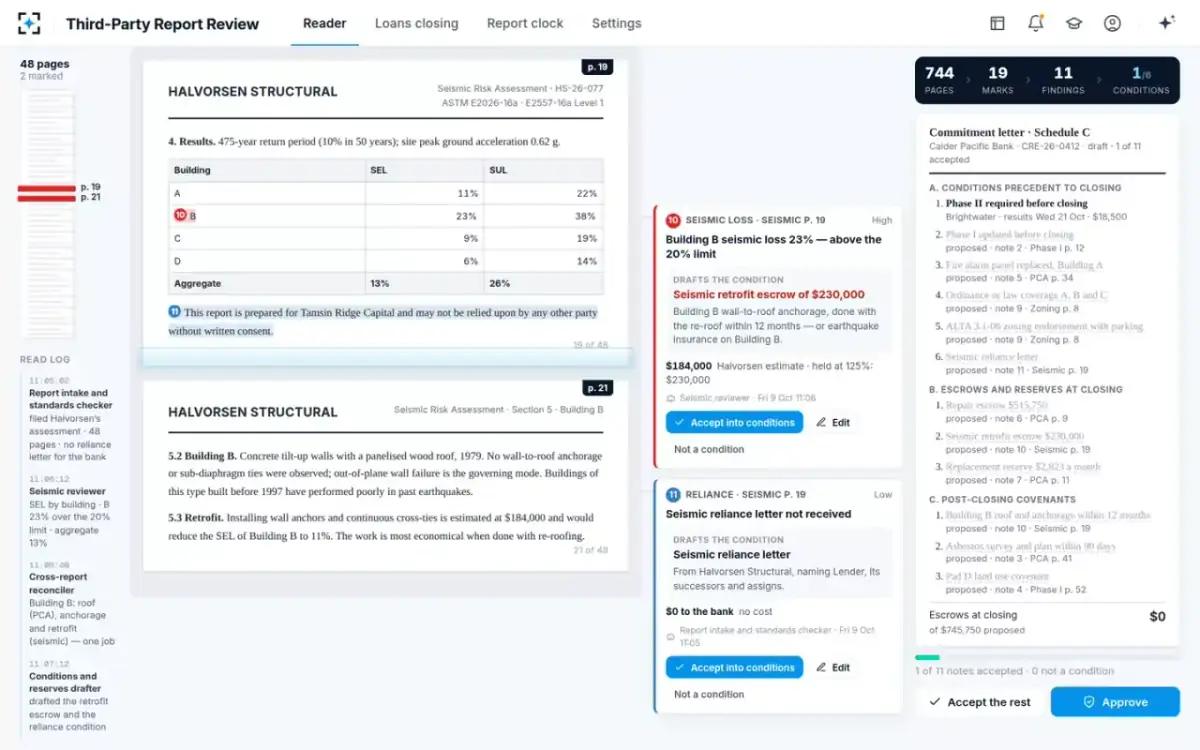
The aggregate is a weighted average, so a large, sound building can hide a smaller, weak one. On the sample property, Building A's 41,200 square feet at 11% pull the total down to 13%, comfortably inside the limit, while Building B's in-line shops sit at 23%. A reviewer who reads only the summary page sees a pass. The rule, and the risk, is in the per-building table on page 19.
Does earthquake insurance satisfy Fannie Mae? Not as a fix for the loss
No. Insurance pays for damage after an earthquake; it does not make the building less likely to be damaged, and Fannie Mae's Guide says so in one line. For any building above 20% or with a stability issue, the lender must contact Fannie Mae's multifamily insurance team "to determine acceptable mitigants", which include a retrofit that reduces "the SEL of all Improvements to 20% or below" and earthquake insurance under the Guide's insurance section. Then it adds:
Earthquake insurance does not mitigate seismic risk.
Fannie Mae Multifamily Selling and Servicing Guide §505.05, Seismic Risk Mitigants
Read together, the rule is that insurance can be part of what Fannie Mae requires, but it does not bring a building's SEL under the line. The retrofit does. That matters to an underwriter because the two options look similar on a spreadsheet: a retrofit costs capital up front, insurance costs premium every year, and both appear to "deal with" the risk. Only one changes the number the rule is written on. A bank lending on its own balance sheet may decide otherwise for its own loans, but it should know it is departing from the agency standard when it does.
Why older tilt-up buildings fail: the wall-to-roof connection
Older tilt-up concrete buildings fail where heavy walls meet a light roof. In an earthquake the concrete panels try to pull away from the roof diaphragm, and if the connection between them is weak or missing, the wall can fall outward and the roof edge with it. FEMA's guide to seismic rehabilitation describes the history plainly: "With each subsequent earthquake since 1971, building code requirements have been revised to reflect changing understanding of the magnitude of forces generated in wall anchors", and "simply providing positive connections from the walls to the diaphragm has not resulted in adequate performance" (FEMA 547, ch. 16).
The weak links FEMA lists are specific and visible in a structural review: "cross-grain tension of wood ledgers, rotation of non-symmetric connectors, low-cycle fatigue of straps", and fractures at bolt holes. On the sample loan, Building B is a 1979 tilt-up with a panelised wood roof and no wall-to-roof anchorage or sub-diaphragm ties. The seismic consultant prices wall anchors and continuous cross-ties at $184,000, which brings Building B's SEL from 23% to 11%, and notes the work is most economical with re-roofing. The property condition report, meanwhile, says the same roof is leaking over five suites.
Third-Party Report Review reading the seismic table, building by building
What a lender's seismic analysis should contain
Fannie Mae spells out the lender's analysis as well as the consultant's. Beyond the assessment itself, the Guide expects the lender to describe the conditions behind the loss and what will be done about them, with photographs of the buildings that matter (Guide §505.03).
The lender's seismic file, from Fannie Mae's Guide
- A Level 1 seismic risk assessment
Including the ASTM E2557 summary findings form (Appendix X4).
- The lender's own analysis and recommendation
The "severity and pervasiveness of the conditions driving the SEL and stability issues".
- The risks, one by one
Building stability, building damageability, site stability and life safety.
- The retrofit plan
A retrofit letter or the borrower's plan, with a timetable and a cost estimate.
- Form 4099.C
The structural risk questionnaire from the property condition assessment.
- At least six photographs
Including elevation views of any building with an SEL over 20% or a stability issue.
- A retrofit ordinance check
If local law requires a retrofit, the assessment must describe the plan and its costs (§505.04).
The list also shows where seismic review meets the rest of the closing set. The retrofit plan's cost belongs in an escrow, sized like any other required repair; how that is done is covered in the repair escrow holdback. And the seismic report needs its own reliance letter: on the sample loan, the assessment was "prepared for" another lender and "may not be relied upon by any other party without written consent", so the missing letter became a condition of its own.
Testing every building in Third-Party Report Review
In the solution, the seismic reviewer reads the assessment's per-building table and tests each building and the aggregate against the bank's limit, set in one-point steps (20% on the sample bank), and flags any building above 40% as ineligible. The cross-report reconciler links findings that land on the same building, which is how the leaking roof in the PCA and the missing anchorage in the seismic report become one recommendation: retrofit with the re-roof, funded from the repair escrow and a $230,000 retrofit escrow at 125% of the consultant's estimate.
One building, three reports: the site plan with every finding pinned

The agents draft and the credit officer decides. The seismic reviewer never averages a building's loss into the aggregate to make it pass, and the conditions drafter never waives a condition; a note marked "not a condition" needs a written reason and the chief credit officer.
Questions people ask
What SEL does Fannie Mae accept?
An SEL of 20% or less for every income-producing building and any building supporting amenities, together with the ASTM E2026 building stability requirements. A building between 20% and 40% needs mitigants agreed with Fannie Mae; any building above 40% makes the loan ineligible for delivery.
What is a probable maximum loss (PML) report?
It is the older name for a seismic loss assessment, still used by many lenders and insurers. Fannie Mae requires assessments under ASTM E2557, the practice for probable maximum loss evaluations, together with ASTM E2026, and asks for both the scenario expected loss and the scenario upper loss.
What PGA triggers a seismic risk assessment?
A peak ground acceleration of 0.15g or more, at a 10% probability of exceedance in 50 years on USGS data, makes a site high seismic risk under Fannie Mae's Guide. The lender then completes Form 4099.C and orders an assessment if it finds a structural risk factor.
Which buildings are ineligible regardless of SEL?
On a site at 0.15g or more, Fannie Mae will not take a loan secured by an unreinforced masonry building that has not been seismically retrofitted, or by a building on a slope steeper than 30 degrees (a 50% slope).
Does Fannie Mae require a new seismic report after the loan closes?
No. The Guide says that "after you Deliver the Mortgage Loan, no additional seismic risk evaluation is needed", and a supplemental loan on a small mortgage loan may rely on the original seismic analysis.