In a Phase I environmental site assessment, a REC (recognized environmental condition) is the presence or likely presence of hazardous substances or petroleum products on the property from a release, or a material threat of one; a CREC (controlled recognized environmental condition) is a past release that was addressed to the regulator's satisfaction but with contamination left in place under controls such as a land use covenant; and an HREC (historical recognized environmental condition) is a past release addressed to unrestricted use, with no controls left, which under ASTM E1527-21 is no longer a REC at all. The difference matters to a commercial real estate lender because each label sets off a different response, from a Phase II and an escrow to a title covenant or nothing. It is hard because the same closed case can read as either a CREC or an HREC depending on one line in a closure letter. Botminds' Third-Party Report Review reads the Phase I alongside the title commitment and the other closing reports, records each finding exactly as the environmental professional classified it, and routes every REC and CREC to the bank's environmental risk manager for concurrence.
REC vs CREC vs HREC, side by side
What it is: Contamination present or likely, or a material threat of a release, that has not been addressed. A REC can come from the property or migrate from a neighbour.
What the lender usually does: Further investigation (often a Phase II), a remediation plan, an escrow; Fannie Mae approval before rate lock.
What it is: A past release addressed to the regulator's satisfaction, with contamination left in place subject to controls (a land use limitation, a cap, a monitoring requirement). Still a REC.
What the lender usually does: Tie the control to title, covenant the borrower to comply, keep any O&M plan; Fannie Mae approval before rate lock.
What it is: A past release addressed to unrestricted use, with no controls remaining. Not a REC under E1527-21.
What the lender usually does: Read the closure letter and its date; record the regulatory status; usually no condition.
What it is: A condition that generally poses no threat to health or the environment and would not prompt enforcement. Not a REC.
What the lender usually does: Nothing, unless the bank's policy treats the use as sensitive.
What is a recognized environmental condition? Examples from one shopping centre
A recognized environmental condition is a finding that hazardous substances or petroleum products are, or are likely to be, in the soil, groundwater, vapor or structures of the property because of a release. Under EPA's rule the professional's job is to give "an opinion as to whether the inquiry has identified conditions indicative of releases or threatened releases" (40 CFR 312.21(c)); REC is the trade's name for a yes.
A fictional sample loan from Third-Party Report Review shows all three classes on one property. Arroyo Vista Marketplace, a grocery-anchored centre in Ontario, California, has a Phase I with one REC, one CREC and one HREC. The REC is a former dry cleaner: Bel-Air Cleaners used tetrachloroethylene (PCE) in Suite B-112 from 1981 to 2004, with no investigation, cleanup or closure on record, and a vapor screen that cannot rule out a vapor condition. The CREC is on the pad building, where a past release was closed in 2009 under a land use covenant that appears as item 14 of the title commitment. The HREC is a past release that the regulator closed for unrestricted use.
One Phase I, three classes of finding
1REC
former dry cleaner, PCE 1981–2004, no closure; the suite is now a daycare for 46 children
1CREC
closed in 2009 under a land use covenant, title item 14
1HREC
closed to unrestricted use, no controls left
The REC is the one that changes the closing, and not only because of the solvent. The suite above it is now a licensed childcare centre, which the environmental professional treats as a sensitive receptor, and the sample bank's policy requires further investigation before closing whenever a sensitive receptor sits over a REC. SBA would require the same Phase II for any property with a past dry cleaner, whatever the loan size; its rule is in the Phase 1 environmental site assessment checklist.
When does a cleaned-up site become a CREC rather than an HREC?
A cleaned-up site is a CREC when anything still restricts the property after the cleanup, and an HREC only when nothing does. The test is not how long ago the release was or how small, but whether the regulator's closure depends on a control that someone must keep honouring: a deed restriction against residential use, a cap that must not be disturbed, a ban on drawing groundwater, a vapor system that must keep running.
That is why the closure letter matters more than the narrative. A letter that grants closure "for commercial use" with a covenant recorded against title describes a CREC. A letter granting unrestricted closure describes an HREC. Fannie Mae's Form 4251 asks the consultant to report each separately: the executive summary must identify "each identified Recognized Environmental Condition, including any Controlled Recognized Environmental Condition (CREC)", and say "whether an Historical Recognized Environmental Condition previously existed at the Property and the current regulatory status", with a copy of any "no further action" letter attached (Form 4251 §1.E and §1.G).
De minimis conditions and data gaps: the two other answers
Not every stain is a finding. A de minimis condition is one that generally presents no threat to health or the environment and would not draw enforcement action if regulators knew of it, such as a small, contained drip at a properly managed equipment pad. EPA's rule supports the same idea: the report is "not intended to require the identification ... of quantities or amounts ... that because of said quantities and amounts, generally would not pose a threat to human health or the environment" (40 CFR 312.20(h)).
A data gap is different: it is missing information, not a small problem. The rule requires the professional to name each gap and comment on "the significance of such data gaps" for the opinion (312.21(c)(2)). A gap does not become a REC by being serious, but a serious gap can make the professional unable to say there is no REC, and Fannie Mae has the lender obtain a Phase II where "the lack of data or information concerning the conditions" warrants it. On the sample Phase I, one tenant was unavailable for interview, and the report says why that is not a significant gap.
Who decides if a finding is a REC?
The environmental professional decides; the lender decides what to do about it. The classification is part of the professional's opinion under 40 CFR 312.21, given by someone who meets the rule's definition and signs a declaration that they do. A credit officer, an underwriter or a software agent can question a classification, ask for the basis, or treat a finding more conservatively than the report does, but cannot rewrite it.
The bank's decision has its own owners. The OCC expects a bank's program to include "persons responsible for evaluating environmental risk who have relevant knowledge, skill, and competence" and "criteria for evaluating environmental risk factors and costs in the loan approval process" (OCC, Commercial Real Estate Lending, p. 67). The FDIC adds that where an issue is beyond staff's expertise, training should instruct them "to consult legal counsel, environmental consultants, or other qualified experts" (FDIC RMS Manual §3.2). Fannie Mae puts the last word with itself: lenders must "obtain Fannie Mae's approval before Rate Lock if the Phase I ESA identified any RECs/CRECs" (Guide §504.01).
Why two reviewers grade one finding differently
Two careful reviewers disagree on these labels for three predictable reasons: they read different documents, they weigh the same document differently, or one of them is reading for a different purpose. The pad building's 2009 closure on the sample loan is a typical case.
Three readings of the same 2009 closure
| Reader | What it read | What it concluded |
|---|---|---|
| Reviewer one | The Phase I narrative: "closed by the regional board in 2009, no further action" | Historical: cleaned up, nothing to do. Misses the land use covenant, which sits in an appendix and on the title commitment |
| Reviewer two | The closure letter: closure "for commercial use" with a recorded covenant restricting residential use | Controlled, and asks for the covenant to be tied to title item 14 and to the borrower's compliance covenants |
| The agents | The narrative, the closure letter, the professional's classification and the title commitment | Record the finding as the professional classified it, a CREC, with its page and the title item, and flag the narrative's wording for the environmental risk manager to settle with the consultant |
Disagreements of this kind are not failures of competence. They are signs of an unwritten rule. If one reviewer treats any covenant as making a finding controlled and another only covenants that restrict use, the bank has two policies, and examiners will see whichever one reached the file. The cure is to write the rule down, and the way to find which rules need writing is to measure where reviewers disagree.
Measuring reviewer agreement on environmental findings
Agreement is measured by having two reviewers classify the same findings independently and counting how often they match, by class and by cause. No public study we found reports how often commercial lenders' reviewers disagree on REC classifications, so the test has to be run on the bank's own files.
A reviewer-agreement test on closed Phase I reports
| Step | What to do | What it shows |
|---|---|---|
| 1. Pick the sample | Twenty to thirty Phase I reports from loans already closed, with every finding the professionals listed | A base of real findings, not test cases |
| 2. Classify blind | Two reviewers and the agents each record REC, CREC, HREC, de minimis or not a finding, with the page relied on | Independent calls, each with its evidence |
| 3. Compare with the report | Match every call against the professional's own classification | Where readers drift from the report, and in which direction |
| 4. Sort the disagreements by cause | Different documents read, different weight on one document, or a different policy assumed | Which policy rules are missing |
| 5. Write the rules | For example, "any recorded use restriction makes a closure a CREC" or "a sensitive receptor over a REC needs a Phase II" | A rule a new reviewer can follow |
| 6. Re-run | The same test a quarter later on new files | Whether the rules closed the gaps |
The agents earn their place in step 2 by reading every page, not by being smarter. A reviewer under time pressure reads the narrative and the executive summary; the agents read the appendices, the closure letters and the title commitment, and cite the page for each call. The disagreements that remain are then about judgment, which is where a credit committee's time belongs.
What each class means for the loan
Each class leads to a different set of loan terms, and a reviewer who gets the class wrong usually gets the terms wrong too. A REC treated as historical has no Phase II and no escrow; a CREC treated as historical has no title tie-in and no covenant to keep the control in place.
From classification to loan terms
| Class | Before closing | In the loan documents |
|---|---|---|
| REC | Phase II or other investigation the professional recommends; a remediation plan with cost and schedule if needed; agency approval where required | Condition precedent; remediation escrow (Fannie Mae: at least 125%); environmental indemnity naming the condition |
| CREC | Confirm the control is recorded, current and complied with; match it to the title commitment | Covenant to comply with the land use limitation or engineering control; O&M plan if one is required |
| HREC | Read the closure letter; confirm the regulatory status is current | Usually none; the closure letter goes in the file |
| De minimis | Nothing beyond the report | None |
Fannie Mae's indemnity rule shows how specific the follow-through gets. For any REC or CREC the lender must consider revising the environmental indemnity, including "additional covenant(s) requiring ... compliance with any Environmental Activity and Use Limitations and/or institutional or engineering controls" and "specifically identifying any liability associated with the REC/CREC in the indemnification provisions" (Guide §504.03). A CREC misread as historical would never reach that clause.
Classifying findings in Third-Party Report Review
In the solution, the environmental reviewer reads the Phase I for RECs, CRECs, HRECs, de minimis conditions, significant data gaps and vapor encroachment, flags sensitive receptors, and ties land use limitations to the title commitment. It works under two limits: it never downgrades the environmental professional's classification, and any REC needs a person's concurrence before the conditions are final.
A finding's path from the Phase I to the commitment letter
Agent
Environmental reviewerRecords the class as the professional wrote it, with its page, its source (on site or off) and any receptor above it.
Never: downgrades the classification
Agent
Cross-report reconcilerMatches a CREC's control to the title commitment and the survey, and links findings on the same building.
Never: picks a winner silently between two documents
A person decides
Environmental risk managerConcurs on every REC, CREC and vapor finding, or sends it back to the consultant with a question.
A person decides
Credit officerAccepts, edits or rejects each drafted condition; "not a condition" needs a reason and the chief credit officer.
Findings by building: the REC, the CREC and the title item they connect to
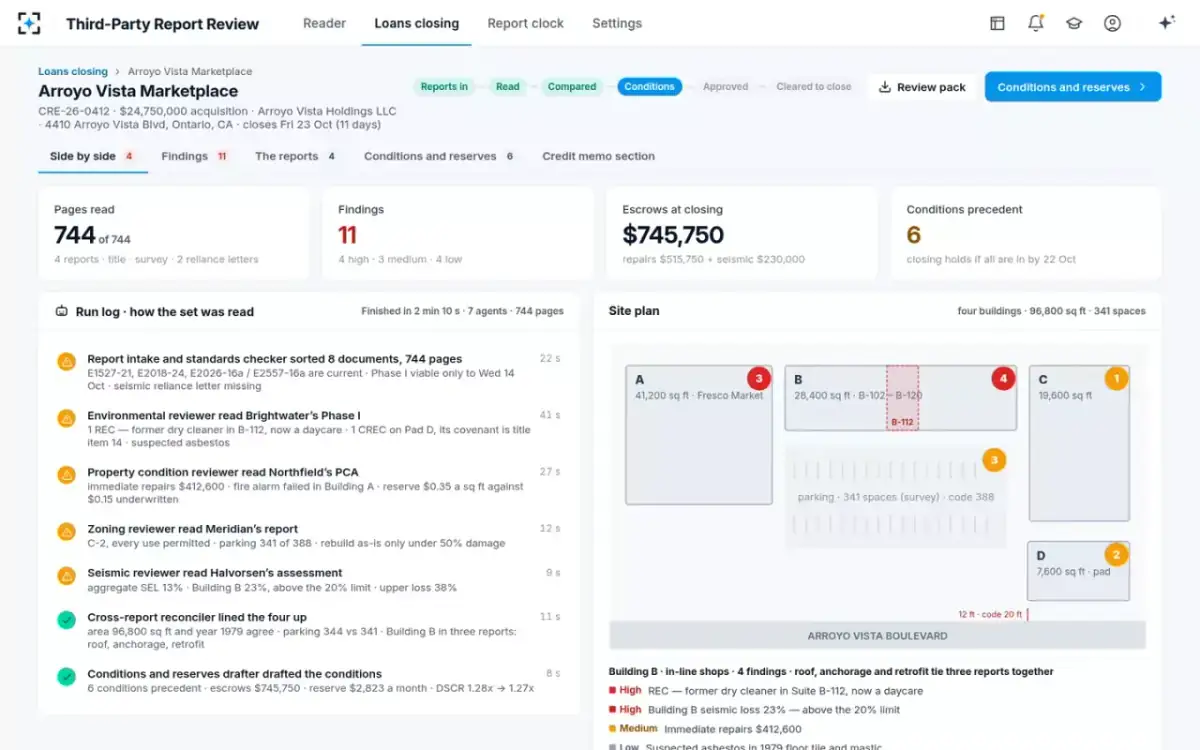
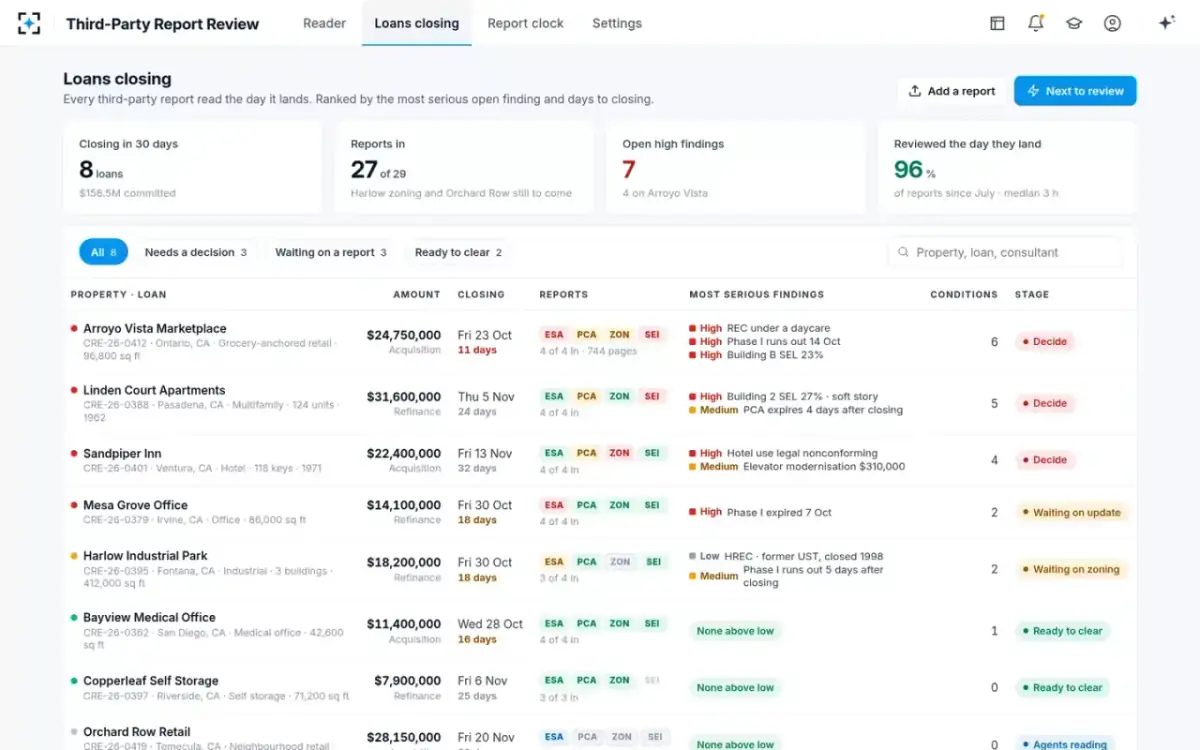
The same habit shows up across a pipeline. On the sample bank's list of loans closing, one industrial park's most serious finding is an HREC, a former underground tank closed in 1998, shown as low severity rather than ignored: the closure letter is in the file, and the credit officer can see why it needs nothing more. How the reliance letter decides whether the bank can lean on any of these classifications is covered in who can rely on a Phase 1 ESA.
Every loan closing in 30 days, with its most serious finding named
Questions people ask
Is a CREC still a REC?
Yes. Under ASTM E1527-21 a controlled recognized environmental condition is a kind of REC, because contamination remains in place and the control has to keep working. Fannie Mae treats them together: a Phase I that finds "any RECs/CRECs" needs Fannie Mae's approval before rate lock.
Is an HREC a REC?
No. Under E1527-21 a historical recognized environmental condition is a past release addressed to unrestricted use with no controls, and it is not a REC. The report should still describe it and its regulatory status, and Fannie Mae's Form 4251 asks for any "no further action" letter to be attached.
What are examples of a recognized environmental condition?
A former dry cleaner with no closure on record, a leaking underground storage tank, stained soil near a former industrial use, or contaminated groundwater migrating from a neighbouring property. On the sample loan in Third-Party Report Review, the REC is a dry cleaner that used PCE for 23 years in a suite that is now a daycare.
Can a lender downgrade a REC?
A lender can decide how to respond, but should not rewrite the environmental professional's classification. If it disagrees, the route is a question to the consultant and a decision by the bank's environmental risk owner, documented in the file, not a quieter label in the credit memo.
Does a vapor encroachment condition count as a REC?
It can. When a vapor screen cannot rule out a vapor condition from a known release, as on the sample loan, the professional may treat it as part of a REC and recommend sub-slab and indoor air sampling. Fannie Mae's Form 4251 asks the executive summary to address "whether vapor intrusion is a potential risk to human health" where soil or groundwater contamination is present.