A Phase 1 environmental site assessment checklist for a commercial lender is not the consultant's scope of work; it is the list of things the bank must confirm before it accepts the report and lends against the property. It asks who prepared the report and whether they qualify, whether the dates still hold at closing, whether the scope met EPA's All Appropriate Inquiries rule, what the environmental professional found and recommended, and what the bank must do about it. The work is hard because the answers are spread across 300 or 400 pages that arrive weeks before closing, and because a missed recommendation becomes a missing loan condition. Botminds' Third-Party Report Review reads the Phase I alongside the property condition, zoning and seismic reports for a loan, marks each of these checks on the page it rests on, and drafts the resulting conditions for the credit officer and the environmental risk manager to decide.
Why the checklist starts with the rule, not the report
12
checks a lender should run on every Phase I before accepting it
5
report components that go stale after 180 days
1mile
search radius for federal Superfund (NPL) sites and RCRA corrective action sites
125%
of a remediation plan's cost that Fannie Mae says should be escrowed
What should a Phase 1 environmental site assessment checklist cover?
It should cover the report's authority, its currency, its scope and its consequences. The first three decide whether the report counts; the fourth decides what the loan documents must say. The list below is the version we would hand a new environmental reviewer, with the rule each check rests on.
The lender's Phase I checklist: twelve checks, in the order they fail
- The standard and version
ASTM E1527-21 or the AAI rule itself; E1527-13 stopped counting for new work on 13 February 2024 (40 CFR 312.11).
- The environmental professional
Named, with the qualifications in 40 CFR 312.10 and the signed declaration in 312.21(d).
- The five component dates
Interviews, lien search, records review, site visit and declaration all within 180 days of closing; everything else within one year.
- Who may rely on it
Addressed to the bank, or a reliance letter naming the bank, its successors and assigns.
- Whole property, every parcel
Fannie Mae requires a Phase I "of the entire Property"; check outparcels and pads.
- Records searched to the right distances
The 312.26 list: one mile for NPL and RCRA corrective action sites, half a mile for state sites and leaking tanks.
- Interviews, history and site visit done
Current owner and occupants interviewed; history back to first developed use; limitations to the visit stated.
- The user's own inquiries supplied
Liens, specialized knowledge, purchase price against value, commonly known information (312.22).
- Findings classified
Each recognised, controlled or historical condition, with its source and page, and the professional's opinion.
- Data gaps and their significance
Named, with what was done to fill them and whether they stop the professional reaching an opinion (312.21(c)).
- Recommendations followed
Every recommended investigation obtained or escalated; a Phase II scoped where the report calls for one.
- Findings turned into loan terms
Conditions precedent, escrows, O&M plans, indemnity and access rights in the loan documents.
The order is deliberate. A report on a superseded standard, or signed by someone who does not meet the definition, fails before anyone reads its findings. A report whose dates will not hold at closing is a scheduling problem that only gets worse with every week of delay. The scope and findings checks come next, and the consequences last, because a finding has nowhere to go until the report itself is sound.
Who signed it: the environmental professional test
An environmental professional is a defined term, and a lender should check the signer against it. EPA's rule requires a current Professional Engineer or Professional Geologist licence and three years of full-time relevant experience; or a government licence or certificate to perform environmental inquiries and three years; or an engineering or science degree and five years; or ten years of full-time relevant experience (40 CFR 312.10). Anyone else may help, but only "under the supervision or responsible charge" of someone who qualifies.
The report must then carry the professional's declaration, in words the rule prescribes: "[I, We] declare that, to the best of [my, our] professional knowledge and belief, [I, we] meet the definition of Environmental Professional as defined in § 312.10 of this part." A missing declaration is not a typing error. It is one of the five components on the 180-day clock, so its absence or its date can decide whether the report is current at all, as how long a Phase 1 ESA is good for explains.
Agency programs add their own tests. SBA requires every Transaction Screen, Phase I and Phase II to be "performed by an Environmental Professional and be accompanied by the Reliance Letter" in its SOP, and asks for an independent professional with a Professional Engineer's or Professional Geologist's licence when a Phase II follows a dry cleaner (SBA SOP 50 10 8.1).
The scope a Phase I must show: records, interviews, site visit, history
A compliant Phase I shows four kinds of work: government records searched to set distances, interviews with the people who know the site, a visual inspection of the property and its neighbours, and historical sources back to the property's first developed use. Each is a section of the AAI rule, and each leaves traces a reviewer can check in the report's appendices.
The records a Phase I must search, and how far from the property
| Government records | Search distance |
|---|---|
| National Priorities List (Superfund) sites and tribal or state equivalents | One mile |
| RCRA facilities subject to corrective action | One mile |
| State and tribal hazardous waste sites, voluntary cleanup and brownfield sites | Half a mile |
| Leaking underground storage tanks | Half a mile |
| Delisted NPL sites; engineering controls; former CERCLIS sites with no further action | Half a mile |
| Permitted landfills and solid waste facilities | Half a mile |
| RCRA small and large quantity generators; registered storage tanks | Adjoining properties |
The other scope checks are quicker. The interviews must include "the current owner and occupant of the subject property", and on a multi-tenant property, the major occupants and any occupant "likely to use, store, treat, handle or dispose of hazardous substances" (312.23). The site visit must note physical limitations, and the mere refusal of a voluntary seller to grant access does not excuse an on-site inspection (312.27). Historical sources must reach back as far as the property has been developed or used (312.24). On a shopping centre, the tenant list is where the answer often hides: a dry cleaner that left in 2004 is invisible from the parking lot and plain in a 1985 city directory.
What the user owes the Phase I: four inquiries of its own
The person relying on the Phase I for CERCLA protection owes it four inquiries the consultant cannot make alone: a search for environmental cleanup liens if the professional did not run one, the user's specialized knowledge of the property, whether the purchase price reflects the value of the property if it were not contaminated, and commonly known information about the site (40 CFR 312.22). The questionnaire a consultant sends at engagement exists to collect them.
For a lender, the practical check is whether the questionnaire came back and who answered it. A purchase price well below value "must" lead the purchaser to consider whether the difference is due to contamination (312.29). A borrower who knew about an old spill and did not say so has not completed the inquiry, and "all appropriate inquiries ... are not complete unless the results of the inquiries take into account the relevant and applicable specialized knowledge" of the person responsible (312.28(b)). Fannie Mae puts a matching duty on the lender: to "disclose to Fannie Mae your knowledge of any actual or suspected environmental conditions affecting the Property, whether or not disclosed in the Phase I ESA" (Guide §504.02).
Reading the findings: recognised conditions, data gaps and the professional's opinion
The findings section is where a lender reads the environmental professional's classification of each condition, and the rule's core requirement is an opinion: whether the inquiry "has identified conditions indicative of releases or threatened releases" on the property (312.21(c)(1)). The ASTM standard sorts what it finds into recognised environmental conditions, controlled ones and historical ones, and the bank's treatment differs for each, as REC vs CREC vs HREC sets out.
Data gaps deserve their own line on the checklist. The rule defines a data gap as information the standard requires but that could not be obtained "despite good faith efforts", and the report must identify each one and comment on "the significance of such data gaps" (312.21(c)(2)). A gap that does not matter, such as one tenant unavailable for interview, should say so. A gap that stops the professional reaching an opinion must be stated in the opinion itself. Fannie Mae's Form 4251 goes further and has the lender obtain a Phase II when "the lack of data or information concerning the conditions" warrants it (Form 4251 §2).
A finding on the page, and the condition it becomes
Is a Phase II needed? Reading the recommendations
A Phase II is needed when the environmental professional recommends one, and in some programs whatever the professional says. The lender's job is not to second-guess the recommendation but to make sure it is followed, escalated or, rarely, formally excepted.
The agency rules are blunt. Fannie Mae's Guide requires the lender to "obtain all investigations recommended or indicated by the Phase I ESA" (§504.02). SBA requires the lender to "proceed as recommended by the Environmental Professional" or seek an exception from its Environmental Committee, and for any property with on-site dry cleaning, current or historical, "a Phase I followed by a Phase II Environmental Assessment is required", addressing soil, groundwater and soil vapor (SOP 50 10 8.1). The bank regulators leave it to policy: the OCC expects procedures that "specify the circumstances in which a more detailed environmental assessment" is required (OCC, p. 66).
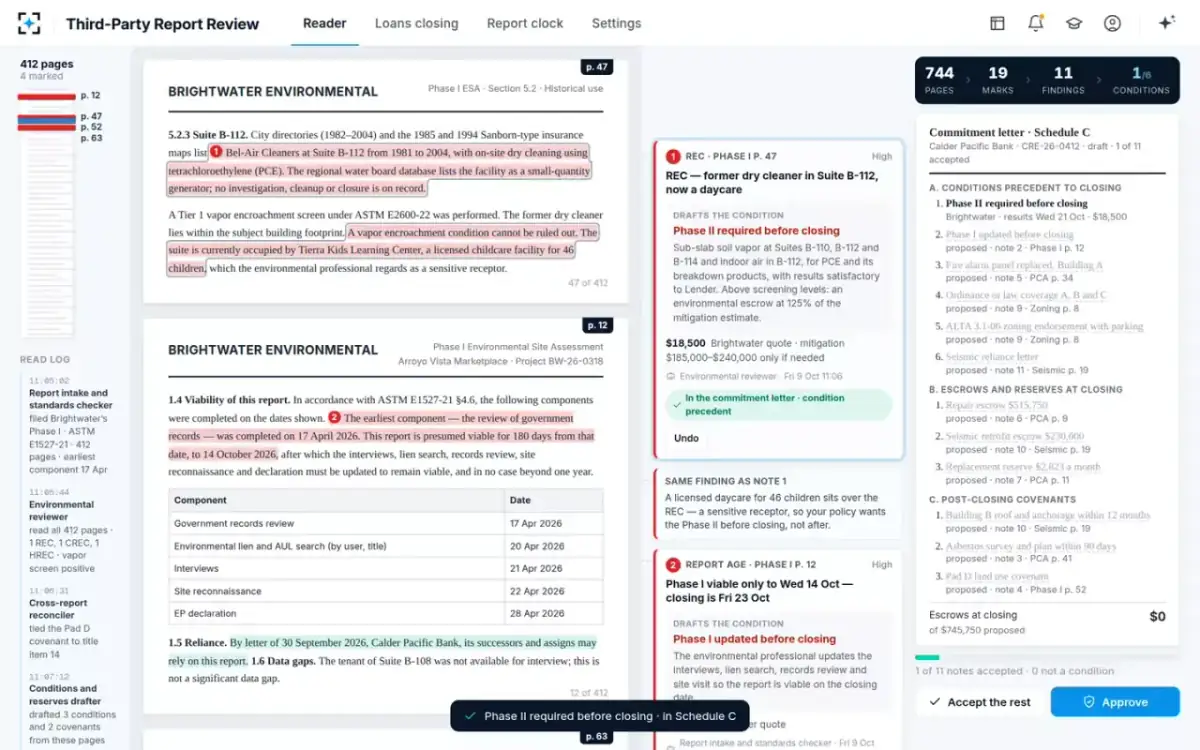
In the sample loan behind the screens on this page, the trigger was a former dry cleaner whose suite is now a daycare for 46 children. The consultant recommended sub-slab vapor sampling under three suites and indoor air sampling in one, at $18,500, and the sample bank's policy calls for further investigation before closing whenever a sensitive receptor sits over a recognised condition. The Phase II became condition precedent number one.
From finding to loan terms: what the lender does next
Every finding that survives review becomes a term of the loan: a condition precedent, an escrow, an operations and maintenance plan, an indemnity or a monitoring covenant. The Phase I is only finished, from the bank's side, when each finding has a home in the documents.
What the agencies and examiners expect a finding to become
The rule or guidance: Fannie Mae: obtain a remediation plan from an environmental professional with "a cost estimate and schedule", and add its cost to the repair escrow, "at least 125%".
In the loan documents: A condition precedent for the plan; an escrow sized at 125% of its cost.
The rule or guidance: Form 4251: an O&M plan where buildings predate 1981 (asbestos) or 1978 (lead paint), or where the professional recommends one.
In the loan documents: An O&M compliance agreement signed at closing, and the plan kept on site.
The rule or guidance: FDIC: loan documents "might also call for an indemnity of the institution by the borrower and guarantors".
In the loan documents: An environmental indemnity, revised to name the specific condition.
The rule or guidance: OCC: documentation "should include contractual provisions, such as rights of access".
In the loan documents: Access and inspection rights; a covenant to monitor the property.
Examiners test the sequence, not just the outcome. The FDIC tells its examiners to determine "whether management conducts an initial environmental risk analysis during the application process prior to making a loan", and the OCC expects the bank to receive and evaluate environmental reports "before the bank finally commits to lend". A finding drafted into a condition after the commitment letter has gone out is a finding the bank has to renegotiate.
Running the checklist with agents: where Third-Party Report Review fits, and where it does not
Agents fit the reading and the cross-checking: dates, signatures, distances, classifications, recommendations and costs, each pulled to its page. They do not fit the judgments the rule assigns to people: the professional's opinion, the bank's decision to lend, and the environmental risk manager's concurrence.
One Phase I through Third-Party Report Review
Agent
Intake and standards checkerIdentifies the standard and version, the signer, the five component dates and the reliance language, and computes the date the report stops being current.
Never: accepts a Phase I on a superseded standard
Agent
Environmental reviewerReads every recognised, controlled and historical condition, de minimis condition, data gap and vapor screen, flags sensitive receptors, and ties land use limitations to the title commitment.
Never: downgrades the professional's classification
Agent
Conditions and reserves drafterDrafts the Phase II, the update and the escrow as conditions, each citing its page and cost.
Never: waives a condition or approves
A person decides
Environmental risk managerConcurs on every recognised condition, controlled condition and vapor finding before conditions are final.
A person decides
Credit officerAccepts, edits or rejects each drafted condition; approval stays blocked until every note is decided.
Where it does not fit: it does not perform the site visit, interview the occupants, run the database search or replace the environmental professional, and it does not decide whether a risk is acceptable. It also does not invent a classification. If the report calls a former tank a historical condition, the agent records it as historical and shows the page; if the reviewer disagrees, that is a question for the consultant and the environmental risk manager, not a silent change.
Six questions to ask before buying a Phase I review tool
The useful questions are about evidence and control rather than speed. A tool that reads 400 pages in minutes is only valuable if every statement it makes can be checked against the page, and if nothing it drafts reaches a commitment letter without a person.
Buying a Phase I review tool: what to ask, and what a good answer sounds like
| Question | A good answer |
|---|---|
| Does every finding cite its report and page? | Yes, every note, cell and memo sentence links to the page; Third-Party Report Review sets that as a target of 100% of findings cited. |
| Can it change the consultant's classification or cost? | No. It shows both values where reports disagree and names the document that governs by policy. |
| How does it count viability? | From the earliest of the five component dates, never beyond one year, against the actual closing date. |
| Who signs off? | The credit officer decides each note; environmental findings need the environmental risk manager; a waiver needs the chief credit officer. |
| Does it read the other reports too? | The Phase I matters most when read with the PCA, zoning, seismic report, title and survey, where the same building appears in each. |
| Can we test it on our own closed files? | Yes: run it on reports from loans you have already closed and compare its findings with what your reviewers found. |
The last question is the one that settles a purchase. A review of reports from twenty closed loans shows, on the bank's own files, how many stale dates, missing reliance letters and unescrowed recommendations reached a closing, and whether the agents would have caught them. That pilot is laid out in the commercial real estate due diligence checklist.
Questions people ask
What is included in a Phase 1 environmental site assessment?
Under EPA's rule a Phase I includes interviews with owners and occupants, a review of historical sources, searches for recorded cleanup liens, a review of government records to set distances, a visual inspection of the property and its neighbours, and the professional's opinion, data gaps and declaration. The user adds its own inquiries on specialized knowledge, purchase price and commonly known information (40 CFR 312.21 to 312.31).
What is the Phase 1 ESA user questionnaire?
It is how the consultant collects the inquiries the rule puts on the user rather than the professional: cleanup liens, specialized knowledge, whether the price reflects uncontaminated value, and commonly known information (40 CFR 312.22). An unanswered questionnaire is a gap in the user's own inquiry, not just in the report.
Does a bank require a Phase 1 ESA?
No federal rule requires one on every commercial loan. The OCC expects a bank's policy to set "risk thresholds based on property type, use, and loan amount" for when and what due diligence is needed, while Fannie Mae requires a Phase I on every multifamily property except certain small loans, and SBA requires one for listed environmentally sensitive uses regardless of loan amount.
How do lenders review a Phase 1 ESA?
Before the bank commits, and apart from the people selling the loan: the OCC expects environmental reports to be received and evaluated "before the bank finally commits to lend", and its construction-lending procedures look for separation of "ordering, performing, and reviewing related due diligence" from origination. The reviewer checks the report's standard, signer and dates, reads its findings and recommendations, and turns them into conditions before the bank commits.
Can AI review a Phase 1 environmental report?
It can read one and draft the review, but not replace the environmental professional or the bank's decision. In Third-Party Report Review the agents mark each finding on its page and draft conditions, the environmental risk manager concurs on recognised conditions, and the credit officer decides every note.
What triggers a Phase II?
A recommendation by the environmental professional, or a data gap serious enough to stop an opinion. Fannie Mae requires lenders to obtain all recommended investigations, and SBA requires a Phase I followed by a Phase II for any property with current or past on-site dry cleaning.