A reliance letter for a Phase 1 ESA is a letter from the environmental consultant that names parties other than its client, usually the lender, the lender's successors and assigns, and any agency guaranteeing or buying the loan, and authorizes them to use and rely on the report as if it had been prepared for them, on stated terms. It matters because most environmental reports say they are for the client's use only, and a lender that relies on a report it has no right to rely on may have no claim against the consultant if the report is wrong. The work is easy to skip because the letter is a page or two, often arrives last, and is checked against nothing. Botminds' Third-Party Report Review reads the reliance language in each report in a loan's closing set, the Phase I, property condition, zoning and seismic reports, compares the names with the lender of record, and drafts a missing letter as a condition before closing.
What the agencies require of reliance
Every
SBA Phase I, Phase II and Transaction Screen needs the SBA's standard reliance letter
$1M
per claim of errors and omissions cover the consultant must certify in the SBA letter
0
changes allowed to the SBA letter's wording
What is a reliance letter for a Phase 1 ESA?
It is a short contract that extends a report's audience. The consultant's agreement with its client sets who the report is for; the reliance letter adds named parties, says which reports and dates it covers, and sets the terms on which the new parties may rely, including how much the consultant will answer for and for how long. Its practical effect is to make the consultant's duty of care run to the lender as well as to whoever paid for the report.
It is separate from the report's content. A reliance letter does not say the property is clean or the report current. The SBA's standard letter is explicit on both counts: "This letter is not an update or modification to the Environmental Investigation", and the consultant "makes no representation or warranty, express or implied, that the condition of the Property on the date of this letter is the same or similar to the condition of the Property described in the Environmental Investigation" (SBA SOP 50 10 8.1, Appendix 5).
Who is the user of a Phase 1 ESA, and who can rely on it?
The user, in EPA's terms, is the person seeking CERCLA protection, usually the purchaser and borrower; the lender is a reader with its own reasons to rely. The two are often confused because the same report serves both, and because the lender often orders it.
Who relies on a Phase I, for what, and on what authority
| Party | Why it relies on the Phase I | What gives it the right |
|---|---|---|
| Purchaser and borrower | Its own CERCLA defences as a bona fide prospective purchaser or innocent landowner | All appropriate inquiries done for it, or another party's report plus its own additional inquiries (40 CFR 312.20(d)) |
| Lender | Credit decision, collateral value, loan conditions; not its own CERCLA protection | A report addressed to it, or a reliance letter naming it, its successors and assigns |
| Fannie Mae (multifamily) | Loan purchase and approval of any REC or CREC | Phase I "addressed to, and explicitly authorize reliance by" the lender, Fannie Mae and their successors and assigns |
| SBA (7(a) and 504) | The guaranty | The SBA's standard reliance letter, unmodified, with every investigation |
| Later holders of the loan | A sale, participation or securitization | Successors and assigns language in the letter |
The lender's row is the one people misread. EPA's fact sheet for lenders says the AAI rule "primarily applies to borrowers who want to claim protection from CERCLA liability", and that the secured lender exemption "is not conditioned by a bank or lender undertaking AAI" (EPA, 2023). So the bank does not need the Phase I for its own CERCLA position. It needs the Phase I to be right, because it lends against the property and sets conditions from the findings, and reliance is what gives it recourse if the report turns out to be wrong.
Fannie Mae draws the line from the other side. Its Phase I is ordered by the lender and must be addressed to the lender and Fannie Mae, while the borrower "may not rely on the Phase I ESA ordered by the Lender" and "is expected to perform its own pre-transaction diligence" (Form 4251 §1.D). The lender's report protects the lender; the borrower's protection is the borrower's job.
What a reliance letter should say: the SBA's letter as a model
The most complete public model is the SBA's, because it is mandatory and may not be edited. A lender outside the SBA programs can use its clauses as a checklist for any letter a consultant offers.
Clauses in a sound reliance letter, from the SBA's standard form
- The parties
The lender and the agency by name, so reliance is not left to "the client and its lender".
- The reports, by date
Each investigation and any addendum, with its date and standard (ASTM E1527-21 for a Phase I).
- The professional's standing
A statement that the signer meets 40 CFR 312.10 and addressed the user's additional inquiries under 312.22.
- Authority to rely
"Authorize(s) Lender and SBA to use and rely upon the Environmental Investigation."
- Copies to the borrower
Permission to release the report to the borrower "for information purposes only".
- Insurance
Errors and omissions cover of at least $1,000,000 per claim, with evidence attached.
- Liability limits waived
Waiver of dollar limits up to $1,000,000 and of time limits other than statutes of limitation.
- No indemnity back
The consultant waives any right to be indemnified by the lender or the agency.
- Impartiality
Independent of the seller and borrower, and "not ... unduly influenced" in preparing the report.
- Signatures
The environmental professional, and an authorized officer of the firm.
Three of those clauses do most of the work. The liability waiver decides what reliance is worth: a letter that lets the lender rely but caps the consultant's exposure at the fee for a 412-page report gives the bank a claim worth very little. The insurance clause decides whether a claim can be paid. And the impartiality clause answers the question an examiner will ask about any report the borrower commissioned.
Can a lender rely on a borrower's Phase 1?
It can, if it gets a reliance letter and the report is current and sound, but the agencies and examiners prefer the lender to control the report. EPA's rule lets anyone use a report "prepared by or for other persons" provided the user reviews it and makes its own additional inquiries (40 CFR 312.20(d)). Reliance is a separate question that the rule does not answer; only the consultant can grant it.
Three ways a lender ends up holding a Phase I
What the lender has: A report addressed to the bank, under the bank's engagement terms.
What to check: Successors and assigns named; liability terms acceptable; the consultant independent of the borrower.
What the lender has: A report the bank can rely on, on the letter's terms.
What to check: The letter covers this report and date, names the bank and its successors and assigns, and does not cap liability at the fee.
What the lender has: Useful background, but no right to rely.
What to check: Obtain a letter, or order a new report; treat the findings as unverified until then.
The independence point is the one that turns a legal question into a credit one. The OCC's examination procedures for construction lending ask whether related reports "have sufficient information and analysis to guide credit and disbursement decisions", and whether ordering and reviewing them is kept apart from origination (OCC, Commercial Real Estate Lending); the same logic applies to any report a credit decision rests on. A borrower-ordered report with a reliance letter can meet the legal test and still fall short of that one, which is why many banks order their own.
Successors and assigns: why the bank's name alone is not enough
A reliance letter that names only the originating bank stops working the day the loan is sold, participated or securitized. "Successors and assigns" carries reliance to whoever holds the loan later, which is why Fannie Mae requires the Phase I to authorize reliance by the lender, Fannie Mae "and their respective successors and assigns", and its PCA instructions require the lender "and its successors and/or assigns" to be named as additional insureds on the consultant's liability policy (Form 4099 §1.3.E).
On the fictional sample loan behind this page, the Phase I's own text records the point: "By letter of 30 September 2026, Calder Pacific Bank, its successors and assigns may rely on this report." The intake checker in Third-Party Report Review finds that sentence on page 12, compares the name with the lender of record and the commitment letter, and marks the check as passed.
A reliance letter is not an update
A new reliance letter does not make an old report current. The sample loan shows how easily the two get confused: the reliance letter is dated 30 September 2026, but the Phase I's earliest component is dated 17 April 2026, so the report stops meeting the 180-day test on 14 October, nine days before the 23 October closing. A reviewer who sees a September date on the reliance letter and a "current" stamp on the file can miss that the fieldwork underneath is six months old.
This letter is not an update or modification to the Environmental Investigation.
SBA SOP 50 10 8.1, Appendix 5, Reliance Letter
The two checks have to run separately: reliance against the lender of record, and viability against the closing date. An update of the 180-day components, with a new declaration, renews the report; a reliance letter on the updated report then extends it to the bank. The date arithmetic is in how long a Phase 1 ESA is good for.
Reliance on the other reports: PCA, zoning and seismic
Every report in a closing set raises the same question, and the answer is not always in the report the bank received. Fannie Mae writes reliance into the PCA engagement itself: by accepting it, the consultant "agrees and acknowledges that Fannie Mae is an intended third-party beneficiary of the PCA and the PCA Report and will act in reliance on" them (Form 4099 §1.3.A). Commercial banks outside the agency programs have to ask for it.
The seismic report that says the bank may not rely on it
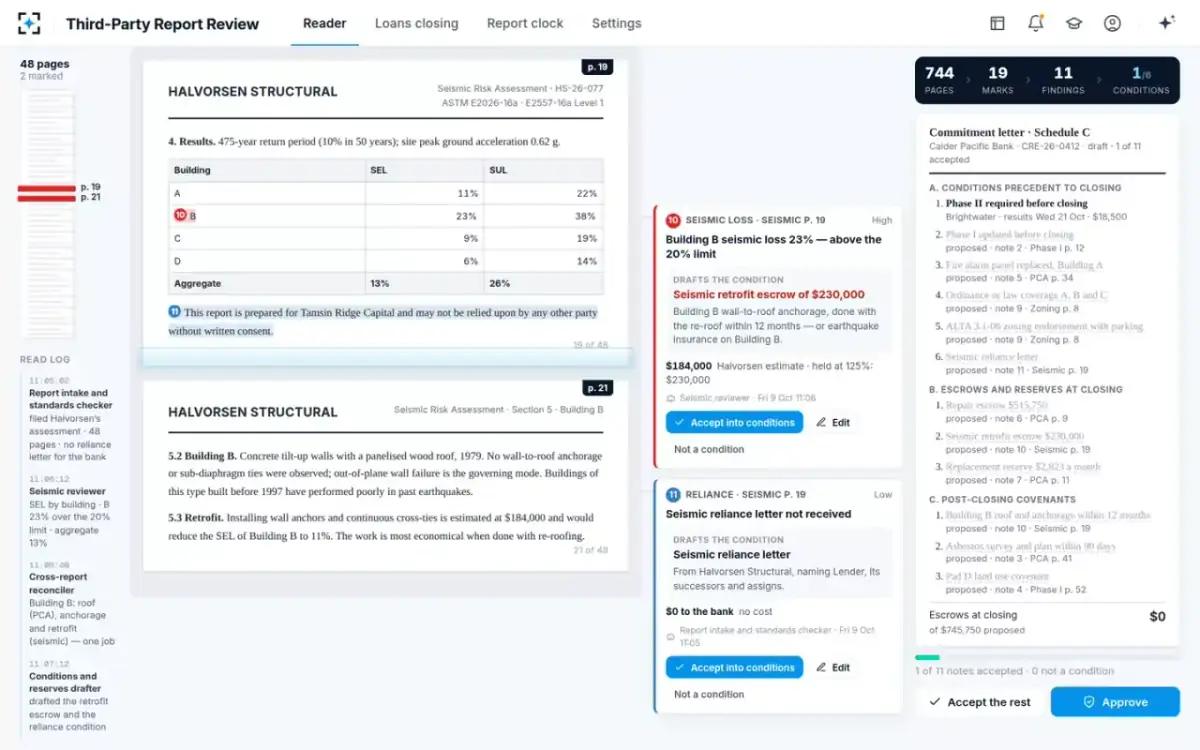
On the sample loan, the seismic assessment was prepared for a different lender and says it "may not be relied upon by any other party without written consent". Its findings were the most consequential in the set, a building above the seismic loss limit, and the bank was about to set a $230,000 retrofit escrow on the strength of a report it had no right to rely on. The condition costs nothing to draft and only a letter to satisfy, but it has to be found first.
Checking reliance in Third-Party Report Review
In the solution, the intake and standards checker identifies each report's author, standard and dates and reads its reliance language: who the report is addressed to, whether a reliance letter is attached or cited, and whether it names the bank, its successors and assigns. Where reliance is missing or names someone else, the conditions drafter drafts the letter as a condition precedent with the report and page behind it.
Reliance checks passed and failed, in one approval
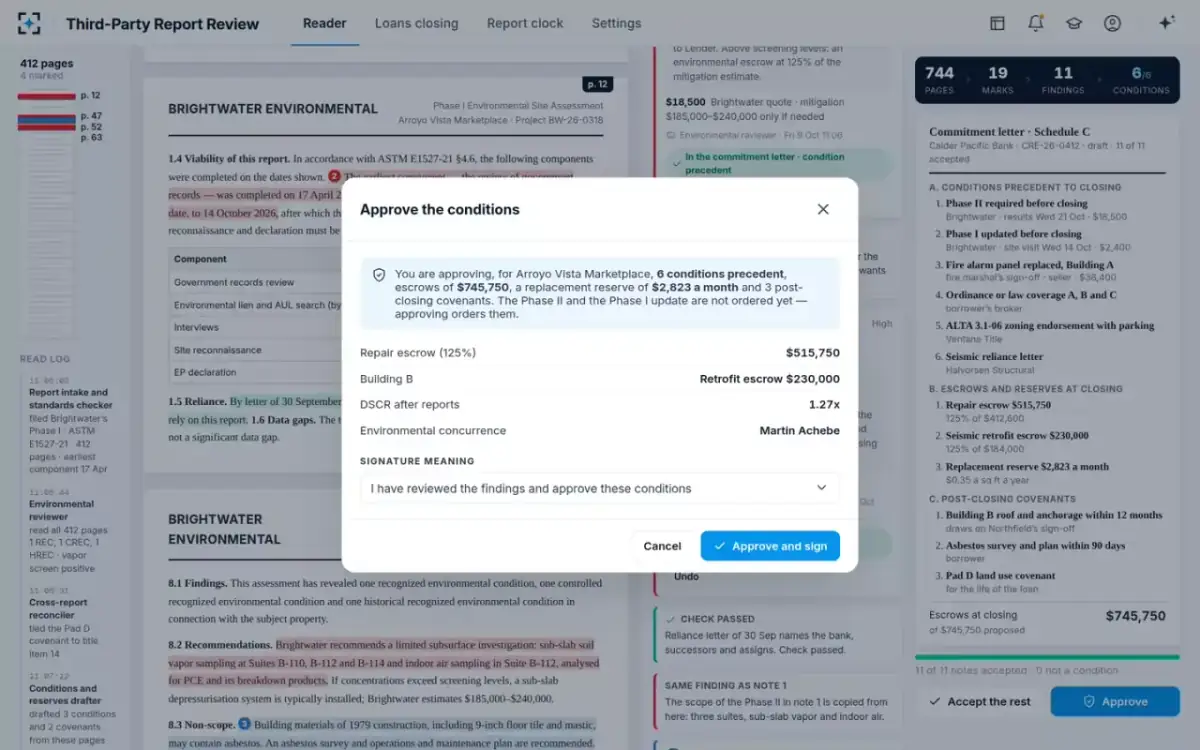
What the solution does not do is draft the letter's legal terms or judge whether a liability cap is acceptable; that belongs to the bank's counsel and policy. It finds the clause, names the gap and puts it in front of the credit officer early enough to fix. The other places a report's authority can fail before anyone reads its findings, such as a superseded standard or an unqualified signer, are on the Phase 1 environmental site assessment checklist.
Questions people ask
What is an environmental reliance letter?
It is a letter in which the consultant who prepared an environmental report authorizes named parties, such as a lender and its successors and assigns, to rely on it. The SBA's version also certifies the consultant's qualifications and insurance, waives some liability limits and confirms impartiality.
What is the SBA environmental reliance letter?
It is the standard letter in Appendix 5 of SOP 50 10, which must accompany every Transaction Screen, Phase I and Phase II on an SBA 7(a) or 504 loan, even when the report is addressed to the lender. Its wording "may not be modified", and lenders should not enter any agreement that alters its terms.
Can a borrower rely on a lender's Phase I?
Under Fannie Mae's multifamily rules, no: the borrower "may not rely on the Phase I ESA ordered by the Lender" and is expected to do its own diligence. Outside that program it depends on the consultant's terms; the borrower's CERCLA defences depend on its own all appropriate inquiries in any case.
Does a reliance letter extend the life of a Phase I?
No. The SBA's letter says it "is not an update or modification", and EPA's 180-day and one-year limits run from the report's component dates. Only an update by the environmental professional renews the report.
Does the bank need a reliance letter for the PCA and seismic report too?
Yes, for the same reason: without one, the bank may have no claim against the consultant if a cost or loss estimate is wrong. Fannie Mae builds this into the PCA engagement by making itself an intended third-party beneficiary; a bank lending on its own account should ask for a letter on each report.