A commercial real estate due diligence checklist, from the lender's side, lists the third-party reports the bank needs before it closes a loan (the appraisal, the Phase I environmental site assessment, the property condition assessment, the zoning report, a seismic assessment where the hazard calls for one, the flood determination, and the title commitment and ALTA survey) and, for each, the rule it must satisfy and the facts it must prove. The checklist is easy to write; the hard part is that the reports arrive in the last weeks before closing, run to hundreds of pages each, and are read one at a time by different people, so the misses happen between them. Botminds' Third-Party Report Review reads the Phase I, property condition, zoning and seismic reports for a loan together with the title, survey and reliance letters, lines up every finding by building, and drafts the conditions, escrows and memo section for the credit officer to decide. The test this guide recommends is simple: run the checklist, with or without agents, over twenty loans the bank has already closed, and count what reached the closing table without its condition.
Four rules that set the checklist's deadlines
$500K
commercial real estate loans above this need a state-certified appraiser
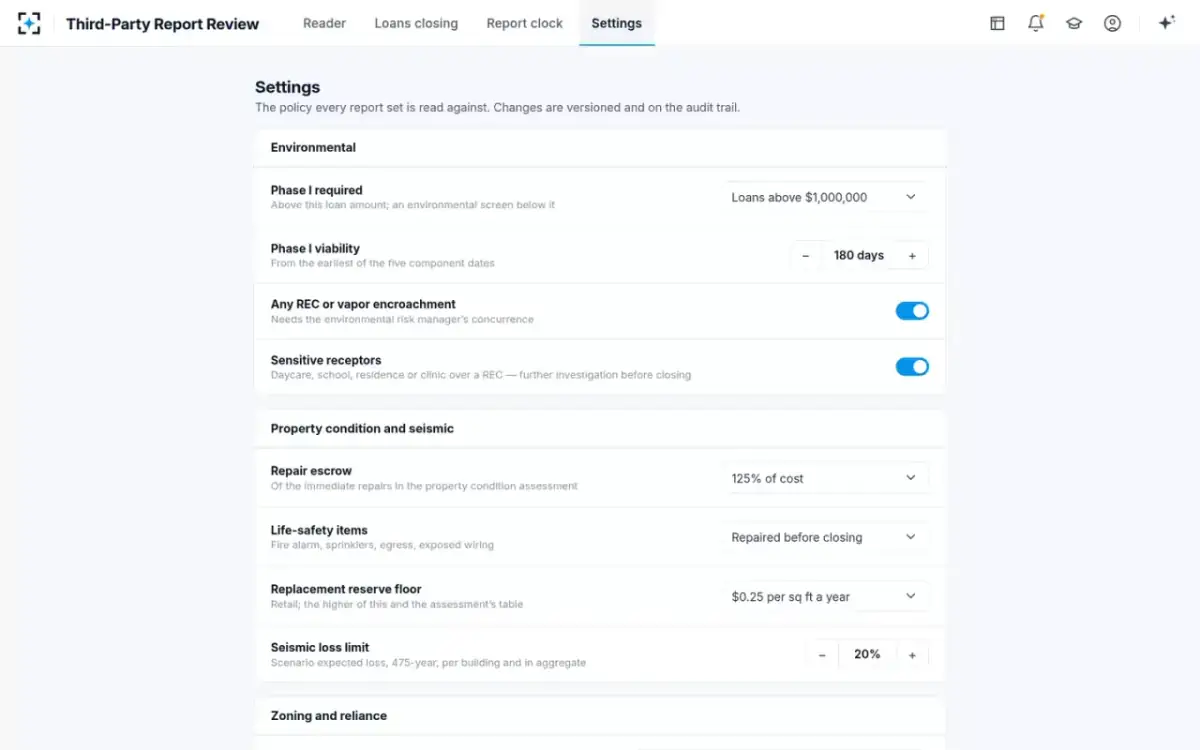
180days
before acquisition, the limit for a Phase I's five fieldwork components
125%
of estimated repair cost: the agency guide for repair escrows
10days
the notice of flood hazards regulators regard as reasonable before closing
What is on a commercial real estate due diligence checklist for a lender?
Every report the bank relies on, each with three things: the rule or policy that requires it, what it has to prove for this loan, and who reviews it. A purchaser's checklist covers leases, estoppels and operating history; a lender's checklist covers the collateral reports that set the loan's conditions, and it is the one examiners read.
A lender's due diligence checklist for a commercial property
| Report | Rule or standard | What it must prove before closing | Reviewed by |
|---|---|---|---|
| Appraisal or evaluation | 12 CFR 34.43: state-certified appraiser above $500,000 for CRE; USPAP | Value supports the loan; reviewed before the credit decision | Appraisal reviewer, independent of the loan |
| Phase I environmental site assessment | 40 CFR 312; ASTM E1527-21; bank environmental policy | Current at closing; signer qualified; every REC and recommendation addressed | Environmental risk manager |
| Property condition assessment | ASTM E2018; lender or agency scope | Immediate repairs costed and escrowed; reserve sized from the capital table | Underwriter and credit officer |
| Zoning report | Local ordinance; bank policy | Use permitted; nonconformities and rebuild rights known; open violations costed | Credit officer and counsel |
| Seismic risk assessment, where hazard is high | ASTM E2026 and E2557; agency or bank loss limits | Every building within the loss limit; retrofit planned where not | Credit officer |
| Flood determination | 12 CFR 339 (and parallels); FEMA form | Each building's zone; cover in place; notice sent in time | Flood compliance |
| Title commitment, ALTA survey, reliance letters | Bank policy; agency requirements | Land use limitations and covenants matched; building and parking counts agree; the bank can rely on each report | Closing officer and counsel |
The "what it must prove" column is where most checklists go thin. A checklist that says "Phase I: received" passes a report that runs out nine days before closing. One that says "PCA: received" passes an immediate repair that never reached the escrow. Writing the proof into each line turns the checklist from an inventory into a test, and only a test can be measured. The full Phase I version of that test is in the Phase 1 environmental site assessment checklist, and the PCA version in the property condition assessment checklist.
What third-party reports does a lender need? Policy decides, within the rules
Outside a few fixed rules, the bank's own policy decides which reports a loan needs, by property type, use and loan size. The OCC expects an environmental policy with "risk thresholds based on property type, use, and loan amount for determining when and what type of due diligence is required", using methods that range from borrower questionnaires and site visits to "testing or inspections using qualified professionals" (OCC, Commercial Real Estate Lending, p. 67).
The fixed rules sit around that discretion. An appraisal by a state-certified appraiser is required for commercial real estate transactions above $500,000, and an evaluation below it (12 CFR 34.43). A flood determination is required on every loan secured by a building (12 CFR 339.6). The agencies add their own: Fannie Mae requires a Phase I on every multifamily loan except some small ones and a seismic assessment where the site's ground acceleration reaches 0.15g and a structural risk factor appears (Guide §505); SBA starts with the property's industry code, requiring a Phase I for listed sensitive uses at any loan size, and at least a records search with a risk assessment above $250,000 (SOP 50 10 8.1).
The bank's thresholds, as settings every report set is read against
Who orders the third-party reports, and why examiners care
The bank should order them, or at least control them, and someone apart from the loan officer should review them. The OCC's examination procedures for construction lending look for "clear separation of origination and servicing functions (e.g., ordering, performing, and reviewing related due diligence.)", and for reports with "sufficient information and analysis to guide credit and disbursement decisions" (OCC, Commercial Real Estate Lending). The same logic applies to any report a credit decision rests on.
Timing is the other half. The OCC expects environmental reports to be received and evaluated "before the bank finally commits to lend", and the FDIC tells examiners to check that an environmental analysis happens "during the application process prior to making a loan" (FDIC RMS Manual §3.2). A finding that surfaces after the commitment letter is a renegotiation; one that surfaces after closing is a loss the bank can only manage. Ordering also settles reliance: a report the bank ordered is addressed to the bank, while one the borrower ordered needs a letter, as who can rely on a Phase 1 ESA explains.
How long does commercial due diligence take?
No regulator or research body publishes how long lenders spend reviewing third-party reports, so any figure is an estimate. What the rules do fix are the windows: a Phase I's fieldwork must be within 180 days of acquisition, a Fannie Mae seismic assessment within 12 months of the commitment, and the flood notice a reasonable time, generally 10 days, before closing. Review time has to fit inside them.
Where a report set's review days go, by hand and with the agents (Botminds' estimate)
By hand: about 10 days of review for one loan's four reports
- Phase I, 3 · 30%
- PCA tables, 2 · 20%
- Zoning and seismic, 1.5 · 15%
- Lining up findings, 1 · 10%
- Drafting conditions and memo, 2 · 20%
- Age and reliance, 0.5 · 5%
With Third-Party Report Review: about 1 day, mostly decisions
- Reading, 0.5 · 50%
- Lining up, 0.1 · 10%
- Age and reliance, 0.1 · 10%
- Drafting and deciding, 0.3 · 30%
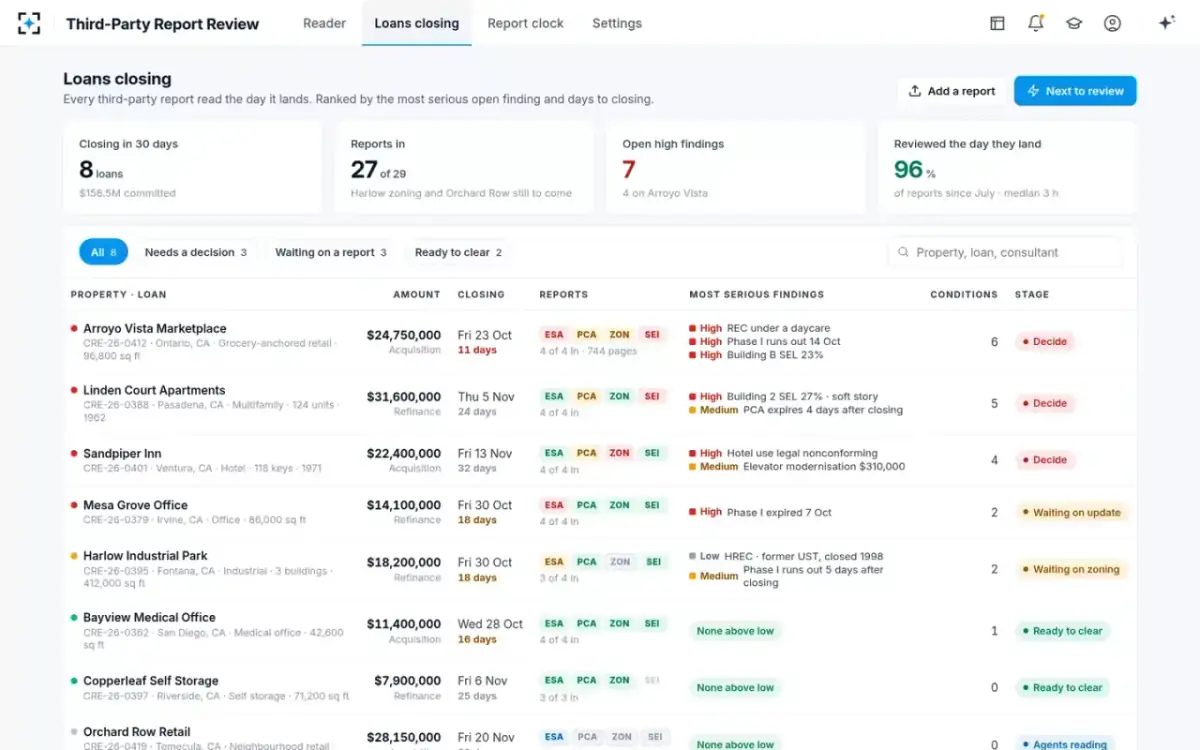
The estimate's shape matters more than its total. By hand, the reading consumes most of the days and the lining-up step, comparing one report with another, gets a day or less. With agents doing the reading, what remains is the part only people can do: deciding what each finding means for this loan. On the fictional sample loan behind these screens, the agents read four reports, 744 pages, in 2 minutes 10 seconds; the credit officer's time went on eleven decisions.
Reading the reports together: where the misses hide
Misses hide between reports, where no single reviewer is looking. Each report is usually reviewed competently on its own; what goes wrong is that a finding in one changes the meaning of a finding in another, or that two reports describe the same building differently and nobody notices.
One sample loan's findings, and what a report-by-report reading misses
| Finding | Reports involved | What reading them separately misses |
|---|---|---|
| A former dry cleaner's suite is now a daycare for 46 children | Phase I, bank environmental policy | The REC is over a sensitive receptor, so the bank's policy requires a Phase II before closing, not after |
| The Phase I runs out on 14 October; closing is 23 October | Phase I, closing schedule | A report that was current when it arrived is stale on the closing date |
| Building B's seismic loss is 23% against a 20% limit, while the aggregate is 13% | Seismic assessment | The summary page passes; the per-building table fails |
| Building B's roof leaks, and its walls are not anchored to that roof | PCA, seismic assessment | One job, not two: the retrofit is cheapest done with the re-roof |
| Parking: 344 spaces in the PCA, 341 on the survey and in the zoning report | PCA, survey, zoning report | The survey governs, and the centre is legally nonconforming on parking either way |
| The seismic report was prepared for another lender | Seismic assessment, reliance letters | The bank had no right to rely on the report setting a $230,000 escrow |
None of these needed expertise the bank lacked. Each needed someone to hold two reports open at once, which is exactly the step that gets a day or less in a closing week. The problem statement behind the solution puts it plainly: the leaking roof in the PCA is the same roof whose missing anchorage drives the seismic loss, and a report past its date can reach the closing table without its condition.
Testing the checklist on closed loans: a 30-day pilot
The fairest test of a due diligence checklist, or of software that runs one, is to apply it to loans the bank has already closed and compare the result with what the bank actually did. The files are real, the outcomes are known, and nothing is at risk. A month is enough for twenty loans.
A 30-day pilot on twenty closed loans
- Choose loans, load policyWeek 1: choose, set policy
- Agents readWeek 2: read
- Compare with filesWeeks 2–3: compare
- Count and decideWeek 4: count, decide
Twenty loans is a judgment, not a statistic: enough to see whether misses cluster in one report type or one reviewer, few enough for two people to compare in a fortnight. The loans should include the bank's usual mix and at least a few multi-building properties, because that is where cross-report misses live. The pilot should use the bank's real policy settings, not defaults, so that a "miss" means a departure from the bank's own rules.
What to count, and what the count means
Count the things a checklist exists to prevent, defined so two people would count them the same way. There is no published benchmark for how often these reach a commercial closing, so the bank's own count is the first one it will have.
Six measures for the pilot
- Reports stale at closing
Phase I fieldwork past 180 days on the closing date; other reports past the bank's age limit.
- Recommendations without a condition
A Phase II, survey or repair the consultant recommended that the commitment letter does not require.
- Repairs without an escrow
Immediate repairs in the PCA missing from the repair schedule or under-escrowed against policy.
- Buildings over a loss limit
Any building above the bank's seismic limit, whatever the aggregate said.
- Reports the bank could not rely on
No reliance letter, or one that names another party or omits successors and assigns.
- Facts that disagree between reports
Building count, area, year built or parking, with no note of which document governs.
Read the result in two directions. The count of misses in the closed files says how much the current process lets through, and it becomes the bank's own baseline. The agents' count says how much of that a tool would have caught, and how many of its flags were noise. A pilot that finds three stale reports and two missing reliance letters across twenty loans has paid for itself in examiner findings avoided, whatever the bank decides about software.
Buying third-party report review software: what to look for
Look for evidence, restraint and fit. Evidence means every statement cites the page it came from. Restraint means the software never changes a consultant's classification or cost opinion and never approves anything. Fit means it reads the reports the bank already orders, against the bank's own policy, rather than imposing a new workflow.
Third-Party Report Review is built on those three. Its agents (an intake and standards checker, environmental, property condition, zoning and seismic reviewers, a cross-report reconciler and a conditions and reserves drafter) each work under written limits: dates cite their pages, the environmental professional's classification is never downgraded, the engineer's cost opinion is never edited, every building is tested and not only the aggregate, and no condition is waived without a written reason and the chief credit officer. Its design target is 100% of findings cited to their report and page.
Every loan closing in 30 days, worst first
Where it does not fit: it does not review appraisals, make flood determinations, perform site work or replace the consultants, and it does not decide. A bank that wants a tool to approve conditions on its own should not buy this one; a bank that wants every finding in front of the right person, with its page, before the commitment letter goes out, should run the pilot. The flood side of the checklist, which stays with the bank's compliance process, is covered in whether flood insurance is required for commercial loans.
Questions people ask
What third-party reports are required for a commercial real estate loan?
An appraisal (by a state-certified appraiser above $500,000) and a flood determination are required by regulation; the rest follow the bank's policy and any agency program. Most banks require a Phase I above a loan-size threshold, a property condition assessment for income property, a zoning report or letter, title and survey, and a seismic assessment in high-hazard areas.
Is there a commercial real estate due diligence checklist PDF regulators publish?
Not as such. The closest are the OCC's examination procedures and internal control questionnaire in its Commercial Real Estate Lending booklet, the FDIC's examination manual section on loans, and the agencies' published scopes, such as Fannie Mae's Form 4099 for property condition assessments.
Who pays for third-party reports on a commercial loan?
Usually the borrower, even when the bank orders them. The OCC expects a bank's environmental provisions for commitment letters to cover the "extent of due diligence required, borrower costs" and approvals, so who pays should be set out before the reports are ordered.
When should third-party reports be reviewed?
Before the bank commits. The OCC expects environmental reports to be evaluated "before the bank finally commits to lend", and agency rules tie report ages to the commitment or origination date, so a review in closing week is already late.
Can the pilot run on loans that are still open?
It can, but closed loans make a better first test because the outcome is known and nothing depends on the result. Once the bank trusts the count, the same settings can read new report sets the day they land.