A Phase 1 ESA is good for one year before the date a property is acquired, but five of its parts (the interviews, the cleanup lien search, the government records review, the site visit and the environmental professional's declaration) must be done or updated within 180 days before that date. In practice a Phase I ESA expires 180 days after the earliest of those five dates, not after the date on its cover, and it can be brought back with an update only while the rest of the work is less than a year old. For a commercial real estate lender, the question is narrower and more urgent: will the report still be good on the closing date? Botminds' Third-Party Report Review reads each Phase I with the property condition, zoning and seismic reports for a loan, takes the five component dates from the report itself, and flags any report that runs out before its closing while there is still time to order the update.
The numbers that decide whether a Phase I still counts
1year
outer limit: all appropriate inquiries must be done within one year before acquisition
180days
the limit for five named components, counted back from acquisition
5
components on the 180-day clock: interviews, lien search, records review, site visit, declaration
2024
the year EPA stopped recognising ASTM E1527-13 for new work, on 13 February
How long is a Phase 1 ESA good for? Two clocks in one rule
The answer sits in one federal regulation, the All Appropriate Inquiries rule. "All appropriate inquiries" under CERCLA, EPA's rule says, "must be conducted within one year prior to the date of acquisition of the subject property" (40 CFR 312.20(a)). Then comes the exception that matters in practice: "the following components of the all appropriate inquiries must be conducted or updated within 180 days of and prior to the date of acquisition".
So a Phase I has two clocks. The one-year clock covers the whole inquiry, including the historical research and the environmental professional's opinion. The 180-day clock covers the five parts most likely to change: who is on the property and what they say, whether a cleanup lien has been recorded, what the agencies' databases show, what the site looks like, and the professional's statement that they are qualified. Both clocks count backwards from acquisition. A report is never "good for 180 days" in the abstract; it is good for an acquisition that happens inside both windows.
The trade calls this a report's viability, and ASTM E1527-21, the industry standard EPA recognises as one way to meet the rule, is written around the same two windows. The point for a lender is that the cover date, the issue date and the date the bank received the report are all irrelevant. The date that matters is the earliest of the five component dates, which is usually printed somewhere in the report's first twenty pages and rarely on the cover.
Which parts of a Phase I expire first
The parts that expire first are the ones the rule names, and they are all fieldwork or database pulls. The historical review, the professional's analysis and the purchaser's own inquiries sit on the longer clock. The table below lays the rule out by section, so a reviewer can see what an update would have to repeat.
What each part of a Phase I is, and which clock it is on
| Component | Section of 40 CFR 312 | Clock | What goes stale |
|---|---|---|---|
| Interviews with past and present owners, operators and occupants | 312.23 | 180 days | A new tenant, a new operator, a manager who now remembers the old tank |
| Searches for recorded environmental cleanup liens | 312.25 | 180 days | A lien recorded since the last search |
| Reviews of federal, tribal, state and local government records | 312.26 | 180 days | A new spill report, an enforcement action, a changed site status nearby |
| Visual inspections of the property and adjoining properties | 312.27 | 180 days | Drums, stains, a new use next door |
| Declaration by the environmental professional | 312.21(d) | 180 days | The professional's statement that they meet the definition |
| Reviews of historical sources | 312.24 | One year | Rarely changes; aerial photos and maps do not move |
| Specialized knowledge, purchase price against value, commonly known information | 312.28 to 312.30 | One year | The purchaser's own inquiries, supplied to the professional |
The fifth component surprises people. The professional's declaration is not a formality that survives the report; it is on the 180-day clock like the fieldwork. An update that refreshes the interviews, the lien search, the records review and the site visit but carries over an old declaration has not updated all five, and a reviewer should check that the update carries a new one.
Is the 180 days counted from the report date? No, from the earliest component
The 180 days runs from the earliest of the five component dates, because every one of them must sit inside the window. If the records review was done on 17 April and the report was signed on 28 April, the report stops meeting the 180-day test 180 days after 17 April, eleven days earlier than a reader counting from the signature would expect.
Take a fictional sample loan from Third-Party Report Review: Arroyo Vista Marketplace, a grocery-anchored shopping centre in Ontario, California, financed with a $24,750,000 acquisition loan closing on Friday 23 October 2026. Its Phase I lists five component dates: the government records review on 17 April, the lien and land-use search on 20 April, the interviews on 21 April, the site visit on 22 April and the declaration on 28 April. Counting 180 days from 17 April gives Wednesday 14 October, nine days before the closing.
One sample Phase I against its closing: the earliest component sets the date
- 180 days17 Apr → 14 Oct
- 9-day gap
- 180 days28 Apr → 25 Oct
- to closing189 days
The trap in the second lane is common, because the declaration date sits next to the signature and reads like the report date. On a calendar it is the difference between a closing that holds and one that slips while the consultant goes back to the site. Here the gap was found on the day the report arrived, with three weeks to spare.
When is a Phase 1 ESA update enough, and when do you need a new report?
An update is enough while the whole inquiry is less than a year old: the professional refreshes the five 180-day components and the report stands. Past one year, the rule treats the old work as previous information that a new inquiry may use, but not as the inquiry itself.
The rule says so in two places. Earlier inquiries may be used if the information "was collected or updated within one year prior to the date of acquisition", if the five components were done or updated within 180 days, and if the old information is "updated to include relevant changes in the conditions of the property" (312.20(c)). Reports prepared for someone else can be used too, provided the person relying on them "reviews the information and conducts the additional inquiries" the rule requires of a purchaser (312.20(d)).
An update or a new Phase I: what the rule allows
An update is enough: Less than one year before the acquisition date.
A new inquiry is needed: More than one year before acquisition: the old report is background, not the inquiry.
An update is enough: Interviews, lien search, records review, site visit and a new declaration.
A new inquiry is needed: All of it, though earlier work may inform the new report.
An update is enough: The update must pick up relevant changes since the first visit.
A new inquiry is needed: Same, with a full historical review.
An update is enough: Usable if the new user reviews it and makes its own additional inquiries.
A new inquiry is needed: Same, and the professional must still meet 312.10.
There is no fixed price for an update in any regulator's text. On the sample loan the consultant's quote was $2,400 for the refreshed components against a full report of 412 pages, which is why a reviewer who catches the date early saves money as well as time. Who may rely on the updated report is a separate question, set by the reliance letter rather than by EPA, and is taken up in who can rely on a Phase 1 ESA.
Whose clock is it? The borrower's defence, the bank's collateral
The 180-day clock protects the purchaser, not the bank directly. EPA's own fact sheet for lenders is plain about it: the AAI rule "primarily applies to borrowers who want to claim protection from CERCLA liability", and the secured lender exemption "is not conditioned by a bank or lender undertaking AAI before issuing a mortgage or before the borrower purchases the property" (EPA, Lender Liability and Applicability of AAI, 2023).
Banks may choose to further protect themselves from loss (due to decreases in the value of the property or collateral) by requiring that borrowers qualify for liability protections.
EPA, Lender Liability and Applicability of All Appropriate Inquiries (EPA-560-F-23-006)
That is the lender's reason to police the date. A borrower who closes with a stale Phase I may lose the bona fide prospective purchaser protection, and a borrower facing a cleanup bill is a borrower who may not repay. The OCC makes the same point from the collateral side: the exemptions "do not protect the lender from the decline in value that contamination can cause" (OCC, Commercial Real Estate Lending, p. 66). A stale Phase I does not create liability for the bank; it removes a layer of protection from the asset the bank is lending against.
What lenders and agencies count from: origination, closing or loan number
Lenders and the agencies count from their own transaction date, which is usually the funding of the loan, and some set the clock shorter or longer than EPA's. Before reading a Phase I, a reviewer needs to know which date the investor or program uses.
Phase I age rules a commercial lender meets in practice
| Who | What the rule says | Counted from |
|---|---|---|
| EPA (all appropriate inquiries) | Whole inquiry within one year; five components within 180 days | Date of acquisition |
| Fannie Mae multifamily (Form 4251) | The five components "within 180 days prior to the Mortgage Loan Origination Date"; any other components within one year | Mortgage loan origination date |
| SBA 7(a) and 504 (SOP 50 10 8.1) | Environmental investigation reports "dated within one year of the date of issuance of the SBA loan number" | SBA loan number issuance |
| A bank's own environmental policy | Often 180 days from the earliest component, sometimes shorter for higher-risk uses | Usually the closing date |
The SBA rule shows why a single number is not enough. A Phase I dated eleven months before the SBA loan number meets the SBA's age test, yet a purchaser closing a month later would be outside EPA's 180 days for every fieldwork component. The bank needs both answers, because the SBA test decides the guaranty and the EPA test decides the borrower's defence. The other reports in a closing set run on different clocks again: a Fannie Mae seismic assessment must be dated within 12 months of the commitment, and the property condition assessment by the lender's policy.
Where Phase I dates slip in a closing pipeline
Dates slip between ordering and closing. A Phase I is commissioned early, often before the purchase contract's diligence period ends, and the loan closes months later after an appraisal, a rate lock and a negotiation. Every week of delay on the transaction is a week off the report's life, and nobody owns the arithmetic unless someone puts every report and every closing on one calendar.
Third-Party Report Review's report clock: every report in the pipeline against its loan's closing date
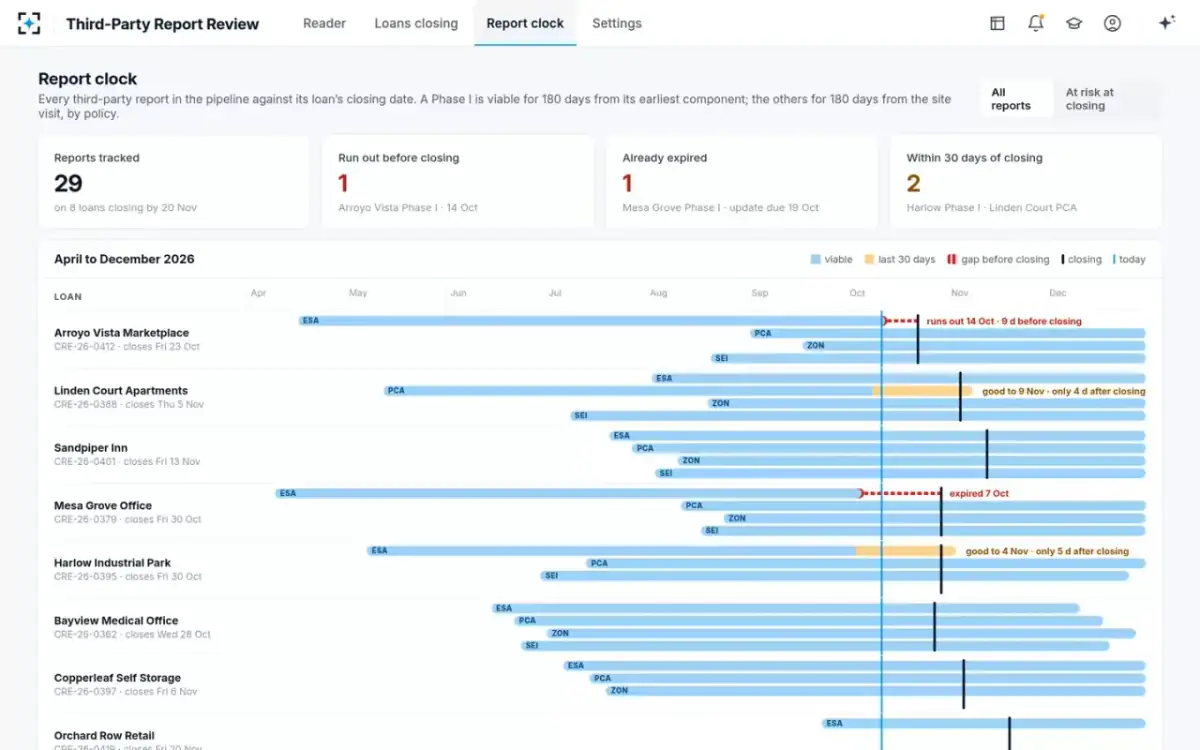
On the sample pipeline, two of eight loans had a Phase I problem: one report expired before anyone ordered its update, and another would run out nine days before its closing. Two more were inside 30 days of closing with only a few days to spare. None of this is a reading problem; it is a calendar problem that hides in page 12 of a 412-page report.
Checking Phase I viability in Third-Party Report Review
In the solution, an intake and standards checker reads every report the day it arrives: which standard it follows, who signed it, its five component dates, and who it names as able to rely on it. It computes the 180-day date from the earliest component, never beyond one year, and compares it with the loan's closing date. When a report would run out first, it drafts the update as a condition precedent with the consultant's price and the page it came from.
The Phase I opens at the page that dates it
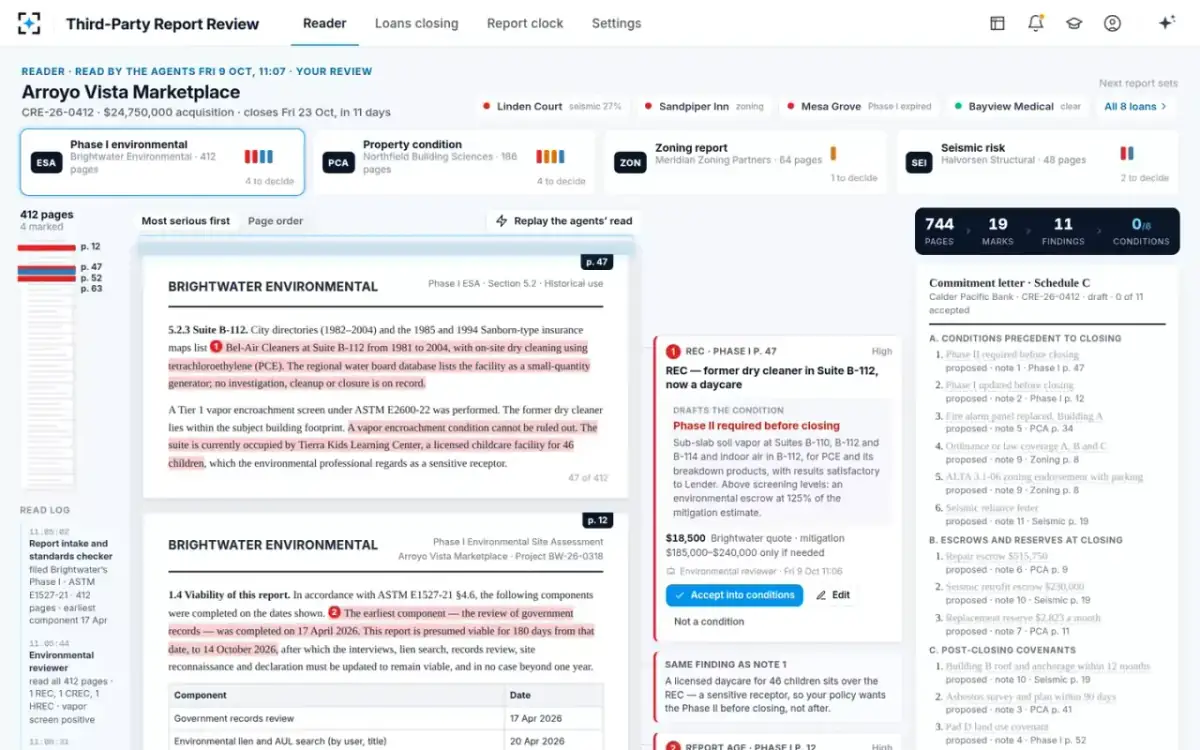
The credit officer still decides. The checker drafts; it does not order the update, and the condition only reaches the commitment letter when a person accepts it. The run that read the sample loan's four reports, 744 pages in all, finished in 2 minutes 10 seconds on the sample data, which matters less than when it ran: the day the report landed, not the week of closing. For the full list of what a reviewer checks on a Phase I beyond its dates, see the Phase 1 environmental site assessment checklist.
Questions people ask
Does a Phase 1 ESA expire after 180 days?
Five of its components do: the interviews, the lien search, the government records review, the site visit and the environmental professional's declaration must each be within 180 days before acquisition under 40 CFR 312.20(b). The rest of the inquiry lasts up to one year. Updating the five components restores the report, as long as the whole inquiry is still inside the one-year window.
Is a Phase 1 ESA good for a refinance?
The AAI clocks are tied to an acquisition, because they decide the purchaser's CERCLA defences, so a refinance does not start one. Lenders set their own age limits for refinances in their environmental policy, and the OCC expects that policy to use "risk thresholds based on property type, use, and loan amount" to decide what due diligence is needed. Agencies set theirs too: SBA counts one year back from the SBA loan number.
Can a lender use a Phase I ordered by the seller or another bank?
The rule allows it: reports "prepared by or for other persons" may be used if the new user reviews them and makes its own additional inquiries (40 CFR 312.20(d)). Whether the bank can rely on that report, and sue its author if it is wrong, depends on a reliance letter. Fannie Mae requires the Phase I to be addressed to the lender and Fannie Mae and their successors and assigns.
What is the one-year rule for a Phase I?
All appropriate inquiries "must be conducted within one year prior to the date of acquisition" (40 CFR 312.20(a)). Past one year, an update of the five components is no longer enough; the old report becomes previous information that a new inquiry may draw on.
When did the AAI rule take effect?
EPA published the All Appropriate Inquiries rule on 1 November 2005 and it took effect on 1 November 2006. The current version recognises ASTM E1527-21; reports on the older E1527-13 were recognised only until 13 February 2024 (40 CFR 312.11).