Flood insurance is required for commercial loans in the same way as for home loans: a federally regulated lender may not make, increase, extend or renew any loan secured by a building in a special flood hazard area of a community in the National Flood Insurance Program unless the building, and any personal property securing the loan, is insured against flood for the term of the loan. The rule is the same for an office, a warehouse or a shopping centre, and the amount is set building by building: the lesser of the loan balance and the maximum available under the program, which for a non-residential building is $500,000. What makes commercial files hard is that they have many buildings, contents taken as collateral, construction phases and several reports that each describe the property a little differently. Botminds' Third-Party Report Review does not make flood determinations; it reads the Phase I, property condition, zoning and seismic reports for a loan together and reconciles the building count and the flood zone each of them reports, so the determination, the notice and the policy all cover the same buildings before closing.
The flood numbers on a commercial loan
$500K
maximum program building cover for each non-residential building, and the same for contents
10days
before closing: what regulators generally regard as reasonable notice to the borrower
45days
after notice of a lapse before the lender must force-place cover
30days
the program's waiting period, which shapes construction loans
Is flood insurance required for commercial loans? The rule in one sentence
Yes, wherever a building securing the loan is in a mapped special flood hazard area and the community participates in the program. The FDIC's version of the rule reads: an institution "shall not make, increase, extend, or renew any designated loan unless the building or mobile home and any personal property securing the loan is covered by flood insurance for the term of the loan" (12 CFR 339.3(a)). A designated loan is simply "a loan secured by a building or mobile home that is located or to be located in a special flood hazard area in which flood insurance is available".
Nothing in that definition asks whether the loan is commercial. The regulators' own list of non-residential buildings includes those "designed for use as office or retail space, wholesale space, hospitality space", mixed-use buildings mostly given to business, and "houses of worship, schools, agricultural structures, garages, pool houses, clubhouses, and recreational buildings" (Interagency Q&A, Amount 4). The OCC lists flood insurance among the compliance risks of commercial real estate lending, next to fair lending and building and zoning requirements (OCC, Commercial Real Estate Lending, p. 14).
Which loans and which buildings: designated loans and the flood zone
The requirement follows the building, not the land or the borrower. A loan secured only by land in a flood zone is not a designated loan, because nothing on it can be insured; a loan secured by a building that is going to be built there is one from the start. The regulation defines a building as "a walled and roofed structure, other than a gas or liquid storage tank, that is principally above ground and affixed to a permanent site", including one "in the course of construction, alteration, or repair" (12 CFR 339.2).
Participation matters too. In a community outside the program, the purchase requirement does not apply, but the lender must still make the determination and, if the building is in a flood zone, still notify the borrower; and a federally guaranteed loan, such as an SBA loan, cannot be made on such a building at all (Interagency Q&A, Applicability 1). The regulators add that a lender must still avoid lending on an uninsurable building in a flood zone "if doing so would pose an unacceptable risk to the lender".
How much flood insurance is required on a commercial building?
The required amount is the lesser of the outstanding principal balance and the maximum the program offers, where the maximum is itself the lesser of the limit for that type of building and the building's insurable value. For a non-residential building the program limit is $500,000 of building cover, with up to $500,000 more for contents if they secure the loan.
Working out the required amount, three ways
| Case | Inputs | Required flood cover |
|---|---|---|
| One equipment shed in a flood zone | Loan $300,000; program limit $500,000; insurable value $30,000 | $30,000: the building's insurable value |
| Five non-residential buildings, three in a flood zone | Loan $150,000; limit $1.5 million for three; insurable value $300,000 for three | $150,000, the loan balance, allocated across the three in any reasonable split |
| A warehouse and its inventory both securing the loan | Loan $200,000; warehouse insurable value $150,000; inventory $100,000 | $200,000 in total, for example $150,000 on the building and $50,000 on contents |
| Illustration: a four-building shopping centre, $24.75 million loan, all four buildings in a flood zone | Program limit $500,000 each, insurable values above that | At least $2,000,000 of building cover, $500,000 on each building |
The fourth row shows why commercial loans are different in practice. On a large loan the balance is never the binding limit; the program cap is, building by building, so the count of buildings in the flood zone decides the minimum cover directly. A lender can require more than the federal minimum, and on a $24.75 million loan most will, through private or excess cover. But the federal floor depends on getting the count right, and every building in the zone "must be covered in accordance with the statutory requirement" (Amount 6).
Contents, detached buildings and other commercial surprises
Three rules catch commercial lenders who learned flood on home loans. Each comes from the regulators' own answers rather than the regulation's headline text.
Where commercial loans differ from home loans on flood
Home loans: A detached structure that is part of a residential property and is not a residence is exempt.
Commercial loans: No exemption: the regulators say they "cannot create an exemption for detached structures that are part of a commercial property".
Home loans: Rarely taken as collateral.
Commercial loans: Often taken (inventory, equipment); if they secure the loan and sit in a flood-zone building, they must be insured too.
Home loans: Required for most loans made, increased, extended or renewed since 2016.
Commercial loans: Not required: loans "primarily for business, commercial or agricultural purposes" are excepted, even on residential property.
Home loans: $250,000 per one-to-four family dwelling.
Commercial loans: $500,000 per non-residential building under the General Property Form, and $500,000 for contents.
The contents rule is the easiest to trip on, because it turns on the loan agreement's wording. If the lender takes a security interest in contents located in a flood-zone building, cover is required on them, "even if the lender takes a security interest in the contents out of an abundance of caution", in the regulators' words. A security agreement drafted to cover "all assets" can create a flood requirement nobody priced.
When must flood insurance be in place on a construction loan?
Either at origination, or before any money is disbursed for building construction. The regulators allow a lender to defer the purchase until the slab is poured or an elevation certificate is issued, but "the lender must require the borrower to have flood insurance for the security property in place before the lender disburses funds to pay for building construction", except for money spent on the slab, site work or materials (Interagency Q&A, Construction 4).
The program's 30-day waiting period makes the deferral a planning task. A lender that defers "should have adequate internal controls in place at origination to ensure that the borrower obtains flood insurance no later than 30 days prior to disbursement of funds", and if the borrower applies only after closing, the waiting period applies (Construction 5). A first building draw requested in week four of a construction loan is the moment a missing flood policy turns into a stopped project.
The determination and the notice: what happens before closing
The lender determines the flood zone on FEMA's standard form, tells the borrower in writing if the building is in a flood zone, and confirms cover before closing. Two of these duties apply to every loan secured by a building, wherever it is: the determination form and its fees rules (12 CFR 339.1).
Flood steps on a commercial loan, from application to after closing
A person decides
DetermineComplete FEMA's Standard Flood Hazard Determination Form for each building, and keep it "for the period of time the FDIC-supervised institution owns the loan".
A person decides
NotifyIf any building is in a flood zone, send the notice of special flood hazards within a reasonable time before closing; the regulators generally regard 10 calendar days as reasonable.
A person decides
InsureConfirm building and contents cover, per building, for at least the required amount, from the program or an acceptable private policy.
A person decides
MonitorIf cover lapses or falls short during the loan, notify the borrower; if it is not bought within 45 days, force-place it.
Private flood insurance is a real option on commercial loans. The rule requires lenders to "accept private flood insurance" that meets the regulatory definition, and lets a lender rely without further review on a policy that states "This policy meets the definition of private flood insurance contained in 42 U.S.C. 4012a(b)(7) and the corresponding regulation" (12 CFR 339.3(c)). A policy without that statement can still be accepted at the lender's discretion if it meets the conditions in the same section.
After closing: force placement and penalties
The duty does not end at closing. If at any time the lender finds a building in a flood zone uninsured or under-insured, it must notify the borrower, and "if the borrower fails to obtain flood insurance within 45 days after notification", buy it on the borrower's behalf and may charge the borrower for it (12 CFR 339.7).
The penalties are what make flood a board-level compliance item. A pattern or practice of violations of the purchase, escrow, force-placement or notice rules "shall be assessed a civil penalty", with a statutory limit of $2,000 per violation adjusted for inflation, and "there is no ceiling on the total penalty amount" (Interagency Q&A, Penalty 1). On a commercial loan with four buildings, each building is its own opportunity to get it wrong.
Where flood fits in a third-party report review
Flood sits next to the third-party reports rather than inside them, but the reports carry facts the flood process depends on. Fannie Mae's property condition instructions require the consultant to "review FEMA flood map and provide the flood zone or zones in which all portions of the Property are located" and to identify "the map number and date of publishing" (Form 4099 §4.5.A). The survey shows the buildings; the zoning report describes them; the rent roll leases them. A determination that covers three buildings when the survey shows four is the kind of error that only shows up when the documents are read together.
Flood checks a third-party report reviewer can add before closing
- Same buildings everywhere
The building count on the survey, the PCA, the zoning report and the flood determinations agree.
- Same flood zone
The PCA's stated zone and map panel match the standard determination form for each building.
- Contents in the collateral
If the security agreement takes contents, the policy covers contents in each flood-zone building.
- Notice dated in time
The notice of special flood hazards went out a reasonable time, generally 10 days, before closing.
- Construction timing
On a construction loan, cover is bound at least 30 days before the first building disbursement.
Third-Party Report Review handles the first check as part of its normal work: the cross-report reconciler compares area, year built, parking and the number of buildings across the reports, the ALTA survey and the rent roll, flags every disagreement with both sources, and names the document that governs by policy. It does not read or issue the flood determination, send the borrower's notice or choose the policy; those stay with the bank's flood compliance process. What it can do is make sure the facts that process relies on agree, and that a disagreement reaches the credit officer before the closing rather than the examiner after it. The same reconciliation feeds the commercial real estate due diligence checklist.
Four buildings, one site plan: the count every other document must match
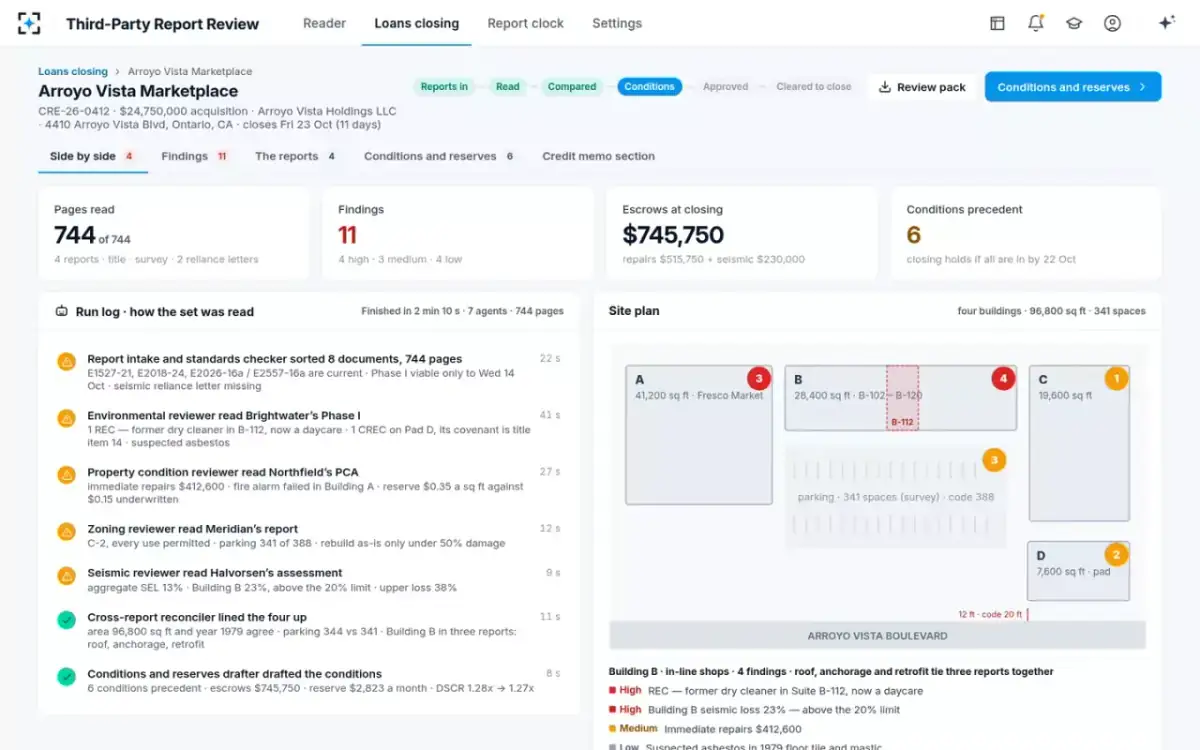
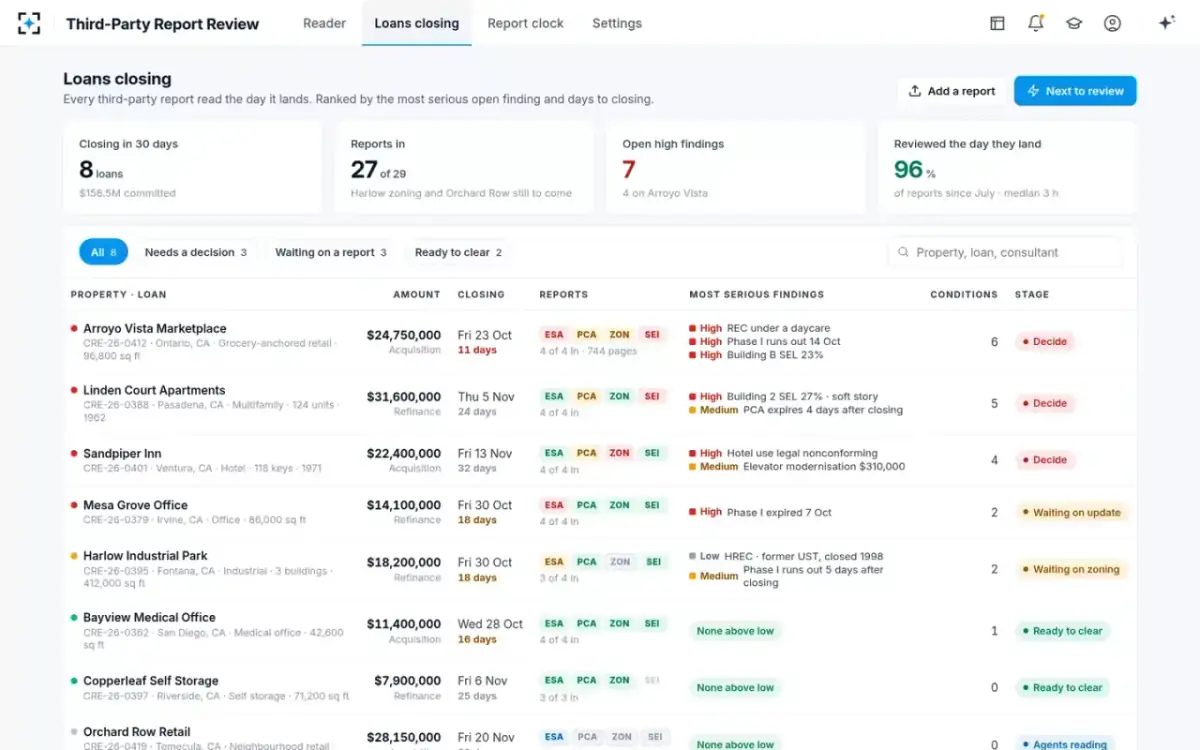
The parking disagreement on the sample loan is small, three spaces, but it shows the method: two documents, both values shown with their pages, and the governing document named. Applied to buildings and flood zones, the same method stops the more expensive mismatch. On a pipeline, the same discipline appears as one list of every loan closing in the next 30 days, each with its reports and its most serious open finding.
Every loan closing in 30 days, with each report's status
Questions people ask
Does flood insurance apply to commercial property?
Yes. The mandatory purchase rule applies to any loan from a regulated lender secured by a building in a special flood hazard area of a participating community, whatever the building's use. Offices, retail, warehouses, hotels, churches and schools are all non-residential buildings under the program, with up to $500,000 of building cover each.
What is a special flood hazard area?
It is an area that FEMA has determined to have special flood hazards, shown on its flood maps; the flood rules apply to loans on buildings "located or to be located" there (12 CFR 339.1). Lenders identify it for each building on FEMA's Standard Flood Hazard Determination Form, which the rule requires for every loan secured by a building.
Is a flood zone determination required for every commercial loan?
For every loan secured by a building, yes, wherever the building is: the requirement to use the standard determination form applies "regardless of location" (12 CFR 339.1). Insurance is required only if the determination puts a building in a special flood hazard area where flood insurance is available.
Can a lender accept private flood insurance on a commercial building?
Yes. Lenders must accept a private policy that meets the regulatory definition, may rely on the policy's compliance statement, and may accept other private policies at their discretion if they meet the conditions in 12 CFR 339.3(c).
Does a loan secured only by land need flood insurance?
No. A loan secured only by land in a flood zone is not a designated loan, because there is no building to insure. Once the loan is secured by a building to be constructed there, it is a designated loan, and cover must be in place before building construction funds are disbursed.