A property condition assessment checklist for a commercial real estate lender follows the report's own structure: the consultant's qualifications and limits, the immediate repairs (life safety, critical and deferred maintenance), the schedule of capital replacements over the loan term, the building systems behind both, and the code, zoning and hazard findings that sit at the back. Each of those sections ends up somewhere in the loan, as a condition, an escrow, a replacement reserve or a covenant, so a checklist that stops at "report received" misses the point. The hard part is that a PCA runs to 150 or 200 pages, arrives with three other reports in the last weeks before closing, and its numbers move the underwriting. Botminds' Third-Party Report Review reads the PCA with the Phase I, zoning and seismic reports, ties every cost table back to the page, and drafts the escrows and reserve for the credit officer to approve.
The published scope a PCA is checked against
3
phases: preliminary due diligence, a site visit, then the report
7
sections in the report, from executive summary to limitations
+2years
the capital table runs through the loan term plus two years beyond maturity
3%
a year: the inflation factor added to every future replacement cost
What is a property condition assessment? A capital plan the lender can enforce
A property condition assessment is a consultant's opinion of a building's physical condition at one point in time and of the capital it will need over a set period. Fannie Mae's instructions describe it as "a capital planning and risk assessment tool" and list what it provides: the current condition, the effective age and remaining useful life of each system, an evaluation of maintenance practices, and "all significant (i) capital replacement costs, (ii) deferred maintenance, and (iii) on-going maintenance costs" over "the term of the proposed mortgage loan ... plus two years beyond the maturity date" (Form 4099 §1.1).
For a lender, the second half of that sentence matters most. The appraisal values the building as it stands; the PCA says what keeping it standing will cost. Its two cost tables become two different things in the loan: the immediate repairs become a repair escrow or a condition, and the capital replacements become the monthly replacement reserve that underwriting takes out of net cash flow. A reviewer who reads the PCA only for its headline rating has read the part that moves the loan least.
What should a property condition assessment checklist include? The seven sections
It should include each of the report's seven sections, with the question a lender asks of each. Fannie Mae prescribes the order, and most commercial PCAs follow something close to it because the ASTM baseline process does.
The seven sections of a PCA, and what a lender checks in each
| Section | What it contains | What the lender checks |
|---|---|---|
| 1. Executive summary | Findings, the summary cost table, known problematic materials, the consultant team | Who ordered it, which standard and version, the site visit date, limitations, reliance language |
| 2. Cost estimate schedules | Immediate repairs (life safety, critical, deferred maintenance) and replacement of capital items | Totals tie to the line items; every estimate names its cost source; nothing removed for the borrower's planned work |
| 3. Property characteristics | Site, structure and envelope, mechanical, electrical and plumbing, interiors | Each system rated 1 (best) to 5 (worst), with effective age and remaining useful life |
| 4. Moisture, microbial growth and pests | Observed conditions and remediation | Any remediation is in the immediate repairs, not a footnote |
| 5. Special hazards, zoning, codes, compliance | Peak ground acceleration, natural hazards, flood zone, zoning, open code violations, accessibility | Seismic and flood answers match the other reports; open violations are costed |
| 6. Areas of additional assessment | Problematic materials; three years of capital history; planned work | Work in progress and the owner's capital plan, assessed rather than copied |
| 7. References, methodology, limitations | Sources, method, what could not be seen | Inaccessible roofs or units, and whether the reserve was made more conservative for them |
Two checks in that table catch most problems. The first is the limitations section, read before the numbers: a PCA whose consultant could not reach the flat roofs, or saw five of the required units instead of ten, has priced what it could see. Fannie Mae's guidance is that a lack of roof access "should result in a more conservative Replacement Reserve estimate" (Fannie Mae PCA FAQ). The second is the tie-out: the summary table in section 1 must equal the line items in section 2, and both must agree with the escrow and reserve the underwriter carries.
Who may prepare a PCA: qualifications and independence
The consultant must be independent of the property and qualified by education and experience, and the report must be certified by an engineer, an architect or someone with equivalent standing. Fannie Mae's test is specific: a bachelor's degree in engineering, architecture, construction management or a related field; five years of professional experience; at least five multifamily PCA inspections in the last three years; and knowledge of ASTM E2018. The firm and its subcontractors must be "independent third-parties, unrelated to, and not have any financial or economic interest in, the Property" (Form 4099 §1.3).
The reliance point is easy to miss. By accepting the engagement, the consultant "agrees and acknowledges that Fannie Mae is an intended third-party beneficiary" of the report, and the lender, its successors and assigns must be named as additional insureds on the consultant's general liability insurance. A commercial bank outside the agency programs gets those protections only if its engagement letter or a reliance letter provides them, which is why the reliance check for every report sits on the same list as the Phase I's, covered in who can rely on a third-party report.
What are critical repairs? The three kinds of immediate repair
Critical repairs are items that need attention now to prevent further substantial deterioration, meet an immediate need, or extend the life of a system the property cannot run without. They sit between life safety items, which can hurt someone, and deferred maintenance, which erodes value more slowly. Each category has its own deadline and its own place in the loan.
Immediate repairs: what each category is, and what it becomes in the loan
What the PCA says: Items that, left as they are, could cause "injury, illness, or death"; the consultant's opinion governs unless the law already calls it a violation.
What the loan does with it: Fannie Mae: completed within 60 days of origination on an acquisition, otherwise before delivery. Many banks require it before closing.
What the PCA says: Extreme deficiencies that will cause damage or continued deterioration; also ingress, egress, and repairs needed for ADA, Fair Housing or code compliance.
What the loan does with it: Completed within 6 months of origination, or sooner if the consultant says so.
What the PCA says: Items at or past their useful life that need repair to keep the property "sound and marketable".
What the loan does with it: Completed within 12 months of origination, or sooner if recommended.
What the PCA says: Items expected to reach the end of their life during the loan term plus two years, inflated at 3% a year.
What the loan does with it: The replacement reserve schedule and the monthly deposit.
Two rules in the agency text prevent common shortcuts. Planned work does not remove an immediate repair: "Regardless of the Borrower's planned CAPEX, all Immediate Repairs ... must be included" in the PCA's cost schedule and on the lender's required repair schedule (Fannie Mae PCA FAQ). And Fannie Mae declines to define life safety at all. Its FAQ points to the Mortgage Bankers Association's description, a "visually obvious construction or design defect or deferred maintenance condition that creates a potential hazard", and adds that life safety issues "are, by their nature, not 'minor', and require immediate action".
How the cost tables are built, and how to test them
The cost tables are the consultant's opinion of probable cost, and a lender tests them for completeness and arithmetic, not for price. Fannie Mae's instructions require that "all cost estimates provided as part of the PCA must reference the source", that a published cost handbook be no more than two years old with costs inflated 3% a year for each year out of date, and that hidden costs such as abatement or scaffolding be included or explicitly excluded (Form 4099 §4.2.A).
One sample PCA's immediate repairs: the paving and the roof outweigh the alarm, but the alarm comes first
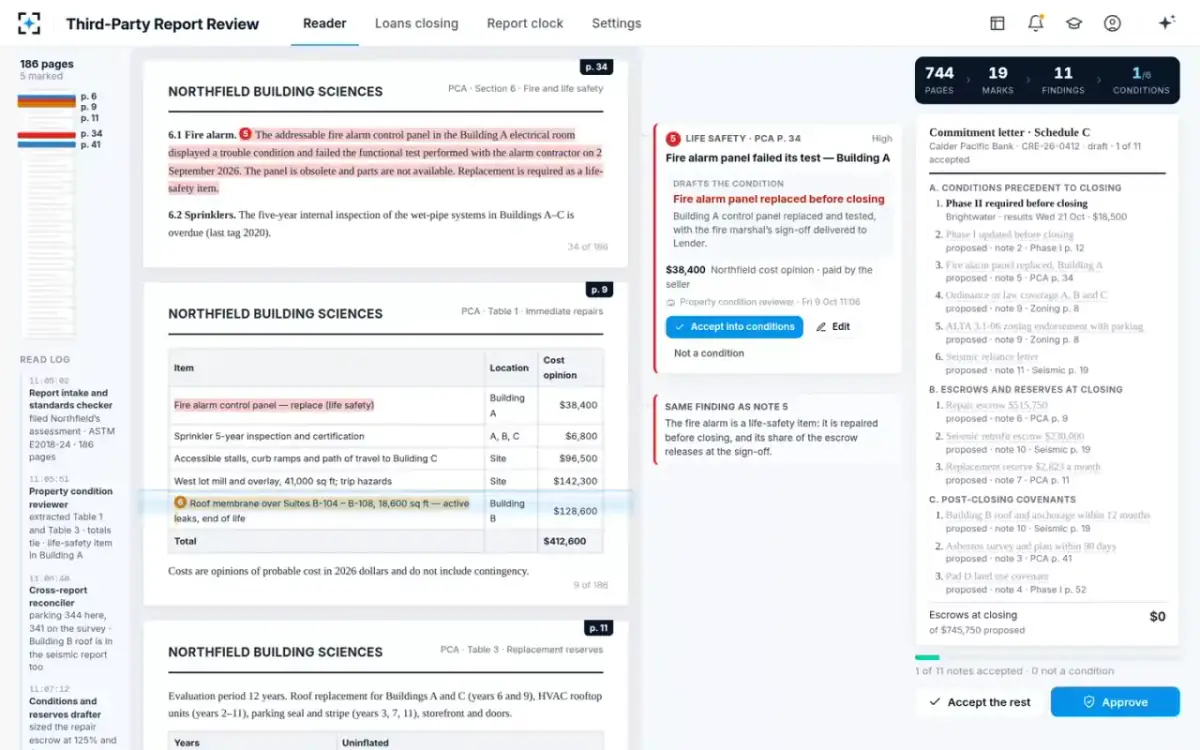
Ranking by dollars and ranking by urgency give opposite orders, which is why the categories matter. The $38,400 fire alarm panel is the smallest line but the only one the sample bank requires fixed before closing, with the fire marshal's sign-off. The $142,300 paving job can wait months without anyone being hurt. A reviewer reading the total alone would escrow it all at the same priority; a reviewer reading the categories writes one condition precedent and one escrow.
Third-Party Report Review reading a PCA: the life safety item and Table 1, marked on the page
Replacement reserves: reading the capital table
The capital table is a schedule of every system expected to need replacing during the evaluation period, with today's cost and the inflated cost in the year it falls due. The lender turns it into a monthly reserve deposit, and the deposit comes straight out of the cash flow the loan was sized on.
Fannie Mae does not publish a reserve range by property rating, except for small loans: "if a Property is older and has not had any significant renovation or replaced major Property components, higher on-going Replacement Reserves are warranted" (Fannie Mae PCA FAQ). The arithmetic, though, is simple to check. On the sample loan, the PCA's 12-year table averages $33,880 a year across 96,800 square feet, or $0.35 a square foot; underwriting had carried $0.15. The difference, $19,360 a year, lowers net cash flow and moves the debt service coverage ratio from 1.28x to 1.27x, still above the sample bank's 1.25x minimum.
Five checks on a PCA's capital table before it reaches the reserve
- The evaluation period
Loan term plus two years; a table that stops at maturity understates the last years.
- Inflation applied
3% a year from the report date to each replacement year, on Fannie Mae's method.
- Remaining useful life explained
Any system whose life ends inside the period is either scheduled or excluded with a reason.
- No double counting
Items in the immediate repairs are not also in the capital table, unless recurring work is needed later.
- Per-unit or per-foot sanity check
The annual average against the underwritten reserve and the bank's policy floor.
Reuse has limits too. For a supplemental loan, Fannie Mae waives a new PCA only if there has been no adverse change, the existing report "is less than 3 years old", all its immediate repairs are done, and the latest inspection rated the property 1 or 2 (Guide §1302.05A). Outside that program, the age of a PCA at closing is a matter of bank policy; the sample bank uses 180 days from the site visit.
Property condition report vs inspection: what a PCA does not do
A PCA is a visual, non-invasive survey, not a building inspection with testing. The field observer walks the property, looks at what is accessible, interviews the people who maintain it and reads its records; "the Field Observer is not required to perform diagnostic testing as part of the PCA unless otherwise specifically stated" (Form 4099 §3.2.A).
That limit shapes how a lender reads the conclusions. A PCA can say a roof membrane is at the end of its life and leaking over five suites; it cannot say whether the deck beneath is sound without opening it. It can say a fire alarm panel failed its functional test, because the alarm contractor ran one. Where the consultant recommends further work (a roof survey, a structural review, a sewer camera), the recommendation belongs on the condition list in the same way as a Phase I's recommendation for a Phase II.
Reading the PCA with the other reports
A PCA shares buildings with every other report in the set, so its findings often explain or contradict theirs. Fannie Mae builds part of the link into the scope: section 5 asks for the site's peak ground acceleration, a structural risk questionnaire where it is 0.15g or more, the FEMA flood zone, the zoning code and any open code violations.
The sample loan shows why reading them together pays. The PCA's leaking roof over Building B is the same roof whose missing wall anchorage drives that building's seismic loss to 23%, above the 20% limit, and the retrofit is cheapest done with the re-roof, so two reports' findings become one job. The PCA counted 344 parking spaces where the survey and the zoning report counted 341; the survey governs by policy, and the zoning report shows the centre is legally nonconforming on parking either way. The seismic side of that story, and the number that ends a Fannie Mae loan, is in Fannie Mae seismic requirements.
Where Third-Party Report Review fits in PCA review, and where it does not
It fits the reading, the tie-outs and the drafting. The property condition reviewer extracts the immediate repairs, the life safety items and the capital table, checks that every total ties to its line items, and compares the reserve per square foot with what underwriting carried. The cross-report reconciler compares area, year built, parking and building counts with the survey, the rent roll and the other reports, and links findings on the same building. The drafter turns them into conditions, a repair escrow and a reserve, each citing its page.
The PCA's findings, written into the credit memo with their pages
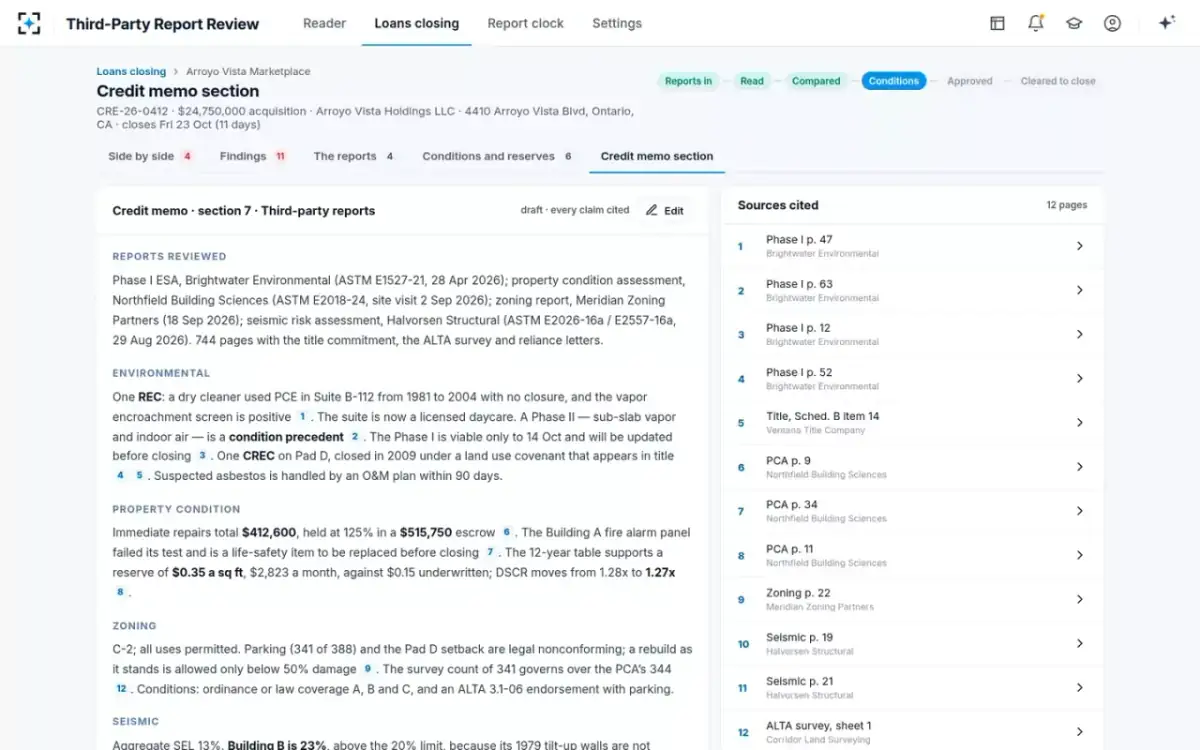
Where it does not fit: it does not inspect the property, re-estimate the consultant's costs or overrule the engineer's categories. If a reviewer thinks the paving belongs in the capital table rather than the immediate repairs, that is a conversation with the consultant, and the agent's note shows both the PCA's category and the reviewer's question. The estimates of time saved that come with the solution are Botminds' own: about two days to pull a PCA's repair and reserve tables by hand, against a fraction of a day with the agents doing the extraction.
Questions people ask
What is ASTM E2018?
ASTM E2018 is the standard guide for a baseline property condition assessment of commercial real estate. Fannie Mae's Form 4099 requires its multifamily PCA to include "an expanded evaluation" of the E2018 baseline process and expects consultants to know it.
What are Fannie Mae's PCA requirements?
A PCA prepared to Form 4099 by an independent, qualified consultant, with immediate repairs and capital replacements costed over the loan term plus two years. Critical repairs must be finished within 6 months of origination and deferred maintenance within 12, and the repair escrow "should be at least 125%" of the estimated cost (Guide §405).
How many units does a PCA inspect?
On a multifamily property, Fannie Mae requires at least 5 occupied units where there are 5 to 50, at least 10% of units where there are 51 to 300, and at least 5% (not fewer than 30) above 300, plus every unit vacant more than 90 days and every down unit. On mixed-use properties, 100% of the commercial or retail space is inspected.
How long is a property condition assessment good for?
No federal rule sets an expiry; it is set by the lender or the program. Fannie Mae lets a supplemental loan rely on a PCA less than three years old if nothing has changed and its repairs are done, and many banks require a PCA dated within 180 days to a year of closing.
Who pays for the repairs a PCA identifies?
The borrower. The lender holds back an escrow for the immediate repairs, or obtains written assurances where it funds less than the full escrow, and collects a monthly reserve for capital replacements. Fannie Mae requires the lender to verify that required repairs were made "whether the Completion/Repair Escrow was funded or not".