E1527-21 is the current ASTM standard practice for Phase I environmental site assessments, and it replaced E1527-13 in two steps: EPA's rule recognising E1527-21 as meeting the All Appropriate Inquiries rule took effect on 13 February 2023, and EPA's recognition of E1527-13 ended a year later, on 13 February 2024. EPA itself says there are "no legally significant differences" between its rule and E1527-21, so for a commercial real estate lender the question is practical: is each Phase I in a closing file on a version that still counts, and does the program the loan is going into ask for the current one? That is harder than it sounds, because the version sits in a line of small print, and a closing set carries four or five other ASTM standards beside it. Botminds' Third-Party Report Review reads the Phase I, property condition, zoning and seismic reports for a loan together, records each report's standard and version from its own pages, and flags any report on a version the bank's policy no longer accepts.
Four dates that settle the E1527 question
2022
15 December: EPA publishes the final rule recognising ASTM E1527-21
2023
13 February: the rule takes effect, and E1527-21 can be used to meet AAI
2024
13 February: E1527-13 no longer recognised for new Phase I work
1year
the outer age of any Phase I supporting an acquisition, whatever its version
E1527-21 vs E1527-13: what changed in the law
What changed in law was which industry standard EPA names as a way to comply. The All Appropriate Inquiries rule, 40 CFR Part 312, sets the requirements; the ASTM standard is a recognised method of meeting them. EPA's current list says the procedures of E1527-21 "may be used to comply", and that E1527-13 could be used only "until February 13, 2024" (40 CFR 312.11).
The rule's own requirements did not change. The one-year and 180-day limits, the environmental professional's qualifications, the search distances and the user's additional inquiries are all in Part 312 and were untouched. EPA was explicit when it first proposed the change: "The Agency notes that there are no legally significant differences between the regulatory requirements and the ASTM E1527-21 standard" (87 FR 14174, March 2022). It placed a side-by-side comparison of the rule, E1527-13 and E1527-21 in its docket to show the "slight differences".
The ASTM standard is not an EPA regulation, and its use is not required to comply with the All Appropriate Inquiries Rule or any other EPA regulations.
EPA, Standards and Practices for All Appropriate Inquiries, final rule, 87 FR 76578 (2022)
That sentence is the one lenders tend to overlook. A Phase I prepared directly to Part 312, without citing any ASTM standard, can satisfy EPA's rule. Whether it satisfies a lender, an agency or an investor is a different question, answered by their own requirements, and most of them name the ASTM standard.
When did E1527-21 take effect?
E1527-21 took effect as an EPA-recognised method on 13 February 2023, after a false start. EPA first tried to recognise it by a direct final rule in March 2022, received adverse comments, withdrew that rule in May 2022, and then finalised the change in December 2022, adding the sunset for the older version that commenters had asked for.
How the Phase I standard has changed since the AAI rule
| Date | Event | Effect for a Phase I |
|---|---|---|
| 1 Nov 2005 | EPA publishes the AAI rule, recognising ASTM E1527-05 | The rule takes effect on 1 Nov 2006 |
| 15 Aug 2013 | EPA recognises E1527-13 | E1527-13 becomes a compliant method |
| 14 Mar 2022 | Direct final rule to recognise E1527-21 | Withdrawn on 2 May 2022 after adverse comments |
| 15 Dec 2022 | Final rule recognising E1527-21, with a one-year sunset for E1527-13 | Published; effective 13 Feb 2023 |
| 13 Feb 2023 | E1527-21 recognised | Either version can be used for one year |
| 13 Feb 2024 | E1527-13 sunset | Only E1527-21 (or the rule itself) for new work |
| 24 Jun 2024 | EPA recognises E2247-23 for forestland and rural property | E2247-16 recognised until 24 Jun 2025 |
The sunset was EPA's response to the market. Commenters argued that keeping both versions would "create confusion within the marketplace because users will need to unnecessarily compare the costs and benefits of the use of the two standards", and that E1527-21 now represented "good commercial and customary business practice" (87 FR 76578). EPA agreed to remove the older reference after a year, so that work already under way could finish.
Is E1527-13 still valid?
Not for new work, and in practice not for any acquisition closing today. EPA's final rule says that "a Phase 1 Environmental Site Assessment completed before that date using ASTM E1527-13 will be recognized as compliant", so a report finished before 13 February 2024 did not become non-compliant overnight. But every Phase I supporting an acquisition must be within one year of it, with five components inside 180 days (40 CFR 312.20), and any E1527-13 report completed before the sunset is now more than two and a half years old.
An E1527-13 report found in a file today
What it still is: A Phase I that complied with AAI when it was completed, if completed before 13 Feb 2024.
What it is not: A basis for a new acquisition: it is past the one-year limit.
What it still is: Background: history of the site, earlier findings, a starting point for a new consultant.
What it is not: A current view of the property, or one that meets an agency's "current" requirement.
What it still is: Prior work may inform a new inquiry under 40 CFR 312.20(c) and (d).
What it is not: Updatable by refreshing the five components: those updates only work inside one year.
The one-year rule makes the sunset date mostly a historical point. The real version question in 2026 arises in two places: an older report reused as background for a new one, and a portfolio review of existing loans whose files were last refreshed years ago. In both, the version tells a reviewer how much of the report's method can be trusted, not whether the loan can close. How the two clocks run is set out in how long a Phase 1 ESA is good for.
What changed in E1527-21, as far as a lender needs to know
For a lender, the changes show up in how findings are labelled and how much historical work the report shows, not in any new legal duty. The standard's text is ASTM's copyright and sits behind a paywall, but its effects are visible in the reports and in the agency rules that adopted it.
Three are worth knowing. First, the classes of finding (recognized, controlled and historical recognized environmental conditions) are the ones agencies now write into their own rules by reference: Fannie Mae's Guide asks for action on any "Recognized Environmental Condition (REC)/Controlled Recognized Environmental Condition (CREC), as those terms are defined in ASTM E1527" (Guide §504.01), so a report on any other footing does not map cleanly onto the lender's obligations. The distinctions between them are in REC vs CREC vs HREC.
Second, E1527-21 refers to "emerging contaminants" as a consideration outside the AAI scope, which one commenter objected to as potentially adding liability "prematurely"; EPA declined to treat it as a reason not to recognise the standard (87 FR 76578). For a lender, non-scope items matter when an investor asks for them: Fannie Mae defines its "Business Environmental Risk" to include "all non-scope considerations under current ASTM E 1527" (Guide §504 glossary), and its Form 4251 requires the Phase I to contain "an expanded evaluation" of them. Third, depth of history: EPA's rule asks for historical sources reaching back "as far back in the history of the subject property as it can be shown that the property contained structures" (40 CFR 312.24), and the SBA turns that into a firm line for its own records search, "back to the property's first developed use, or back to 1940, whichever is earlier" (SBA SOP 50 10 8.1).
Who requires which version: EPA, Fannie Mae, SBA and the examiners
EPA accepts the rule itself or a recognised standard; the agencies that buy or guarantee loans name the current ASTM standard; and bank examiners leave it to policy. A reviewer needs the strictest of the rules that apply to the loan in hand.
Phase I standard requirements a commercial lender meets
| Who | What it requires | Practical effect |
|---|---|---|
| EPA (CERCLA defences) | Part 312 itself, or a recognised standard: E1527-21, or E2247-23 for forestland and rural property | An E1527-13 report is recognised only if completed before 13 Feb 2024 |
| Fannie Mae multifamily | Phase I "meeting the current requirements of ASTM E1527" by a professional under 40 CFR 312.10 | Current version only, and structured data per the standard |
| SBA 7(a) and 504 | Phase I "conducted in accordance with ASTM International's most recent standard (currently ASTM E1527-21)" | Current version, plus the SBA reliance letter |
| OCC and FDIC examiners | A policy that reflects "adequate consideration of the EPA's AAI rule" | Version set by the bank's environmental policy |
The OCC line deserves a note. Its Commercial Real Estate Lending booklet says the AAI rule "created new standards (ASTM E1527-05)" (OCC, p. 65), which was true in 2005 and is two versions out of date now. A bank whose environmental policy quotes the booklet word for word may still name E1527-05; the policy, not the examiner's text, is what a reviewer should update.
The version check on every report in a closing set
The Phase I is not the only report with a version line. A closing set for a commercial loan typically cites five or six ASTM standards, and an agency rule or bank policy may require a particular edition of each.
Standards a lender sees in a commercial closing set
| Report | Standard cited | Where the requirement comes from |
|---|---|---|
| Phase I environmental site assessment | ASTM E1527-21 | 40 CFR 312.11; Fannie Mae §504.01; SBA SOP 50 10 |
| Transaction screen (lower-risk loans) | ASTM E1528-22 | SBA SOP 50 10; Fannie Mae for some small loans |
| Phase II environmental site assessment | ASTM E1903-19 | Fannie Mae Form 4251 |
| Property condition assessment | ASTM E2018 baseline process | Fannie Mae Form 4099 (expanded scope) |
| Seismic risk assessment | ASTM E2026-16a and E2557-16a | Fannie Mae Guide §505.02 and Form 4099 |
| Phase I for forestland or rural property | ASTM E2247-23 | 40 CFR 312.11 |
On the fictional sample loan behind the screens below, the four reports cite E1527-21 for the Phase I, E2018-24 for the property condition assessment, and E2026-16a with E2557-16a for the seismic assessment. Each is current under the sample bank's policy, and the check took the intake agent a few seconds per report; the value is that it ran on every report, including the 48-page seismic assessment nobody had opened yet.
Checking standards in Third-Party Report Review
In the solution, the intake and standards checker identifies each report, its standard and version, its author, its component dates, how long it stays viable and whether the bank can rely on it, and every date it reports cites its page. Under the sample bank's policy it never accepts a Phase I on a superseded standard; a report on E1527-13 would be drafted as a condition for a new or updated report before closing.
The run log: standards confirmed before anyone reads a finding
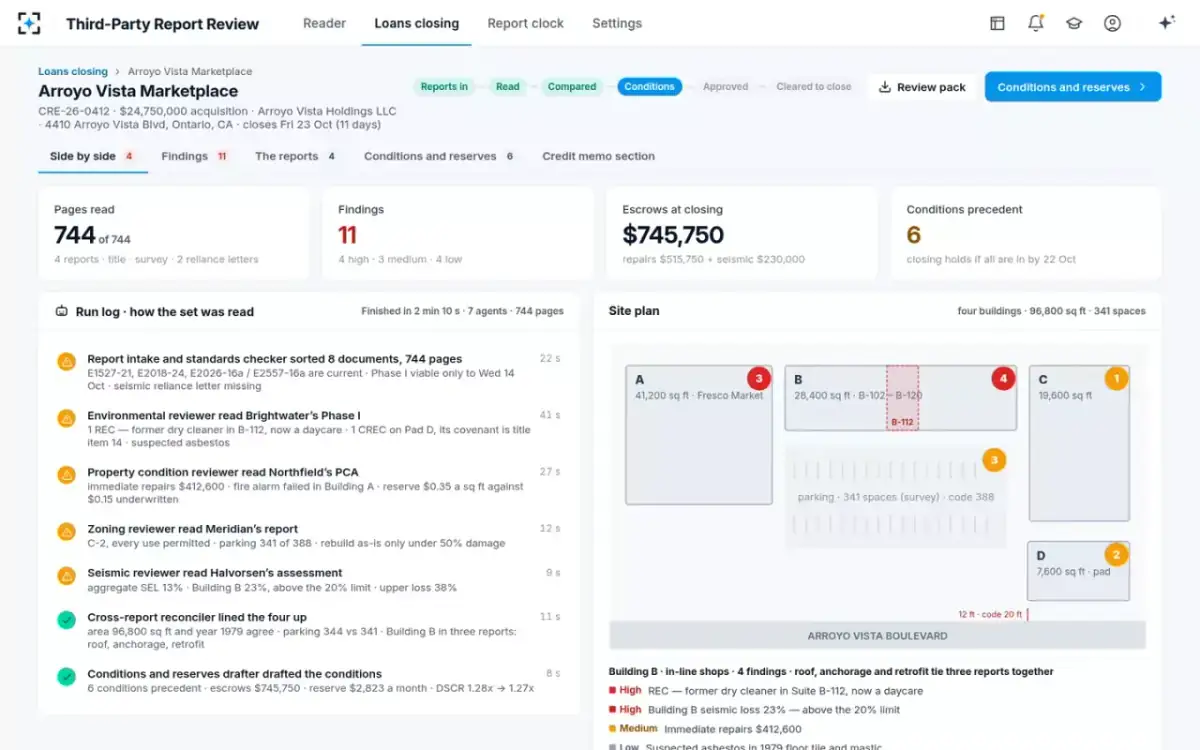
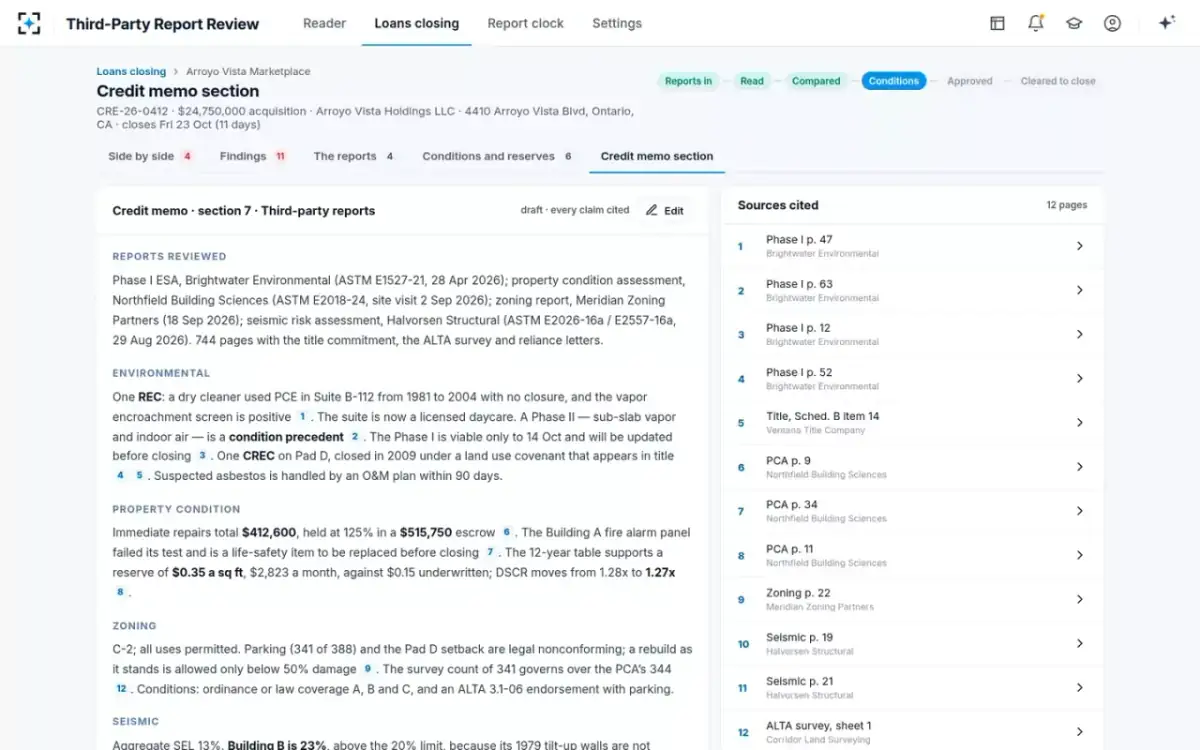
The standards also reach the credit memo. The drafted "Third-party reports" section opens with the reports reviewed, each with its consultant, its standard and its date, so an examiner reading the memo two years later can see what the bank relied on without opening the file.
The credit memo names each report's standard and date
Questions people ask
What is ASTM E1527-21?
It is ASTM International's Standard Practice for Environmental Site Assessments: Phase I Environmental Site Assessment Process, published in 2021. EPA recognises it as a way to meet the All Appropriate Inquiries rule, effective 13 February 2023, and SBA and Fannie Mae require the current version for the loans they guarantee or buy.
When did E1527-13 expire?
EPA's recognition of E1527-13 ended on 13 February 2024, one year after the E1527-21 rule took effect (40 CFR 312.11(c)). Reports completed on E1527-13 before that date remain recognised as compliant, but the one-year limit on any Phase I supporting an acquisition means none can support one now.
Is ASTM E1527-21 mandatory?
Not under EPA's rule: "Use of the ASTM E1527-21 standard is not required for compliance with the All Appropriate Inquiries Rule." It is required in practice by SBA, which names the most recent standard, and by Fannie Mae, which requires "the current requirements of ASTM E1527".
Does E1527-21 change the 180-day rule?
No. The 180-day limit for the five components and the one-year limit for the whole inquiry are in 40 CFR 312.20, which the 2022 rule did not change. The standard is written to meet the same windows.
Do I need a new Phase I if mine is on E1527-13?
For a new acquisition, yes: any E1527-13 report is now more than a year old, so it cannot satisfy the AAI timing on its own. Its history and findings can still inform the new report, which the rule allows if the new user reviews them and makes its own inquiries.