A sovereign rating model is a two-layer method for grading a government's ability and willingness to pay: a quantitative score built from a short list of public variables (income per head, growth, inflation, the fiscal and external balances, debt and default history), and a qualitative overlay in which people adjust the score for what the variables miss, such as politics and institutions. The second layer is not optional decoration. Research on the main agencies' sovereign ratings finds that the variables alone, without a term for each country's own history, put a country on exactly the right notch less than half the time. That is why the question for anyone building or buying one is less "which model?" than "who is allowed to do what?". Botminds' Sovereign Credit Analysis answers it in the software: agents read the documents, compute and test, and draft; the analyst proposes; the senior sovereign strategist approves the house view.
What the numbers explain, and what they leave to people
8factors
an EU-registered agency must evaluate in writing when a sovereign rating changes
45%
or so of ratings placed on the exact notch by a model without country effects
80%
or more placed within one notch by the same model
6months
longest interval between reviews of an EU sovereign rating
What is a sovereign rating model?
A sovereign rating model is a repeatable way of turning public information about a government into a grade, and in practice it is always a model plus a committee. The EU's rules for registered rating agencies describe exactly that structure. When an agency changes a sovereign rating, its public research report must contain "a detailed evaluation of the changes to the quantitative assumption", "a detailed evaluation of the changes to the qualitative assumption" and "a summary of minutes of the meeting of the rating committee that decided on the rating change" (EU Credit Rating Agencies Regulation, Annex I, Section D, Part III).
The same structure appears wherever governments grade other governments. The OECD's country risk classification for export credits runs a Country Risk Assessment Model, "which produces a quantitative assessment of country credit risk", followed by "the qualitative assessment of the Model results, considered country-by-country to integrate the political risk and/or other risk factors not taken into account in full or in part by the Model" (OECD Arrangement on Officially Supported Export Credits, 2018 text). The IMF's own sovereign risk framework combines mechanical signals with staff judgment that is "scrutinized in the interdepartmental review process" (IMF SRDSF guidance note, 2022).
On a buy-side desk the output is usually not a letter grade but a house view: Overweight, Neutral or Underweight, with a fiscal outlook and a list of what would change the firm's mind. The structure is the same. Some of it is arithmetic on documents, and some of it is a decision a named person must be able to defend.
What variables drive sovereign ratings?
A small set of macro and fiscal variables drives most of the variation in sovereign ratings, and regulators and researchers list nearly the same ones. The EU regulation names the factors an agency must evaluate, with their relative weight, when a rating changes: "per capita income, GDP Growth, inflation, fiscal balance, external balance, external debt, an indicator for economic development, an indicator for default and any other relevant factor". An ECB study of the three main agencies' ratings from 1995 to 2005 found the relevant explanatory variables to be "GDP per capita, GDP growth, government debt, government effectiveness indicators, external debt, external reserves, and default history" (Afonso, Gomes and Rother, ECB WP 711).
The inputs of a sovereign rating model, and the document each one comes from
| Input | Usually read from | Why it moves a rating | Where it goes wrong |
|---|---|---|---|
| Income per head, growth, inflation | Statistics office, central bank report, IMF WEO | Capacity to carry debt and to adjust | The ministry's growth assumption is not the outturn |
| Fiscal balance and government debt | Budget, fiscal framework, debt bulletin, Article IV | The government's own solvency | Central government compared with general government; one-offs counted as revenue |
| External balance, external debt, reserves | Central bank, balance of payments, debt office | Ability to pay in foreign currency | Guarantees and state-company debt left out |
| Government effectiveness and institutions | Governance indicators, laws, fiscal rule texts | Willingness to pay and to keep a rule | A rule on paper with an escape clause in practice |
| Default history | Long-run default databases and research | Debt intolerance: past defaulters face lower safe debt levels | Treated as a dummy when its effect depends on how long ago and how severe |
Read the third column of the table with the fourth. Every input is a figure in a government document, and every one has a known way of going wrong on the way into the model. A deficit that excludes a state company, a sale of equity booked as revenue, a growth number that is a target rather than a forecast: none of these is a modelling problem. They are reading problems, and they are where agents are useful.
How accurate are sovereign rating models?
Sovereign rating models are accurate to within a notch most of the time and exactly right much less often, and the gap between the two is where judgment lives. The ECB study is unusually candid about it. With a country-specific term included, its best model "correctly predicts 70 per cent of all observations and more than 95 per cent of the predicted ratings lie within one notch"; without it, as for a new country or a genuine forecast, the best method "predicts correctly around 45 per cent of all observations and more then 80 per cent within one notch".
Within a notch most of the time; on the exact notch less than half the time without country effects
The authors explain what the country term is doing: "the country errors capture factors like political risk, geopolitical uncertainty and social tensions that are likely to systematically affect the ratings". In other words, the part of a sovereign rating a regression cannot see is the part a committee is for. A model that looks precise in sample has learned each country's personality; one that has to judge a country fresh gets the notch wrong more often than right. Who signs what in such a committee, for corporate issuers, is set out in what each signature on an internal rating attests.
The IMF's framework says the same in probabilistic terms. Its near-term model estimates "the probability of sovereign stress within the next two years", with thresholds calibrated so that missed crises and false alarms are each 10 percent. Even in the high-risk zone the average probability of stress is 0.40, and the guidance warns that "“high risk” does not necessarily imply that a stress event is the most likely outcome". A score is a starting point for an argument, not the end of one.
Can AI rate a country?
AI can compute a sovereign scorecard and keep it current; it should not own the rating. The calculation half of a rating model, reading the documents, extracting the figures with their units and perimeter, recomputing ratios and testing a fiscal rule under different assumptions, is exactly the work language models and agents now do quickly. The decision half is a different matter, for two reasons the IMF's own staff have set out.
The first is that language models can be confidently wrong. The IMF's FinTech note on generative AI describes models that "produce wrong but plausible-sounding answers or output and then defend those responses confidently", and expects that "The hallucination risk, however, will likely remain a concern in the foreseeable future" (IMF FinTech Note 2023/006). The second is accountability: "Financial institutions are required to be able to explain their decisions and actions, internally and to external stakeholders", and the same note says generative models make it "exceedingly difficult at present to map GenAI’s output to the data". A country view is a decision the firm must be able to explain.
The workable answer is to make every number an agent produces traceable to its page, so the hallucination risk is checkable, and to keep the decision with a person, so the accountability is clear. That is a design choice, and it should be visible in the product, not in a policy memo.
Where the agents stop in Sovereign Credit Analysis: what each one may and may not do
In Sovereign Credit Analysis the boundary is written into each agent's limits and into the firm's settings, and it holds whichever analyst is logged in. The chain below runs from the release to the approved view; the green steps are people.
Seven agents in Sovereign Credit Analysis, and the two people who decide
Agent
Release WatcherFetches each release from 312 official publishers, versions it, lists what changed and re-runs the country's standing questions.
Never: log in to a paid site or delete a version; a failed fetch goes to a person within an hour
Agent
Original-Language ReaderReads each document in its own language and takes figures with page, table, unit, year and basis.
Never: take a figure without unit and year; scanned figures below 0.80 confidence wait for a person
Agent
Translation VerifierBack-translates every quoted passage and checks numbers, decimal commas, units and perimeter.
Never: edit a sentence; it can only hold one for the analyst
Agent
Reconciler and Fiscal Rule TesterExplain each gap between government, IMF, central bank and house, and test the fiscal rule on each set of assumptions with breakevens.
Never: pick a "right" number or use any deck but the approved house deck; results are labelled estimated
Agent
Answer Writer and View DrafterWrite the cited answer, then a view-change memo with the holdings it touches when a trigger fires.
Never: write a sentence without a source, recommend a trade, contact a client or publish without approval
A person decides
Sovereign analystAccepts, edits or rejects each sentence with a reason, saves to the country file and proposes any view change.
A person decides
Senior sovereign strategistApproves or rejects each proposed change with a reason code; never one he proposed.
Three of those limits do most of the work. The Translation Verifier can block but not edit, so a disputed translation always reaches a person. The Fiscal Rule Tester may use only the economist's approved house deck, so an analyst cannot quietly run the rule on friendlier assumptions. And the View Drafter drafts only when a trigger the firm has chosen fires: in the sample, a fiscal-rule miss on the house deck or an unexplained gap on a rule figure. An agency rating action on a large holding does not trigger a draft by default, because, as the settings put it, agency actions are read but a house view is the firm's own.
Who owns the house country view?
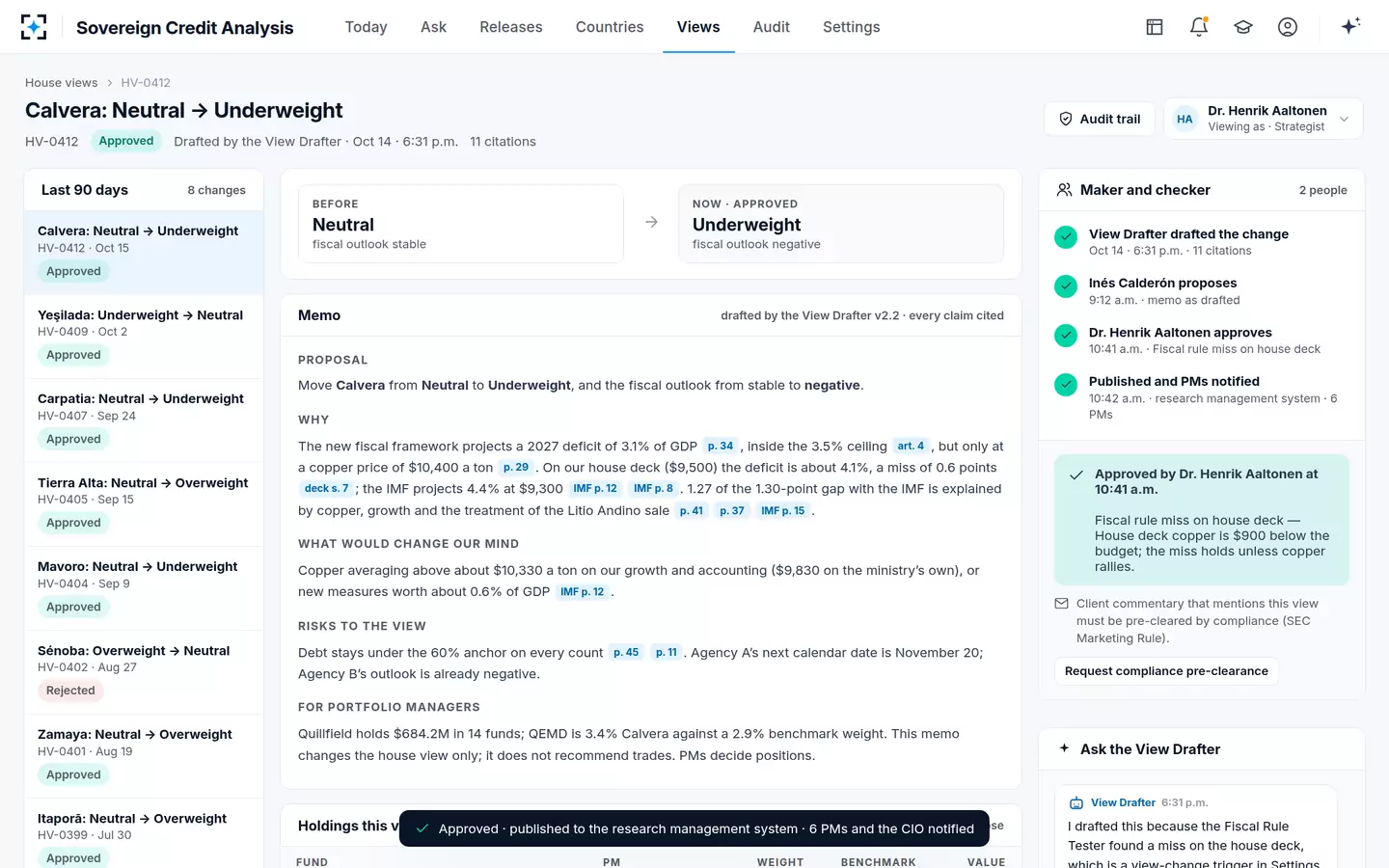
The senior sovereign strategist owns the house country view, and the system should make it impossible for anyone else to change it, including the strategist acting alone. In the sample, Quillfield's analyst Inés Calderón proposed moving the fictional Republic of Calvera from Neutral to Underweight at 9:12 a.m.; Dr. Henrik Aaltonen approved at 10:41 with the reason code "Fiscal rule miss on house deck" and a one-line note that the house copper price sits $900 below the budget's.
The view-change memo: every claim cited, and what would change the house's mind
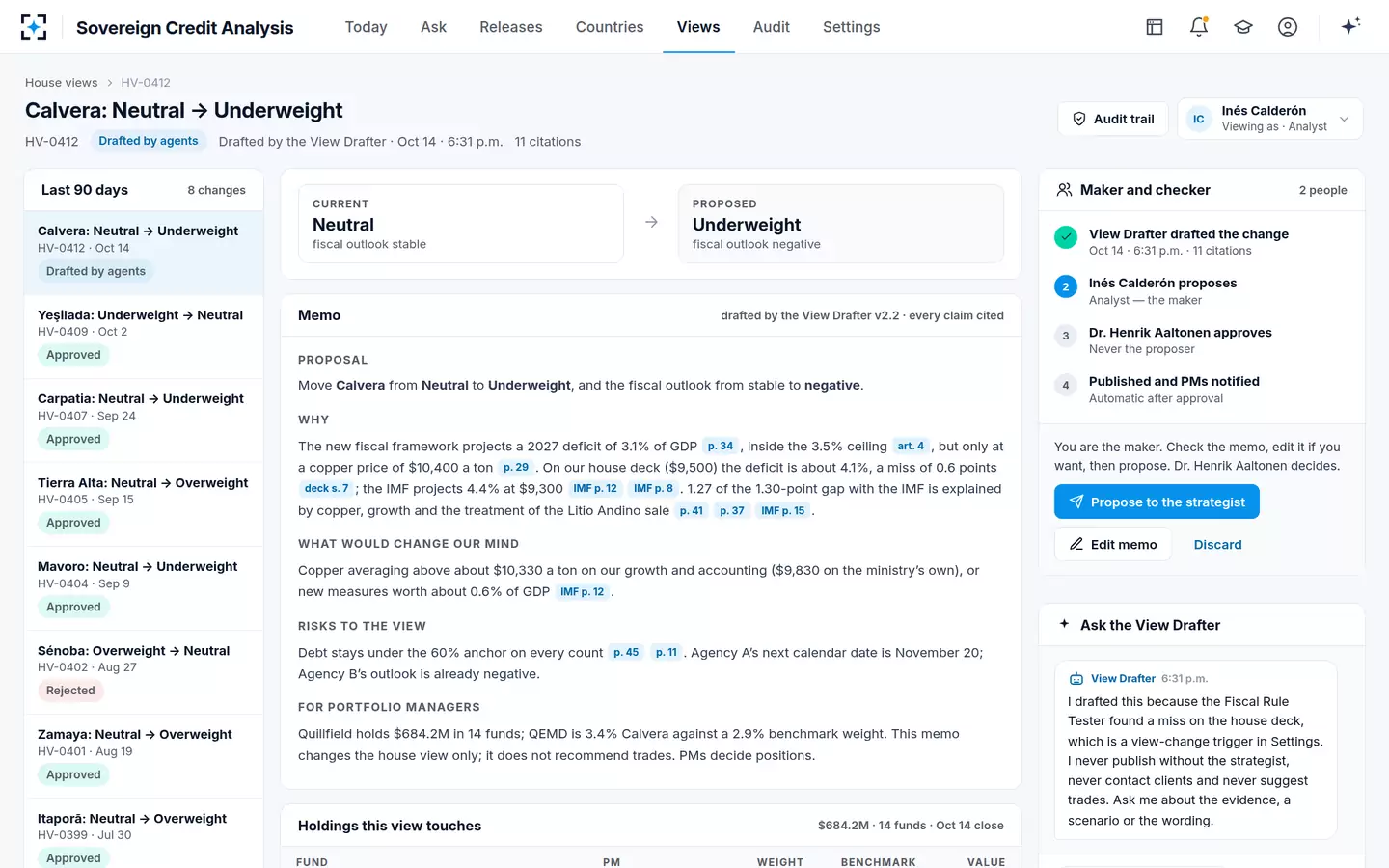
Two details in that memo matter more than its conclusion. The "what would change our mind" section turns the view into something testable: copper averaging above about $10,330 a ton on the house's growth and accounting, or new measures worth about 0.6% of GDP. And every claim carries a citation to a page in the ministry's framework, the IMF report or the house deck, so the strategist approves evidence, not prose. How the strategist gets comfortable doing that in the first weeks is the subject of earning a strategist's trust.
Can AI recommend sovereign trades?
Not in this solution, by design. The View Drafter "never places or suggests orders, and never contacts clients"; the order management system link is read-only, used only for the restricted list; and the memo's last line says that portfolio managers decide positions. A house view informs a portfolio manager; it does not instruct one. Keeping that separation in the software means the research function's output stays research.
There is a practical reason as well as a governance one. A sovereign view applies across funds with different mandates and benchmarks. In the sample, the same Underweight touches $684.2 million in 14 funds, including one emerging-markets debt fund that is 3.4% Calvera against a 2.9% benchmark weight. What to do about that is a portfolio decision with information the research team does not hold.
Approved by a second person, with a reason code
How often should a sovereign view be reviewed?
A sovereign view should be reviewed whenever a document that feeds it changes, and on a fixed cycle as a floor. The EU sets the floor for registered agencies: "Sovereign ratings shall be reviewed at least every six months" (EU CRA Regulation, Article 8(5)). A buy-side house view has no regulatory clock, but six months is a long time in a country whose budget, central bank and debt office each publish several times in that window.
The practical alternative is event-driven review: standing questions per country that re-run whenever a relevant release lands. In the sample, Calvera's three standing questions re-ran within minutes of the framework's publication; the fiscal-rule answer changed from "meets" on the ministry's numbers to "likely miss" on the house deck, and the gross financing needs answer did not change. Service levels sit in the settings, one business day from publication to a reviewed answer for countries where the firm holds more than $250 million and three for the rest, with escalation to the strategist four hours past either.
What to look for in a sovereign rating model or tool
Whether you build a scorecard, buy third-party scores or run agents on the documents, the same questions separate a tool you can defend from one you have to trust. The economics of the three routes are worked through in build, buy scores, or run agents; the checklist below is about authority and evidence.
Eight questions to put to any sovereign rating model or research tool
- Can every input be opened at its page?
A figure without its document, page, unit and year cannot be checked, and a translated figure without its original cannot be checked at all.
- Does it say which government it measured?
Central or general government, with or without state companies and guarantees. The IMF works on general government; many budgets do not.
- Does it explain gaps between sources, or pick one?
An unexplained gap between the ministry and the IMF is a finding. A tool that silently averages them hides it.
- Whose assumptions does the fiscal-rule test use?
The government's, the IMF's and the house's, side by side, with breakevens. Only an approved house deck should count.
- Who can change the view, and can they approve their own change?
Maker and checker should be enforced by the system, with a reason code on every decision.
- Is there a hard line between research and trading?
No orders, no order suggestions, no client contact from the research tool.
- What happens when a source is late, moved or restated?
Each should reach a person with one next step, and a restated report should re-run the answers that used it.
- Can compliance replay a decision without asking anyone?
Who changed the view, when, why and on what page, from an append-only trail.
Where Botminds' solution fits, and where it does not: Sovereign Credit Analysis does not issue ratings and does not replace a scorecard a team already trusts. It feeds that scorecard with figures read from the original documents and checked, reconciles them with the IMF and the central bank, tests fiscal rules on the house's own assumptions and drafts the memo when the firm's triggers fire. The judgment the ECB study could not model, and the decision the strategist signs, stay where they were.
Questions people ask
How do sovereign scorecards work?
A scorecard assigns each country a score on a short list of factors, such as income per head, growth, inflation, fiscal balance, debt, external position, institutions and default history, weights them, and maps the total to a grade. The EU requires registered agencies to show those factors and "the relative weight of each factor" when a sovereign rating changes. A committee then adjusts the result for what the factors miss.
Is a house view the same as a credit rating?
No. A credit rating from a registered agency is a published opinion subject to rules such as the EU's sovereign calendar and six-month review. A house view is a firm's internal position used by its own portfolio managers. It can use the same inputs and methods, but its value depends on the evidence behind it and on who is allowed to change it.
Why do sovereign ratings use default history?
Because past default predicts how much debt a country can carry. Reinhart, Rogoff and Savastano argue that "safe" external debt thresholds for debt-intolerant countries are low, "perhaps as low as 15 percent in some cases", and that they "depend on a country's default and inflation history". Two countries with the same debt ratio can therefore deserve different grades.
Can a sovereign rating model predict defaults?
It can rank risk, but it is calibrated to tolerate error. The IMF's near-term model sets its thresholds so that missed crises and false alarms are each about 10 percent, and the average probability of stress in its high-risk zone is 0.40. A good model tells you where to look harder, not what will happen.
What triggers a house-view change in Sovereign Credit Analysis?
Triggers the firm chooses in settings. In the sample, the View Drafter drafts a memo when the Fiscal Rule Tester finds a miss on the house deck or when a rule figure has a gap the Reconciler cannot explain within 0.1 point of GDP. Every draft is a proposal; only the strategist's approval changes the view.