A country risk model is a repeatable method for scoring the risk that a country's government, or borrowers in it, will not pay foreign creditors in full and on time. It combines a quantitative score from economic, fiscal, external and payment-history data with a qualitative overlay for politics and anything the data miss, and it is refreshed whenever the inputs change. A research team has three ways to run one: build it on free public data, buy third-party country scores, or run agents that read each country's own budgets, central bank reports and IMF documents and keep the figures current. The model is the cheap part. What makes country risk analysis expensive is the analyst time behind each update and the evidence behind each change of view, and that is where Botminds' Sovereign Credit Analysis is designed to cut the bill: its agents read and reconcile every release in its original language, and people decide.
Country risk in public: what governments themselves publish
0–7
the OECD's eight country risk categories for officially supported export credits
3groups
of risk indicators in the OECD model: payment experience, financial situation, economic situation
2.69
composite-indicator cut-off below which the IMF and World Bank treat debt-carrying capacity as weak
$437B
sovereign debt in default in 2025, 0.4% of global public debt
What is a country risk model?
A country risk model turns public information about a country into a risk grade, and the best-documented public example shows its standard shape: a quantitative model followed by a country-by-country judgment. The OECD's country risk classification, used by export credit agencies to price official support, places countries into "one of eight Country Risk Categories (0-7)". Its Country Risk Assessment Model "produces a quantitative assessment of country credit risk which is based, for each country, on three groups of risk indicators: the payment experience of the Participants, the financial situation and the economic situation", and a "qualitative assessment of the Model results" then integrates "the political risk and/or other risk factors not taken into account in full or in part by the Model" (OECD Arrangement, Article 25, 2018 text).
Country risk and sovereign risk overlap but are not the same. Country risk covers the chance that a government stops payments leaving the country, by a moratorium or transfer restrictions, or that war or disaster prevents repayment; sovereign risk is the government's own credit. The OECD keeps the two apart on purpose: a separate sovereign assessment identifies, "on an exceptional basis", sovereigns "whose credit risk is significantly higher than country risk". An investor in government bonds needs both: the first tells you whether money can get out, the second whether the government will pay it.
The same structure appears in the IMF and World Bank's framework for low-income countries, which scores debt-carrying capacity with a composite indicator and cut-offs ("weak if its CI value is below 2.69, medium if it lies between 2.69 and 3.05, and strong if it is above 3.05") before applying debt thresholds and staff judgment (LIC DSF guidance note, 2018). Public, documented, and free: that matters for the build option below.
What data feeds a country risk model?
Most of the data a country risk model needs is free and published by official bodies; the difficulty is not access but timeliness and comparability. The international datasets are clean, consistent and late. The national documents are current and inconsistent, and often not in English.
The data behind a country risk model: free, official, and each with a catch
| Input | Free official source | How current | The catch |
|---|---|---|---|
| Government debt, deficit, growth | IMF World Economic Outlook and Fiscal Monitor data | Published in vintages; October 2026 is the latest | Projections, on a general government basis, months behind the budget |
| Fiscal rules in force | IMF Fiscal Rules Dataset | Annual; the series runs to 2024 | Says whether a rule exists, not whether it holds this year |
| Default history and arrears | BoC–BoE Sovereign Default Database | Annual; 2025 figures published October 2026 | Stocks in default, not the documents behind each case |
| Debt-carrying capacity, thresholds | IMF–World Bank LIC DSF and its country DSAs | At least annually per country | Low-income countries only |
| The current budget and fiscal framework | Finance ministry | The day it is published | Original language, national definitions |
| Debt stock, guarantees, issuance | Debt office or treasury bulletins | Monthly or quarterly | Guarantees and state-company debt often in a separate table |
| Monetary stance and its forecasts | Central bank | On its own calendar | Its assumptions may differ from the ministry's |
The top four rows are what a desk can download in an afternoon. The bottom three are where country views actually change, because they arrive first. Research on sovereign crises makes the point sharply: Reinhart and Rogoff found that "public borrowing accelerates markedly ahead of a sovereign debt crisis" and that "governments often have “hidden debts” that far exceed the better documented levels of external debt" (Reinhart and Rogoff, NBER Working Paper 15795). A model fed only by international datasets sees that build-up a year late.
How to build a country risk model
Building a country risk model is mostly a design exercise, not a coding one: choose the indicators, fix their definitions, weight them, map the score to grades, and write down how judgment may override the score. The public frameworks give a template for each step.
Start with three to five groups of indicators, as the OECD does: payment history, the fiscal position, the external position, the economy and institutions. Fix the perimeter of every fiscal indicator, general government where possible, because a model that mixes central and general government figures across countries ranks them on accounting, not risk. Weight the groups by how well they predicted past stress: the IMF's sovereign framework weights its inputs "by their power to predict past stress events" and calibrates its thresholds to a 10 percent probability of missed crises and of false alarms. Map scores to grades with published cut-offs, as the LIC framework does. Then write the override rule: who may move a grade, by how many steps, and with what evidence.
The hidden cost of the build option arrives after launch. Every country update means reading the new budget, re-keying the figures into the model's definitions and explaining why the score moved. For a desk of 25 countries that is the bulk of the work, and it does not shrink as the model matures. The sovereign rating model guide looks at the override rule from the governance side.
Build, buy scores, or run agents: what each route gives you
The three routes differ less in the score they produce than in what sits behind it. A bought score arrives ready but explains itself in someone else's words; a built model explains itself but has to be fed by hand; agents feed the model from the documents and leave the score and the view to you.
Three ways to run a country risk model, compared
| Build in-house | Buy third-party scores | Run agents on the documents | |
|---|---|---|---|
| What you get | Your own score, on your definitions | A score per country, updated on the provider's cycle | Every release read, figures extracted, reconciled and tested; your score and your view |
| Up-front cost | Design and build time, mostly analysts and a developer | Licence negotiation; vendors do not publish prices | Set-up: countries, languages, sources, people, systems |
| Cost per update | Analyst reads, re-keys and explains each release | Low to read; high to explain a move you disagree with | Analyst reviews cited answers and decides |
| Original-language documents | Only as far as the team reads them | Inside the provider's process, not shown to you | Read in the original, each quote back-translated and checked |
| Gap with the IMF explained | If someone has time | Rarely shown | Each gap bridged from the sources' own numbers |
| Evidence for an examiner | Spreadsheets and emails | The provider's methodology document | Every step on an append-only trail with its page |
| Who owns the view | The team | The team, leaning on the provider | The team; agents never change it |
The middle column deserves a fair hearing. Bought scores are quick to deploy, cover many countries consistently, and give a second opinion that a house view can be tested against. Their limit for a research team is that a score is an answer without the working: when it moves after a budget, the team still has to read the budget to decide whether it agrees, and when the provider's view differs from the house's, there is nothing to reconcile it with except a methodology document.
How much does a country risk model cost?
No regulator or independent study publishes what a country risk model costs, and score vendors don't publish prices, so the honest answer is a method rather than a number: count the analyst-days each route needs per year, add the licence where there is one, and price your own day rate. Analyst time dominates for any team that reads documents to form a view, which is every team that owns a house view.
Here is the arithmetic on one illustration. Take a book of 25 countries, each with four major fiscal releases a year (a budget, a mid-year framework update, a debt strategy, a central bank report that moves the outlook), so 100 releases. On our estimate for a major release on a large holding, working one through by hand takes 5.25 analyst-days and reviewing what agents have read, reconciled and tested takes 0.85. Not every release in a real book needs the full treatment, so treat the totals as an upper bound you replace with your own counts.
Analyst-days a year on 100 major releases: by hand against with agents
Five hundred and twenty-five analyst-days is more than two analysts' working years before anyone writes a note on a country that did not publish anything that quarter. Over three years the gap between the first two bars and the third is the main line in the comparison, and it is the reason bought scores alone rarely save research time: they replace the score, not the reading.
Where the analyst hours go, and which ones agents remove
Inside each by-hand update, most of the time goes to finding, reading and re-keying, the tasks a careful agent can do, and a minority to comparing, testing and deciding. Splitting the same estimate by task shows what changes when the reading moves to agents: the analyst's time becomes mostly review and judgment.
One major release, by task: by hand against with agents
By hand · 5.25 analyst-days
- Find · 10%
- Read in the original · 29%
- Re-key · 14%
- Compare with IMF and others · 19%
- Test the rule · 14%
- Note and approval · 14%
With agents · 0.85 analyst-days
- Review the cited answer, gaps and tests · 65%
- Note and approval · 35%
The comparison step is the one that matters most for a model's quality and the one most often cut when time runs short. A model fed by hand under pressure compares the government's headline deficit with the IMF's and stops. A model fed by agents gets the bridge between them, line by line, which is the analysis that tells you whether the government's number or the IMF's is closer to the truth. When the IMF and the budget disagree shows what that bridge looks like.
How often should country risk be updated?
Country risk should be updated whenever a document that feeds the score is published, with an annual full review as the floor. The OECD's classifications "shall be monitored on an on-going basis and reviewed at least annually"; the IMF's surveillance cycle is annual for most members; and the World Bank expects a full DSA for low-income countries "at least once every calendar year". Annual is a floor because the documents that move a country's risk, a budget, a revised fiscal framework, a debt restatement, do not wait for it.
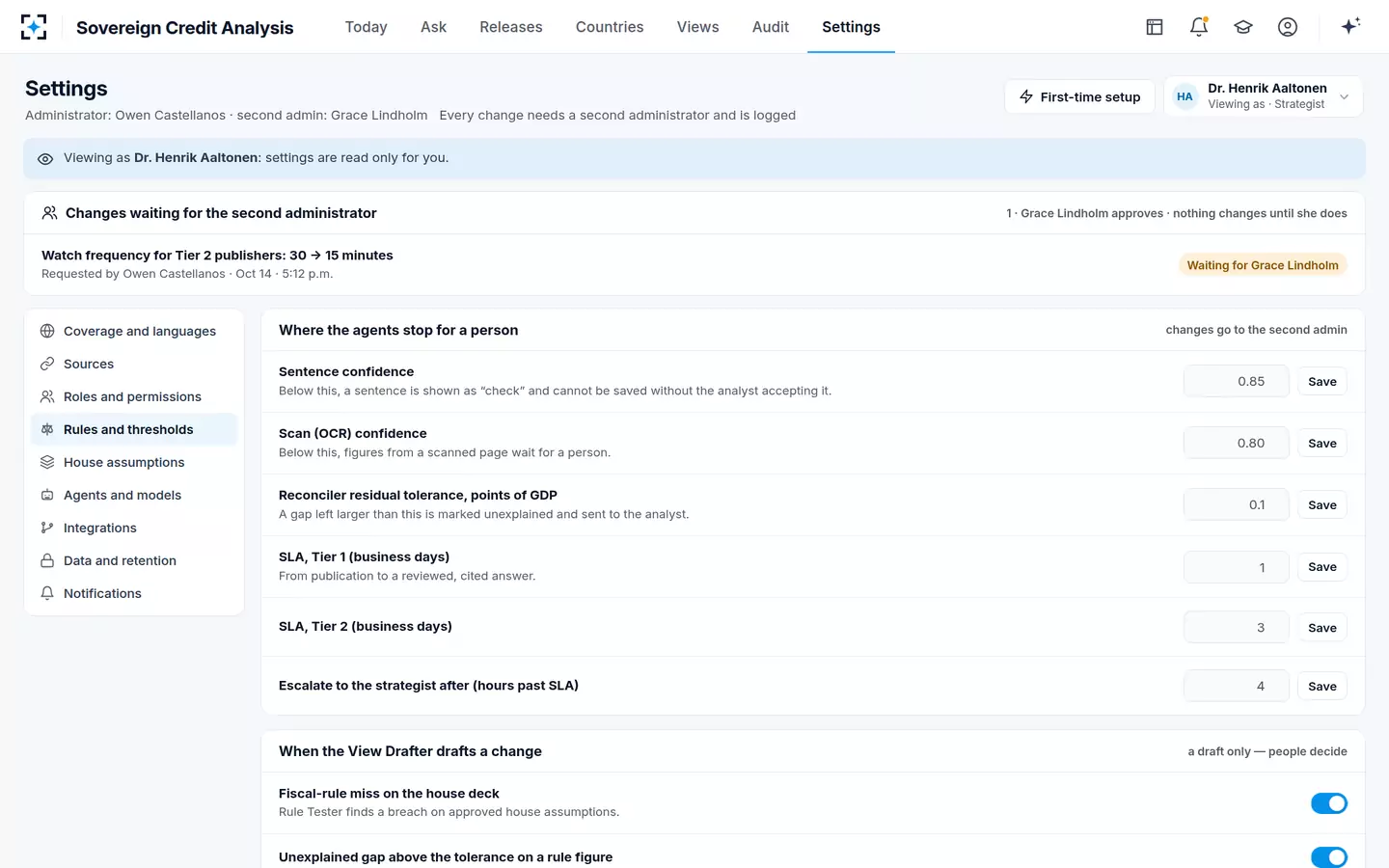
Event-driven updating is only affordable when the cost per update is low, which brings the comparison back to analyst time. In Sovereign Credit Analysis the cadence is a setting: one business day from publication to a reviewed, cited answer for countries where the firm holds more than $250 million, three for the rest, and escalation to the senior strategist four hours past either.
The update cadence in Sovereign Credit Analysis, and the points where agents stop
The audit trail is a cost line too
The third cost in the comparison is evidence: when a compliance officer, an internal auditor or an examiner asks why the house moved a country to Underweight in October, how long does it take to show the page the decision rested on? For a built model run by hand, the answer lives in spreadsheets, emails and the analyst's memory. For a bought score, it lives in the provider's methodology. Neither is free; both cost the most when the question arrives a year later and the analyst has moved on.
Every action by people and agents, with who, what, when, why and the evidence
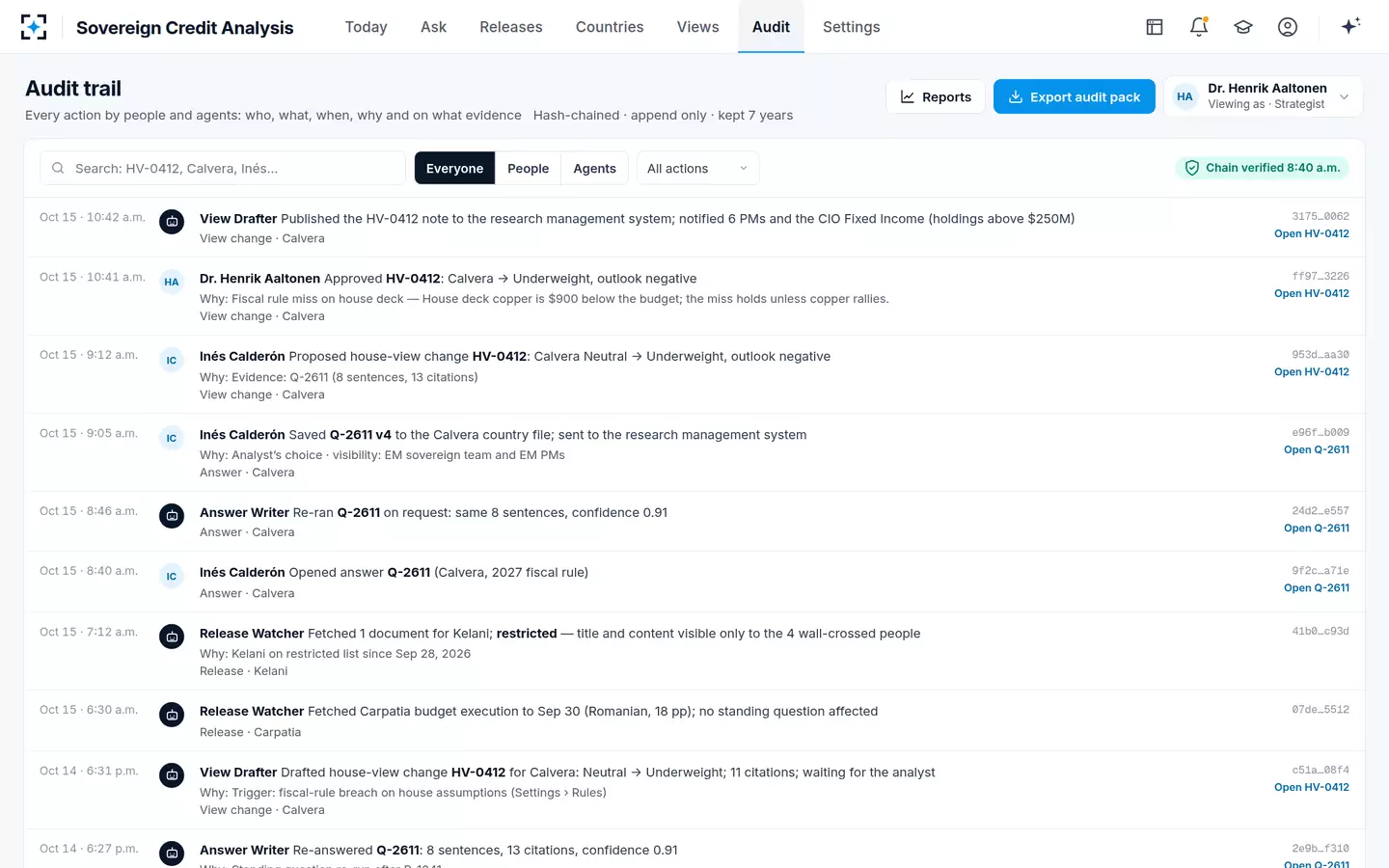
A trail that is written as the work happens costs nothing extra to keep. That is a structural advantage of the agent route rather than a feature: the same step that reads the page notes which page was read.
Where Sovereign Credit Analysis fits as the agent option, and where it does not
Botminds' Sovereign Credit Analysis is the agent option in this comparison, so it is worth being precise about what it is not. It is not a score vendor: it does not sell a country grade and does not replace a model a team already trusts. It feeds that model, or a house view without one, with figures read from the original documents and checked, reconciles them with the IMF, the central bank and the debt office, tests fiscal rules on the house's own assumptions, and drafts a memo when the firm's triggers fire. Positions, ratings and the house view stay with people.
Questions to settle before you choose a route
- How many releases a year really move your views?
Count them by country for last year. It is the multiplier on every per-update cost.
- What is an analyst-day worth to you, fully loaded?
Multiply it by the days each route needs. The licence is usually the smaller number.
- Which languages does your book publish in?
A route that reads only English documents covers fewer countries on the day they publish.
- Can you show an examiner the page behind last October's view change?
If not, the audit trail is a cost you are already carrying.
- Who may override the score, and is that written into the system?
Every route needs an override rule; only some enforce it.
- What does a two-week pilot on your own countries show?
Run your last quarter's releases through each route and compare the hours and the answers.
The last question is the decisive one. Set-up in Sovereign Credit Analysis starts with the countries, languages and official sources a team covers, the people and roles who propose and approve, and the systems it connects to, so a pilot can run on a desk's own countries rather than a demonstration book. How a strategist comes to trust it covers what the first month of that looks like.
Questions people ask
What is the OECD country risk assessment model?
It is the quantitative half of the OECD's country risk classification for officially supported export credits. The model scores each country on the payment experience of the participating export credit agencies, its financial situation and its economic situation, and the result is then assessed country by country for political and other risks before placing it in one of eight categories, 0 to 7. The classifications are reviewed at least annually and made public.
Is there a free country risk model?
The OECD publishes its country risk classifications, and the IMF and World Bank publish the debt sustainability framework for low-income countries, including its composite indicator cut-offs and thresholds. The data to build your own, from the IMF's World Economic Outlook and fiscal rules dataset to the BoC–BoE sovereign default database, are free. What is not free is the analyst time to keep any model current.
What is the difference between country risk and sovereign risk?
Country risk is the risk that events in a country, such as a payments moratorium, transfer restrictions or war, stop creditors being paid; sovereign risk is the government's own creditworthiness. The OECD separately flags sovereigns "whose credit risk is significantly higher than country risk", which shows the two can diverge.
How many countries are in default?
The Bank of Canada and Bank of England estimate that 80 sovereigns were in default in 2025, down from 91, on US$437 billion of debt, or 0.4% of global public debt. Just three, Venezuela, Russia and Lebanon, accounted for 55% of the amount, which is why a country risk model needs both a stock measure and a count.
Should we build or buy sovereign research?
Build or buy the score as you prefer; the bigger decision is how the reading behind each update gets done. On our estimate, working a major release through by hand takes about 5.25 analyst-days against 0.85 days reviewing agents' cited answers, and that difference, multiplied by the releases in your book, usually outweighs the licence.