The difference between the primary balance and the fiscal balance is interest. The fiscal balance, also called the overall balance or net lending/borrowing, is revenue minus all expenditure; the primary balance is the same thing with interest payments left out. The primary balance measures the government's own fiscal effort, the part it controls this year; the overall balance measures how much it must borrow. In the IMF's October 2026 Fiscal Monitor data, Brazil's 2025 primary balance is close to zero (−0.1% of GDP) while its overall deficit is 7.4% of GDP, and Egypt runs a primary surplus of 3.3% of GDP alongside an overall deficit of 6.6%. Confusing the two is the first of five errors that regularly flip a fiscal-rule verdict in sovereign credit analysis; the others are nominal against structural balance, central against general government, ratios to GDP against ratios to revenue, and the decimal comma. Botminds' Sovereign Credit Analysis checks each figure for all five before it reaches the analyst.
The same budgets, two very different balances
−0.1%
Brazil's 2025 primary balance, % of GDP
−7.4%
Brazil's 2025 overall balance, % of GDP
+3.3%
Egypt's 2025 primary balance
−6.6%
Egypt's 2025 overall balance
What is the difference between primary balance and fiscal balance?
The fiscal balance includes interest and the primary balance does not; everything else is the same. The IMF's Fiscal Monitor defines the overall balance, net lending/borrowing, as "the difference between revenue and total expenditure, using the 2014 edition of the IMFs Government Finance Statistics Manual", and the primary balance as "Overall balance excluding net interest payment (interest expenditure minus interest revenue)" (IMF DataMapper, Fiscal Monitor indicator notes).
The two answer different questions. The overall balance tells you how much new borrowing the year requires, which is what a bond investor funds. The primary balance tells you whether the government's own decisions on taxes and spending are adding to the debt, which is what a fiscal rule usually tries to discipline. A government can run a primary surplus, doing its part, and still need to borrow heavily because last decade's debt is expensive.
That is why a credit view needs both, and why naming the wrong one in a note can reverse its conclusion. The table below sets out the five confusions this page covers, each with the check that catches it.
Five confusions that flip a fiscal-rule verdict, and how to catch each
| Confusion | Example | Effect on the verdict | The check |
|---|---|---|---|
| 1. Primary vs overall balance | A primary target read against an overall ceiling | A pass turns into a fail, or the reverse, by the full interest bill | Name the aggregate the rule constrains, from the law text |
| 2. Nominal vs structural balance | A one-off asset sale counted in a structural target | A deficit looks 0.2 point smaller than the rule measures it | Strip one-offs and cyclical effects the way the rule does |
| 3. Central vs general government | A central government deficit compared with an IMF general government projection | A gap blamed on assumptions is really perimeter | Name the perimeter of every figure before comparing |
| 4. % of GDP vs % of revenue | Interest as a share of revenue read as a share of GDP | A ratio off by a factor of four or five | Carry the denominator with the number |
| 5. The decimal comma | "3,1" read as 31 or 3,100 | A target read as absurd, or a ceiling read wrongly | Read the number in its own locale, then back-check it |
What is the primary balance formula?
The primary balance is the overall balance with interest added back: primary balance = revenue − (expenditure − interest expense), or equivalently overall balance + interest expense. The IMF's statistics manual says an "analysis of gross debt sustainability requires calculating a primary balance, which can be calculated by excluding interest expense", and that "When net debt is considered in the analysis, the primary balance should be calculated excluding the impact of interest expense and interest revenue" (IMF GFSM 2014, paragraph 4.55).
So there are two primary balances, and the IMF's own documents use both. Its debt framework notes that its primary deficit, consistent with the World Economic Outlook, is "noninterest expenditures less noninterest revenues", and flags "a difference with the GFSM 2014’s primary balance definition ..., which removes interest expenditures, but not interest revenues" (IMF SRDSF guidance note, 2022, footnote 35). For a government with large deposits or a sovereign fund earning interest, the difference is material, and a fiscal rule written in a national law may use either.
Why does the primary balance matter for debt?
The primary balance matters because it is the term in the debt equation the government controls. Whether debt rises or falls as a share of GDP depends on the primary balance against the interest–growth differential times the stock of debt: the debt-stabilising primary balance is (r − g) ÷ (1 + g) × debt. If the real interest rate on the debt exceeds real growth, the government must run a primary surplus just to hold the ratio steady.
That is why the gap between the two balances, the net interest bill, is itself a credit signal. The table below is the IMF's own arithmetic for six countries, the difference between the overall and primary balances being net interest.
The interest wedge: overall and primary balances, 2025, % of GDP
| Country | Primary balance | Overall balance | Difference: net interest |
|---|---|---|---|
| Egypt | +3.3 | −6.6 | 9.8 |
| Brazil | −0.1 | −7.4 | 7.3 |
| Italy | +0.5 | −3.1 | 3.6 |
| Colombia | −3.5 | −5.8 | 2.3 |
| Indonesia | −0.8 | −2.9 | 2.2 |
| Chile | −2.0 | −2.8 | 0.8 |
Read across the rows and the two balances tell opposite stories. Egypt's primary surplus is the largest in the table and its overall deficit nearly the largest, because net interest takes almost ten points of GDP. Colombia's overall deficit is smaller than Brazil's, but its primary deficit is much larger, so more of its borrowing is the government's own choice rather than the cost of past debt. Which of those is the more serious credit problem depends on the question being asked, which is why a note must say which balance it means.
Confusion 1: a primary target read against an overall ceiling
The commonest version of the first confusion is a rule-check that uses the wrong aggregate. A fiscal rule may cap the overall deficit, target a primary surplus or limit structural balance, and budgets often present all three on the same page. Testing an overall-deficit ceiling with the primary balance makes any country with significant interest costs look compliant; testing a primary target with the overall balance makes it look in breach.
The defence is to read the rule in the law, not in the budget speech. In the fictional sample in Sovereign Credit Analysis, the Fiscal Rule Tester encodes the Republic of Calvera's ceiling from the text of its fiscal responsibility law: the overall deficit "no podrá exceder" 4.25% of GDP in 2026, 3.5% in 2027 and 3.0% from 2028. That one phrase fixes the aggregate, the unit and the path, and the test runs on nothing else. Testing a country's rule yourself walks through the same steps.
Confusion 2: what is a structural balance, and why does it differ from the headline?
A structural balance is the fiscal balance with the effects of the business cycle and of one-off or temporary measures removed; a cyclically adjusted balance removes only the cycle. The IMF's statistics manual defines the structural balance as the fiscal balance "stripped of the impact of cyclical movements in revenue, expenditure, and the effects of unusual or one-off events", and the Fiscal Monitor's cyclically adjusted balance as "an estimate of the fiscal balance that would apply under current policies if output were equal to potential" (IMF GFSM 2014, Table 4A.1).
One-offs are where the second confusion lives. In the sample, Calvera's new framework counts a 0.2%-of-GDP sale of a state stake in a mining company as revenue in 2027. A headline deficit of 3.1% therefore includes a gain that will not recur; a structural measure, or the IMF's treatment of the sale as financing, gives a deficit 0.2 point larger. The EU's fiscal rules go further and build their operational indicator, net expenditure, net of "one-offs and other temporary measures" among other items, and set the safety margin "in structural terms": a deficit resilience margin of "1,5 % of GDP relative to the deficit reference value of 3 % of GDP" (Regulation (EU) 2024/1263).
A one-off is not a policy. A deficit that meets its rule only because of an asset sale has met it once.
The structural measure has its own weakness. It depends on an estimate of potential output, and the IMF's guidance for Article IV staff concedes that "Estimating the structural balance can be challenging because of operational and data constraints" (IMF Article IV guidance, 2015). Where a rule is written in structural terms, note whose output-gap estimate it uses; a finance ministry's and the IMF's can differ by enough to decide the verdict.
Confusion 3: central government vs general government
Central government is the national government's own units; general government adds state and local governments, social security funds and other public units. The IMF's statistics manual describes the budgetary central government as "usually covered by the main (or general) budget", while general government covers all "resident institutional units that fulfill the functions of government as their primary activity" (IMF GFSM 2014, Chapter 2). The IMF's guidance tells its staff to prefer general government "or an even broader definition of the public sector, rather than central government".
The confusion shows up whenever a budget is compared with an IMF projection or an IMF table. A gap that looks like a disagreement about growth or revenue may simply be a different set of government units. In the sample, the Translation Verifier checks the perimeter of every figure it passes: on page 34 of the Calvera framework, the 3.1% is "% of GDP · central government". Why the IMF and the budget disagree takes the perimeter question further.
Confusion 4: % of GDP vs % of revenue
A ratio is only meaningful with its denominator, and fiscal documents use several. Interest is often quoted as a share of revenue, debt service as a share of exports, deficits as a share of GDP. Since general government revenue is typically a fraction of GDP, the same interest bill can be "3% of GDP" and, for a government collecting a fifth of GDP in revenue, "15% of revenue". Read one as the other and the ratio is off by a factor of four or five.
The official frameworks treat the denominators as different tests. The IMF–World Bank framework for low-income countries sets separate thresholds for external debt service as a share of exports and as a share of revenue, at 10% and 14% respectively for a country with weak debt-carrying capacity (LIC DSF guidance note, 2018, Table 6). A note that carries the number without the denominator has dropped half the information.
A subtler form of the same error is a revenue concept. In the sample run, the one translated passage the Translation Verifier held for the analyst was "ingresos tributarios" on page 42: tax revenue, as the Verifier read it, or revenue, as the Reader had written it. Tax revenue excludes non-tax income such as royalties and dividends, which in a copper exporter can be large. The difference changes any ratio built on it, which is why the passage waited for a person.
Confusion 5: the decimal comma
Much of the world writes decimals with a comma and thousands with a point, so "3,1" is three point one and "10.400" is ten thousand four hundred. A reader or a parser expecting the English convention can turn a 3.1% deficit target into 31, or a copper price of US$10.400 a ton into ten dollars and forty cents. Most such errors are caught because they look absurd. The dangerous ones look plausible: "1.250" is one thousand two hundred and fifty in a Spanish table and one and a quarter in an English one, and either could pass for a debt figure in millions or a sensitivity in points.
The figure check in Sovereign Credit Analysis on one Spanish budget page: decimal comma, unit, perimeter, year
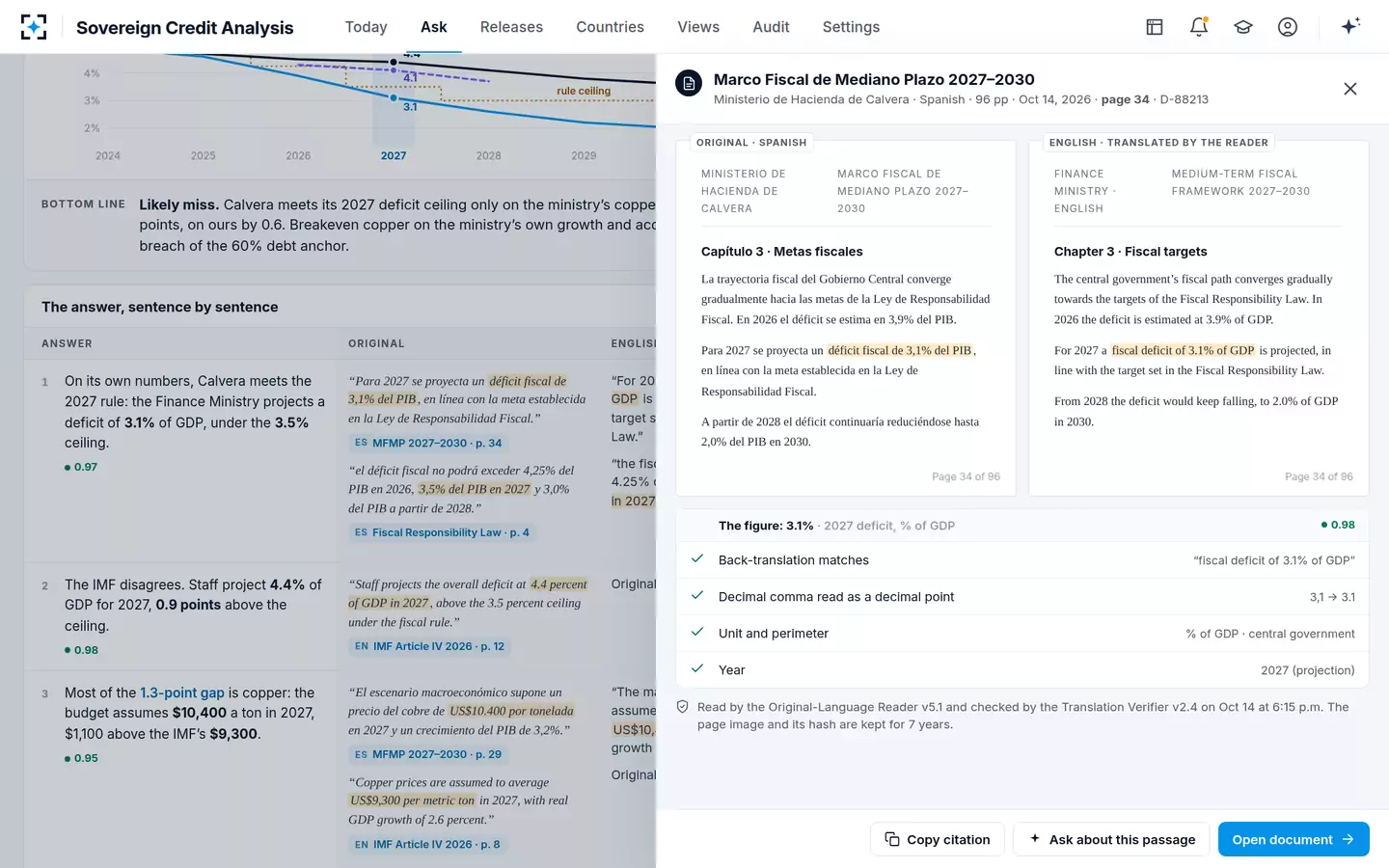
The defence is to read every number in its own locale and then back-check it, which by hand is slow enough that it rarely happens for every figure. In the sample, the Translation Verifier back-translated all 23 quoted passages and checked number, decimal comma, unit, perimeter and year on each; 22 matched and one, the revenue concept above, was held. None of the five confusions on this page is exotic. Each is ordinary, each is checkable, and each is cheaper to catch on the page than in a note a portfolio manager has already read.
Five confusions on one test: how the verdict moves
Put the five together on the sample's 2027 test and the stakes are clear. On the ministry's own numbers, Calvera's 3.1% deficit meets its 3.5% ceiling by 0.4 point. Treat the 0.2-point asset sale as the IMF does, as financing, and the margin halves before any assumption changes. Use the IMF's copper and growth assumptions as well, and the deficit is 4.4%, a 0.9-point miss. A misread perimeter, denominator or decimal comma on the way in could move the answer just as far for no economic reason at all.
One ceiling, one country in Sovereign Credit Analysis: how far each reading moves the 2027 deficit
The answer the analyst signs off is the same either way; what changes is whether she can defend it. A note that says "meets its rule" and a note that says "meets its rule on the ministry's copper price and accounting, misses on ours by 0.6 point" are both true, and only the second will survive the next budget. What makes a strategist trust such an answer is the subject of a separate guide.
Questions people ask
What is a primary deficit?
A primary deficit is a negative primary balance: noninterest spending exceeds revenue, so the government is borrowing even before paying interest on its debt. In the IMF's October 2026 data, Colombia ran a general government primary deficit of about 3.5% of GDP in 2025, and Chile about 2.0%.
Is the fiscal deficit the same as the overall deficit?
Usually yes: "fiscal deficit", "overall deficit", "budget deficit" and the IMF's "net borrowing" all mean revenue minus total expenditure including interest, but on whatever perimeter the document uses. Some national budgets also exclude items the IMF includes, such as policy lending, so check the definition before comparing two "fiscal deficits".
What is a cyclically adjusted balance?
It is the fiscal balance with the automatic effects of the business cycle removed, so that it shows the stance of policy rather than the state of the economy. The IMF's Fiscal Monitor defines it as the "Difference between the overall balance and the automatic stabilizers". A structural balance goes further and also removes one-off measures.
Why can a country run a primary surplus and still see debt rise?
Because interest can exceed the surplus. If the real interest rate on the debt exceeds real growth, the debt-stabilising primary balance is positive, and a primary surplus smaller than that level still lets the debt ratio rise. Egypt in 2025, with a primary surplus of 3.3% of GDP and an overall deficit of 6.6% in the IMF's data, shows how large the gap can be.
Which balance do fiscal rules use?
All of them, depending on the country. The IMF's fiscal rules research notes that budget balance rules "can be specified as limits on the overall balance, primary balance, or structural or cyclically adjusted balance". The only reliable answer for a given country is the text of its law.