A fiscal rules escape clause is a provision in a country's fiscal rule that allows the government to deviate from its numerical limit, on the deficit, debt or spending, when defined exceptional events occur, such as a severe recession, a natural disaster or a war, usually for a limited time and with an obligation to return to the rule. Escape clauses are now standard: by the IMF's count, two thirds of countries with fiscal rules had one before the pandemic, and over 30 invoked them in 2020. For a sovereign analyst, the clause changes what a rule is worth. A deficit ceiling with a broad escape route is a weaker promise than one without, and a budget that meets its rule only on the government's own forecast may not meet it on anyone else's. Botminds' Sovereign Credit Analysis treats both as testable: its Fiscal Rule Tester encodes each country's rule from the law text, cited, and tests it on the government's, the IMF's and the house's assumptions, with breakevens.
Fiscal rules: common, flexible and often broken
122countries
had a national or supranational fiscal rule in 2024, by the IMF's count
2/3
of countries with fiscal rules had an escape clause before the pandemic
50%
of the time, countries exceeded their deficit limits, 2004–21
1.5%of GDP
yearly cap on extra defence spending under the EU's 2025 national escape clause
What is a fiscal rule escape clause?
Fiscal rules are, in the words of IMF researchers, "long-lasting constraints on fiscal policy through numerical limits on broad budget aggregates", and an escape clause is the part of the rule that says when the constraint may be set aside (Davoodi and others, IMF WP/22/11). A well-designed clause names the triggering events, says who decides that one has occurred, limits how long the deviation may last and how large it may be, and sets out how the government returns to the rule.
The IMF's researchers describe escape clauses as a cornerstone of "second generation" fiscal rules, adopted after the global financial crisis exposed rules that had no exit and were simply abandoned. During 2008–10, "nearly 30 percent of countries with national fiscal rules modified or suspended the fiscal rules", many "without adopting any plan to return to compliance". The escape clause is the attempt to make the exit orderly and visible.
The EU's version is the clearest example in law. Its general escape clause allows member states to deviate from their expenditure paths "in the event of a severe economic downturn in the euro area or the Union as a whole, provided that it does not endanger fiscal sustainability over the medium term", for a period the Council sets at one year, extendable a year at a time (Regulation (EU) 2024/1263, Article 25). The national escape clause, Article 26, applies "where exceptional circumstances outside the control of the Member State have a major impact on the public finances of the Member State concerned".
How many countries have fiscal rules?
122 countries had a national or supranational fiscal rule in 2024, according to the IMF's Fiscal Rules Dataset: 35 advanced economies and 87 emerging market and developing economies. In 1990 the same dataset counts seven. The spread has come mostly from emerging markets since the late 2000s, which is why the question of what a rule is worth now arises on almost every country in an EM book.
From 7 countries to 122: the spread of fiscal rules since 1990
Counts like these say whether a rule exists in law, not whether it binds. The dataset "focuses on de jure arrangements and not to what degree rules have been adhered to in practice", and it excludes arrangements that can be changed every year: "Medium-term budgetary frameworks or expenditure ceilings that provide multi-year projections but can be changed annually are not considered to be fiscal rules" (IMF WP/22/11, Annex I). That distinction matters for reading a medium-term fiscal framework, which is a plan, not a rule.
What is a debt rule vs a balance rule?
A debt rule caps or anchors public debt, usually as a share of GDP; a balance rule limits the deficit, on the overall, primary, structural or cyclically adjusted balance. The IMF dataset recognises four types, and they behave very differently under stress.
Four kinds of fiscal rule, and what each one is good and bad at
| Rule type | What it limits | Strength | Weakness the IMF notes |
|---|---|---|---|
| Debt rule | Debt as a share of GDP, as an anchor or ceiling | Tied directly to sustainability; "relatively easy to communicate" | Debt moves with exchange rates and interest rates the government does not control; no short-term guidance |
| Budget balance rule | The overall, primary, structural or cyclically adjusted balance | Clear operational limit, "largely under government control" | Cyclical adjustment is hard to communicate and monitor, and tends to treat good shocks as structural |
| Expenditure rule | Total, primary or current spending, often as a growth rate | Limits "relatively easy to operate and monitor" | Not linked directly to debt, since revenue is unconstrained |
| Revenue rule | A ceiling or floor on revenue | Can stop windfalls being spent | Revenue is highly cyclical; alone, it can make policy procyclical |
Which type a country runs decides how to test it. A ceiling on the overall deficit can be tested from the budget's own deficit figure, once the perimeter and one-off items are right. A structural balance rule needs an estimate of the output gap, and the IMF's own Article IV guidance warns that estimating the structural balance "can be challenging". An expenditure rule needs the spending aggregate as the law defines it, which may exclude interest, investment or items financed by grants. The five confusions page shows how a mismatch on any of these can flip a verdict.
When can a government suspend its fiscal rule?
A government can deviate from its rule when its own escape clause is triggered, under the procedure the law sets; without one, it has to suspend or amend the rule, usually by a new law. The pandemic tested both routes. "Over 30 countries have invoked the escape clauses in national and supranational rules", the IMF's researchers found; others that had no clause, or too narrow a one, suspended or modified the rules instead.
The cases are instructive for anyone reading a rule today. Peru suspended its rules, judging that the crisis "would require greater flexibility than the escape clauses allowed". Poland's escape clause "had provisions for war and national disaster but not for the pandemic", so it suspended its national expenditure rules and later added automatic triggers. Brazil activated a "public calamity clause" to lift its primary balance target. Jamaica activated its clause for one year and postponed its debt target by two years, to fiscal year 2027/28 (IMF WP/22/11). The design of the clause, which events it names, decided whether a government used it or broke the rule.
What is the EU national escape clause, and what does it cost?
The EU national escape clause, Article 26 of Regulation (EU) 2024/1263, lets the Council allow one member state, at its request, to deviate from its net expenditure path when "exceptional circumstances outside the control of the Member State" have "a major impact on the public finances", provided fiscal sustainability over the medium term is not endangered. In March 2025 the Commission proposed using it, in a coordinated way, for defence: the flexibility "should be capped at 1.5% of GDP" and "would be available for a period of four years, starting from 2025" (European Commission Communication C(2025) 2000).
The Council's draft recommendation for Denmark, dated June 30, 2025, shows what such a clause costs in numbers. It allows Denmark to exceed its expenditure path during 2025–2028 by the rise in defence spending since 2021, up to 1.5% of GDP, and quotes the Commission's projection that with full use the deficit and debt ratios in 2028 "would be 1.1 pps. and 2.4 pps. higher" than on the agreed path (Council of the EU, document 10466/25). That is the right way to read any escape clause: not as a loophole or a virtue, but as a priced deviation with a return date.
Do countries comply with fiscal rules?
Often not. Over 2004–21, "countries exceeded the deficit and debt limits about 50 and 42 percent of the time", and just before the pandemic debt already exceeded its limit or anchor in "more than half of countries (44 out of 81)". In 2020, "About 90 percent of countries had deficits larger than the rule limits", and the authors warn that "deviations from debt limits have been very difficult to reverse" (IMF WP/22/11).
That record does not make rules worthless; the same paper finds that "countries benefit from a good track record in abiding by rules before crises", which lets them respond to shocks more forcefully. It does mean that a rule's existence is weak evidence on its own. The credit question is whether this government will meet this rule this year, on realistic assumptions, and what happens if it does not.
How to test fiscal rule compliance yourself
Testing a fiscal rule is a reading exercise before it is a calculation: get the rule's exact wording, compute the constrained aggregate the way the law defines it, and then run it on more than one set of assumptions. The steps below are the ones the Fiscal Rule Tester in Sovereign Credit Analysis follows, and they work just as well by hand.
Seven steps to test a country's fiscal rule
- Read the rule in the law, not in the budget speech
The aggregate, the perimeter, the limit for each year, any adjustment for the cycle or for one-offs, and the article number.
- Read the escape clause in the same law
Which events trigger it, who declares them, how long it lasts, how large the deviation may be, and the path back.
- Compute the aggregate on the rule's own definition
If the rule covers the central government, so must the figure; if it excludes one-offs, take them out.
- Test on the government's assumptions
Usually a pass. The question is by how much.
- Test on the IMF's and on your own
Growth, commodity prices, interest rates. Use the government's own sensitivity tables to translate each difference into points of GDP.
- Compute the breakeven
The value of the key assumption at which the rule is exactly met. It turns a verdict into a single number to watch.
- Ask whether a miss would trigger the escape clause
If not, a miss is a breach; if so, what the deviation would cost and when the rule would bind again.
A worked test: one ceiling, three sets of assumptions
Take a sample as it runs through the solution. The fictional Republic of Calvera's fiscal responsibility law caps the overall deficit at 4.25% of GDP in 2026, 3.5% in 2027 and 3.0% from 2028. Its new medium-term fiscal framework projects 3.1% for 2027. The Fiscal Rule Tester encoded article 4 from the law text, cited to its page, and tested it three ways.
Calvera's 2027 deficit against its 3.5% ceiling in Sovereign Credit Analysis, on three sets of assumptions
On the ministry's numbers the rule holds with 0.4 point to spare. On the IMF's it fails by 0.9 point, on the house deck by 0.6. The breakeven makes the verdict watchable: on the ministry's own growth path and accounting, copper must average about $9,830 a ton for the deficit to sit exactly at 3.5% (3.1% plus $570 × 0.07 ÷ 100); on the house's growth of 2.9%, with the asset sale booked as financing, about $10,330. The house deck has $9,500. These are estimates, and the solution labels them so.
The breakeven in Sovereign Credit Analysis, asked in plain words beside the answer
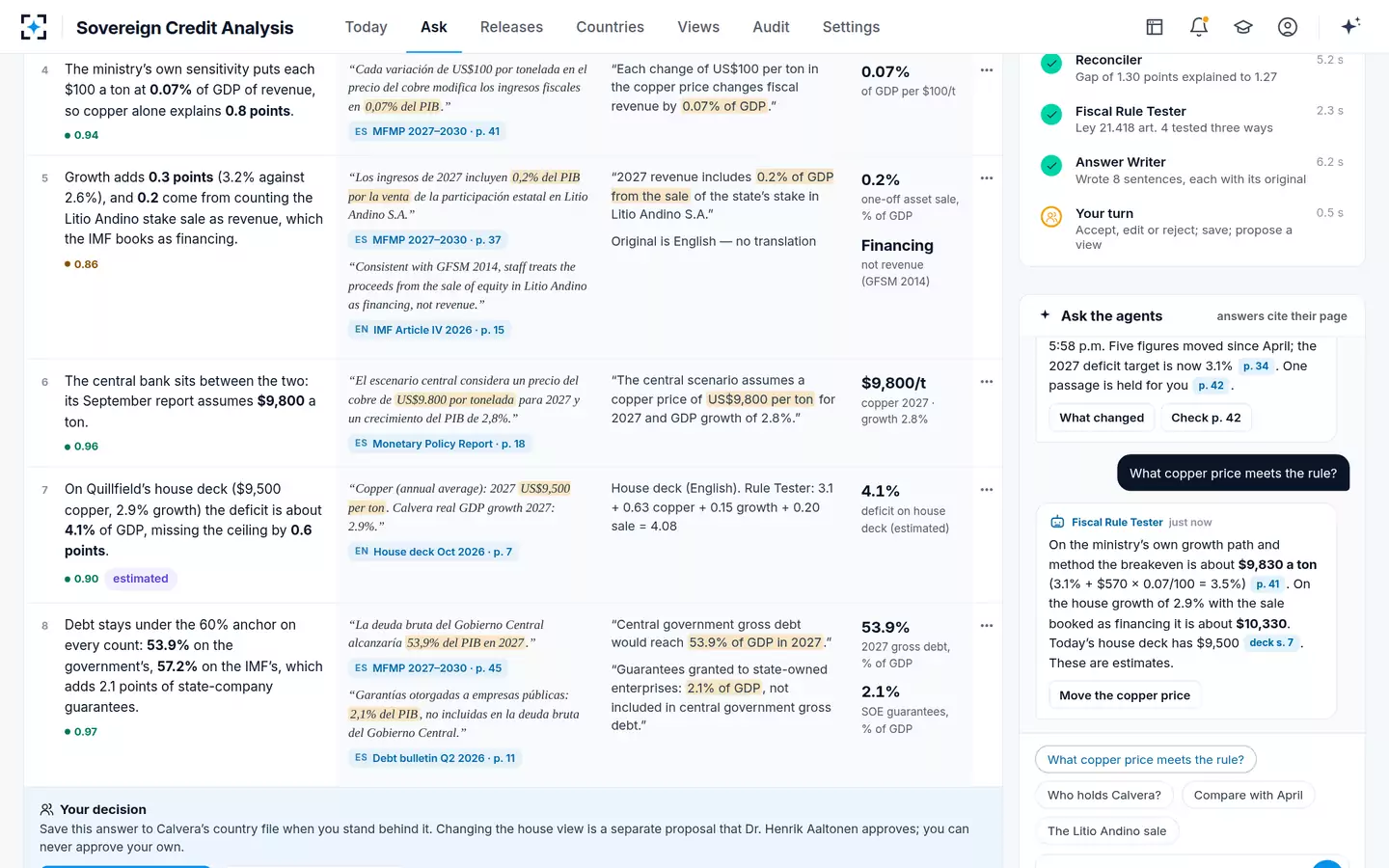
The last step of the test is the one most notes skip: would a miss trigger the escape clause? A copper price fall is exactly the kind of shock some rules treat as outside the government's control and others do not. The answer changes the credit reading. A miss inside a clause is a priced, temporary deviation of the kind the Danish projection quantifies; a miss outside one is a breach, and the IMF's evidence says breaches of debt limits are hard to reverse. Reading that clause, in the original language, is part of the test, and the sample answer's citations to the law's own page are what let a strategist check it.
Why a rule test belongs in the house view
A fiscal-rule test on house assumptions is one of the clearest triggers a research desk can write down for reviewing a country view, because it ties the view to a law and a number. In the sample firm, a miss on the house deck is one of two settings that make the View Drafter draft a view-change memo; the analyst proposes it and the senior strategist decides. The memo then carries the breakeven as its "what would change our mind" line. Where the agents stop follows that memo to the strategist's signature.
Questions people ask
What is the IMF fiscal rules dataset?
It is the IMF's cross-country database of national and supranational fiscal rules, covering their type, legal basis, coverage, escape clauses and enforcement, with a summary indicator on the IMF DataMapper. The 2025 vintage (Alonso and others) counts 122 countries with a rule in 2024. It records rules as they stand in law, not whether governments comply.
What is a structural balance rule?
A rule that limits the budget balance after removing the effects of the economic cycle and one-off measures, so that a government is not forced to tighten in a recession or allowed to loosen in a boom. Its weakness is measurement: it depends on an estimate of potential output, and the IMF notes such rules are "difficult to communicate and monitor".
How many EU countries have activated the national escape clause?
The Commission invited all member states in March 2025 to use the clause for defence, with a cap of 1.5% of GDP a year over four years from 2025. Activation is country by country, on each government's request: Denmark asked on April 30, 2025, and the Council's draft recommendation for it is dated June 30, 2025. Because requests continue, check the Council's current list before relying on a count.
Do fiscal rules lower borrowing costs?
The IMF's researchers find that deviations from deficit limits "are associated with higher financing costs", and that a good record of abiding by rules before a crisis lets governments respond to shocks more forcefully. A rule that is kept is worth more than one that exists.
What is a fiscal anchor?
A fiscal anchor is the medium-term target a government's policy is built around, most often a debt-to-GDP level, with operational rules on the deficit or spending to get there. In the IMF dataset the most common combination is exactly that: a debt ceiling or anchor supported by an expenditure or budget balance rule.