An IMF Article IV consultation is the IMF's regular review of a member country's economy and policies, named after the article of the IMF's founding treaty that obliges each member to consult. IMF staff visit, usually once a year, discuss policy with the finance ministry and central bank, and write a staff report with their own projections and a debt sustainability analysis; the IMF's Executive Board then discusses it, and most countries publish the result. For a sovereign analyst the report's value is that it is independent, and that is also why it so often disagrees with the government's budget: different perimeter, different accounting for one-off items, different timing and different assumptions. Explaining each of those gaps is the analysis. Botminds' Sovereign Credit Analysis does the explaining from the documents themselves: its Reconciler lays the same figure side by side from the government, the IMF Article IV staff report, the central bank, the debt office and the house, and bridges the difference line by line.
The Article IV cycle in four numbers
1a year
consultations for members without a Fund arrangement are normally expected annually
65days
Board norm from the end of the consultation to discussion, for most members
24months
cycle for members with some Fund arrangements
1.30points
of GDP between a sample ministry's 2027 deficit and the IMF's
What is an IMF Article IV consultation?
An IMF Article IV consultation is the surveillance exchange every IMF member owes the Fund under Article IV of the Articles of Agreement. The treaty says "the Fund shall exercise firm surveillance over the exchange rate policies of members", and "Each member shall provide the Fund with the information necessary for such surveillance, and, when requested by the Fund, shall consult with it" (IMF Articles of Agreement, Article IV, Section 3(b)). In practice the consultation covers far more than exchange rates: fiscal policy, debt, the financial sector and growth.
The IMF's own description is short: "IMF monitoring typically involves annual visits to member countries", the process "involves comprehensive discussions with government and central bank officials", staff then "present a report to the Executive Board for discussion", and the Board's views are passed to the authorities, "concluding the Article IV Consultation" (IMF, IMF Surveillance factsheet).
For investors, three parts of the published package matter most. The staff report contains a baseline projection and, under the IMF's guidance, a "Fiscal sustainability" assessment "informed by a public debt sustainability analysis (DSA)". The staff appraisal states the IMF's view in a few pages. And the statistical appendix classifies whether the country's data are adequate for surveillance, which is itself a warning sign when it is not.
How does an Article IV consultation work, step by step?
An Article IV consultation runs from a staff mission to a Board discussion to publication, and each stage produces a document an analyst can use. The sequence below follows the IMF's 2015 guidance for staff.
From mission to published report: what each stage produces
| Stage | What happens | What is published | What an analyst takes from it |
|---|---|---|---|
| Mission | Staff meet the finance ministry, central bank and others | A concluding statement or a press release, "but normally not both" | Staff's first view, labelled as preliminary and subject to the Board |
| Staff report | Staff write projections, policy discussion, the DSA and annexes | The report, if the country consents | An independent baseline on a stated government perimeter |
| Board discussion | Executive Directors discuss the report | A press release whose assessment follows the staff appraisal | Whether the Board endorsed the thrust of staff's view |
| Between missions | Staff statements or supplements if the picture changes before the Board | Attached to the report | Revised projections, if any |
Timing is the detail most analysts underestimate. The Board's norm is to discuss the report "within 65 days" of the end of the consultation for most members, and 90 days for low-income members. A report discussed in July describes a mission held in the spring, using the government's documents of the winter. When that government publishes a new budget or medium-term framework in October, the IMF's projection is not wrong; it is earlier.
How often does the IMF do Article IV consultations?
Usually once a year. The guidance says consultations for countries without a Fund arrangement "are normally expected annually"; members with a Flexible Credit Line or Precautionary and Liquidity Line are also on a 12-month cycle; those with other Fund arrangements are placed on a 24-month cycle, because program reviews keep the IMF in close contact in between. The Board may agree to a longer cycle of up to 24 months for some members, but only with the member's consent.
For a desk, the annual rhythm sets a practical question for each country: how old is the latest Article IV, and how many government documents have been published since? In a country where the ministry publishes a budget, a mid-year framework and quarterly debt bulletins, the IMF's projection may be three or four documents behind by the time a portfolio manager asks about it.
Are Article IV reports published?
Most are. Publication is "voluntary but presumed" under the IMF's transparency policy (IMF Article IV guidance, 2015, paragraph 90): the member must consent, and the IMF's factsheet notes that "most member countries publish the staff report". The authorities may ask for deletions and corrections, "no later than two days before the Board meeting", within limits the transparency policy sets, mainly for market-sensitive information.
Language is the other publication detail that matters. The Fund encourages publication "in languages other than English (LOE)" where appropriate, but the staff report is an English document. The budget it is compared with usually is not, which is why the comparison so often happens through a translation, and why checking a translated figure before comparing it is not optional.
Why do IMF numbers differ from government numbers?
IMF and government fiscal numbers differ for four reasons, and they should be separated in this order: what is counted (perimeter), how it is counted (classification), when it was counted (vintage) and what is assumed (forecast). Only the last is a genuine difference of view; the first three are accounting, and leaving them unexplained makes the IMF look more pessimistic or more optimistic than it is.
Four reasons the IMF and the budget disagree, and the question each one raises
Why the numbers differ: The IMF prefers "general government or an even broader definition of the public sector, rather than central government". Many budgets cover the central government only.
What to check: Which units each figure covers: social security funds, local governments, extrabudgetary funds, state companies and guarantees.
Why the numbers differ: Under the IMF's statistics manual, "all proceeds under privatization ... are included as financial items", not revenue. Some ministries book asset sales as revenue.
What to check: One-off revenues, asset sales, arrears and policy lending, line by line, in each source.
Why the numbers differ: The staff report reflects the documents available at the mission; the budget may be newer, or older.
What to check: The date of each source, and what the government has published since the IMF's mission.
Why the numbers differ: Staff project growth, prices, commodity prices and policy on their own baseline.
What to check: Each assumption side by side, and the government's own sensitivity to it.
The classification row is the one that surprises analysts most often, because it can change a deficit by a large fraction of a point with no difference of view at all. If a government sells a stake in a state company and counts the proceeds as revenue, its deficit falls; the IMF, following its statistics manual, treats the same proceeds as financing, below the line, and its deficit does not. Both are internally consistent. Only one is comparable across countries.
What is general government vs central government debt?
Central government debt is what the national treasury owes; general government debt adds the debt of state and local governments, social security funds and other government units. The IMF's statistics manual defines the general government sector as "resident institutional units that fulfill the functions of government as their primary activity", and notes that the budgetary central government "is usually covered by the main (or general) budget", with extrabudgetary entities outside it (IMF GFSM 2014, Chapter 2).
The difference can be large, and the direction is not always obvious. General government figures are consolidated, presented, in the manual's words, "as if they constituted a single unit", so debt one government unit owes another nets out, and a central government that has borrowed from its own social security fund may show more debt on its own than general government does. Guarantees to state companies sit outside both until they are called. In the fictional sample below, the ministry reports central government gross debt of 53.9% of GDP for 2027 and the IMF 57.2%, and the sample answer attributes 2.1 points of that to guarantees for state-owned companies that the ministry's debt bulletin lists separately. The IMF's debt table uses general government gross debt throughout.
Explaining the gap: a worked bridge from one budget
Take a sample as it runs through Sovereign Credit Analysis. On October 14, 2026 the fictional Republic of Calvera published a medium-term fiscal framework projecting a 2027 deficit of 3.1% of GDP, inside the 3.5% ceiling of its fiscal responsibility law. The IMF's Article IV staff report, published on July 22, had projected 4.4%. Quillfield Capital, the fictional firm, and every figure below are sample data.
One country, five lines: the government's figure, the IMF's, and why they differ
| Line | Finance ministry, Oct 14 | IMF Article IV, Jul 22 | Reason for the difference |
|---|---|---|---|
| 2027 overall deficit, % of GDP | 3.1% | 4.4% | The sum of the three lines below, plus a 0.03-point residual |
| Copper price, 2027 | $10,400 a ton | $9,300 a ton | Assumption: worth 0.77 point on the ministry's own sensitivity of 0.07% of GDP per $100 |
| Real GDP growth, 2027 | 3.2% | 2.6% | Assumption: worth 0.30 point |
| Stake sale in a state mining company | Revenue, 0.2% of GDP | Financing | Classification: the IMF follows GFSM 2014; worth 0.20 point |
| Gross debt, 2027, % of GDP | 53.9% | 57.2% | Perimeter: the IMF adds state-company guarantees of 2.1% of GDP, among other differences |
The bridge explains 1.27 of the 1.30 points: 0.77 from copper, 0.30 from growth and 0.20 from the treatment of the asset sale. Each step uses a number the sources themselves publish: the ministry's own sensitivity table on page 41 for copper, the IMF's statement on page 15 that it treats the sale proceeds as financing. The Reconciler never picks the "right" deficit. It explains and cites both sides, and leaves the judgment of which copper price to believe to the analyst and the house economist.
The Reconciler in Sovereign Credit Analysis: a bridge from the ministry's 3.1% to the IMF's 4.4%
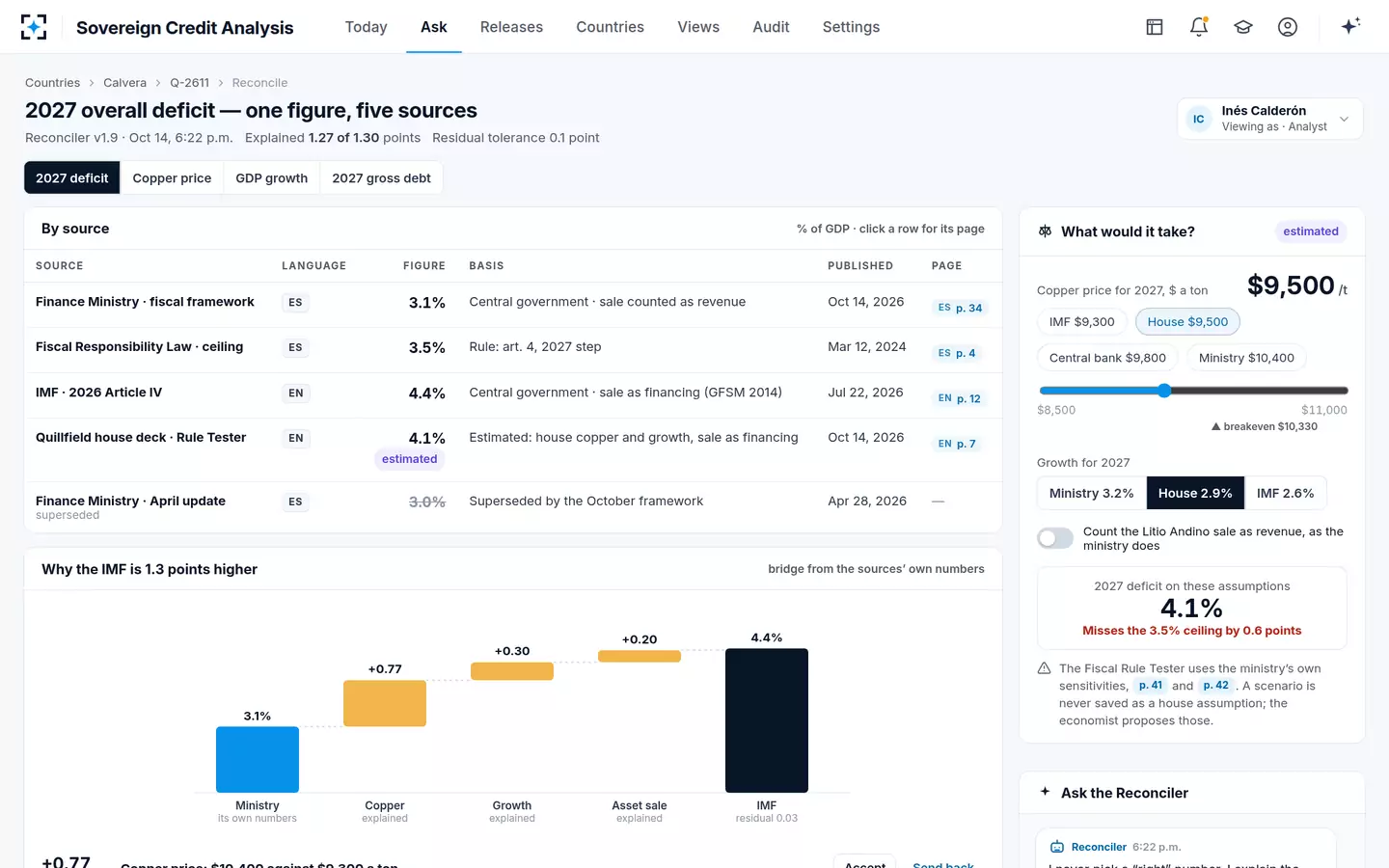
The bridge changes the question a portfolio manager hears. "The IMF is 1.3 points more pessimistic" sounds like a difference of view about Calvera's fiscal discipline. "The IMF uses $1,100 less copper, 0.6 point less growth and books the stake sale as financing" is a statement about commodities and accounting, and only the first two parts are a matter of opinion. The house view then turns on one testable question, which copper price to believe, and testing the fiscal rule on the house's own assumptions answers it.
When the gap cannot be explained, it is a finding
An unexplained gap between the government's figures and an independent source is not noise to average away; it is the most important thing in the file until it is explained. In the sample, the firm's tolerance is 0.1 point of GDP: a larger residual is marked unexplained and goes to the analyst, and in the sample week one country's figures did exactly that.
Real cases show why the rule exists. In 2025 the IMF dealt with misreporting of Senegal's fiscal data; after an audit, its staff estimated total public sector debt at 132% of GDP at the end of 2024, including domestic expenditure arrears still under audit (IMF press release 25/360, November 2025). The IMF's October 2026 World Economic Outlook table carries general government gross debt for Senegal of 136.1% of GDP for 2024 and 127.7% for 2025, and no projection beyond 2025 (IMF DataMapper, WEO October 2026). Two official figures for the same year, a few points apart, on different perimeters, and a missing projection: each is a reason to read the documents rather than the headline.
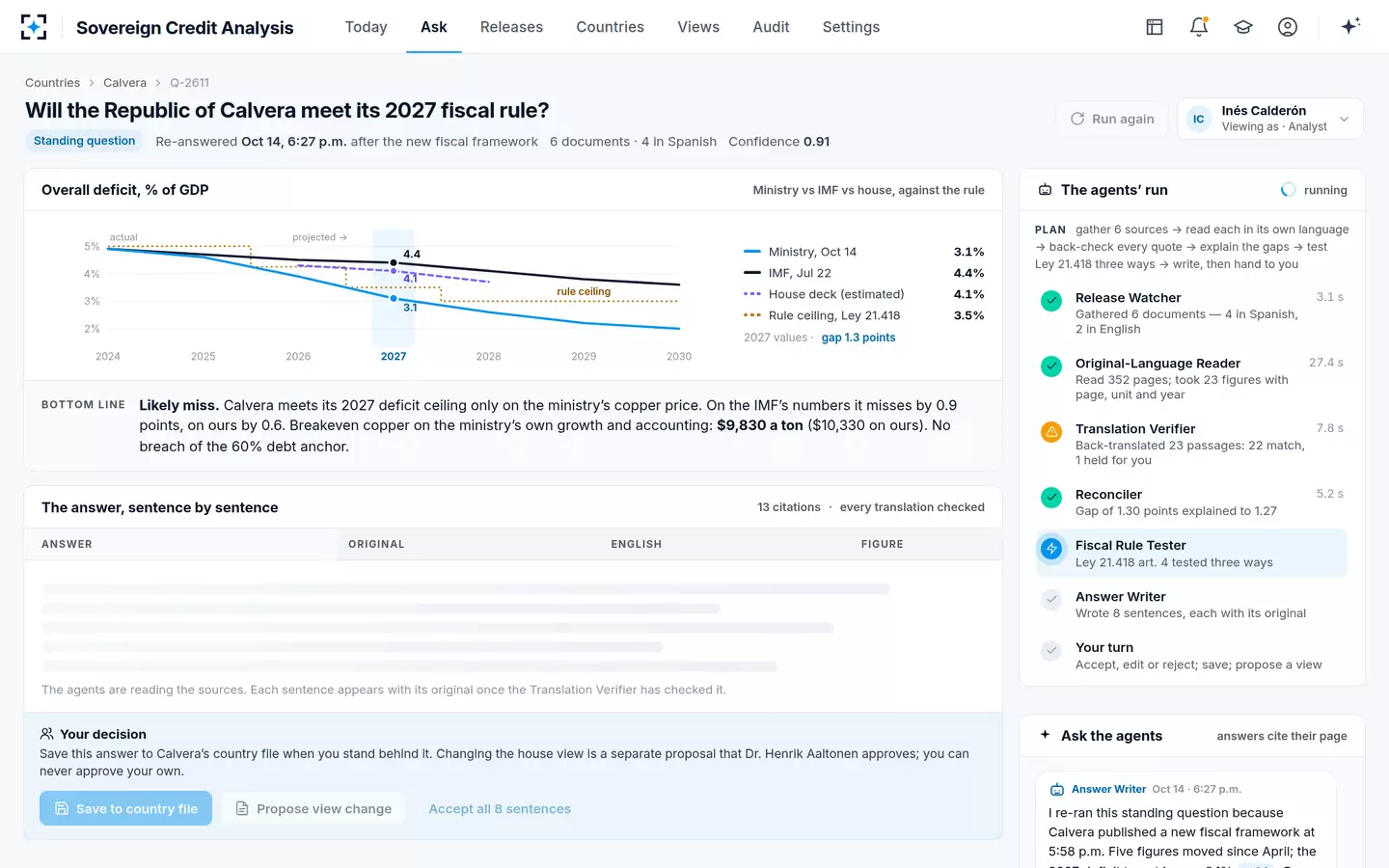
Six documents, four in Spanish, read and reconciled by Sovereign Credit Analysis in 52 seconds
How to read an Article IV staff report in an hour
An Article IV staff report is long, but an analyst comparing it with a budget needs only a handful of sections, read in the right order. The IMF's guidance lists what every report must contain, from "A clear and candid assessment of the short- to medium-term outlook" to "A classification of data adequacy for surveillance" and an assessment of how the authorities responded to past advice.
Reading an Article IV report against the budget: eight stops
- The press release and the Board's assessment
Whether Directors endorsed the thrust of the staff appraisal, and the one-paragraph view.
- The dates
Mission, staff report, Board. Then list what the government has published since the mission.
- The fiscal table's perimeter
General government, central government or wider, and whether it matches the budget you are comparing.
- The assumptions table
Growth, inflation, the exchange rate and any commodity price the budget depends on.
- One-off items and asset sales
How staff treat them, usually in a footnote or text box; this is where classification gaps hide.
- The debt sustainability analysis annex
The baseline debt path, the financing needs and which shock breaks the path first.
- The data adequacy classification
Adequate, broadly adequate, or significantly hampering surveillance; anything but adequate deserves a note.
- The authorities' views
Where the government disagrees with staff, in its own words. Often the best guide to the next budget.
Done by hand for one country, that is an hour. Done for every Article IV and every budget in a 25-country book, with the bridge built line by line, it is the step that gets cut. That is the step Sovereign Credit Analysis is built to keep: the analyst starts from the explained gap and spends the hour on the line that was not explained.
Questions people ask
What is a concluding statement?
It is the short statement IMF staff may issue at the end of an Article IV mission, before the staff report is written. The IMF's guidance says missions issue "either a concluding statement or a press release, but normally not both", and that concluding statements "represent the preliminary views of staff" subject to Board discussion. It is the earliest public read on what the report will say.
What is in an IMF staff report?
Recent developments, staff's baseline projections and risks, a policy discussion with the authorities' views, a staff appraisal with recommendations, a debt sustainability analysis, and a statistical appendix with a data adequacy classification. Selected issues papers on specific topics are sometimes published alongside.
Why is the IMF deficit higher than the government's?
Usually some mix of a wider government perimeter, stricter treatment of one-off revenues such as asset sales, an older or newer vintage, and more cautious assumptions on growth or commodity prices. Under the IMF's statistics manual, privatisation proceeds are financing, not revenue, which alone can raise the IMF's deficit relative to a budget that counts them as income.
Where can I find IMF Article IV reports?
On the IMF's website, under each country's page and the country reports series, when the member has consented to publication. The IMF's DataMapper carries the projections that feed its World Economic Outlook, which is often the quickest way to see the IMF's latest numbers for a whole book at once.
Does the IMF use the government's data?
Yes, as its starting point, but it compiles them to its own standards and adds its own projections. The Article IV must classify whether a country's data provision is adequate for surveillance, and the statistical appendix notes weaknesses, so a reader can see how far the IMF trusts the national figures.