Sovereign credit analysis is the work of judging whether a government can and will keep servicing its debt, from its budget, fiscal rule, debt path and financing plans, and comparing the government's numbers with independent ones such as the IMF's. Software for it has to clear a higher bar than most research tools, because the senior sovereign strategist who signs the house view will not act on a number she cannot trace, and in emerging markets the number is usually on a page in Spanish, Turkish or Bahasa Indonesia. Strategists come to trust such software feature by feature, by checking it, not because a vendor states an accuracy rate. Botminds' Sovereign Credit Analysis is built around that: every sentence of an answer sits beside its original-language quote, its English and the figure it uses; every translation is back-checked; every gap with the IMF is explained or marked unexplained; and the strategist approves every change to the view.
Why checking comes before trusting
82.5%
of machine-translated sentences kept their overall meaning in a peer-reviewed test of seven languages
55%
for Armenian in the same test, against 94% for Spanish
22/23
translated budget quotes matched on back-translation in the sample run; one was held for the analyst
100%
of answer sentences tied to an original-language page
design target
What is sovereign credit analysis?
Sovereign credit analysis, also called sovereign risk analysis, is the assessment of a government's capacity and willingness to repay its debt. It rests on four bodies of evidence: the fiscal accounts (deficit, primary balance, debt and its currency and maturity mix), the financing plan, the external position (reserves, external debt, the current account) and the institutions that hold policy in place, from a fiscal rule to an independent central bank. The analyst's output is a judgment about direction as much as level: is this government's position getting better or worse, and do its own plans add up?
The defining feature of the work is that the sources disagree. A ministry publishes its own deficit on its own assumptions; the IMF projects the same deficit on its own; a central bank uses a third copper price or oil price. The analysis is largely the explanation of those differences. Formal tools sit on top: the IMF's debt sustainability frameworks, covered in how the IMF reaches its verdict, and fiscal-rule tests on the house's own assumptions.
How is sovereign credit analysis done in practice?
In practice, sovereign credit analysis is a loop that restarts every time a government publishes: find the release, read it, take the figures that matter, compare them with the last version and with the IMF, test whether the country's fiscal rule still holds, and decide whether the house view should change. On a desk covering a full emerging-markets book, that loop runs dozens of times a month.
Each step has a characteristic failure. Finding fails when a ministry moves its web page. Reading fails in a second language. Taking figures fails on decimal commas, units and the government perimeter. Comparing fails when time runs out and only the headline is compared. Testing fails when the rule is run on the government's assumptions instead of the house's. Deciding fails when a view changes by email and nobody can later find the page it rested on. Good software is judged on how visibly it handles each of those, not on how fluent its summaries sound.
What software do sovereign analysts use?
Most sovereign desks combine spreadsheets for country models, market data terminals for prices and spreads, official databases such as the IMF's World Economic Outlook, a research management system for notes and views, and email for everything in between. No regulator or independent study publishes which tools desks use or in what proportion, so treat any market-share claim with suspicion.
What the usual stack lacks is the step between the government's document and the spreadsheet. Data terminals carry prices and published statistics; official databases carry harmonised figures months later; neither reads the 96-page framework a ministry published at 5:58 p.m. That step, done by people with browser translations, is where most of the hours and most of the errors sit, and it is the step agent-based software takes on. The week after a budget follows those hours through one release.
Why strategists do not trust AI output by default
Strategists are right to start sceptical, and the IMF's own staff explain why. A FinTech note on generative AI in finance concludes that "In the context of financial services, GenAI hallucination is a significant risk on multiple levels. It undermines GenAI robustness and raises financial safety and consumer protection concerns", and observes that mitigation efforts "are narrowly focused on specific tasks (for example, abstractive summarization) rather than on addressing the problem from a broader perspective" (IMF FinTech Note 2023/006).
For sovereign work, a second risk sits on top of the first: translation. A model can read a Spanish budget fluently and still turn "3,1" into 31, "ingresos tributarios" (tax revenue) into revenue, or a central government figure into a general government one. None of those errors is visible in the English. They only show when the English is put back beside the original and the figure is checked against its unit, perimeter and year.
A strategist who cannot see the page behind a number is being asked to trust the software. One who can see it is being asked to check it, which is a much easier request.
How accurate is machine translation for financial documents?
No regulator or independent study publishes an accuracy rate for machine translation of budgets or fiscal frameworks, so the honest answer comes from adjacent evidence and from measuring your own. The best-controlled public evidence comes from medicine. A peer-reviewed study had native speakers score 400 machine-translated emergency-department instructions in seven languages: "The overall meaning was retained for 82.5% (330/400) of the translations", with Spanish at 94% and Armenian at 55%, and the authors concluded the tool was "inconsistent between languages" (Taira and others, Journal of General Internal Medicine, 2021).
Machine translation keeps the meaning far more often in some languages than others
Two lessons transfer to sovereign work. Accuracy differs by language, so a desk covering eight languages cannot rely on one average. And "meaning retained" is the wrong test for a budget anyway. A translated fiscal table can keep its meaning while getting the one thing that matters wrong. For budgets, accuracy has to be scored figure by figure, against five things: the number, the unit, the perimeter, the period and the sign.
Five checks on every translated budget figure, and what each catches
| Check | What it asks | What goes wrong without it | In the sample |
|---|---|---|---|
| Number | Does the back-translation give the same figure? | Decimal comma read as a thousands separator: "3,1" becomes 31 | "3,1" on p. 34 read as 3.1; back-translation matches |
| Unit | Percent of GDP, of revenue, local currency, dollars? | A share of revenue compared with a ceiling in % of GDP | % of GDP |
| Perimeter | Central, general government, or wider public sector? | A central government deficit tested against a general government rule | Central government |
| Period and status | Which year, and outturn, estimate or projection? | A 2026 estimate compared with a 2027 target | 2027 projection |
| Sign and negation | Deficit or surplus; "no podrá exceder" or "podrá exceder"? | A ceiling read as a floor, a negation dropped | "no podrá exceder" read as a ceiling (the rule text, p. 4) |
How do analysts check translated figures?
The reliable method is back-translation plus a figure check: translate the passage into English, translate the English back into the original language independently, compare the two originals, and then check the figure against its unit, perimeter and period. It is slow by hand, which is why desks usually skip it and trust the first translation. In Sovereign Credit Analysis the Translation Verifier does it for every quoted passage, and it "can block a sentence, cannot edit it": a mismatch goes to the analyst, never into a silent correction.
Page 34 in Spanish and in English, with the checks on the figure
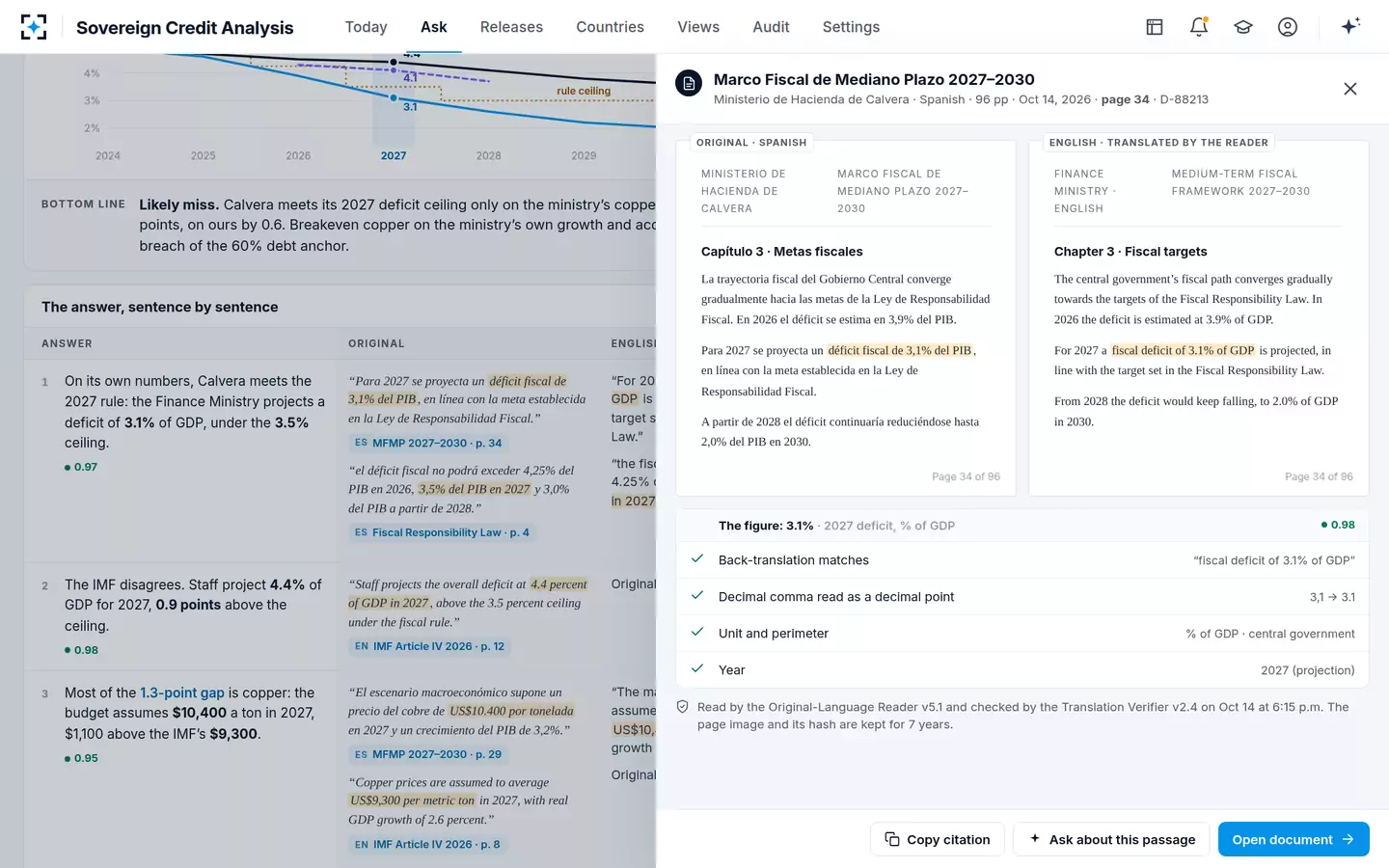
The held passage is the most useful thing on the screen for a sceptical strategist. A tool that reports 23 of 23 matched every time is either very good or not checking. One that holds the one passage where two readings are possible, says which two, and waits for a person, is showing its working. The perimeter check matters as much: the IMF's statistics manual defines the general government as "resident institutional units that fulfill the functions of government as their primary activity", which is wider than the central government budget most ministries publish (IMF, Government Finance Statistics Manual 2014).
A first month in which checking gives way to trust
Trust in research software is earned in a sequence: first the strategist checks everything, then only what the software flags, then only what changes a view. The plan below is our suggestion for the first month, built on what the software makes checkable. It shortens as the measured error rate falls, and stops shortening if it does not.
From checking every sentence to checking the exceptions, in four weeks
- Every sentence against its pageweek 1
- Every held passage and gapweek 2
- One answer in five, in fullweek 3
- Exceptions onlyweek 4
- Every citation in each memoweeks 1–2
- The bridge and the rule testweek 3
- The reason to changeweek 4
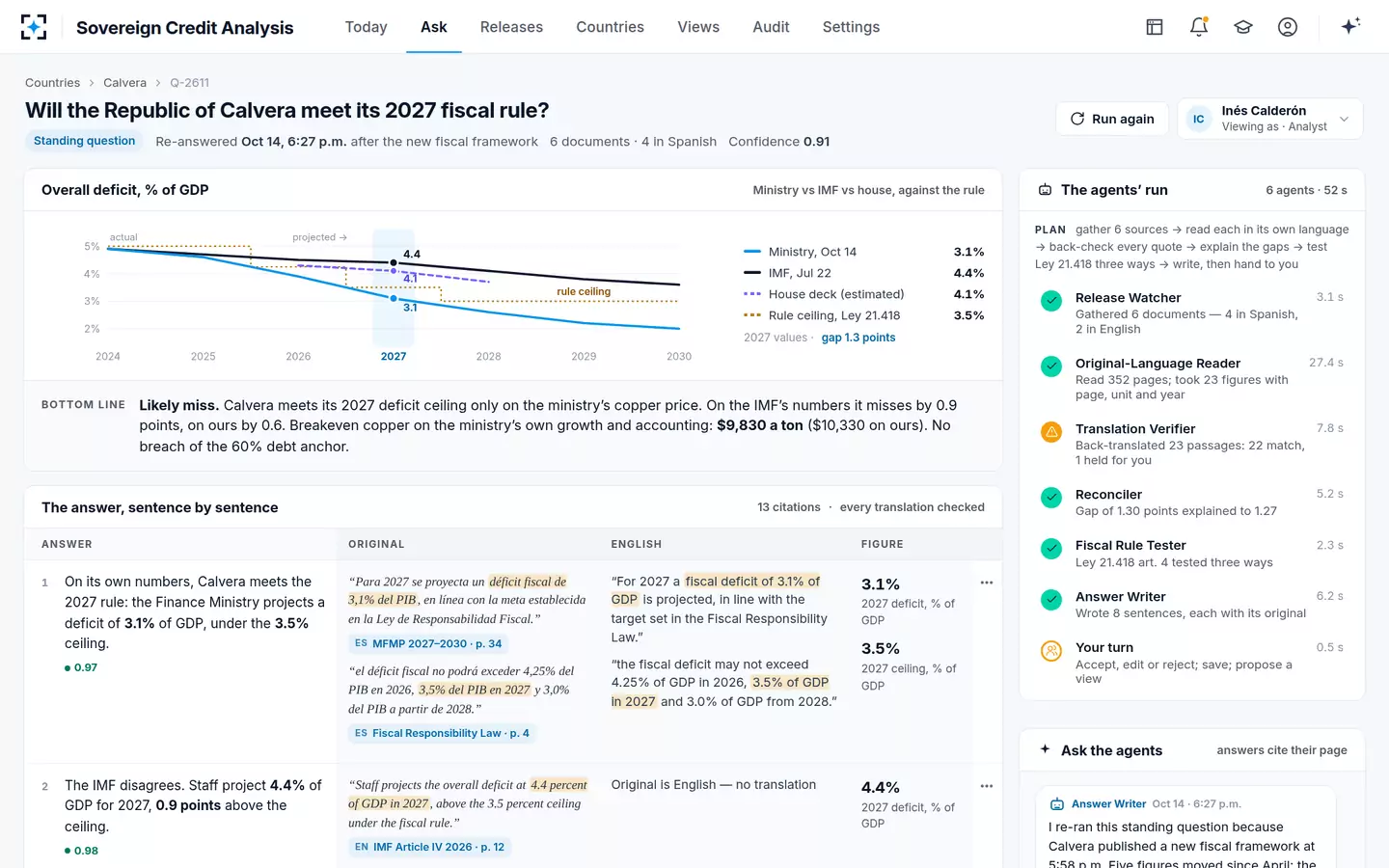
Week one costs time on purpose. The analyst opens every cited page for every answer, which on the sample's eight-sentence fiscal-rule answer means 13 citations, and the strategist opens every citation in every memo. Week two narrows to what the software flags: held translations, figure gaps the Reconciler could not explain within 0.1 point of GDP, and sentences below the 0.85 confidence floor. By week four the analyst checks the exceptions and the strategist reads the reason to change, the part of the job that was always theirs.
Two numbers tell a team whether to move on: how often an analyst edits or rejects a sentence the software wrote, and how often a held translation turns out to have been wrong. Both are visible in the trail, because every accept, edit and reject is logged with its reason. A team that sees those rates stay high should stay in week two, and should tell the vendor which language or document type is failing.
The answer the strategist reads: each sentence beside its proof
What makes analysts trust AI output?
Analysts trust AI output that shows its sources, shows its uncertainty and cannot overrule them. That translates into specific features a buyer can test in a demonstration, rather than claims to take on faith.
Eight features that make sovereign research output checkable
- Every sentence beside its original-language quote
Not a footnote list at the end: the quote, the English and the figure on the same line, one click from the page.
- A confidence per sentence, with a floor
Below the floor a sentence shows as "check" and cannot be saved until a person accepts it.
- Disagreements surfaced, not resolved
When the ministry and the IMF differ, both figures appear with the reason; the software never picks a "right" number.
- A residual left unexplained is labelled
A gap the bridge cannot explain within a stated tolerance is marked unexplained and sent to the analyst.
- Checkers that can block but not edit
A translation check that silently fixes text hides its own errors.
- Versioned readers and checkers
Which version of which agent read which page, and when, so a change in behaviour can be traced.
- Results on house assumptions labelled as estimates
A fiscal-rule test on the firm's copper price is an estimate, and should say so.
- The source page kept with the answer
Ministry sites move documents; the page image and a hash of it should stay with the answer.
Most of the list is about what the software refuses to do. The IMF's own debt framework takes the same stance toward its mechanical signals: users must rely on judgment "if a mechanical signal is counterintuitive", and that judgment is reviewed (IMF SRDSF guidance note, 2022). Software that leaves room for a person to overrule it, and keeps the reason, is easier to trust than software that never seems to need one.
How long does it take to adopt research software?
No independent study measures how long research desks take to adopt new software, so set the timeline by evidence rather than by calendar. The month above is a reasonable plan for one team on one book if the error rates fall; the gating question at each stage is whether the checks found anything material. Set-up comes first: the countries, languages and official sources covered, the people and roles who propose and approve, and the systems the software connects to, such as the research management system and portfolio accounting.
The fastest adoption comes from running the software on documents the team has already worked through by hand. Take last quarter's releases for five countries, run them, and compare the answers with the notes the team actually wrote. Where they differ, find out who was right and why. That exercise answers the strategist's real question, whether she would have reached the same view faster, in a way no accuracy claim can.
Where Sovereign Credit Analysis fits, and where it does not
Botminds' Sovereign Credit Analysis fits a desk whose bottleneck is reading and reconciling official documents in many languages, and whose strategist wants every view change to rest on a page. It does not fit a desk looking for a ready-made country score to buy; it does not trade, recommend trades or contact clients; and it reads agency rating actions without adopting them, because the house view is the firm's own. Its translation checks reduce the risk of a misread figure, but the Verifier holds what it cannot decide, so a team should expect to decide some passages itself, especially early on. Five confusions that flip a fiscal-rule verdict shows the kind of error those checks exist to catch.
Questions people ask
Can AI help with sovereign credit research?
Yes, with the reading and reconciling, which is most of the time spent. Agents can fetch releases, read them in the original language, extract figures with their units and pages, compare them with the IMF's and explain the gaps. On our estimate that turns about 5.25 analyst-days per major release into 0.85 days of review, while the judgment and the house view stay with people.
Is Google Translate reliable for financial reports?
Not reliably enough to use unchecked. In the peer-reviewed medical study above, meaning survived in 94% of Spanish translations but only 55% of Armenian ones, and fiscal documents add a stricter test: the figure, unit, perimeter, period and sign must all survive. A translation you use for a credit decision should be back-checked figure by figure.
What is back-translation?
Back-translation is translating a translated passage back into its original language, independently, and comparing it with the source to see whether the meaning, and in financial text the numbers and units, survived. It catches errors invisible in the English alone, such as a decimal comma read as a thousands separator or a dropped negation.
How do I evaluate sovereign credit analysis software?
Run it on releases your team has already analysed, in at least three of your languages, and check every sentence against its page for a week. Count edits, rejections and held passages by language, and ask to see an unexplained gap. Software that can show you where it was unsure is the kind you can adopt.
What does a cited answer mean?
A cited answer is one in which every sentence carries the passage it rests on, with the document and page, so a reader can open the source in one step. In Sovereign Credit Analysis each citation shows the original-language quote, its English and the figure used, and a sentence with no source is refused before it reaches the analyst.