An EM sovereign analyst judges whether emerging-market governments can and will keep paying their debts, and turns that judgment into a house country view that portfolio managers use to size positions. The raw material is the government's own paper: budgets, medium-term fiscal frameworks, debt office bulletins, central bank decisions, plus the IMF's Article IV reports. Much of it is published only in the original language, and the questions that matter, whether a fiscal rule will hold and why the IMF sees a different deficit, are buried in tables on page 34 and page 41. Botminds' Sovereign Credit Analysis exists for that gap: seven agents fetch every release, read it in its own language, check every translated figure and reconcile it with the IMF, and the analyst starts from a cited answer instead of a blank spreadsheet. This guide follows one week of the work, the week after a budget lands.
The week on this page is sample data. Quillfield Capital, its people and the Republic of Calvera are fictional, and so is every figure that describes them; the IMF and EU rules quoted along the way are real and linked where they appear.
One Spanish framework, one analyst, one week
96pages
in Spanish, published Wednesday at 5:58 p.m.
5figures
moved since the April version of the same framework
1.30points
of GDP between the ministry's 2027 deficit and the IMF's
5.25days
of analyst time to work it through by hand
Botminds estimate
What does an EM sovereign analyst do?
An EM sovereign analyst answers one question for each country in the book, over and over: will this government keep servicing its debt, and is that changing? The answer is built from the fiscal accounts (deficit, primary balance, debt and its currency mix), the financing plan (how much the government must borrow this year and from whom), the policy framework (fiscal rules, the central bank's stance) and the gap between what the government says and what independent forecasters such as the IMF project.
The output is rarely a rating. On a buy-side desk it is a house view, such as Neutral to Underweight with a negative fiscal outlook, a note that explains it, and a short list of what would change the house's mind. Portfolio managers decide positions; the analyst's job is to make sure the view rests on the latest documents and that every number in the note can be traced to its page. The corporate side of the same desk works the same way, as the buy-side credit analyst shows.
What makes the role hard is not any single calculation. It is that the calculations must be redone every time a document lands, in a dozen or more countries, from documents that disagree with each other on purpose. A ministry projects its own deficit under its own assumptions; the IMF projects the same deficit under its own; the house has a third set. The analyst's value is in explaining the differences.
What documents do sovereign analysts read, and when do they land?
Sovereign analysts read the government's fiscal documents first and the IMF's second, because the government publishes first. The table below is the core of a typical country file. The cadence column is only as firm as its source: the IMF and EU rules are quoted from the texts linked in the caption; the national documents follow each country's own budget law and calendar.
The documents behind a sovereign country view, and who publishes them
| Document | Published by | When | What the analyst takes from it |
|---|---|---|---|
| Budget and medium-term fiscal framework | Finance ministry | Each budget cycle, often with a mid-year update | The deficit target, the macro assumptions behind it, the sensitivities, one-off measures |
| Fiscal responsibility law or fiscal rule | Parliament | When enacted or amended | The ceiling or anchor the budget must meet, and its escape clause |
| Debt bulletin and borrowing plan | Debt office or treasury | Usually monthly or quarterly | Debt stock, currency and maturity mix, guarantees, the year's issuance |
| Policy decision and monetary policy report | Central bank | On the central bank's calendar | Its own growth and commodity assumptions, often different from the ministry's |
| Article IV staff report, with its debt sustainability analysis | IMF | Consultations are "normally expected annually" | An outside projection on general government, and the gaps with the budget |
| Sovereign rating actions | Rating agencies registered in the EU | On a published calendar, on Fridays, outside market hours | An external signal, read but not adopted as the house view |
Two features of this list shape the analyst's week. The first is language. Everything in the first four rows is published by the government in its own language, and the English versions, where they exist, are often shorter. The IMF's own staff are told that "Publication in languages other than English (LOE) is also encouraged as appropriate" (IMF Article IV guidance, 2015), which tells you the default for the outside view is English, and the default for the inside view is not.
The second is timing. The government's documents arrive throughout the year; the IMF's outside view arrives once. The IMF factsheet says "IMF monitoring typically involves annual visits to member countries" (IMF, IMF Surveillance factsheet), and the Board's norm is to discuss the report within 65 days of the end of the consultation for most members. A budget that lands in October is therefore usually compared with an IMF projection made months earlier, which is why the gap between the IMF and the budget is the first thing to explain, not a mistake to correct.
Wednesday, 5:58 p.m.: a 96-page framework in Spanish
Take the sample week as it runs. At 5:58 p.m. on Wednesday, October 14, 2026, Calvera's Finance Ministry publishes its Marco Fiscal de Mediano Plazo 2027–2030: 96 pages, in Spanish, superseding an April update of 38 pages. Inés Calderón, the senior sovereign credit analyst who covers Calvera for Quillfield, also covers 24 other countries in eight other languages. Her portfolio managers hold $684.2 million of Calvera's bonds across 14 funds, and they want to know by Thursday morning whether the new framework changes anything.
By hand, Wednesday night is the browser-translation pass: skim the macro chapter, find the fiscal targets chapter, note that the 2027 deficit target moved from 3.0% to 3.1% of GDP. The rest waits for Thursday, because the figures that explain the move are in a sensitivity table on page 41, a revenue line on page 37 and a debt table on page 45, and they all have to be typed into the country model before anything can be compared.
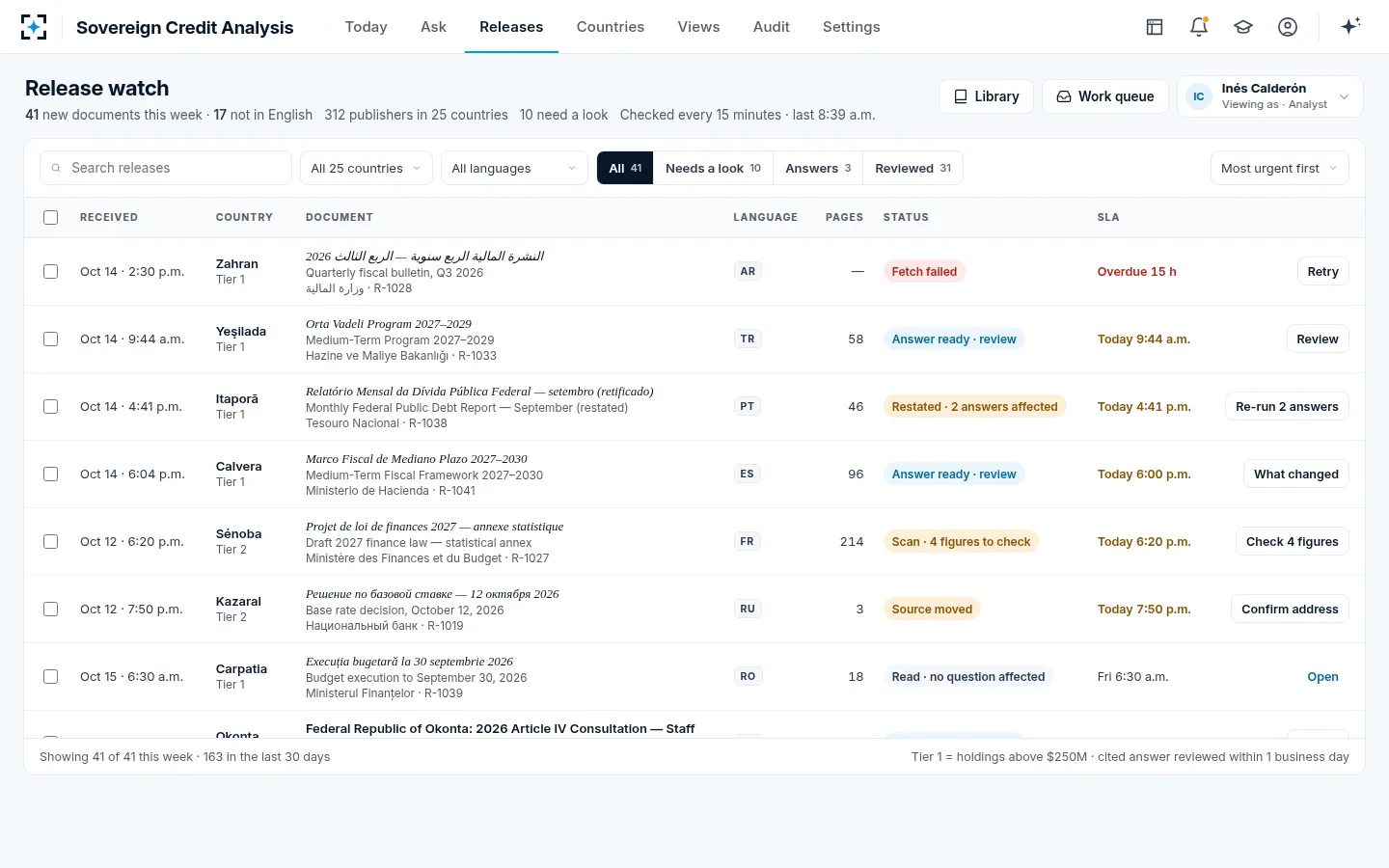
The release queue in Sovereign Credit Analysis on the day the Calvera framework landed
Where the week goes when the reading is done by hand
Most of an analyst's week after a budget goes to finding, reading and re-keying, not to the judgment the job exists for. The Timeline below splits one framework release on a large holding into its tasks. The by-hand lane is our estimate for an analyst working without the solution; the second lane is the analyst's time when the agents have done the fetching, reading, checking and first comparison overnight.
Five days of reading and re-keying become under one day of review
- Find0.5 d
- Read it in Spanish1.5 d
- Re-key figures0.75 d
- Compare1 d
- Test rule0.75 d
- Note0.75 d
- Review0.55 d
- Note0.3 d
The by-hand lane is not slow because analysts are slow. Reading a 96-page fiscal document in a second language is genuinely a day and a half of work, and re-keying is where errors enter: a decimal comma read as a thousands separator, a percentage of revenue entered as a percentage of GDP, a central government figure compared with a general government one. Each of those can flip a fiscal-rule verdict, and five confusions that flip a verdict walks through them one by one.
The comparison step is the one that suffers most when time runs short. With a full book, the government's numbers get compared with the IMF's on the headline deficit only, and the reasons for the gap go unexplained. That is the step where an analyst adds the most, and it is the first one cut.
How many countries does a sovereign analyst cover, and why the long tail goes unread
There is no standard coverage figure: no regulator or independent study publishes one, and desks split the work differently between analysts, economists and strategists. In the sample team, Inés covers 25 countries in nine languages, English among them. What matters more than the number is the shape of the book: a handful of large holdings that get read the day a document lands, and a long tail of smaller countries that get read when there is time, or through someone else's English summary.
The sample week shows the arithmetic. Forty-one releases arrived from 312 official publishers; 17 were not in English. On a desk working by hand, the Tier 1 countries, where the firm holds more than $250 million, absorb the week, and a scanned French budget annex in a Tier 2 country waits. Even a restated Portuguese debt report on a Tier 1 country can sit unread if it lands the same evening, and a Russian-language rate decision whose web address moved may not be found for days.
The cost of the long tail is not visible until it is. A country that is small in the book can still produce the surprise of the quarter, and history is unkind to the assumption that a quiet country stays quiet: Reinhart and Rogoff's long history of crises found that "serial default is a nearly universal phenomenon" as countries move from emerging to advanced status (Reinhart and Rogoff, NBER Working Paper 13882). Coverage that reads only the big names is a bet that the next problem will be one of them.
How do sovereign analysts use IMF reports?
Sovereign analysts use the IMF's Article IV report as the outside benchmark: an independent projection, on a defined government perimeter, with a debt sustainability analysis attached. They do not use it as the answer. The IMF's 2015 guidance for Article IV surveillance tells its staff to "focus on general government or an even broader definition of the public sector, rather than central government" (IMF Article IV guidance, 2015), while many budgets are presented for the central government, so the two documents can disagree before anyone has made a forecast.
The IMF's data also sets the context for a whole book at once. Its October 2026 World Economic Outlook puts general government gross debt in emerging market and developing economies at 76.2% of GDP for 2026, up from 69.9% in 2024, against 94.6% for the world (IMF DataMapper, WEO October 2026). The 2025 and 2026 figures are IMF estimates and projections, and reading the IMF debt table correctly depends on its definitions.
In the sample, the IMF's July 2026 Article IV projected Calvera's 2027 deficit at 4.4% of GDP against the ministry's new 3.1%. On a Thursday morning by hand, that 1.3-point gap is a sentence in a note. With the agents it is a bridge: 0.77 points from copper (the budget assumes $10,400 a ton, the IMF $9,300, at the ministry's own sensitivity of 0.07% of GDP per $100), 0.30 from growth (3.2% against 2.6%) and 0.20 from a state stake sale the ministry counts as revenue and the IMF books as financing. That is 1.27 of 1.30 points, each line cited to its page.
Thursday, 8:40 a.m.: the answer is waiting before the release is opened
With the solution, the Release Watcher fetched the framework at 6:04 p.m. on Wednesday, six minutes after publication, compared it with the April version and listed the five figures that moved, each with its page. It then re-ran Calvera's three standing questions. Overnight, the Original-Language Reader read 352 pages across six documents and took 23 figures with page, unit and year; the Translation Verifier back-translated each of the 23 quoted passages, matched 22 and held one for Inés; the Reconciler built the IMF bridge; and the Fiscal Rule Tester tested the 3.5% ceiling in Calvera's fiscal responsibility law three ways.
Thursday morning in Sovereign Credit Analysis: what needs the analyst, and what the agents did overnight
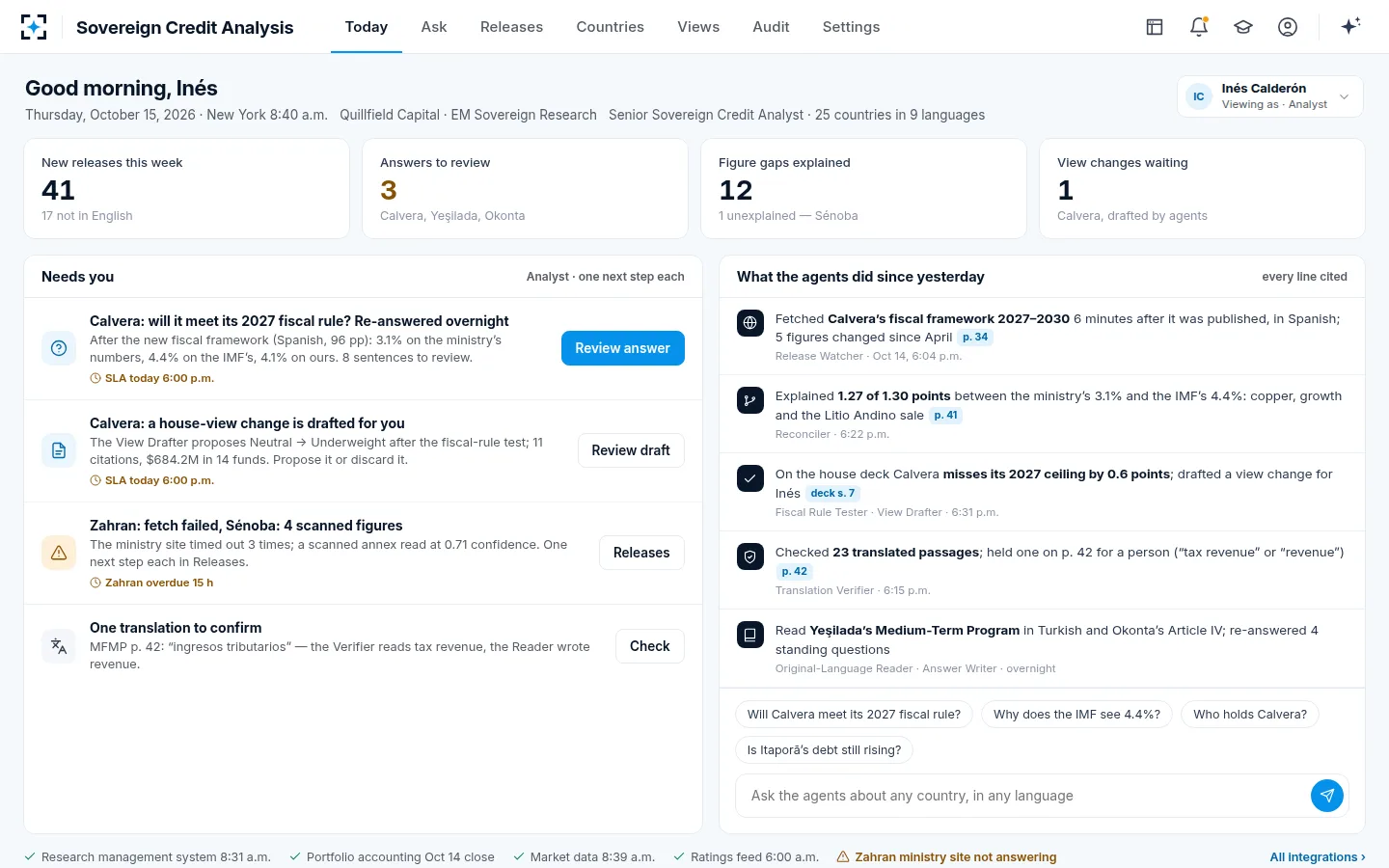
Inés's morning therefore starts in a different place. The answer reads "likely miss": Calvera meets its 2027 ceiling only on the ministry's copper price; on the IMF's numbers it misses by 0.9 points, on the house deck by 0.6. The decision in front of her is not whether the figures were typed correctly but whether she stands behind the conclusion, whether the held word on page 42 changes it, and whether to propose a change to the house view. Testing a rule this way is the subject of how to test a country's fiscal rule yourself.
What is a house country view, and who is allowed to change it?
A house country view is the firm's own, documented position on a sovereign, such as Overweight, Neutral or Underweight with a fiscal outlook, that portfolio managers use alongside their own judgment. It is a decision about other people's money, so the useful question is not who writes it but who may change it, and on what evidence.
Five people stand behind one sovereign view; only one of them can change it
Today
Reads the Spanish framework through a browser translation on Wednesday night, re-keys the figures into the country spreadsheet on Thursday and compares them with the IMF line by line on Friday.
With agents
Opens Thursday on an answer re-run overnight, each sentence beside the ministry's own words, and spends the morning on the one passage the translation check held.
Still theirs: What goes into the country file, and whether to propose a view change
Today
Hears about a view change by email, often after the trade, with the evidence in someone else's workbook.
With agents
Approves or rejects each change with a reason code, the cited memo and the holdings in front of him; never a change he proposed.
Still theirs: The house country view
Today
Keeps the house copper and growth deck in a separate workbook that the fiscal-rule test may or may not use.
With agents
Her approved deck is the only one the rule test may use; when it changes, the answers that rest on it re-run.
Still theirs: The house macro and commodity assumptions
Today
Reads the note, then works out which funds and bonds it touches.
With agents
Is told when a view changes on a country he holds, with holdings by bond and fund and spreads since the release.
Still theirs: Every position
Today
Rebuilds who changed a view, when and on what page from emails and spreadsheets.
With agents
Filters the trail to one view change and exports every step, with its evidence, for an examiner.
Still theirs: The right to read everything and change nothing
In the sample, the View Drafter wrote the memo at 6:31 p.m. on Wednesday because the Fiscal Rule Tester had found a miss on the house deck, one of two triggers set in the firm's settings. Inés proposed it at 9:12 a.m. on Thursday; Dr. Henrik Aaltonen, the senior sovereign strategist, approved it at 10:41 with the reason code "Fiscal rule miss on house deck"; the note reached the research management system and six portfolio managers a minute later. None of the agents can approve a change, trade, or contact a client, and the strategist cannot approve a change he proposed himself. Where the agents stop and the house view starts sets out that boundary in detail.
What the week leaves the analyst for
Taking the reading and re-keying out of the week does not take the analyst out of it; it moves the analyst to the parts no model does well. In the sample week those were concrete: one translated word that changes a revenue line, one figure gap in a Tier 2 country that the Reconciler could not explain within its 0.1-point tolerance, one restated debt report that changed two saved answers, and one failed fetch from a ministry site that timed out three times and went to a person within the hour.
Each of those is a judgment call with a page behind it. The point of the tools is that the analyst gets to them on Thursday morning, for every country in the book, rather than on Friday for the largest five. The rest of this series looks at the same week through other eyes: the strategist who must trust the output before signing, the head of research weighing what it costs against building or buying a country risk model, and the economics underneath, from debt sustainability to the difference between a primary and an overall balance.
Questions people ask
What languages do EM sovereign analysts need?
Enough to read the source documents, which is the problem: a broad EM book spans Spanish, Portuguese, French, Arabic, Turkish, Romanian, Russian and Bahasa Indonesia, and few analysts read all of them. The IMF encourages publication "in languages other than English" for its own reports, but national budgets and debt bulletins are published first, and often only, in the national language. Teams cover the gap with colleagues, translations or summaries, each of which adds time or a layer between the analyst and the page.
When are sovereign ratings published in the EU?
On a calendar. An EU-registered rating agency must publish each December a calendar for the next 12 months with "a maximum of three dates for the publication of unsolicited sovereign ratings", and the dates must fall on a Friday, under Article 8a of the EU Credit Rating Agencies Regulation. Sovereign ratings are released after the close of regulated markets and at least one hour before they open, and they must be reviewed at least every six months.
How often does the IMF review a country?
Usually once a year. The IMF's 2015 guidance says consultations for members without a Fund arrangement "are normally expected annually", while members with some kinds of Fund arrangement are placed on a 24-month cycle. Program reviews and staff visits can add contact in between, but the full Article IV staff report with its debt sustainability analysis is, for most countries, an annual document.
Does the IMF publish every Article IV report?
No, but most are published. Publication of staff reports is "voluntary but presumed" under the IMF's transparency policy, which means the member country must consent, and the IMF's factsheet notes that "most member countries publish the staff report". A missing report is itself worth noting in a country file.
Does an AI tool change the country view?
Not in Sovereign Credit Analysis. The agents fetch, read, check, reconcile and draft; the analyst accepts, edits or rejects each sentence with a reason, and a change to the house view needs the senior sovereign strategist's approval, never the proposer's. The agents never trade, never contact clients and never suggest orders.
How much of an analyst's week does the solution give back?
On our estimate for one framework release on a large holding, about 5.25 days of analyst time by hand against 0.85 days with the agents, most of the difference coming from reading in the original language, re-keying and the first comparison with the IMF. That is an estimate on fictional sample data, not a customer's measured result; a pilot on your own countries is how to measure it.