Section 16 filing software for an investment manager has to do something an issuer's insider-filing tool never does: decide whether the manager has become a beneficial owner of more than 10% of a registered class, and so a Section 16 insider with a Form 3 due within 10 days and a Form 4 due by the end of the second business day after each trade. For a fund manager the answer is not the same as for Schedule 13D or 13G. SEC Rule 16a-1(a)(1) counts beneficial ownership the 13(d) way but excludes shares a registered adviser holds for clients in the ordinary course without a control purpose, so a passive manager at 12% is often not an insider while an activist at 10.5% is. Botminds' Shareholding Disclosure Monitoring aggregates a manager's holdings across every entity each morning, flags the crossing of 10% and sends the Section 16 question to Legal with the facts behind it.
The rules are the Exchange Act's Section 16 and the SEC's Rules 16a-1 and 16a-3, read on the eCFR as current to October 2026. Examples from the product use its fictional sample manager.
From a 10% crossing to a Section 16 decision: what a tool should do and who decides
Agent
Count 13(d) beneficial ownership dailyAggregates every fund, mandate and affiliate by voting or investment power, as Rule 16a-1(a)(1) requires for the 10% test.
Agent
Flag the crossing of 10%Shows the date, the holdings behind it and which are held for clients in the ordinary course.
Agent
Check the purpose behind the holdingReads the filing basis: a Schedule 13D or a control purpose removes the adviser exclusion.
Never: Never decides the exclusion
A person decides
Legal decides insider statusApplies Rule 16a-1(a)(1) to the facts and records the reasoning.
A person decides
File Form 3, then a Form 4 per tradeWithin 10 days of becoming an insider; each change before the end of the second business day after the trade.
What should Section 16 filing software do for a fund manager?
It should know when the manager became a filer, before it helps with any form. Issuer-side Section 16 tools start from a list of directors and officers whose status is never in doubt. A manager's status turns on a daily count across every fund and entity, on which holdings Rule 16a-1(a)(1) excludes, and on whether the manager's purpose has changed. A tool that cannot tell a manager when it crossed 10% under the Section 16 count, or that the crossing now matters because the manager has filed a Schedule 13D, leaves the hardest part to a spreadsheet.
After that, the work is clocks and content. Forms 3, 4 and 5 each have their own deadline, the content follows a different definition of beneficial ownership from the one that triggered the filing, and every person who submits must have individual EDGAR credentials. Software that gets those right but misses the trigger is fast at the wrong job.
When does a fund manager become a Section 16 insider?
When it becomes the beneficial owner of more than 10% of a class of equity securities registered under Section 12, counted the 13(d) way. Section 16(a) applies to every person who is "directly or indirectly the beneficial owner of more than 10 percent" of such a class, as well as to directors and officers (15 U.S.C. 78p(a)). Rule 16a-1(a)(1) says that "solely for purposes of determining" whether a person crosses 10%, a beneficial owner is anyone so deemed "pursuant to section 13(d)", which means voting or investment power aggregated across all accounts and group members. That is a different test from the code-of-ethics one, which reaches the manager's own staff through the access person definition.
Then comes the carve-out that matters to asset managers. The same rule lists institutions, including registered investment advisers, banks, broker-dealers, insurers and registered funds, that "shall not be deemed the beneficial owner of securities of such class held for the benefit of third parties or in customer or fiduciary accounts in the ordinary course of business", but only while the shares were bought without any aim or effect of changing or influencing control of the issuer (17 CFR 240.16a-1(a)(1)).
The result is a split that tracks the Schedule 13D and 13G line. A registered adviser holding 12% across client accounts as a passive, ordinary-course investor usually counts none of those client shares for the 10% test. The same adviser running an activist fund that has filed a Schedule 13D cannot rely on the exclusion for those shares, and at 10.5% it is an insider. A fund's own proprietary capital, or a general partner's own holdings, are not held for third parties and are counted either way.
Schedule 13D and 13G against Section 16: two tests for one holding
Schedules 13D and 13G: More than 5% of a covered class.
Section 16 for a 10% owner: More than 10% of a class registered under Section 12.
Schedules 13D and 13G: Voting or investment power, aggregated across accounts and group members (Rule 13d-3).
Section 16 for a 10% owner: The same 13(d) count, except ordinary-course client holdings of listed institutions acquired without a control purpose (Rule 16a-1(a)(1)).
Schedules 13D and 13G: The beneficial ownership counted.
Section 16 for a 10% owner: Holdings in which the filer has a direct or indirect pecuniary interest (Rule 16a-1(a)(2)).
Schedules 13D and 13G: Schedule 13D in five business days; Schedule 13G in five business days or 45 days after the quarter, by filer type.
Section 16 for a 10% owner: Form 3 within 10 days of becoming an insider.
Schedules 13D and 13G: 13D amendment within two business days of a material change; 13G on quarter-end, month-end or two-day clocks.
Section 16 for a 10% owner: Form 4 before the end of the second business day after each transaction.
Schedules 13D and 13G: Cooling-off on voting and buying when switching from 13G to 13D.
Section 16 for a 10% owner: Short-swing profits from a purchase and sale within less than six months are recoverable by the issuer (Section 16(b)).
The adviser exclusion, and the day it falls away
The exclusion is conditional, and the condition can change overnight. It holds "as long as" the shares were bought with no control purpose and no control effect. A board letter, a nomination or a public campaign that moves a manager from Schedule 13G to 13D also removes the basis for excluding the client shares from the Section 16 count. A manager already above 10% when its purpose changes can become an insider the same day, with a Form 3 due within 10 days.
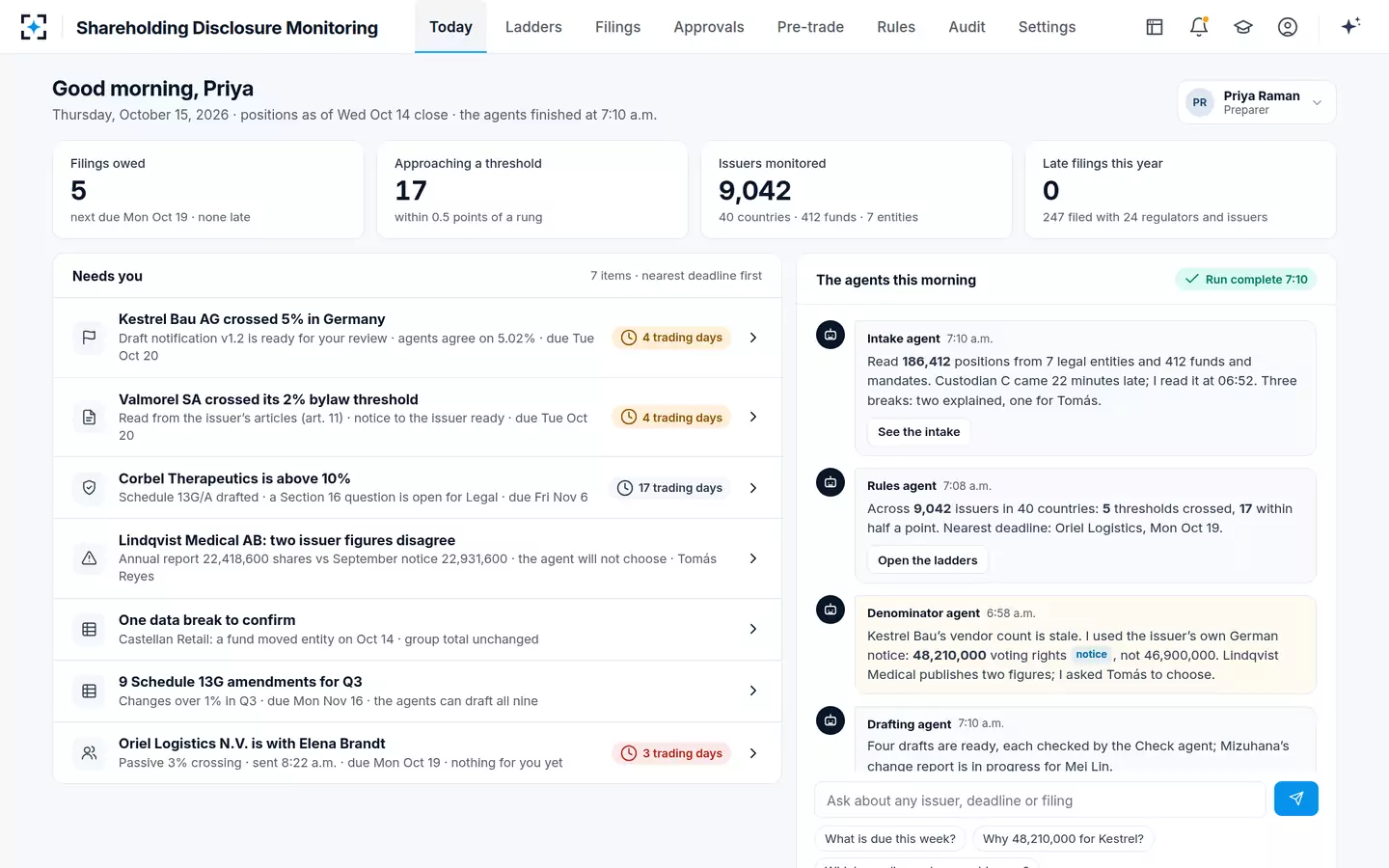
That is why the trigger belongs in the same system that tracks Schedule 13D and 13G. The facts that decide one decide the other: the aggregate holding, the entities and accounts behind it, and the purpose recorded for it. In Shareholding Disclosure Monitoring's sample data, Corbel Therapeutics reached 10.12% held by a registered adviser for clients; the agents' answer is that Rule 16a-1(a)(1) excludes those shares, so they see no Form 3, and that this is a legal judgment for the general counsel to confirm.
Shareholding Disclosure Monitoring flags a 10% crossing and routes the Section 16 question to Legal
Section 16 filing requirements: Forms 3, 4 and 5 and their clocks
Once an insider, a 10% owner files on the same three forms as a director. Section 16(a) requires the initial statement "within 10 days after he or she becomes such beneficial owner" and a statement of changes "before the end of the second business day following the day on which the subject transaction has been executed" (15 U.S.C. 78p(a)). Rule 16a-3 assigns the forms and adds the annual Form 5.
The three Section 16 forms and when each is due
| Form | What it reports | Due | Source |
|---|---|---|---|
| Form 3 | Initial holdings on becoming an insider | Within 10 days after becoming a more-than-10% owner | Section 16(a); Rule 16a-3(a) |
| Form 4 | Changes in beneficial ownership, including every transaction not exempt from Section 16(b) | Before the end of the second business day after the trade | Rule 16a-3(g)(1) |
| Form 5 | Holdings and transactions not previously reported that must be reported annually | Within 45 days after the issuer's fiscal year end | Rule 16a-3(f) |
| Any of the three | Filed on EDGAR | Deemed filed that day if transmission begins by 10 p.m. Eastern | Regulation S-T Rule 13(a)(4) |
Where several members of a group are each 10% owners only because their holdings are aggregated, Rule 16a-3(j) allows a single Form 3, 4 or 5 on behalf of all of them, signed by each. That is the usual route for a fund, its general partner and its adviser, and the software has to handle multiple reporting owners on one form.
What is the Section 16 filing deadline time?
10 p.m. Eastern Time on the due date. Regulation S-T Rule 13(a)(4) deems a Form 3, 4 or 5 filed on the same business day if its direct transmission begins by 10 p.m. Eastern Time; most other EDGAR filings close at 5:30 p.m. (17 CFR 232.13(a)). For a trade on a Monday, the Form 4 must be accepted by 10 p.m. on Wednesday.
The deadline is counted in business days, so federal holidays move it and exchange holidays that are not federal ones do not. A trade on the Friday before Memorial Day has a Form 4 due Wednesday, not Tuesday.
What is counted is not what is reported
Rule 16a-1 uses two definitions. The 13(d) count decides whether a manager is a 10% owner. Once it is, the forms report something else: holdings in which the filer has "a direct or indirect pecuniary interest", the opportunity to profit from a transaction in the securities (Rule 16a-1(a)(2)). The rule's note says so directly: a person deemed a 10% owner under paragraph (a)(1) files a Form 3, but the holdings disclosed on it are determined by paragraph (a)(2).
For fund managers the pecuniary interest rules decide what goes on the form. A general partner's proportionate interest in a partnership's securities is an indirect pecuniary interest. So is a performance-related fee, other than an asset-based fee, received by an adviser, unless the fee is calculated on gains over a period of one year or more and the issuer's securities are no more than 10% of the portfolio's market value. A tool that reports the 13(d) count on Form 4 has reported the wrong number.
A worked example: an activist fund that crosses 10%
Take an illustrative activist adviser whose funds hold 9.6% of a Nasdaq company and which filed a Schedule 13D in the spring after proposing changes to the board. Because its holding has a control purpose, it cannot rely on the Rule 16a-1(a)(1) exclusion for the shares its funds hold. On a Monday it buys enough to reach 10.3%.
The purchase that crosses the line is not itself reportable. Rule 16a-2(c) says "The transaction that results in a person becoming a ten percent beneficial owner is not subject to section 16 of the Act" unless the person is already subject to it, and a 10% owner reports only the transactions it makes while above 10% (17 CFR 240.16a-2(c)). From Monday the fund is an insider: its Form 3 is due within 10 days, and the Schedule 13D may need its own amendment within two business days if the change is material.
Every later purchase or sale is a Form 4 within two business days, and Section 16(b) starts to apply. Profit from a purchase and a sale within less than six months "shall inure to and be recoverable by the issuer", whatever the holder intended, but the subsection does not cover a transaction where the holder "was not such both at the time of the purchase and sale" (15 U.S.C. 78p(b)). That is why the crossing purchase cannot be matched while every purchase after it can.
The software lesson is in the dates. The system must record Monday as the day insider status began, carry that date into a six-month matching window for every later trade, and know that the purpose behind the holding, not just its size, removed the exclusion. A tool that starts from a list of insiders entered by hand will learn all three from the fund's lawyers, after the fact.
What the 2024 sweep showed about late Section 16 filings
The SEC found its late filers with data. On 25 September 2024 it announced settled charges against 23 entities and individuals over late Schedules 13D and 13G and Forms 3, 4 and 5, with penalties totalling more than $3.8 million; "SEC staff used data analytics to identify the charged individuals and entities as filing required reports late" (SEC press release 2024-148). Two public companies were charged as well, for contributing to their insiders' failures.
One SEC sweep of late beneficial ownership and insider reports
23
entities and individuals charged on 25 September 2024
$3.8M+
in combined penalties, including two issuers
13
entities, with penalties listed from $40,000 to $750,000
10
individuals, with penalties listed from $10,000 to $200,000
The examiners are looking at the same forms. For fiscal 2027 the Division of Examinations has said it will check that advisers who engage as activists file their ownership reports, Forms 3, 4 and 5 included, accurately and on time (SEC, Examination Priorities FY2027). Activist advisers are exactly the managers for whom the Rule 16a-1(a)(1) exclusion is least likely to hold. How late filings have been priced is set out in what late and missed filings have cost.
EDGAR Next: who can press submit
Since 15 September 2025, every person who files on EDGAR for a filer must use individual Login.gov credentials with multifactor authentication, and each filer must authorise at least two account administrators, one if the filer is an individual or single-member company, and confirm its authorised users each year (SEC, EDGAR Next fact sheet). The SEC also offers optional machine-to-machine interfaces for submissions.
For Section 16 this changes the evaluation. A fund, its general partner and its adviser filing jointly need their accounts and delegations in place before the Form 3 is due, and a tool or filing agent that submits for them must be authorised on each filer's EDGAR dashboard. A ten-day Form 3 clock is not the moment to discover that only one person in the firm can file.
What to ask of Section 16 filing software
Most Section 16 products were built for issuers filing for their directors and officers. A manager evaluating one, or deciding whether its beneficial ownership system should own the trigger, can use the questions below. Ask for a demonstration on last year's trades, not a slide.
Questions for any Section 16 tool a fund manager is considering
- Does it count 10% the 13(d) way, across every entity and group member, every day?
Rule 16a-1(a)(1) starts from the 13(d) count; a single-fund view will miss crossings.
- Can it hold the ordinary-course exclusion as a recorded legal decision, per issuer?
The exclusion depends on purpose; the tool should store who decided and why.
- Does a Schedule 13D or a change of purpose re-open the Section 16 question automatically?
The exclusion holds only while the holding has no control purpose.
- Does it report pecuniary interest, not the 13(d) count?
General partner interests and performance fees follow Rule 16a-1(a)(2).
- Does it compute Form 4 deadlines on the federal calendar with the 10 p.m. Eastern cut-off?
Two business days from the trade, not from the confirmation.
- Can one form carry several reporting owners?
Rule 16a-3(j) group filings, signed by each.
- How does it submit under EDGAR Next?
Individual credentials, authorised filing agents and, if offered, the SEC's filing interfaces.
- Does it warn before a trade that would create a short-swing match?
Section 16(b) recovery runs on purchases and sales within less than six months.
Where Shareholding Disclosure Monitoring fits for Section 16, and where it does not
The solution owns the part most Section 16 tools leave out: knowing when a manager crossed 10%. Its Intake agent reads end-of-day positions from every entity, fund and mandate; its Aggregation agent keeps the US 13(d) view beside each local rule; its Check agent recomputes every crossing independently before a draft exists. When a holding goes above 10% it flags the crossing, the date and the accounts behind it, and its Rules agent sends any Section 16 question to Legal rather than answering it. Its Pre-trade agent warns the desk before an order would cross a threshold, with the largest size that stays below.
What it does not do matters as much. It does not decide whether the ordinary-course exclusion applies; Legal does, and the decision is kept with its reason. It is not an issuer's tool for its own directors' and officers' Forms 4, and it does not replace a manager's legal review of pecuniary interest. Where Legal decides a fund is a Section 16 filer, the crossing date and the holdings behind it are already assembled with their sources for whoever prepares the Form 3. The 10% line also drives a Schedule 13G month-end clock, covered in the four Schedule 13G amendment clocks, and for a wider view of what to automate and what to keep, see what shareholding disclosure software should automate. The solution itself is at Shareholding Disclosure Monitoring.
Questions people ask
Does a fund manager file Form 4?
Only if it is a Section 16 insider, which for a manager usually means a more-than-10% beneficial owner. Shares a registered adviser holds for clients in the ordinary course, acquired without a control purpose, are excluded from that test under Rule 16a-1(a)(1); an activist manager that has filed a Schedule 13D generally cannot rely on the exclusion.
What are the Section 16 reporting requirements for a 10% owner?
A Form 3 within 10 days of becoming a 10% owner, a Form 4 before the end of the second business day after each change, and a Form 5 within 45 days after the issuer's fiscal year end for anything not already reported. Short-swing profits from matched purchases and sales within less than six months can be recovered by the issuer under Section 16(b).
Is the 10% for Section 16 measured the same way as for Schedule 13D?
It starts from the same 13(d) count, voting or investment power aggregated across accounts and group members, but excludes ordinary-course client holdings of listed institutions acquired without a control purpose. A manager can therefore be above 10% for Schedule 13G and below it for Section 16.
When is a Form 4 due if the trade is on a Friday?
By 10 p.m. Eastern on the following Tuesday, two business days later, or Wednesday if Monday is a federal holiday. The clock counts from the day the trade is executed.
Can a fund and its adviser file one Form 3?
Yes, where they are 10% owners because their holdings are aggregated as a group. Rule 16a-3(j) allows a single Form 3, 4 or 5 for all of them, with the required information for each and signed by each.
Did the SEC charge fund managers for late Forms 3, 4 and 5?
Its September 2024 sweep charged 23 entities and individuals over late Schedules 13D and 13G and Forms 3, 4 and 5, with more than $3.8 million in penalties, and said staff used data analytics to find them. Its fiscal 2027 priorities name those forms again for activist advisers.