There is no fixed 13F late filing penalty: the SEC does not charge a fee per day late. A manager that files Form 13F late, or not at all, faces an enforcement action, and the price is whatever civil penalty the order sets, within statutory ceilings of up to $118,225 per violation for a firm in the lowest tier. The most recent benchmark is September 2024, when the SEC charged eleven institutional investment managers with failing to file Forms 13F; nine agreed to pay more than $3.4 million in combined penalties, with individual amounts from $175,000 to $725,000, and two that had self-reported paid nothing. A week later it charged 23 filers over late Schedules 13D and 13G and Forms 3, 4 and 5, found by data analytics. Botminds' Shareholding Disclosure Monitoring exists to make that kind of miss unlikely: it reads every entity's positions each morning and keeps every 13F, 13G and non-US deadline on one calendar.
Figures on this page come from the SEC's press releases and the Federal Register. Where a range is given for a set of orders, it is our reading of the amounts the SEC listed.
What missing Forms 13F cost nine managers in September 2024
What is the penalty for not filing a 13F?
A civil penalty set in an SEC order, usually a settled one, plus a public finding that the firm broke the rule. The SEC's release for the 2024 cases said "Nine of the firms will pay more than $3.4 million in combined civil penalties" and named every firm (SEC press release 2024-135). No statute or rule sets a price per day or per form. Each order reflects the facts: how long the failure lasted, how many reports were missed, whether the firm came forward, and how it cooperated.
The obligation itself is simple, which is partly why enforcement treats a miss seriously. Any manager with investment discretion over at least $100 million of securities on the SEC's Official List, on the last trading day of any month, must file Form 13F within 45 days after each quarter (17 CFR 240.13f-1). The SEC's release described the duty in one line: managers that "have discretion over more than $100 million in certain securities" must report them.
The ceiling: civil penalty tiers per violation
The Exchange Act sets maximum civil penalties per violation in three tiers, adjusted each year for inflation. The amounts adjusted in January 2025 still apply: in July 2026 the SEC announced that, following Office of Management and Budget guidance, there would be no inflation adjustment for 2026 (91 FR 41722).
Maximum civil penalty per violation under Exchange Act Sections 21B and 21(d)(3), as adjusted in 2025
| Tier | When it applies | Natural person | Any other person |
|---|---|---|---|
| First | Any violation | $11,823 | $118,225 |
| Second | Fraud, deceit, manipulation or deliberate or reckless disregard of a regulatory requirement | $118,225 | $591,127 |
| Third | Second-tier conduct that caused substantial losses, or a significant risk of them, to others, or substantial gain to the violator | $236,451 | $1,182,251 |
The ceilings explain the shape of the 2024 orders. A first-tier maximum of $118,225 per violation for a firm means that a penalty of $475,000 or $725,000 cannot rest on a single first-tier violation: it reflects several violations, such as several quarters of missing reports, or a higher tier. A firm that misses one report and corrects it quickly is in a very different position from one that never knew it had crossed the threshold.
Self-reporting: the two firms that paid nothing
The most useful line in the 2024 release is about the firms that did not pay: "Two firms were not ordered to pay any civil penalties because they self-reported the violations at issue" (SEC press release 2024-135). They were still charged and named. But in a set of orders where the other nine paid between $175,000 and $725,000 each, finding the problem first was worth the whole penalty.
Self-reporting needs detection. A firm can only report a missed 13F if something tells it the $100 million test was met in a month when nobody was looking, or that a subsidiary's holdings should have been aggregated. The control that earns the self-report credit is the same monthly test that would have prevented the miss.
Late 13H filings: the large trader form in the same orders
Two of the eleven managers were "also charged with failing to file Forms 13H as required for large traders" (SEC press release 2024-135). Form 13H is due promptly once a firm becomes a large trader under Rule 13h-1, by daily or monthly volume in NMS securities (the thresholds are in 13F filing deadlines for 2026); after that, an annual update within 45 days after each full calendar year and an amendment promptly after any quarter in which the information became inaccurate (17 CFR 240.13h-1).
A manager large enough to file 13F is often large enough to be a large trader, and the two thresholds are measured differently: one on holdings at month-ends, the other on trading volume over a day or a month. Pairing them in one order is a reminder that a monitoring program has to test both.
Late 13D, 13G and Section 16 filings: the companion sweep
Eight days after the 13F cases, on 25 September 2024, the SEC settled with 23 holders and insiders who had filed beneficial ownership reports or Forms 3, 4 and 5 late, for more than $3.8 million in all, and with two public companies for contributing to their insiders' failures (SEC press release 2024-148). One of the entities was also charged with late Forms 13F.
Late beneficial ownership and insider reports: penalties for thirteen entities, September 2024
The amounts here are smaller per firm than in the 13F orders but the sweep was wider, and it reached some of the largest institutions in the market alongside small advisers. The common thread is that the filings were late, not wrong, and lateness is visible in the public record. The clocks behind those filings are set out in the four Schedule 13G amendment clocks and, for Forms 3 and 4, in Section 16 for funds that cross 10%.
How does the SEC find late filers?
With data it already holds. The SEC's September 2024 release on late beneficial ownership reports said its staff found the late filers through data analytics (SEC press release 2024-148); the Section 16 guide sets out that sweep. Every EDGAR filing carries its acceptance time, Schedules 13D and 13G state the date of the event that triggered them, Form 4 reports the transaction date, and Form 13F filers' holdings can be compared quarter by quarter. A late filing documents itself.
The SEC did not say how it found the 13F cases, but the same data makes a missing report visible: a manager that files Schedules 13G above 5%, or appears in other public filings as an adviser with large equity holdings, but files no Form 13F stands out in the SEC's own records. The examiners add a second route. Its fiscal 2027 priorities put activist advisers' ownership filings on the examination list, Form 13F and Form 13H among them (SEC, Examination Priorities FY2027).
The two September 2024 sweeps in four numbers
11
managers charged over missing Forms 13F; two also over Form 13H
$3.4M+
paid by nine of them; two that self-reported paid nothing
23
entities and individuals charged over late 13D, 13G and Forms 3, 4 and 5
$3.8M+
in that sweep's penalties, found with data analytics
Pricing the monitoring against the miss
The SEC's own estimates of the work are small. In its 2025 paperwork notice it estimated 2 hours per Form 13F holdings report and about $300 a year in vendor services per filer, while warning that the figure does not come from any survey of filers (90 FR, 19 September 2025). For Schedule 13D and 13G it estimated 15.1 hours for an initial 13D and 12.9 for an initial 13G after the 2023 amendments, three quarters of it outside professionals' time (Release 33-11253).
The cost of the work against the cost of the miss, from the SEC's own numbers
The filing, as the SEC estimates it
2 hours per Form 13F holdings report
$300 a year of vendor services per 13F filer
12.9 hours for an initial Schedule 13G; 2.5 for an amendment
15.1 hours for an initial Schedule 13D; 3.5 for an amendment
The miss, as the SEC priced it in 2024
$175,000 to $725,000 per manager that paid, for missing Forms 13F
$40,000 to $750,000 per entity for late 13D, 13G and Section 16 reports
$0 for the two 13F filers that self-reported
Named in a public release, every firm
The comparison is not the whole story, because the SEC's hours describe preparing a filing once the data is clean. The real cost sits upstream: aggregating every entity's positions, testing the $100 million threshold at each month-end, checking share counts and keeping a calendar that moves with weekends and holidays. That is the work a firm should measure on its own book, in hours per quarter and per crossing, before it decides what to buy. A 13F filing service or in-house lists the inputs either route needs.
If you find a missed 13F: five steps to take first
A firm that discovers a missed report has two jobs: put the record right, and decide with counsel what to tell the SEC. The order matters, because the 2024 orders show that coming forward was worth more than any other factor visible in the release. The steps below are our suggestions, not legal advice.
Rebuild the threshold test. Re-run the $100 million test for the last trading day of every month since the firm's holdings could first have reached it, across every entity whose discretion the parent is deemed to exercise. The first month over decides the first quarter owed: the December quarter of that year, and the three that follow.
Prepare each missing report for its own quarter. Each is a complete Form 13F as of that quarter-end, valued at that quarter's closing prices and matched to the Official List in force at the time, not today's. Rebuilding old positions is where the cost of the miss shows up inside the firm.
Check the companion filings. A manager large enough to miss a 13F may also have reached the large-trader levels for Form 13H, or held more than 5% of an issuer without a Schedule 13G. The SEC paired 13F and 13H failures in two of its 2024 orders.
Decide on self-reporting with counsel. In the September 2024 orders, the two managers that self-reported were charged but "not ordered to pay any civil penalties". That outcome is not guaranteed, but it is the one data point the release offers.
Fix the cause and write it down. Most misses trace back to aggregation across entities, the Official List match or a monthly test nobody owned. The fix belongs in the firm's procedures, and the annual review an adviser must carry out under Rule 206(4)-7 is where an examiner will look for it (17 CFR 275.206(4)-7).
Where Shareholding Disclosure Monitoring changes the odds
The 2024 cases were failures of detection more than of drafting, and detection is what the solution runs every morning. Its Intake agent reads and reconciles positions from every legal entity, fund and mandate; its Aggregation agent sums them per issuer under the US rule and each local rule; its Rules agent applies every threshold and counts every deadline on the right calendar, so the month-end tests, the quarter-end 13F and 13G dates and the non-US clocks sit on one list with a preparer and an approver.
Filed in Shareholding Disclosure Monitoring, with the receipt kept against the filing
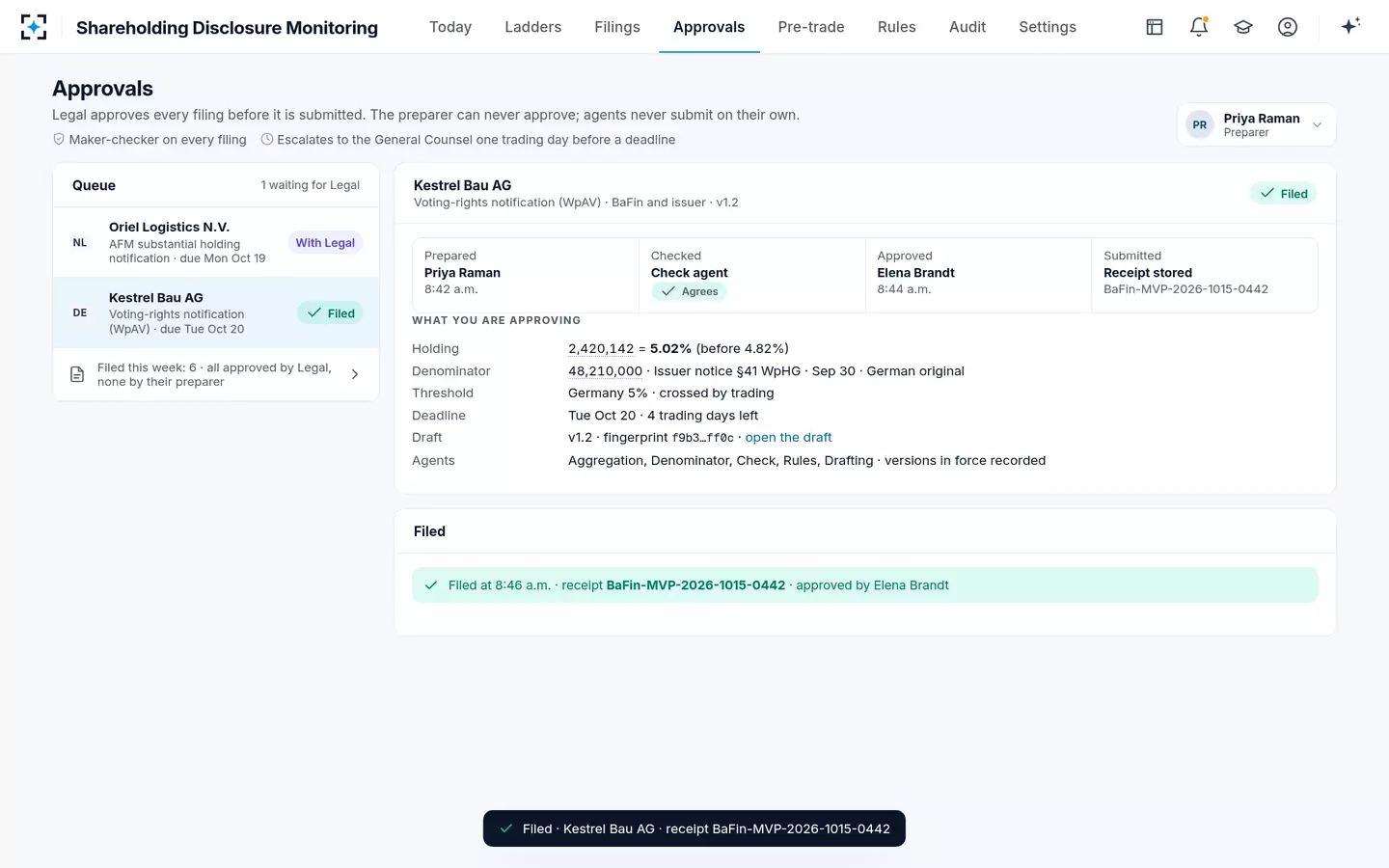
Two controls matter most against the cases above. A filing not approved by the day before its deadline escalates to the general counsel and the chief compliance officer, so lateness is visible before it happens. And every filing's evidence, from the positions read to the receipt, sits in one export kept for seven years, which is what a firm needs both to self-report a problem quickly and to show an examiner that the process works. To see the calendar on your own book, start from Shareholding Disclosure Monitoring.
Questions people ask
How much is the fine for a late 13F?
There is no set fine. In the SEC's September 2024 orders the nine managers that paid were charged between $175,000 and $725,000 each for failing to file Forms 13F, and two that self-reported paid nothing. The Exchange Act caps a first-tier penalty at $118,225 per violation for a firm, as adjusted in 2025.
Can you file a 13F late?
Yes, and a manager that finds a missed report should file it and consider reporting the failure to the SEC. Filing late does not erase the violation, but in the 2024 orders the two managers that self-reported were not ordered to pay any penalty.
What happens if you miss a 13H filing?
The same as a missed 13F: an enforcement action is possible. Two of the eleven managers in the SEC's September 2024 13F orders were also charged with failing to file Forms 13H as large traders.
Are 13F penalties per quarter?
The statute caps penalties per violation, and the SEC sets the amount in each order based on the facts, including how long the failure lasted. The 2024 orders give one total per firm rather than a price per missed quarter.
Did the SEC adjust its civil penalty amounts for 2026?
No. In a notice published on 7 July 2026 the SEC said there would be no inflation adjustment for 2026, so the amounts adjusted in January 2025 continue to apply to penalties imposed after 15 January 2025.
Which SEC filings are examiners focusing on in 2027?
For advisers with activist engagement practices, the Division of Examinations names Schedules 13D and 13G and Forms 13F, 13H, 3, 4, 5 and N-PX, and says it will review whether they are timely and accurate.