The Schedule 13G amendment requirements oblige every 13G filer to amend within 45 days after the end of any calendar quarter in which the facts it last reported changed materially, and they add faster clocks for large holders: a qualified institution above 10% at a month-end files within five business days after that month, and a passive investor that goes above 10% files within two business days. A holder whose intent turns to influencing control leaves Schedule 13G altogether and files a Schedule 13D within five business days. Each clock tests the position as of a particular date, so the work is less about the form than about having the right snapshot of every fund on the right day. Botminds' Shareholding Disclosure Monitoring is software that aggregates a manager's holdings across entities every morning, reads each issuer's own share count and keeps all four clocks on one filing calendar.
The rules are the SEC's, as amended in October 2023 by the beneficial ownership modernization release, effective 5 February 2024; the new Schedule 13G deadlines applied from 30 September 2024. Examples from the product use its fictional sample manager, Quillfield Capital.
The four Schedule 13G clocks, and which filers each one binds
Clock 1
Every 13G filer
TriggerA material change in what the last 13G reported, measured at the end of a calendar quarter
Due45 days after the quarter ends
Rule 13d-2(b)
Clock 2
Qualified institutions (13d-1(b))
TriggerBeneficial ownership above 10% at the close of a month, then each further move of more than 5% at a month-end
DueFive business days after that month ends
Rule 13d-2(c)
Clock 3
Passive investors (13d-1(c))
TriggerAcquiring more than 10%, then each move of more than 5% after that
DueTwo business days after the acquisition
Rule 13d-2(d)
Clock 4
Qualified institutions and passive investors
TriggerHolding with a purpose or effect of changing or influencing control, or a passive investor reaching 20%
DueA Schedule 13D within five business days, and no voting or buying until ten days after filing
Rule 13d-1(e), (f), (g)
What are the Schedule 13G amendment requirements now?
There are four, and a filer can be on two at once. Rule 13d-2(b) binds every Schedule 13G filer: amend "within 45 days after the end of each calendar quarter if, as of the end of the calendar quarter, there are any material changes in the information reported in the previous filing" (17 CFR 240.13d-2(b)). Rules 13d-2(c) and (d) add month-end and transaction clocks for holders above 10%. Rule 13d-1(e) to (g) ends 13G eligibility when the conditions for it stop being true.
Before 2024 the quarter-end clock was an annual one. The old Rule 13d-2(b) required an amendment within 45 days after the calendar year for "any change" in the facts previously reported. The 2023 release replaced "any change" with "material change" and moved the test from the year-end to every quarter-end, which is why the question of what is material now comes up four times a year rather than once.
The scale is large. In 2022 the SEC received 26,523 Schedule 13G filings, of which 18,090 were amendments, according to the release's own count. The Commission's paperwork estimate after the amendments is 2.5 hours for a Schedule 13G amendment and 12.9 hours for an initial 13G, with three quarters of the burden assumed to fall on outside professionals.
Schedule 13G is mostly amendments, and amendments are now quarterly
26,523
Schedule 13G filings the SEC received in 2022
8,433 initial, 18,090 amendments
45days
after each calendar quarter for a material-change amendment
2.5hours
the SEC's paperwork estimate for one 13G amendment after the 2023 rules
30 Sep2024
first day the shortened Schedule 13G deadlines applied
Which clock applies depends on how you filed: qualified institution, passive or exempt
The basis on which a holder first filed decides which clocks bind it. Rule 13d-1 offers Schedule 13G on three routes, and each carries its own amendment duties.
Qualified institutions file under Rule 13d-1(b). The list includes registered broker-dealers, banks, insurers, registered funds, registered investment advisers, ERISA plans, parent holding companies that hold no more than 1% directly, and non-US institutions subject to a substantially comparable regime. They must have acquired the shares "in the ordinary course of the person's business" and without a control purpose. Their initial 13G is due 45 days after the quarter in which they crossed 5%, unless they cross 10% first. They carry clocks 1, 2 and 4.
Passive investors file under Rule 13d-1(c): any holder without a control purpose that stays below 20%. Their initial 13G is due within five business days of crossing 5%, the same as a Schedule 13D. They carry clocks 1, 3 and 4, including the switch to 13D at 20%.
Exempt investors file under Rule 13d-1(d), typically holders who crossed 5% without an acquisition, such as founders who held before a listing. They file 45 days after the quarter-end and amend only on clock 1.
An asset manager registered as an adviser is usually a qualified institution for its discretionary accounts, but not always for every entity in its group. A non-US affiliate qualifies only if it is the functional equivalent of a listed US institution under a comparable regime, and a parent that holds more than 1% directly falls outside clause (G). The entity map decides the clock, so it is the first thing to check when a filing calendar looks wrong.
Clock one: the quarter-end material change, 45 days
Clock one asks one question at each 31 March, 30 June, 30 September and 31 December: as of the end of that day, has anything the last Schedule 13G reported changed materially? If it has, the amendment is due 45 days later. If the 45th day falls on a weekend or federal holiday, the SEC's general filing rule moves it to the next business day (17 CFR 240.0-3).
Two carve-outs in the rule matter most to a reporting team. First, no amendment is needed where the change in the reported percentage "results solely from a change in the aggregate number of securities outstanding". An issuer buyback that lifts a holder from 6.1% to 6.6% without a trade does not, by itself, require an amendment. Second, once an amendment shows 5% or less, no further filings are needed unless the holder crosses 5% again.
The quarter-end test is a snapshot, not a running tally. A holder that went from 6% to 8% and back to 6% inside a quarter has nothing to amend at quarter-end for clock one; one that drifted from 6% to 7.2% has. That makes the quarter-end position file the most important input of the quarter, and the hardest to rebuild later if it was never kept.
What counts as a material change for a 13G amendment?
Rule 13d-2(b) sets no number. "Material" keeps its ordinary Exchange Act meaning under Rule 12b-2, information a reasonable investor would consider important, and the SEC has said where to look for a benchmark. Rule 13d-2(a), which governs Schedule 13D, deems an acquisition or disposition of 1% or more of the class "material", and says smaller changes may be material depending on the facts. In adopting the 2023 amendments the Commission wrote that because Rules 13d-2(a) and (b) "will now share the same materiality standard", the 1% language in 13d-2(a) "is equally instructive" for Schedule 13G amendments (Release 33-11253, section II).
Most teams therefore start from a 1% movement between the last filing and the quarter-end and then look at the other facts on the form: a change of filer name or address, a new member of a filing group, a change in sole or shared voting or dispositive power, or a move of shares between entities that changes who reports. The 1% guide is a floor for attention, not a safe harbour; the SEC declined to adopt one.
The comparison has to be against the last filing, not the last quarter. A holder that moved 0.6% in each of two quarters without filing has moved 1.2% since its last report, and the second quarter-end is the one that triggers the amendment.
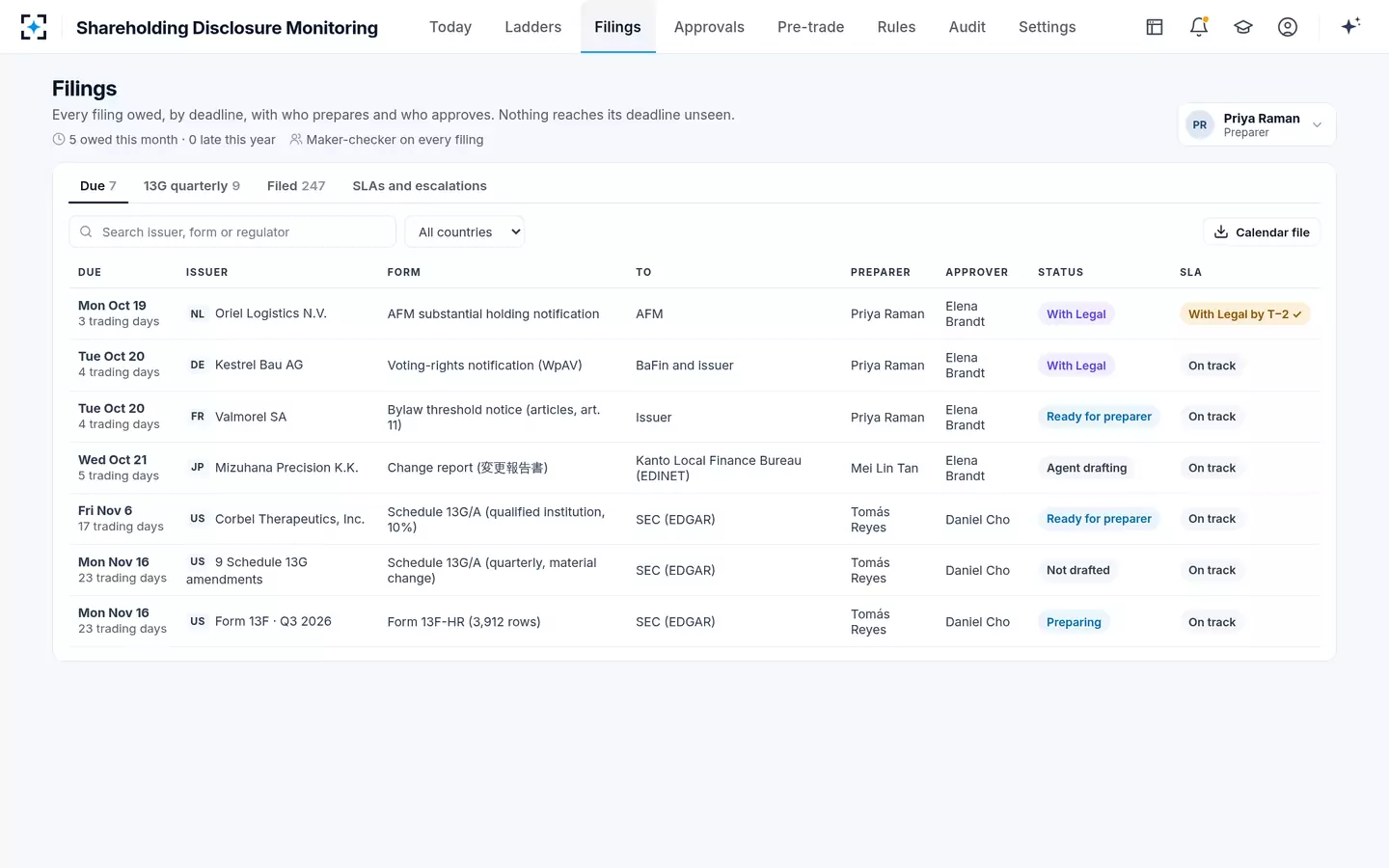
Nine quarterly 13G amendments, drafted together on the filing calendar
Clock two: qualified institutions above 10% at a month-end
For a qualified institution, crossing 10% starts a monthly test. Rule 13d-2(c) requires an amendment "within five business days after the end of the first month in which the person's direct or indirect beneficial ownership, computed as of the last day of the month, exceeds 10 percent of the class". After that, each further month-end change of more than 5% of the class triggers another amendment on the same clock. Before 2024 the window was ten calendar days.
The month-end measurement cuts both ways. A fund that touches 10.4% on the 12th and is back to 9.8% by the 31st has no clock-two filing. One that ends the month at 10.12% does, even if it crossed only on the last trading day. A team that monitors intra-month highs will raise false alarms; one that monitors only quarter-ends will miss the month-end filings entirely.
Here is how the clock runs on the sample manager. Corbel Therapeutics crossed 10% on 13 October 2026 and stood at 10.12% on the morning of the 15th. If it is still above 10% at the close of Saturday 31 October, the amendment is due five business days after the month ends: Monday 2, Tuesday 3, Wednesday 4, Thursday 5 and Friday 6 November, the date the solution's calendar already shows.
A month-end crossing: the clock starts when the month ends, not when the holding crosses
- Above 10% intra-month, no clock yet13–31 Oct
- Five business days1–6 Nov
- Above 10% for part of the month13–22 Oct
- Below 10% at month-end23–31 Oct
The same month-end test governs a qualified institution's first filing if it crosses 10% before it has filed at all: Rule 13d-1(b)(2) brings the initial 13G forward to five business days after that month instead of 45 days after the quarter. Above 10%, a qualified institution also has a separate question to answer about Section 16, which Section 16 filing for funds that cross 10% works through.
Clock three: passive investors above 10%, two business days
Passive investors filing under Rule 13d-1(c) run on transactions, not month-ends. Rule 13d-2(d) requires an amendment "within two business days after acquiring, directly or indirectly, greater than 10 percent", and again within two business days of each later increase or decrease of more than 5% of the class. Before 2024 the rule said "promptly".
This is the tightest clock in the regime, tighter than the Schedule 13D initial filing. A family office or a non-US manager that does not qualify under 13d-1(b) and files as a passive investor needs daily monitoring above 8% or 9%, not a monthly report. The clock starts on the trade date: a business day under Regulation 13D-G is the whole calendar day in Eastern Time, so a trade at 3:58 p.m. on a Tuesday is a Tuesday acquisition.
Filing time matters at this speed. Under the 2023 amendments a Schedule 13G or 13G/A whose transmission starts by 10 p.m. Eastern Time is deemed filed that business day (17 CFR 232.13(a)(4)), and the Commission made the hardship exemption for technical difficulties unavailable to Schedules 13D and 13G.
Clock four: when Schedule 13G stops being available
The fourth clock ends the short form. A qualified institution or passive investor that comes to hold its shares "with a purpose or effect of changing or influencing control of the issuer" while above 5% must file a Schedule 13D within five business days (Rule 13d-1(e)). A passive investor reaching 20% must do the same (Rule 13d-1(f)). A qualified institution that stops being one, or decides it no longer holds in the ordinary course, has five business days to file a 13D or a 13G amendment as a passive investor (Rule 13d-1(g)).
The switch carries a cooling-off period that catches teams out. From the moment the control purpose arises until ten days after the Schedule 13D is filed, the holder may not vote the shares or acquire more of them. A portfolio manager who writes to a board on Monday and buys on Wednesday may have broken a trading restriction before the compliance team has opened the file.
Where the line falls between engagement and influence is set out in staff interpretations. The SEC's Division of Corporation Finance said in February 2025 that discussing views with management, without more, does not cost 13G eligibility, while pressing for specific measures or conditioning votes for directors may; in September 2026 it added interpretations on meetings the company starts, proxy solicitors and requests to clarify disclosures. Engagement tracking and the 13G line sets out each interpretation and how a stewardship team clears agendas against it.
Do you amend a 13G when you drop below 5%?
Yes, once, and then the obligation stops. A holder that falls to 5% or less files an amendment reporting it, under clock one at the next quarter-end, or sooner if clock two or three applies: a qualified institution above 10% that falls by more than 5% of the class at a month-end, for example, files within five business days. Rule 13d-2(b) then says no additional filings are required unless the holder later goes above 5% again and becomes obliged to file under Rule 13d-1.
The exit filing is the one most often missed because it does not feel like a disclosure. A position sold down over a quarter shows up nowhere on a crossing alert, because alerts fire on rising holdings. The quarter-end comparison against every holding the firm has reported on, including those now well below 5%, is the only control that catches it.
The 13G deadlines in 2026 and 2027
The quarter-end amendments share their 45-day deadline with Form 13F, so the same dates recur. The table applies Rule 0-3: when the 45th day is a weekend or federal holiday, the filing is due on the next business day.
Quarter-end Schedule 13G amendment deadlines, 2026 and 2027
| Quarter ending | 45th day | Due | Why it moves |
|---|---|---|---|
| 31 Dec 2025 | Sat 14 Feb 2026 | Tue 17 Feb 2026 | Weekend, then Washington's Birthday on Mon 16 Feb |
| 31 Mar 2026 | Fri 15 May 2026 | Fri 15 May 2026 | No move |
| 30 Jun 2026 | Fri 14 Aug 2026 | Fri 14 Aug 2026 | No move |
| 30 Sep 2026 | Sat 14 Nov 2026 | Mon 16 Nov 2026 | Weekend |
| 31 Dec 2026 | Sun 14 Feb 2027 | Tue 16 Feb 2027 | Weekend, then Washington's Birthday on Mon 15 Feb |
| 31 Mar 2027 | Sat 15 May 2027 | Mon 17 May 2027 | Weekend |
| 30 Jun 2027 | Sat 14 Aug 2027 | Mon 16 Aug 2027 | Weekend |
| 30 Sep 2027 | Sun 14 Nov 2027 | Mon 15 Nov 2027 | Weekend |
The month-end clock for qualified institutions above 10% produces twelve more dates a year; in 2026 the November one, for an October month-end, falls on Friday 6 November. The rest of the reporting team's quarter, including Form 13F, Form 13H and the deferred Form SHO, is laid out in 13F filing deadlines for 2026.
A close routine that keeps all four clocks
Every clock is measured as of a date, so the control is a routine that freezes the right data on the right day and compares it with the last filing, not with yesterday. A team can run it by hand; it cannot run it from an intraday alert feed alone.
Month-end and quarter-end checks for a Schedule 13G filer
- Freeze positions as of the last day of every month
Clock two is computed as of that day, across every entity and fund that reports together.
- Recompute each percentage on the issuer's latest share count
Rule 13d-1(j) lets a filer rely on the issuer's most recent quarterly or annual report and later current reports, unless it has reason to believe they are wrong.
- Compare with the last filing, not the last month
Two moves of 0.6% add up to 1.2% since the last report.
- Separate buyback-only changes
A change caused solely by the number of shares outstanding needs no clock-one amendment.
- List every issuer reported on, including those now below 5%
The exit amendment is filed once, and is the one alerts miss.
- Re-confirm the filing basis for each entity
A non-US affiliate or a parent above 1% may not be a qualified institution.
- Check for any change of purpose
A board letter or a conditioned vote can start clock four and its ten-day standstill.
- Book the deadline on the federal calendar, with a 10 p.m. Eastern cut-off
Rule 0-3 moves weekend and holiday deadlines; Regulation S-T sets the time.
How Shareholding Disclosure Monitoring keeps the four clocks
The solution treats each clock as a rule on the filing calendar rather than as an alert. Each morning the Intake agent reads end-of-day positions from every legal entity and reconciles them with the custodians before anything is tested. The Aggregation agent sums holdings per issuer under the US rule, by voting or investment power, and the Denominator agent reads the issuer's own share count from its latest filing, flagging a data vendor's figure when it is stale. The Rules agent applies the thresholds and counts each deadline on the right calendar.
The morning view in Shareholding Disclosure Monitoring: what crossed, what is due, and the quarter's 13G amendments
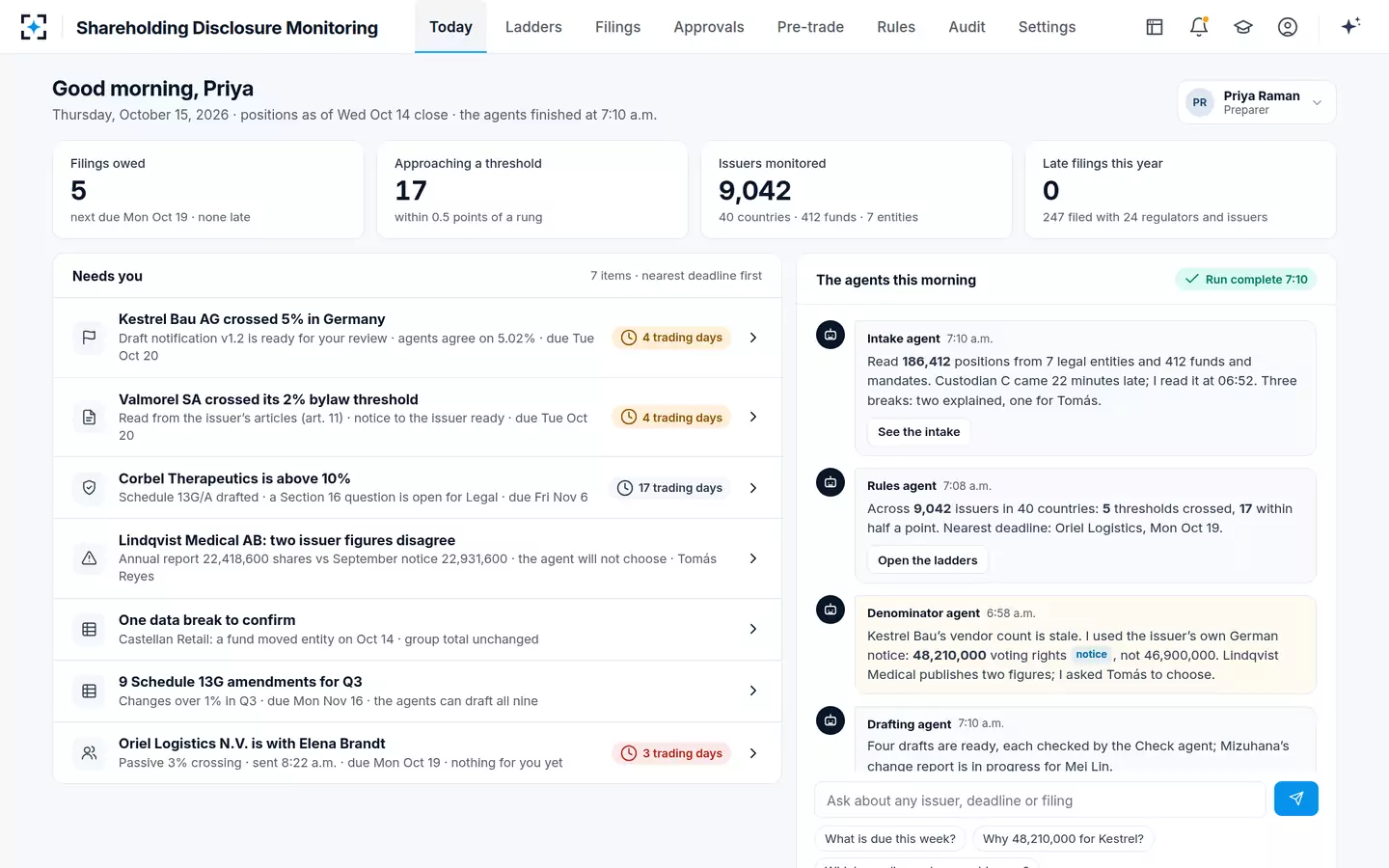
In the sample quarter the agents can draft all nine third-quarter amendments in one pass, each with the fields cited to their sources: the position file, the issuer's filing, the rule text. A person decides what the agents cannot. The regulatory reporting manager prepares; Legal approves with a reason code; nothing is filed unseen. Whether a change of purpose has started clock four is a legal judgment, and the solution sends it to Legal rather than deciding it. The SEC's examiners will look at the same filings: the Division of Examinations says that in fiscal 2027 it will review "whether advisers with activist engagement practices are making timely and accurate filings on Schedules 13D and 13G" and related forms (SEC, Examination Priorities FY2027).
The month-end snapshot is only as good as the share count beneath it, which is why Rule 13d-3 beneficial ownership and the denominator follows one percentage from the issuer's filing to the form. To see the calendar on your own holdings, start from Shareholding Disclosure Monitoring.
Questions people ask
When are 13G amendments required?
Within 45 days after any calendar quarter at whose end the facts last reported have changed materially; within five business days after a month-end at which a qualified institution exceeds 10%, or moves more than 5% after that; and within two business days for a passive investor crossing 10% or moving 5% beyond it. A change of purpose to influencing control requires a Schedule 13D within five business days instead.
What is the 13G amendment deadline for the third quarter of 2026?
Monday 16 November 2026. The 45th day after 30 September is Saturday 14 November, and Rule 0-3 moves a deadline that falls on a weekend to the next business day. Form 13F for the same quarter is due the same day.
Do I have to amend a 13G if the issuer buys back shares?
Not for that reason alone. Rule 13d-2(b) says no amendment is needed where the change in the reported percentage results solely from a change in the number of securities outstanding. If the buyback lifts a qualified institution above 10% at a month-end, however, clock two still applies, because it is computed on beneficial ownership as of that day.
Is a 1% change always a material change on Schedule 13G?
It is the SEC's starting point, not a bright line. The Commission said the 1% language in Rule 13d-2(a) for Schedule 13D is equally instructive for 13G amendments, and that smaller changes may be material on the facts. Changes in voting or dispositive power, group membership or filer details can be material without any change in the percentage.
What time of day is a Schedule 13G amendment due?
By 10 p.m. Eastern Time on the due date. Regulation S-T Rule 13(a)(4) deems a Schedule 13G or 13G/A whose transmission begins by 10 p.m. to be filed that business day; most other EDGAR filings, Form 13F included, have a 5:30 p.m. cut-off.
Did the 2024 rules change the 13G deadlines for all filers?
Yes, from 30 September 2024. Initial filings by qualified institutions and exempt investors moved from 45 days after the year-end to 45 days after the quarter-end, passive investors' initial filings from ten days to five business days, and the annual amendment became a quarterly material-change amendment.