The 13F filing deadlines in 2026 are Tuesday 17 February for the fourth quarter of 2025, Friday 15 May for the first quarter, Friday 14 August for the second and Monday 16 November for the third; the report for the fourth quarter of 2026 is due Tuesday 16 February 2027. Each is 45 days after the quarter ends, moved to the next business day when the 45th day is a weekend or federal holiday, and each must be accepted on EDGAR by 5:30 p.m. Eastern Time. The same date carries the quarterly Schedule 13G amendments, and the weeks before it carry month-end 10% checks, so a reporting team's quarter has two peaks, not one. Botminds' Shareholding Disclosure Monitoring keeps every one of those dates on a single filing calendar, with the positions behind each filing read and reconciled every morning.
Dates below are our arithmetic from Rule 13f-1 and Rule 0-3 on the US federal holiday calendar, and match the SEC staff's own example where it gives one. The adviser's other recurring dates, from Form ADV to the annual compliance review, sit in the RIA compliance calendar for 2026. Product examples use the solution's fictional sample manager.
How long each US holdings filing gives after the date it measures
What are the 13F filing deadlines in 2026?
Four dates. Rule 13f-1(a)(1) requires a manager over the $100 million threshold to file within 45 days after the end of the calendar year and within 45 days after each of the first three calendar quarters of the next year (17 CFR 240.13f-1). In 2026 that gives:
13F filing dates for 2026, and for the first report of 2027
| Quarter ending | The 45th day | Form 13F due | Also due that day |
|---|---|---|---|
| 31 Dec 2025 | Saturday 14 Feb | Tuesday 17 Feb 2026 | Schedule 13G/A for the quarter; Form 13H annual update |
| 31 Mar 2026 | Friday 15 May | Friday 15 May 2026 | Schedule 13G/A for the quarter |
| 30 Jun 2026 | Friday 14 Aug | Friday 14 Aug 2026 | Schedule 13G/A for the quarter |
| 30 Sep 2026 | Saturday 14 Nov | Monday 16 Nov 2026 | Schedule 13G/A for the quarter |
| 31 Dec 2026 | Sunday 14 Feb 2027 | Tuesday 16 Feb 2027 | Schedule 13G/A for the quarter; Form 13H annual update |
The fourth-quarter report is the one most often mis-dated, because it straddles a weekend and a federal holiday. For the fourth quarter of 2025 the 45th day was Saturday 14 February and the following Monday was Washington's Birthday, so the report was due Tuesday 17 February 2026; the SEC staff use the same example in their FAQ.
13F filing deadlines for 2027
In 2027 the quarters fall less kindly: three of the four 45th days land on a weekend. The fourth quarter of 2026 is due Tuesday 16 February 2027, after Sunday the 14th and Washington's Birthday on Monday the 15th. The first quarter of 2027 is due Monday 17 May (the 15th is a Saturday), the second Monday 16 August (the 14th is a Saturday) and the third Monday 15 November (the 14th is a Sunday). The report for the fourth quarter of 2027 is due Monday 14 February 2028.
A team that plans to the calendar 45th day will be early three times in 2027, which is harmless; one that plans to "the Monday after" without checking will be late the year a holiday intervenes. The safest plan books the internal deadline a week before the legal one and treats the move as slack.
What if the 13F deadline falls on a weekend or holiday?
It moves to the next business day. Rule 0-3(a) provides that if the last day for a filing "falls on a Saturday, Sunday or holiday, such papers may be filed on the first business day following" (17 CFR 240.0-3), and the SEC staff's Form 13F FAQ applies the same rule. The holidays are federal ones, so Good Friday, a market holiday, does not move a deadline, while Columbus Day and Veterans Day, when markets are open, do.
What time is the 13F filing deadline?
5:30 p.m. Eastern Time. Form 13F is not among the forms with an extended cut-off, so under Regulation S-T Rule 13(a)(2) a submission that begins after 5:30 p.m. is deemed filed on the next business day (17 CFR 232.13(a)). Schedules 13D and 13G, and Forms 3, 4 and 5, have until 10 p.m. On a 16 November with a 13F and nine Schedule 13G amendments due, the 13F has to be finished first.
The other filings that share the 45 days
Schedule 13G amendments. Every 13G filer amends within 45 days after a quarter in which the facts it last reported changed materially, so the quarterly 13G/As are due on the 13F date. Since 30 September 2024 that test runs every quarter, not once a year. The four Schedule 13G amendment clocks sets out each one.
Month-end 10% amendments. A qualified institution whose holding exceeds 10% of a class at a month-end amends within five business days after that month, and again on further month-end moves of more than 5%. For an October month-end in 2026 that is Friday 6 November, ten days before the 13F, and it is where the quarter's first peak comes from.
Form 13H. A large trader, one whose transactions in NMS securities reach two million shares or $20 million in a day, or twenty million shares or $200 million in a month, files Form 13H promptly after first reaching that level, an annual update within 45 days after each full calendar year, and an amendment promptly after a quarter in which its information became inaccurate (17 CFR 240.13h-1). The annual update therefore falls on the fourth-quarter 13F date.
Form SHO. Rule 13f-2 requires a monthly short-position report within 14 calendar days after each month for managers whose monthly average gross short position in a reporting company's shares reaches $10 million or 2.5% of the shares outstanding (17 CFR 240.13f-2), but the SEC has exempted managers from compliance until 2 January 2028; the first reports would cover January 2028 (SEC order, 3 December 2025). Re-check the date before planning 2028.
Form N-PX. Managers that file Form 13F also report their say-on-pay votes once a year, by 31 August for the twelve months to 30 June; the Form N-PX guide covers it. In 2026, 31 August is a Monday, two weeks after the second-quarter 13F.
The quarter's main filing, by the SEC's count
28,925
Form 13F holdings and combination reports filed a year
three-year average to December 2024
45days
from each quarter-end to the Form 13F deadline
5:30p.m. ET
EDGAR cut-off for Form 13F, against 10 p.m. for Schedules 13D and 13G
2Jan 2028
end of the SEC's exemption from Form SHO reporting
The month-end 10% dates in 2026
A qualified institution above 10% of a class has twelve more deadlines a year, one for each month-end at which a filing is triggered: five business days after the month ends. Counted on the federal calendar, they fall as below; Good Friday, 3 April 2026, is a business day for this purpose, while Independence Day observed on 3 July and Labor Day on 7 September are not.
Five business days after each month-end: the 2026 dates for a month-end 13G amendment
| Month ending | Due | Note |
|---|---|---|
| Sat 31 Jan | Fri 6 Feb | |
| Sat 28 Feb | Fri 6 Mar | |
| Tue 31 Mar | Tue 7 Apr | Good Friday counts as a business day |
| Thu 30 Apr | Thu 7 May | |
| Sun 31 May | Fri 5 Jun | |
| Tue 30 Jun | Wed 8 Jul | Independence Day observed on Fri 3 Jul |
| Fri 31 Jul | Fri 7 Aug | |
| Mon 31 Aug | Tue 8 Sep | Labor Day on Mon 7 Sep |
| Wed 30 Sep | Wed 7 Oct | Same quarter-end feeds the 16 Nov 13F |
| Sat 31 Oct | Fri 6 Nov | |
| Mon 30 Nov | Mon 7 Dec | |
| Thu 31 Dec | Fri 8 Jan 2027 | New Year's Day on Fri 1 Jan |
Trading days abroad: the clocks that do not follow the US calendar
The 13F calendar is federal, but a global manager's reporting team also runs clocks counted in trading days on other exchanges. A UK TR-1 is due within two trading days of learning of a crossing in a UK company; most EU notifications within four trading days; Japan's large shareholding reports within five business days. None of those dates moves for Thanksgiving, and none of the US dates moves for a European bank holiday.
The practical consequence is that a single team calendar needs a holiday table per market and a rule per filing about which one applies. In the solution's sample week a Dutch notification due Monday 19 October, German and French notifications due Tuesday 20 October and a Japanese change report due Wednesday 21 October fell in three consecutive days, each counted on its own market's calendar, while the Schedule 13G work ran to the US federal one. How each regime sets its threshold and clock is laid out in major shareholding notification across three regimes.
The reporting quarter, week by week
Read as a work plan, the 45 days are not a single sprint. The quarter-end positions have to be frozen and reconciled first; the Official List for the quarter has to be published before the match can be final; and the month-end 10% amendments fall in the middle. Here is the fourth quarter of 2026 as a reporting team might plan it.
From 30 September to 16 November 2026: where the reporting team's weeks go
- Freeze and reconcile1–10 Oct
- Match to the 13F List, draft 13G/As11–27 Oct
- Exceptions and maps28 Oct–6 Nov
- Review, approve, file7–16 Nov
- Watch holdings above 9%October
- 13G/Adue 6 Nov
- Watch November7–16 Nov
The plan's two weak points are the exceptions week and the overlap with the month-end amendment. Exceptions are where the work is: holdings not matched to the list, positions that moved between entities, mandates whose voting arrangement changed. If they are found in the first week instead of the sixth, the last fortnight becomes review rather than rework. Form 13F field by field traces each exception to its source.
Who works the reporting quarter
A small team carries a large calendar. At most managers the same three or four people own US beneficial ownership filings, Form 13F and the non-US notifications, with Legal approving and the desk feeding in what it plans to trade. Each seat's quarter changes in a specific way when the mechanical work moves to agents.
The reporting quarter, seat by seat, before and after the agents take the mechanical part
Today
Rebuilds quarter-end positions from entity spreadsheets, chases the late custodian file and keeps the filing calendar by hand.
With agents
Starts each morning with positions reconciled, crossings computed and drafts waiting; prepares and sends to Legal.
Still theirs: The preparer's signature and the calendar
Today
Matches thousands of rows to the 13F List and checks each share count against the issuer's filing.
With agents
Works only the exceptions the agents could not explain, and the quarter's 13G/As drafted in one pass.
Still theirs: Every exception decision, with its reason
Today
Signs at the end of the quarter with little sight of where each number came from.
With agents
Approves each filing with its calculation, denominator source and draft fingerprint on one screen.
Still theirs: Approval, and judgments such as Section 16 or a change of purpose
Today
Hears about a crossing after the trade.
With agents
Sees a warning before an order would cross a threshold, with the largest size that stays below.
Still theirs: The decision to trade, with the reason logged
Where Shareholding Disclosure Monitoring takes the load
The solution moves the reconciliation week to every morning. Its Intake agent reads end-of-day positions from the book of record, the order system, the custodians, the fund administrator and the securities lending agent, and explains each break before any threshold is tested; in the sample run, 186,412 positions from seven legal entities and 412 funds and mandates were read and reconciled by 7:10 a.m. A late custodian file is retried, never replaced with yesterday's.
Position intake in Shareholding Disclosure Monitoring: every entity's holdings, reconciled first
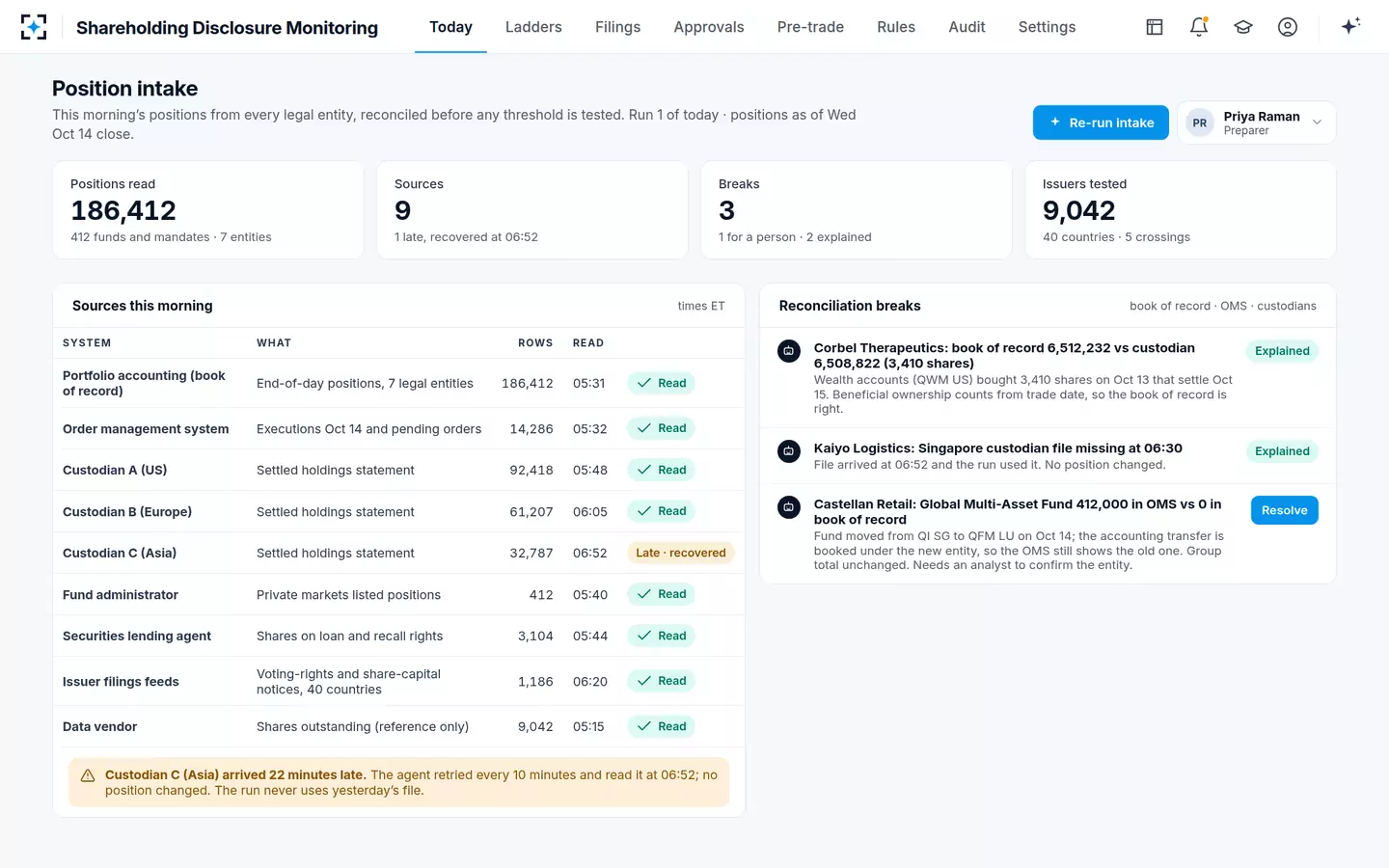
Because the same reconciled positions feed the daily threshold checks, the month-end test and the quarter-end report, the 13F is the last use of data already checked for six weeks rather than a separate project. Every filing then follows the same route: the regulatory reporting manager prepares, Legal approves with a reason code and an attestation, and only an approved, unchanged version is submitted.
Legal sees what it is approving, and approves with a reason
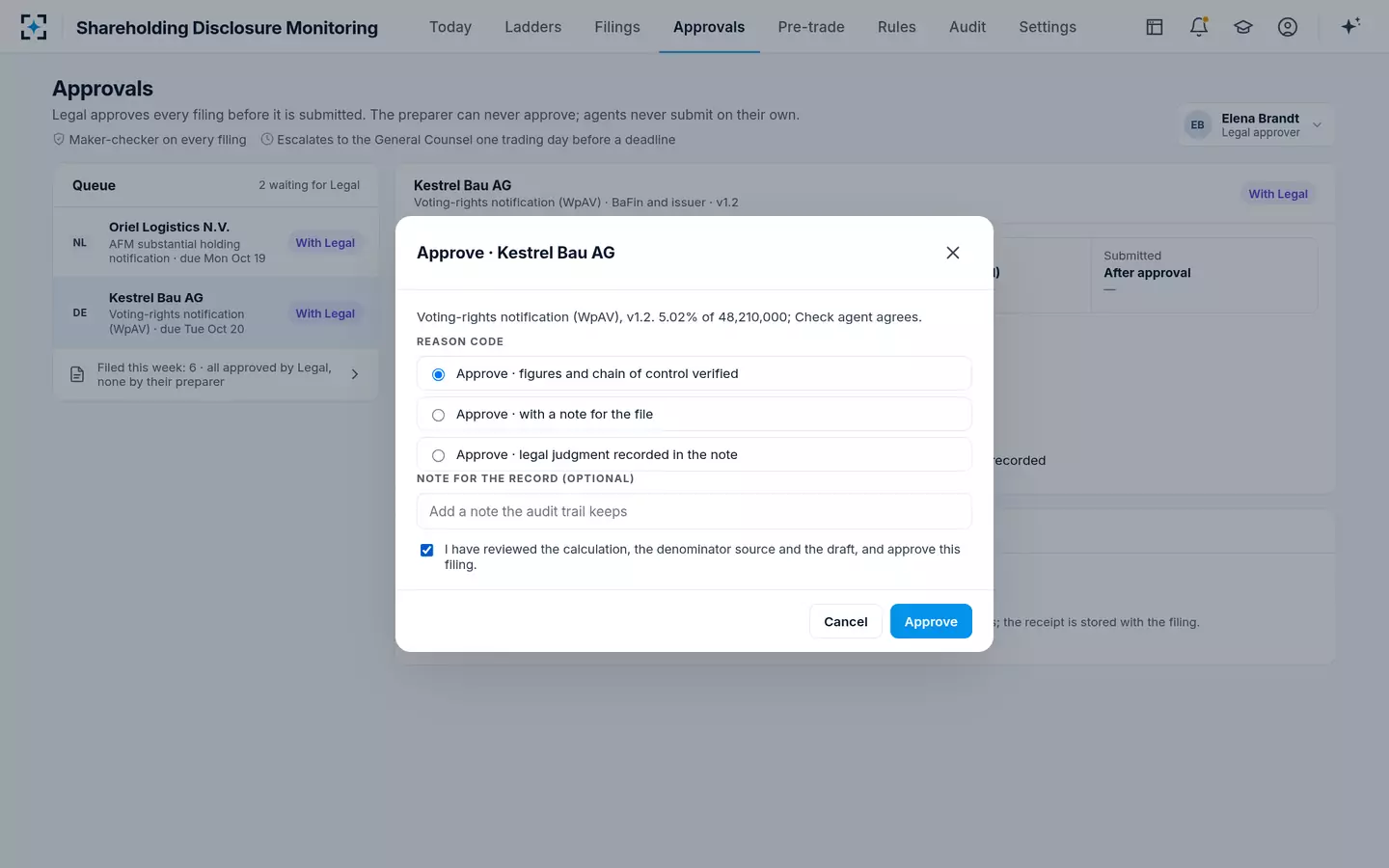
The calendar also holds the deadlines that do not follow the quarter: the European and Japanese notifications, due within two to five trading or business days of a crossing, sit on the same list as the 13F. To see the calendar on your own positions, start from Shareholding Disclosure Monitoring.
Questions people ask
When is the next 13F filing deadline?
As of late October 2026, Monday 16 November 2026, for holdings at 30 September. The 45th day after the quarter is Saturday 14 November, so the deadline moves to the next business day. The next one after that is Tuesday 16 February 2027.
When is the Q4 13F filing deadline?
45 days after 31 December, moved to the next business day if needed: Tuesday 17 February 2026 for the fourth quarter of 2025, and Tuesday 16 February 2027 for the fourth quarter of 2026. Both dates are pushed past a weekend and Washington's Birthday.
What are the 13F filing deadlines for 2027?
Tuesday 16 February, Monday 17 May, Monday 16 August and Monday 15 November 2027, for the fourth quarter of 2026 and the first three quarters of 2027. The report for the fourth quarter of 2027 is due Monday 14 February 2028.
Is the 13F deadline 45 calendar days or business days?
Calendar days. Rule 13f-1 counts 45 days after the quarter, and only a last day that falls on a weekend or federal holiday moves to the next business day under Rule 0-3.
Do 13G amendments have the same deadline as Form 13F?
The quarterly material-change amendments do: both are due 45 days after the calendar quarter. The month-end amendment for a qualified institution above 10% is due five business days after that month instead, and a passive investor's 10% amendment within two business days.
When is Form SHO first due?
Not before February 2028 on the current order. The SEC exempted managers from Rule 13f-2 and Form SHO until 2 January 2028, with the first reports covering January 2028 due within 14 calendar days after that month ends.