The Form 13F filing requirements apply to every institutional investment manager that exercises investment discretion over accounts holding at least $100 million of the securities on the SEC's Official List of Section 13(f) securities, measured on the last trading day of any month of a calendar year. Such a manager files a quarterly report of those holdings within 45 days after each quarter, starting with the December quarter of the year it crossed the threshold. The report itself is an eight-column information table, and every column comes from one of three sources: the Official List, the positions and closing prices on the last trading day of the quarter, and the firm's own map of who decides and who votes for each account. Most errors in a 13F are errors in those sources, not in the arithmetic. Botminds' Shareholding Disclosure Monitoring is software that reads every entity's positions each morning, matches them to the Official List and prepares the table for a person to review and Legal to approve.
Rule citations are to 17 CFR 240.13f-1 and the Form 13F instructions as published by the SEC; staff answers come from the SEC's Form 13F FAQ as updated in September 2026. Product examples use the solution's fictional sample manager.
The Form 13F information table, column by column: where each field comes from and how it goes wrong
1
Name of issuer
SourceThe SEC's current 13F List, as it appears there
How it goes wrongNames typed from the security master instead of the list
2
Title of class
SourceThe 13F List
How it goes wrongThe wrong class of a dual-class issuer
3
CUSIP (nine digits), FIGI optional
SourceThe 13F List, matched to the security master
How it goes wrongA CUSIP that is not on the list for that quarter
4
Value, to the nearest dollar
SourceShares × close on the last trading day of the quarter
How it goes wrongSettlement-date positions, or a price that is not the close
5
Shares or principal; SH/PRN; Put/Call
SourceBook of record at quarter-end; options stated in underlying shares
How it goes wrongOptions written reported as holdings
6
Investment discretion: SOLE, DFND, OTR
SourceThe discretion map: which entity decides for which account
How it goes wrongShared discretion reported as sole, or the reverse
7
Other managers
SourceThe numbered list of other included managers on the cover page
How it goes wrongA manager in column 7 missing from the list
8
Voting authority: sole, shared, none
SourceThe proxy-voting map by account
How it goes wrongVoting assumed to follow discretion
What are the Form 13F filing requirements?
Rule 13f-1 sets four things: who files, which securities count, when, and what the report contains. A manager with investment discretion over accounts holding Section 13(f) securities worth at least $100,000,000 on the last trading day of any month files Form 13F within 45 days after the end of that calendar year and within 45 days after each of the first three quarters of the next year (17 CFR 240.13f-1(a)(1)). The report lists each holding of a security on the Official List as of the quarter-end.
Since 3 January 2023 every dollar value is rounded to the nearest dollar rather than the nearest thousand, and a manager may add a security's share-class FIGI beside the mandatory nine-digit CUSIP (SEC amendments to Form 13F, June 2022). Reports are filed on EDGAR, where the standard 5:30 p.m. Eastern cut-off applies.
Who must file Form 13F? The $100 million test, month by month
The Exchange Act defines an institutional investment manager broadly: it "includes any person, other than a natural person, investing in or buying and selling securities for its own account, and any person exercising investment discretion with respect to the account of any other person" (15 U.S.C. 78m(f)(6)(A)). Advisers, banks, insurers, pension plans, corporations investing their own money and broker-dealers can all be managers; the SEC's FAQ says plainly that broker-dealers are not exempt.
The threshold is tested twelve times a year. If the 13(f) securities over which a manager has discretion were worth $100 million on the last trading day of any month, the manager must file for the December quarter of that year and for the next three quarters, the FAQ explains, even if the value later falls below $100 million. A manager that touched $100 million on the last trading day of March and fell back to $80 million by June still owes four reports.
Discretion, not ownership, decides who counts what. Under Rule 13f-1(b), a manager is deemed to exercise discretion over every account over which a person it controls exercises discretion, so a parent aggregates its subsidiaries. Where two managers in a group share discretion, only one need report the holding, and the other names that one on its cover page.
The 13F filing threshold counts only securities on the list
Only listed securities count toward the $100 million, and only listed securities are reported. The rule is explicit.
Only securities of a class on such list shall be counted in determining whether an institutional investment manager must file a report under this rule (§ 240.13f-1(a)) and only those securities shall be reported in such report.
17 CFR 240.13f-1(c)
That excludes most of what a diversified manager holds by value. Mutual fund shares are not on the list, according to the SEC's FAQ, while exchange-traded fund shares are. So are certain convertible debt securities, equity options and warrants. A manager with $3 billion in fixed income and $90 million in US-listed equities has no 13F obligation; one with $200 million in listed equities split across two subsidiaries has one at the parent.
What is the Official List of Section 13(f) securities?
It is the SEC's quarterly list of the securities 13F filers report: equity securities of the classes Section 13(d)(1) covers that trade on a national securities exchange or are quoted on a registered association's quotation system. The staff publishes it shortly after each quarter ends, and Rule 13f-1(c) lets a manager rely on the most recent list in deciding what to report. The Form 13F instructions require columns 1 and 2 to use the issuer name and title of class "as it appears in the current 13F List".
Matching the book of record to the list is the first source of error. A manager's security master carries its own names and identifiers; the list carries the SEC's. Securities that changed CUSIP during the quarter after a corporate action, new listings, and share classes of the same issuer are where the two drift apart. A holding that is not on the list is left off the report; a holding that is on the list but was not matched is a missing line, and missing lines are what the SEC charges.
Form 13F by the SEC's own count
28,925
Form 13F holdings and combination reports a year
three-year average to December 2024
6,935
13F notices a year, filed by managers whose holdings another manager reports
1,450
Form 13F amendments a year
2hours
the SEC's paperwork estimate per filing, which it says is not derived from a representative survey
Investment discretion: SOLE, DFND and OTR
Column 6 is where a group's structure shows. The instructions require three designations. "Sole" covers securities over which the manager alone exercised discretion. "Shared-defined", entered as DFND, covers discretion shared between controlling and controlled companies, such as a bank holding company and its subsidiaries, an adviser and the funds it advises, or an insurer and its separate accounts. "Shared-other", entered as OTR, covers every other kind of sharing (Form 13F, Special Instruction 11.b.vi).
Each DFND and OTR holding is split again: the part shared with managers on whose behalf the report is filed, and the part shared with anyone else, each on its own line, with column 7 naming the other manager by its number on the cover page's list of other included managers. The instruction adds a point that saves many lines: a manager of an institutional account, such as a pension fund or a registered fund, is not deemed to share discretion with that institution "unless the institution actually participated in the investment decision-making".
None of this can be read from a position file. It comes from the firm's entity map, its sub-advisory agreements and its investment management agreements, and it changes when a fund moves between entities or a sub-adviser is added. The map is the most valuable input to a 13F, and the one most often held only in a reporting analyst's head.
Voting authority: the column most often guessed
Column 8 asks for the number of shares over which the manager has sole, shared or no voting authority. The instructions add a rule that surprises people: a manager with sole authority over "routine" matters but none over "non-routine" ones is deemed to have no voting authority for 13F purposes. Non-routine matters include a contested election of directors, a merger, a sale of substantially all assets, a change in the articles affecting shareholders' rights and a change in fundamental investment policy; routine matters include choosing the auditor, an uncontested director election and approving the annual report.
So voting authority does not follow investment discretion. A mandate where the client keeps the vote, or delegates only routine votes, is reported as "none" even when the manager has full discretion over the trades. The source is the proxy-voting delegation in each account's agreement, and in Shareholding Disclosure Monitoring the same map decides which mandates count in jurisdictions that measure voting power only, so the two uses stay consistent.
Holdings you may leave out, and those you must not
Special Instruction 9 lets a manager omit a holding of fewer than 10,000 shares and less than $200,000 in aggregate fair market value, or less than $200,000 principal amount for convertible debt; both tests must be met. A position of 9,000 shares worth $350,000 must be reported. Options are reported only if the options themselves are on the list, and then in terms of the underlying shares with "PUT" or "CALL" in column 5; the FAQ says options a manager has written are not reported.
Value is measured at the close of trading on the last trading day of the quarter (Special Instruction 8). The positions behind it must be every entity's holdings at the period end. Where the book of record and the custodians disagree at quarter-end, usually over trades not yet settled, the firm should decide its convention once, apply it every quarter and keep the reconciliation in the evidence file before the table is built; a quarter-end rebalancing sits exactly in that gap.
Where 13F errors come from: the list, the map and the entity, not the arithmetic
The SEC's September 2024 cases were about missing reports, not wrong numbers: eleven managers charged for failing to file Forms 13F at all, nine paying more than $3.4 million in combined penalties, two of them also charged over Form 13H (SEC press release 2024-135). What missed 13F filings have cost sets out each penalty. Missing a report starts with not knowing the threshold was crossed, which is a list and entity problem: securities not matched to the list, or a subsidiary's holdings not aggregated.
The same three sources explain most wrong reports. A discretion map that is a year out of date mislabels columns 6 and 7. A voting map assumed rather than read misstates column 8. A security master that has not caught a corporate action drops a line. Multiplying shares by price is the one step that rarely goes wrong.
Form 13F in Shareholding Disclosure Monitoring: three sources to a signed filing
Agent
Match to the Official ListMatches every quarter-end holding to the current 13F List by CUSIP and explains each exception.
Never: Never reports a security that is not on the list
Agent
Price at the last trading dayValues each holding at the close on the last trading day of the quarter, to the nearest dollar.
A person decides
Approve the discretion and voting mapLegal approves which entity decides and who votes for each account; changes are versioned.
Agent
Build the information tableApplies SOLE, DFND and OTR, numbers the other managers and splits voting authority, every row cited.
A person decides
Prepare, then approveAn analyst reviews the exceptions and prepares the filing; Legal approves before anything is submitted.
How Shareholding Disclosure Monitoring builds the information table
The Form 13F workbench in Shareholding Disclosure Monitoring starts from the same positions its agents read every morning for threshold monitoring. In the sample quarter, the third quarter of 2026, it matches 3,912 rows worth $412.6 billion to the Official List, explains each exception and produces the information table for an analyst to prepare and Legal to approve. Because the agents aggregate the same holdings daily for Schedule 13D and 13G, the entity and discretion map used for the 13F is the one already tested every morning, not a quarterly spreadsheet.
Form 13F on the filing calendar beside the quarter's Schedule 13G amendments
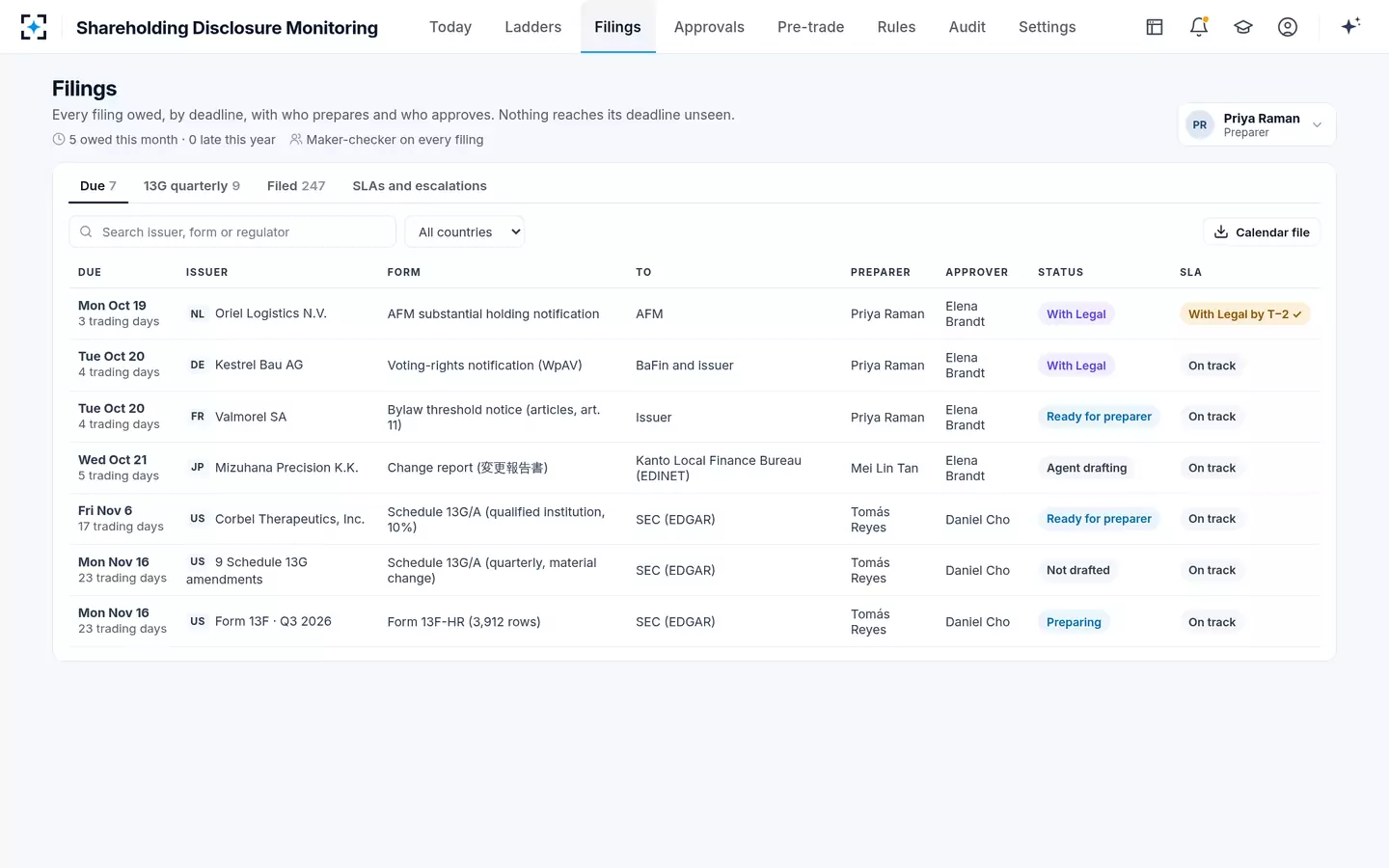
The 45-day deadlines for 13F and the quarterly 13G amendments fall on the same day, and the reporting team's quarter is mapped in 13F filing deadlines for 2026. For a firm choosing between a filing agent and its own preparation, what you bring to a 13F filing service lists the inputs either route needs. The checklist below is the minimum a reporting analyst should be able to show for each quarter.
A Form 13F evidence file, quarter by quarter
- The monthly $100 million test, with the twelve month-end values
It decides whether the firm files at all, and for which quarters.
- The Official List used, with its publication date
Rule 13f-1(c) lets the manager rely on the most recent list.
- Every unmatched holding and why
Not on the list, a CUSIP change, or a security-master error.
- Quarter-end positions by entity, on one stated convention
From the book of record, reconciled to the custodians.
- Closing prices for the last trading day
Values to the nearest dollar.
- The discretion map and the voting map in force
Versioned, with who approved each change.
- Omissions under the 10,000-share and $200,000 test
Both limits checked, per holding.
- Preparer, approver and EDGAR acceptance
Kept with the filing for examiners.
Questions people ask
What is the 13F filing threshold?
$100 million in Section 13(f) securities over which the manager has investment discretion, measured on the last trading day of any month of the calendar year. Only securities on the SEC's Official List count. Crossing once in a year obliges the manager to file for the December quarter and the following three quarters.
Who must file Form 13F?
Any institutional investment manager over the threshold: any person other than a natural person investing for its own account, and any person exercising investment discretion over another person's account. That includes advisers, banks, insurers, pension plans, corporations and broker-dealers.
How often is the 13F securities list published?
Quarterly, shortly after each quarter ends. Managers may rely on the most recent list, and the Form 13F instructions require the issuer name and title of class to be entered as they appear there.
Are mutual funds and ETFs reported on Form 13F?
Exchange-traded fund shares are on the Official List and are reported; open-end mutual fund shares are not on the list and are not reported. Certain listed options, warrants and convertible debt are on the list too, and options a manager has written are not reported.
What is the difference between a 13F holdings report and a 13F notice?
A holdings report lists all of the manager's 13(f) securities; a notice says another manager reports all of them; a combination report lists some and names the managers who report the rest. The SEC counts about 28,925 holdings and combination reports and 6,935 notices a year.
Can a manager leave small positions off Form 13F?
Only if the position is under both limits: fewer than 10,000 shares and less than $200,000 in fair market value, or less than $200,000 principal amount for convertible debt. A large-priced stock can exceed $200,000 with very few shares and must then be reported.