A 13F filing service is a firm that prepares or submits a manager's quarterly Form 13F on EDGAR, from formatting the information table to transmitting it; an in-house route does the same with the manager's own staff and tools. Either way the manager brings the same inputs, and their quality, not the choice of route, decides whether the report is right and on time: a map of which entity exercises investment discretion over which account, a map of who votes, quarter-end positions for every entity, closing prices on the last trading day, a match to the SEC's Official List and working EDGAR access. The manager also stays responsible: the person who signs represents that the report is "true, correct and complete". Botminds' Shareholding Disclosure Monitoring reads the positions every morning, matches them to the Official List, explains each exception and produces the information table for an analyst to prepare and Legal to approve.
The requirements cited are Rule 13f-1, the SEC's Form 13F and its instructions, and the SEC's 2024 EDGAR Next rules. Product examples use the solution's fictional sample manager.
What any 13F route needs from the manager, before the first quarter
- The entity list and control chain
Every legal entity whose discretion the parent is deemed to exercise under Rule 13f-1(b), and which of them file their own reports.
- The discretion map, account by account
SOLE, shared-defined or shared-other, and with which other manager; it drives columns 6 and 7.
- The voting map, account by account
Sole, shared or none, read from each mandate's proxy terms; routine-only voting counts as none.
- Quarter-end positions for every entity
One stated convention, reconciled between the book of record and the custodians.
- Closing prices for the last trading day
Values rounded to the nearest dollar.
- A security master that matches the Official List
CUSIPs, issuer names and titles of class as the SEC lists them, with corporate actions applied.
- The $100 million test at each month-end
Twelve values a year, kept, because one month over obliges four reports.
- EDGAR access that works
CIK, Form 13F file number, EDGAR Next account administrators and authorised filers.
- An approver and an approval record
Who signs the cover page, and evidence of what they reviewed.
What does a 13F filing service do, and what stays with you?
A service converts data into a compliant filing and submits it; the data and the judgments stay with the manager. The SEC's own description of the market is that "Some filers use third-party vendors for a range of services in connection with filing reports on Form 13F, while other filers use vendors for more limited purposes such as providing more user-friendly versions of the list of section 13(f) Securities" (SEC notice, 19 September 2025). For paperwork purposes it estimates about $300 a year in vendor services per filer, and one hour of outside legal services a year for holdings-report filers.
Responsibility does not move with the work. Rule 13f-1 places the obligation on the institutional investment manager, and the Form 13F cover page carries the manager's representation, signed by an authorised person.
The institutional investment manager filing this report and the person by whom it is signed hereby represent that the person signing the report is authorized to submit it, that all information contained herein is true, correct and complete.
SEC Form 13F, cover page (OMB 3235-0006)
Can you outsource 13F filings?
Yes, the preparation and the submission, but not the responsibility. A filing agent can build the XML information table and transmit the report on EDGAR on the manager's behalf, provided the manager has authorised it on its EDGAR account. Since 15 September 2025, under EDGAR Next, every individual acting on EDGAR for a filer must use their own Login.gov credentials with multifactor authentication, and each filer must authorise at least two account administrators who confirm each year that everyone on the account is authorised (SEC, EDGAR Next fact sheet).
What cannot be outsourced is knowledge of the firm. A service does not know that a sleeve moved between entities in August, that a sub-adviser's discretion is shared, or that a mandate's client now keeps non-routine votes. Unless the manager tells it, the report will be well formatted and wrong.
What data is needed for a 13F?
Three sources and two maps. The sources are quarter-end positions, last-trading-day closing prices and the SEC's Official List; the maps are discretion and voting. The report then needs a cover page naming the manager, its Form 13F file number and the report type, a summary page with the number of other included managers and the table's entry total and value total, and the information table itself (Form 13F). Each column of that table is traced to its source in Form 13F field by field.
The 13F workload as the SEC counts it
28,925
holdings and combination reports a year
three-year average to December 2024
6,935
13F notices a year
1,450
amendments a year; one that changes a filed report restates it in full
$300
a year in vendor services per filer, in the SEC's paperwork estimate
The discretion map and the entity list
This is the input that decides who files and what goes in columns 6 and 7, and the one most firms keep least formally. Rule 13f-1(b) deems a manager to exercise discretion over every account over which a person it controls exercises discretion. The Form 13F instructions then ask the manager to split shared discretion into "shared-defined", for parents and subsidiaries, advisers and their funds, and insurers and their separate accounts, and "shared-other" for everything else, and to number each other manager that reports with it (Special Instruction 11.b.vi and vii).
Bring it as a table a stranger could audit: every account, the entity that decides, any sub-adviser, any shared arrangement, and the date each line last changed. A service will ask for it; an in-house tool will need it as configuration; agents need it as a rule set that Legal approves.
Quarter-end positions and closing prices
Positions must cover every entity in the report at the quarter-end, and values use the close on the last trading day, rounded to the nearest dollar (Special Instruction 8). The difficulty is not the arithmetic but the reconciliation: the book of record, the custodians, the fund administrator and the securities lending agent each hold part of the truth on 30 September, and they rarely agree on the first pass.
Bring the reconciliation, not just the positions. A filing service will take a file and trust it; the questions examiners ask are about how the file was built. A firm whose positions are already reconciled every day for threshold monitoring brings a quarter-end file that has been tested on every business day of the quarter before it is used.
The Official List match
Only securities on the SEC's Official List count toward the $100 million and only they are reported, and the instructions require issuer names and titles of class as the list shows them. The match from the security master to the list is where corporate actions, CUSIP changes and new listings cause missing lines. Bring the security master's identifiers and a record of every holding that did not match, with the reason.
Your 13D and 13G positions: the same data under different rules
The data a manager brings for Form 13F is the data it needs every day for Schedules 13D and 13G, counted differently. Form 13F reports holdings over which the manager has investment discretion, with voting authority in its own column; Schedules 13D and 13G count beneficial ownership by voting or investment power, divide by the issuer's own share count and are triggered at 5% (17 CFR 240.13d-1). The quarterly 13G amendments are due on the same day as the 13F.
Building the two from separate files is how the same holding ends up with two different numbers in two filings on the same date. A route that serves both from one reconciled set of positions and one entity map removes that risk, and a service that only formats the 13F leaves it with the manager.
How to file Form 13F on EDGAR
The filing itself is the last step. The manager, or an agent it has authorised, logs in to EDGAR with individual credentials, chooses the report type (holdings report, notice, or combination report), completes the cover and summary pages, attaches the information table in the SEC's XML format, signs, and submits. Form 13F has the standard 5:30 p.m. Eastern cut-off: a transmission that begins later is deemed filed the next business day (17 CFR 232.13(a)(2)). Keep the EDGAR acceptance message with the evidence for the quarter.
Amendments and confidential treatment: the work after the filing
A 13F process is not finished when the report is accepted. Rule 13f-1(a)(2) requires an amendment, other than one that only adds holdings not previously reported, to "set forth the complete text of the Form 13F", and amendments are numbered in sequence (17 CFR 240.13f-1(a)(2)). A wrong discretion code on one line means refiling the whole report, which is why the SEC counts about 1,450 amendments a year.
Confidential treatment is the other tail. Since the SEC's 2022 amendments, a manager asking to keep a position out of the public report, typically while it is still building it, must make the request electronically on EDGAR. If the request is denied, the SEC's FAQ says the manager must amend its public Form 13F within six business days of the denial (SEC, Form 13F FAQ). A service that formats the quarterly report but does not track open requests and their outcomes leaves that clock with the manager.
Service, in-house tool or agents: who does each task
The routes differ less in the filing than in who carries the upstream work. The table sets out the common pattern for each.
Three ways to produce a 13F, task by task: who does the work
| Task | Filing service | In-house tool | Agents (Shareholding Disclosure Monitoring) |
|---|---|---|---|
| Monthly $100 million test | Manager | Manager, with the tool's report | Agents, every morning, on all entities |
| Positions and reconciliation | Manager supplies a file | Manager, often in spreadsheets | Intake agent reads each source and explains each break |
| Official List match | Service | Tool, exceptions to the manager | Agents, each exception explained |
| Discretion and voting maps | Manager supplies | Manager configures | Legal approves the rules; agents apply them |
| Information table and pages | Service | Tool | Agents draft, every row cited |
| Review and approval | Manager | Manager | Analyst prepares; Legal approves; preparer cannot approve |
| Submission | Service, if authorised | Manager | Preparer submits after approval |
| 13D and 13G from the same data | Separate work | Usually separate | Same positions and entity map, daily |
Whichever route a firm chooses, a few questions sort the options quickly. Who tests the $100 million threshold at each month-end, and where is the result kept? Who owns the discretion and voting maps, and how is a change approved? How are Official List exceptions explained, and who sees them? How are amendments and confidential treatment requests tracked? Who holds EDGAR credentials, and who can submit if that person is away on the 45th day? The answers decide more about the quality of the filing than the price does.
A go-live in one parallel quarter
Whatever the route, the safe go-live is one quarter run in parallel with the current process, compared line by line before anything is filed from the new one. The plan below is for agents; for a service the shape is the same with the service in place of the agents.
From entity map to first filing: one parallel quarter
- Maps approved3 weeks
- Connect sources2 weeks
- Daily runs, compared4 weeks
- Parallel 13F4 weeks
- Livego live
The comparison is the test that matters. Every difference between the parallel 13F and the filed one is either an error in the old process or in the new, and each should be resolved and recorded. A firm that finds none has probably compared too little: the most common outcome of a careful parallel run is a handful of discretion or voting lines that were wrong before.
Shareholding Disclosure Monitoring reads and reconciles every source before anything is tested
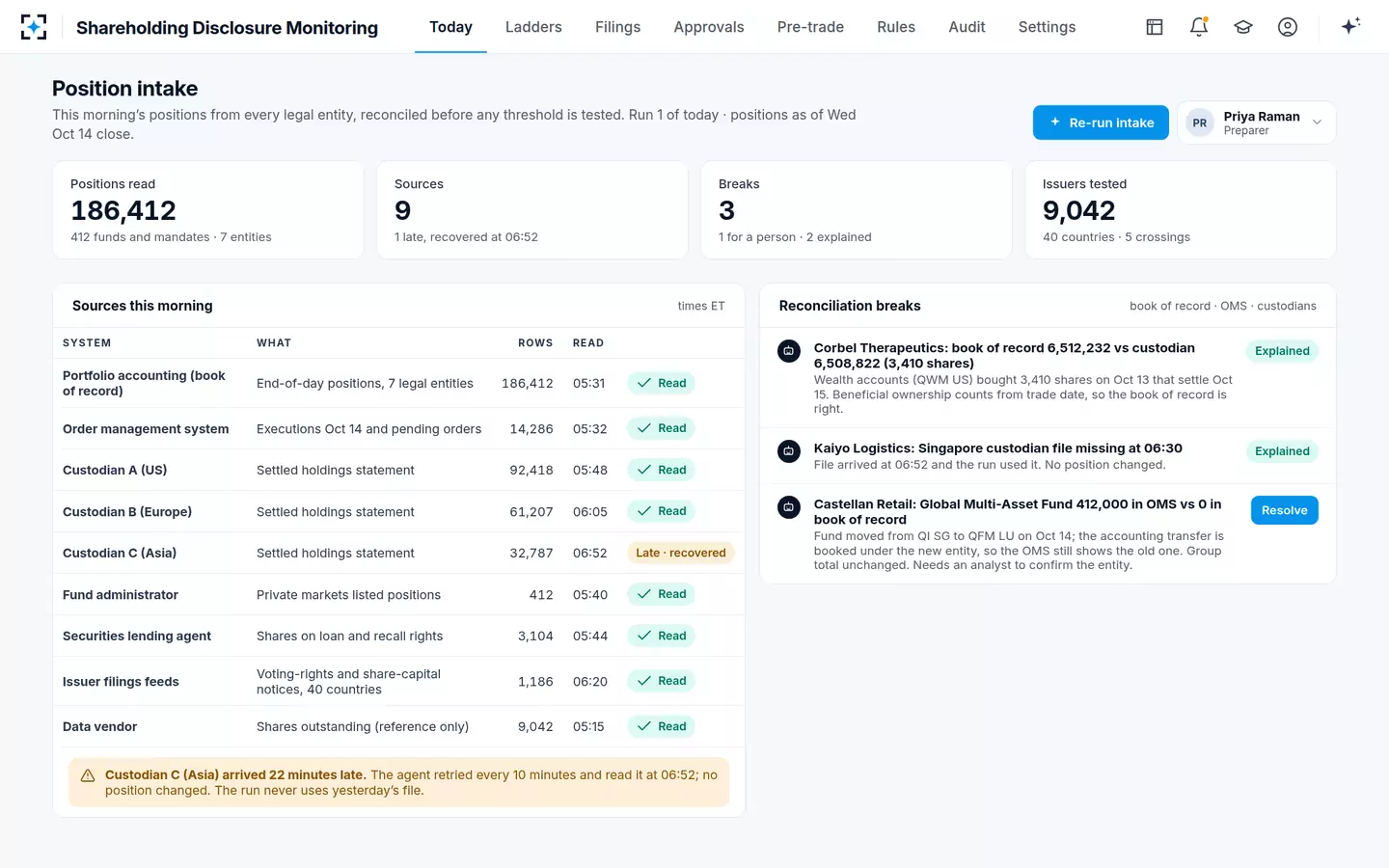
Where Shareholding Disclosure Monitoring fits a 13F process, and where it does not
The solution fits a manager that wants the 13F to be the last use of data checked every day rather than a quarterly project. Its Form 13F workbench matches every holding to the Official List, explains each exception and produces the information table; in the sample quarter that was 3,912 rows worth $412.6 billion, due on 16 November 2026 beside nine Schedule 13G amendments. The analyst prepares, Legal approves and only an approved version is submitted.
Thresholds and tolerances as settings, each change approved by Legal
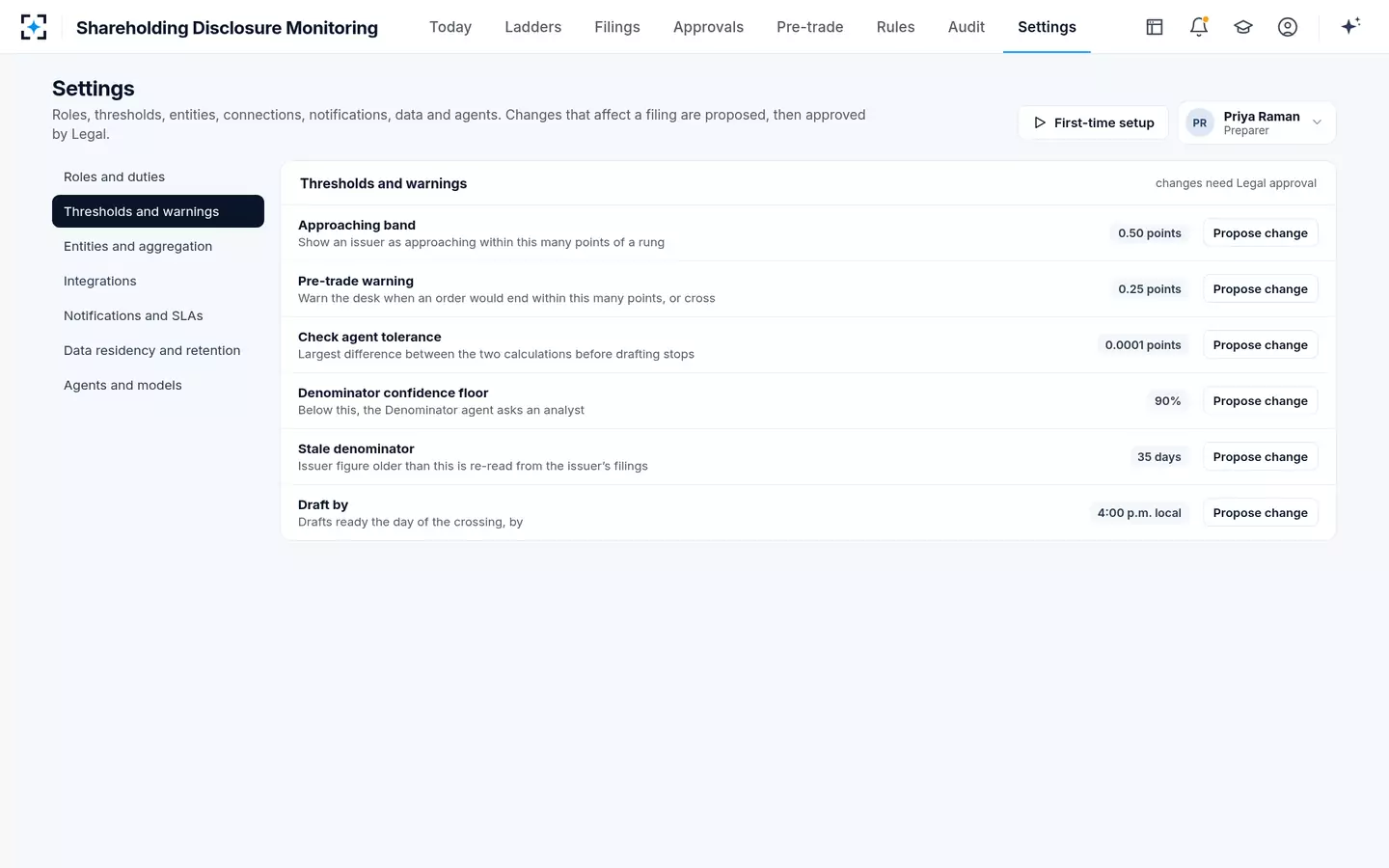
It does not replace the manager's knowledge of its own structure: the entity, discretion and voting maps come from the firm, and Legal approves them. It does not submit anything unapproved, and it is not a service that takes over responsibility; the manager's authorised signer still signs. A firm whose only need is a formatter for a clean file may need no more than a filing agent. One that also files Schedules 13D and 13G and non-US notices gets more from one set of positions serving all of them, which is the case made in what shareholding disclosure software should automate. To run it on a sample of your own quarter, start from Shareholding Disclosure Monitoring.
Questions people ask
What is a 13F filing agent?
A firm authorised by the manager to prepare or submit its Form 13F on EDGAR. Under EDGAR Next the manager authorises who may act on its account, and every individual uses personal Login.gov credentials. The manager remains responsible for the content.
How much does a 13F filing service cost?
No regulator or independent study publishes 13F service prices, and fees vary with the number of holdings, entities and filings. For its paperwork estimates the SEC assumes about $300 a year per filer for vendor services and one hour of outside legal services for holdings-report filers, while noting that its figures are not based on a representative survey.
Do I need a lawyer to file Form 13F?
Not to submit it, but the discretion and voting judgments and any request for confidential treatment are legal questions. The SEC's paperwork estimate assumes some outside legal input for holdings-report filers each year.
What is the difference between filing a 13F in-house and using a service?
Who formats and submits. Positions, discretion and voting maps, the Official List match and the approval stay with the manager on either route, and they decide whether the report is right.
How long does it take to go live on a new 13F process?
Plan for one quarter run in parallel with the current process, filing from the new one the quarter after. The time goes mostly into documenting the entity, discretion and voting maps and reconciling sources, not into the filing.
Can the same system file 13F and Schedule 13G?
It should use the same positions and entity map, because the quarterly 13G amendments fall on the 13F date. The counting differs: discretion for 13F, voting or investment power and the issuer's share count for 13G.