Shareholding disclosure software is the system an asset manager uses to know, every day, whether its aggregate holding in any listed company has crossed a disclosure threshold anywhere it is listed, and to file the notice on time: Schedules 13D and 13G and Form 13F in the US, TR-1 in the UK, the national notifications under the EU Transparency Directive, and Japan's large shareholding reports. The arithmetic is easy. The hard parts are which funds, entities and mandates count under each country's rule, the issuer's current share count, and clocks of two to five days that start with the trade. Good software automates those three hard parts and the draft, and leaves to people the decisions the rules make legal judgments, plus the signature. Botminds' Shareholding Disclosure Monitoring is built that way: seven agents aggregate, read the issuer's count, recompute and draft; the regulatory reporting manager prepares and Legal approves, and nothing is filed unseen.
The rules cited are the SEC's, the FCA's Disclosure Guidance and Transparency Rules, ESMA's practical guide to national rules under the Transparency Directive and Japan's Financial Services Agency. Product examples use the solution's fictional sample manager, Quillfield Capital.
Shareholding Disclosure Monitoring: the work agents take, and the steps that stay with people
Agent
Read and reconcile positionsEvery legal entity, fund and mandate, from the book of record, order system, custodians and securities lending agent, each break explained.
Never: Never fills a missing position or uses yesterday's file
Agent
Aggregate by each country's ruleVoting power or investment power, instruments and lent shares, with the US view kept beside the local one.
Agent
Read the issuer's own countFrom the issuer's latest filing in its own language, with the stale vendor figure flagged.
Never: Never chooses between two issuer figures
Agent
Recompute blind, then draftA second agent recomputes from custodian records on a separate model; the draft is prepared in the regulator's form and language, every field cited.
A person decides
Decide and approveLegal approves the rules and the control chain, makes the judgments and approves each filing; the preparer can never approve their own.
What should shareholding disclosure software do?
Four things, every day, for every issuer in the book. First, aggregate: sum every holding the firm must count in each issuer under each jurisdiction's rule, across all legal entities, funds and mandates. Second, divide by the right number: the issuer's own latest figure for voting rights or shares outstanding. Third, apply the thresholds and the clocks on the right calendar. Fourth, prepare the filing in the regulator's form, with each number traceable to its source.
The fifth thing it should do is stop. A system that decides whether a mandate's voting rights are attributed to the manager, whether a group exists or whether an engagement is a control purpose is making legal decisions with nobody accountable for them. The useful line is not between software and people but between counting and judging: count everything automatically, show every judgment to the person who owns it.
What are the shareholding disclosure requirements a global manager tracks?
They differ on four axes: the first threshold, the steps after it, what is counted and the clock. The table shows six regimes a typical global equity book touches.
Shareholding disclosure requirements in six markets: thresholds, forms and clocks
United States
FilingSchedule 13D or 13G
ThresholdsMore than 5% of a registered voting class, by voting or investment power
Clock13D: five business days. 13G: five business days (passive) or 45 days after the quarter (qualified institutions)
United Kingdom
FilingTR-1 to the issuer and the FCA
Thresholds3% and each 1% from there for UK issuers; managed holdings count only at 5% and at 10% and above
ClockTwo trading days after learning of the change (four for non-UK issuers)
Germany
FilingVoting-rights notification to BaFin and the issuer
Thresholds3, 5, 10, 15, 20, 25, 30, 50, 75%; the 3% rung applies to voting rights, not instruments
ClockIn practice generally four trading days in total
France
FilingNotification to the AMF and the issuer
Thresholds5, 10, 15, 20, 25, 30, ⅓, 50, ⅔, 90, 95%
ClockFour trading days after learning
Netherlands
FilingSubstantial holding notification to the AFM
Thresholds3, 5, 10, 15, 20, 25, 30, 40, 50, 60, 75, 95%
ClockFour trading days after learning
Japan
FilingLarge shareholding report, then change reports, on EDINET
ThresholdsMore than 5%, then each change of 1% or more
ClockFive business days; twice-monthly reference dates for eligible institutions up to 10%
Three differences cause most of the work. The first is the count: the US counts voting or investment power; Germany counts voting rights attributed under its own rules; the UK lets an investment manager disregard the holdings it manages for others below 5%, then counts them at 5% and at 10% and above (FCA DTR 5.1.5R). The second is the denominator: the UK, like the Transparency Directive, uses the issuer's most recent total voting rights disclosure (DTR 5.8.8R), and the US lets a holder rely on the issuer's latest periodic report. The third is the clock: trading days in Europe, business days in the US and Japan, each on its own holiday calendar.
Some issuers add their own. A company's articles can set extra notification thresholds where national law allows it; ESMA's guide notes, for example, that Austria's 3% threshold applies only to issuers that have written it into their articles of association. The sample manager's rules library carries 38 issuer bylaw thresholds alongside 40 jurisdictions. A crossing of a 2% bylaw threshold is as late as a crossing of a statutory one if nobody coded it. Each regime is worked through on one holding in major shareholding notification across three regimes.
How do managers monitor ownership thresholds today?
In a common setup, a rules engine fed by a market-data vendor's share counts flags likely crossings, and compliance analysts do the rest by hand: check each denominator against the issuer's own filing, often in German, Japanese or Swedish; work out which funds and mandates count under the local rule; and type the notification from spreadsheets. The evidence of which number came from where lives in email.
The weak points are well known to anyone who has run that process. A capital increase the vendor has not caught yet, a buyback that causes a passive crossing with no trade, a bylaw threshold nobody coded, or a local holiday that shortens a clock. In the US the SEC has shown that late filings are found by data: in September 2024 it charged 23 filers over late Schedules 13D and 13G and Forms 3, 4 and 5, and its staff "used data analytics to identify" them (SEC press release 2024-148); a week earlier it charged eleven managers for missing Forms 13F (SEC press release 2024-135).
The work agents can take: positions, aggregation, the issuer's count, the draft
The mechanical work is large, repetitive and checkable, which is what agents are good at when each step has a source and a second check. In the solution's sample run the Intake agent read 186,412 positions from seven legal entities and 412 funds and mandates and reconciled them by 7:10 a.m., retrying a custodian file that arrived 22 minutes late rather than using yesterday's. The Aggregation agent then counted each issuer under each country's rule.
Aggregation by country rule: which holdings count in Germany, and which in the US
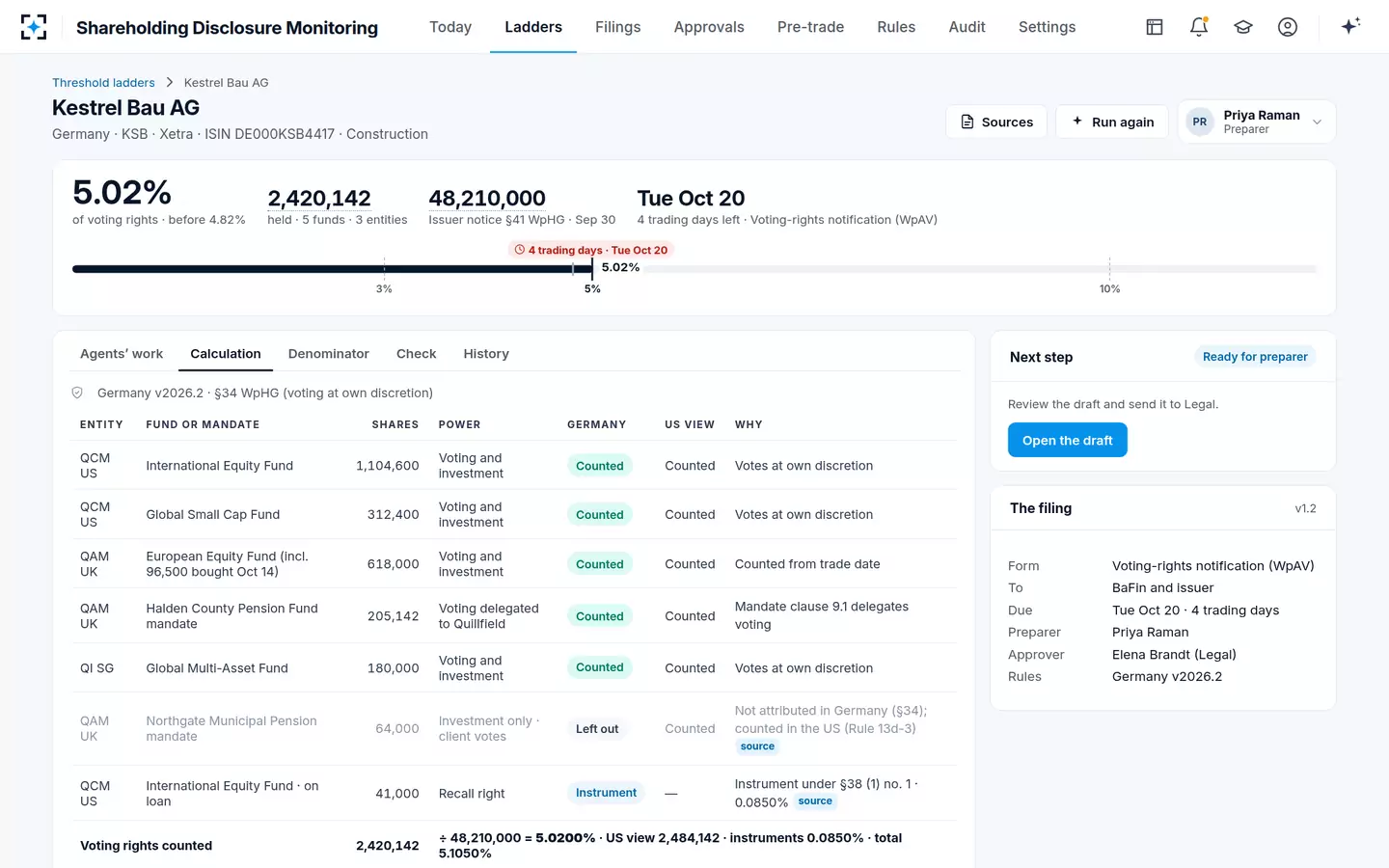
The Denominator agent reads each issuer's own count from its filing, in its own language, with an English translation beside it; in the sample, the issuer's notice gave 48,210,000 voting rights after a capital increase, where the vendor still carried 46,900,000, which would have shown 5.16% instead of 5.02%. A Check agent recomputes every crossing from custodian records without seeing the first result, on a separate model family, and drafting stops if the two differ by more than 0.0001 points. Only then does the Drafting agent prepare the filing in the regulator's form and language.
The decisions that stay with people: who counts, which rule, the signature
Three kinds of decision belong to named people. The first is the rulebook: which jurisdictions' rules and which issuer bylaw thresholds apply, how each mandate's voting arrangement is read, and the control chain through which holdings are attributed. In the solution these are versioned settings that the administrator proposes and Legal approves; the agents apply them and never change them.
The second is legal judgment on the facts. Whether an engagement has become a purpose of influencing control, which moves a US holder from Schedule 13G to 13D; whether holders have agreed to act together as a group; whether a manager above 10% is a Section 16 insider, which Section 16 for funds that cross 10% works through; which of two conflicting issuer figures to use. The agents set out the facts and stop.
The third is the signature. The preparer prepares and can never approve their own filing; Legal approves with a reason code and an attestation; only an approved, unchanged version is submitted; and a filing not approved the day before its deadline escalates to the general counsel and the chief compliance officer.
Where the hours on one crossing go, by hand and with the agents: Botminds' estimate
By hand: about 14 hours
- Triage alerts and data breaks · 14%
- Check the share count against the issuer · 29%
- Work out which holdings count · 21%
- Type the form · 21%
- Second check and Legal sign-off · 15%
With the agents: about 2.25 hours
- Triage · 11%
- Share count · 11%
- Which holdings count · 11%
- Review the draft · 22%
- Second check and Legal sign-off · 45%
Two calculations and one signature: what examiners will ask
Regulators have said they will look at how firms use these tools without changing the rules for them. The SEC's Division of Examinations notes firms bringing what it calls "super intelligence (SI)" into compliance monitoring, among other work, and says it is studying how these tools change results while it tests the same filing duties (SEC, Examination Priorities FY2027). The same document says it will review whether advisers with activist engagement practices file Schedules 13D and 13G and the related forms on time and accurately.
In practice that means evidence. For each filing, a manager should be able to show the positions read and reconciled, the rule version applied, the issuer filing the denominator came from, an independent recompute, who prepared and who approved, and the regulator's receipt. In the solution each of those is kept on an append-only trail, and one export holds a filing's calculation, sources, recompute, approval, receipt and versions, kept for seven years.
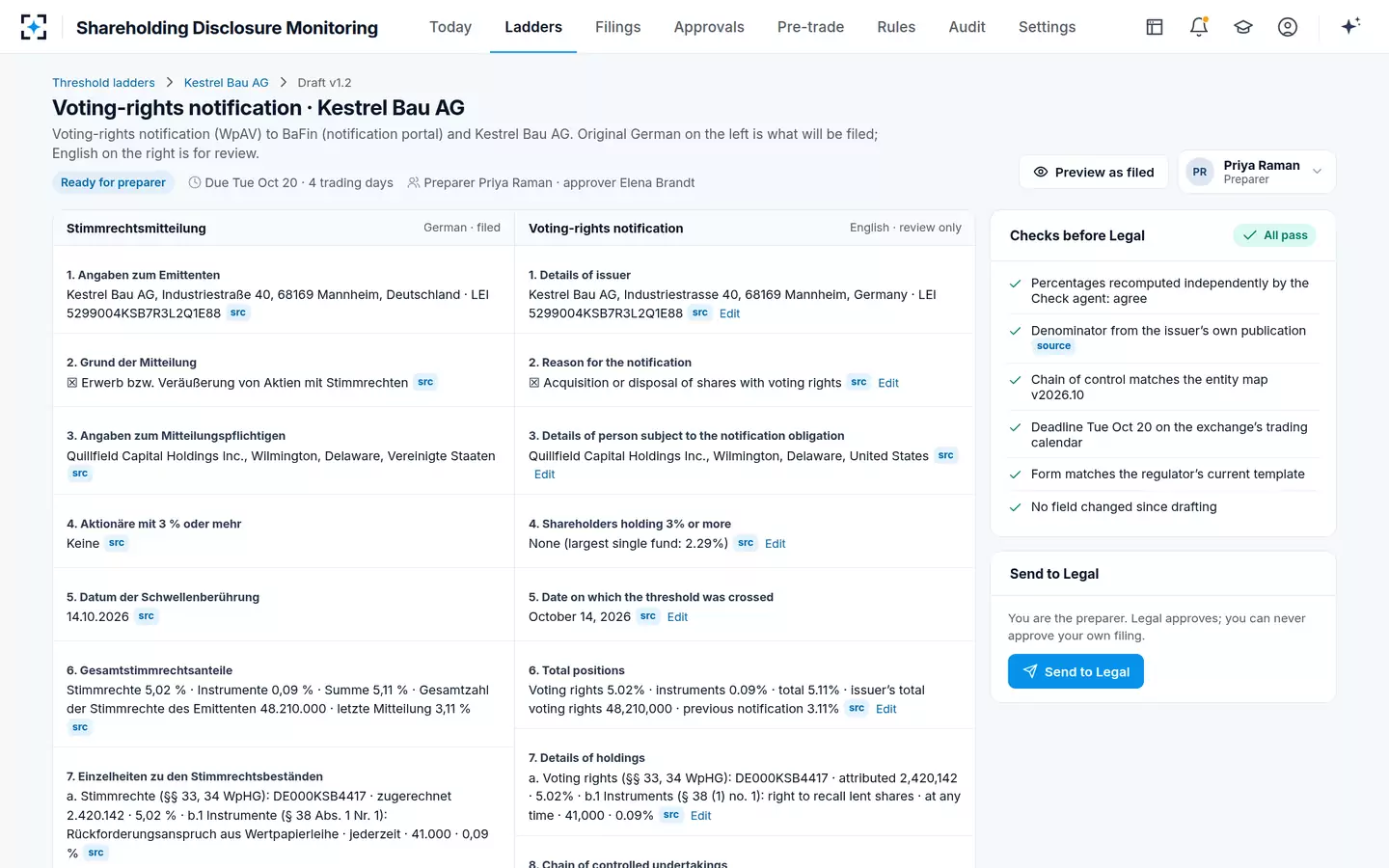
The draft in the regulator's language, every field cited, with the checks before Legal
Test any system on a seeded quarter of your own data
The quickest way to tell a counting engine from a drafting tool is to plant the hard cases in last quarter's data and see which ones it finds. Pick twenty or thirty issuers from your own book, add the cases below, and write down beforehand what should happen to each: the percentage, the rung, the deadline, the form and who should decide. Then score the system on three things. Did it find the case? Did it get the number and the date right? Did it stop where a person should decide?
Eight planted cases, and what a good system does with each
| Planted case | What it tests | A good result |
|---|---|---|
| A capital increase the issuer has published but the data feed has not | Whose denominator | Uses the issuer's figure, names the filing, flags the feed |
| A buyback that moves a holding across a rung with no trade | Passive crossings | Finds it and dates the clock from the issuer's publication where the rule says so |
| A mandate where the client keeps the vote, in a voting-rights market | Counting by rule | Left out locally, kept in the US view, with the clause cited |
| A fund that moved between entities during the quarter | Aggregation | Group total unchanged; the break shown for a person to confirm |
| Shares on loan with a recall right | Instruments | Reported as the local rule requires, the treatment recorded |
| A crossing on the day before a local holiday | Calendars | Deadline counted on that market's trading days |
| An issuer threshold set in its articles | Bylaw rungs | Caught, with the article cited |
| Two issuer publications that disagree | Judgment | Stops and asks an analyst; does not choose |
A system that finds every planted case but decides the judgment ones itself has failed the third test, and that is the failure that matters in an examination. Run the same test again after every change to the entity map or the rules, because those are the changes that quietly break a count.
What to ask a shareholding disclosure software vendor
A demonstration on the vendor's data proves little. Ask to run the system on a sample of your own positions, issuers and past filings, and ask the questions below. The answers that matter are the ones about sources and judgment, not about the number of jurisdictions on a slide.
Questions for any shareholding disclosure software vendor
- Where does each denominator come from?
The issuer's own latest filing, named and linked, or a vendor field. Ask what happens when two issuer figures disagree.
- How does it count a mandate where the client keeps the vote?
It should differ by rule: left out where only voting power counts, kept where investment power counts.
- Is every crossing recomputed independently before a draft exists?
Ask what tolerance stops a draft, and who sees both workings.
- Which judgments does it make, and which does it route?
Group status, control purpose, Section 16 and attribution should go to a named person.
- How are rule changes approved and recorded?
Versioned, approved by Legal, with each run recording the versions it used.
- Does it catch passive crossings?
A buyback or capital increase can cross a threshold with no trade.
- Which calendars does it count on?
Each exchange's trading days in Europe, federal business days in the US.
- Can it warn before a trade, without touching the order?
A warning with the largest size that stays below is useful; blocking or resizing an order is the desk's call.
What to measure in the first quarter
No regulator or independent study publishes how long a crossing takes to notify, or how often vendor share counts are stale, so the baseline has to come from your own book. Four numbers are enough: hours of people's time from a crossing to an approved draft; the share of crossings drafted on the day they happen; the number of denominators where the issuer's figure differed from the data feed; and the number of judgment items routed to Legal, with how long each took to decide. Late filings should be zero before and after; if they are not, that is the first number to fix.
Botminds' own estimate, shown above, is about 14 hours of people's time per crossing by hand against about 2.25 hours with the agents, and the solution's design target is a checked draft on the day of the crossing. Treat both as hypotheses to test in a parallel quarter on your own positions, not as results.
Where Shareholding Disclosure Monitoring fits, and where it does not
The solution fits a manager with holdings across several legal entities and markets that wants the counting, the share counts and the drafts done before the team arrives, with every number cited. Its rules library in the sample covers 40 jurisdictions; its Drafting agent prepares Schedule 13G amendments, the German voting-rights notification, the UK TR-1, the Dutch substantial holding notification and Japan's large shareholding and change reports, each with English beside the original, and it prepares Form 13F.
It does not decide legal questions, approve its own drafts, file without a person's approval, or trade: its Pre-trade agent warns the head of trading when an order would cross a threshold and never blocks, routes or resizes an order. It needs your entity map, your control chain, your mandates' voting terms and a sample of past filings to start, and it is as good as the rule versions your Legal team approves. For the US filings it shares with a 13F process, what you bring to a 13F filing service lists the same inputs. To see it on your own holdings, start from Shareholding Disclosure Monitoring.
Questions people ask
What is shareholder reporting software?
In asset management, it usually means software that tracks the firm's holdings against disclosure thresholds and prepares the resulting filings: Schedules 13D and 13G and Form 13F in the US, and major shareholding notifications elsewhere. Issuers use the same phrase for tools that track who owns their shares, which is a different job.
What are the UK shareholding disclosure thresholds?
For UK issuers, every whole percentage point from 3% upward; for non-UK issuers on UK markets, eight steps from 5% to 75% (5, 10, 15, 20, 25, 30, 50 and 75). An investment manager disregards the holdings it manages for others except at 5% and at 10% and above, under FCA DTR 5.1.5R.
Can shareholding disclosure be fully automated?
The counting, the share counts, the clocks and the drafts can. The decisions that the rules make legal judgments, such as group status, control purpose or Section 16 insider status, and the approval of each filing should stay with named people, and examiners will ask who made them.
How do managers monitor ownership thresholds across countries?
By aggregating every entity's holdings per issuer under each country's counting rule, dividing by the issuer's own latest share or voting-rights figure, and testing the result against that country's thresholds and any issuer bylaw thresholds every day. Passive crossings caused by buybacks or capital increases need the same daily test.
Does shareholding disclosure software need the issuer's share count or the vendor's?
The issuer's. The UK and the Transparency Directive measure against the issuer's most recent total voting rights disclosure, and the US lets a holder rely on the issuer's latest periodic report. A vendor figure is a useful cross-check and a common source of stale denominators.
Will the SEC accept filings prepared with AI?
Its rules are about the filing, not the tool: the filer is responsible for accuracy and timeliness however the filing is prepared. The SEC's fiscal 2027 examination priorities say it is studying how firms use what it calls super intelligence, including in compliance monitoring, and whether they continue to meet existing obligations.