Rule 13d-3 beneficial ownership is the test the SEC uses to decide whose shares count toward the 5% threshold for Schedules 13D and 13G: a beneficial owner is anyone who, directly or indirectly, "has or shares" voting power or investment power over a security, through any contract, arrangement, understanding or relationship. All shares of the class owned in any form are added together, a right to acquire shares within 60 days counts as ownership, and arrangements designed to avoid ownership are disregarded. The rule sets the numerator. The percentage on the form also needs a denominator, the class outstanding, which a filer may take from the issuer's latest periodic report unless it has reason to think it is wrong. Most wrong percentages come from a missed account or a stale denominator, not from the division. Botminds' Shareholding Disclosure Monitoring counts the numerator across every entity each morning, reads the denominator from the issuer's own filing and recomputes every crossing independently before a draft exists.
Rule text is from the eCFR, current to October 2026; the SEC's 2023 guidance comes from its beneficial ownership modernization release. Product examples use the solution's fictional sample manager.
One percentage, two halves: what goes in the numerator and what goes in the denominator
Numerator: what you beneficially own: Rule 13d-3: voting power and/or investment power, held directly or indirectly, alone or shared.
Denominator: what is outstanding: Rule 13d-1(j): the issuer's most recent quarterly or annual report and any later current report may be relied on.
Numerator: what you beneficially own: Every account the firm controls: funds, mandates, affiliates, lent shares with recall rights where they confer power.
Denominator: what is outstanding: The issuer's 10-Q or 10-K cover page, or a later 8-K reporting a change.
Numerator: what you beneficially own: Shares obtainable within 60 days through options, warrants, conversion or revocation are added.
Denominator: what is outstanding: The same shares are added for this holder only, not for anyone else.
Numerator: what you beneficially own: As of the trade date of each acquisition.
Denominator: what is outstanding: As of the date stated in the issuer's filing, which may be weeks old.
Numerator: what you beneficially own: An account, sleeve or affiliate not aggregated; a right to acquire missed.
Denominator: what is outstanding: A vendor figure from an older filing; a buyback or share issue not yet reflected.
Numerator: what you beneficially own: Pledgees, exchange members and underwriters within 40 days are carved out on conditions.
Denominator: what is outstanding: Reliance fails if the filer knows or has reason to believe the issuer's figure is inaccurate.
What does Rule 13d-3 say beneficial ownership is?
Rule 13d-3(a) defines a beneficial owner as "any person who, directly or indirectly, through any contract, arrangement, understanding, relationship, or otherwise has or shares" either "Voting power which includes the power to vote, or to direct the voting of, such security" or "Investment power which includes the power to dispose, or to direct the disposition of, such security" (17 CFR 240.13d-3(a)). Ownership in the property-law sense is irrelevant. An adviser with discretion over a client's account is a beneficial owner of what it holds there; the client, if it keeps the vote, may be one too.
The rest of the rule closes gaps. Paragraph (b) treats as the beneficial owner anyone who uses a trust, proxy, power of attorney or pooling arrangement to divest ownership "as part of a plan or scheme to evade the reporting requirements". Paragraph (c) aggregates all securities of the same class, "regardless of the form which such beneficial ownership takes". Paragraph (d) adds rights to acquire and carves out a few institutional roles: pledgees before default, exchange members voting routine matters without instruction, and underwriters for 40 days after a firm-commitment offering.
Does voting power alone make you a beneficial owner?
Yes. The rule says "and/or": voting power alone, or investment power alone, is enough. A manager that votes a client's shares under a proxy delegation but cannot sell them is a beneficial owner of those shares; so is a manager that can sell but has left the vote with the client. That is the difference from many non-US regimes, which count voting rights only.
The difference shows on one holding in the solution's sample data. A municipal pension mandate of 64,000 shares, where the manager decides trades but the client keeps the vote, is left out of the German count, which attributes voting rights, and counted in the US view under Rule 13d-3, which counts investment power too. The same holding is 5.02% of the issuer for Germany and 5.15% for the United States. Across a global book the two views differ on every mandate with a split arrangement, and both must be kept.
One question, answered with its sources: why this denominator?
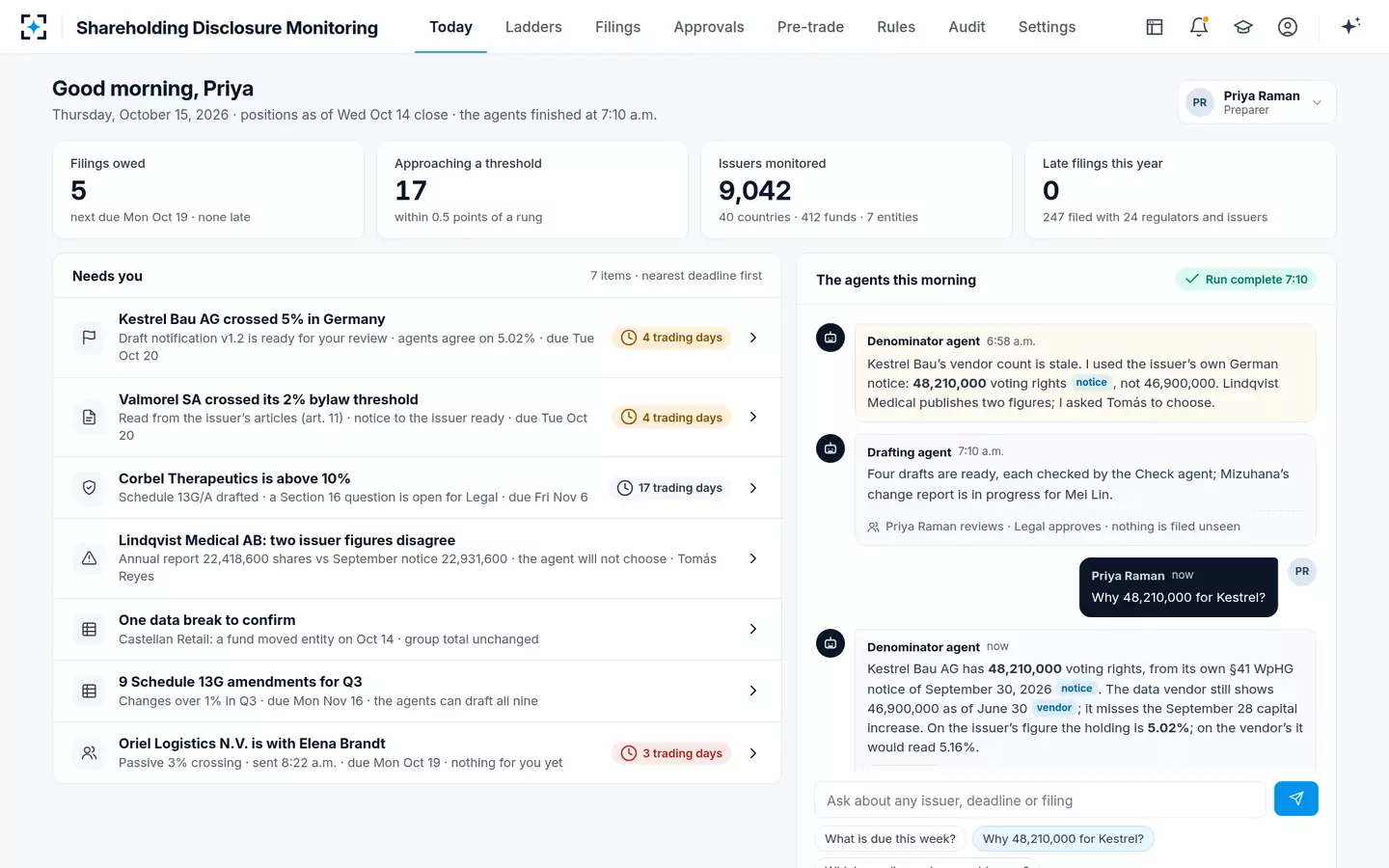
Every fund, every form: aggregation under Rule 13d-3(c)
Aggregation is where most missed crossings start. The numerator is the sum of every share of the class over which any part of the firm has voting or investment power: each fund, each separately managed account, each entity in the group, shares held for clients and shares held as principal. A firm that monitors holdings fund by fund, or entity by entity, can sit above 5% for weeks without an alert.
The Schedule 13D form asks for the result by power as well as in total: Item 5(b) requires the number of shares over which each reporting person has sole or shared power to vote and sole or shared power to dispose (17 CFR 240.13d-101). A good aggregation therefore keeps the breakdown, not just the sum. When the worked case in the Schedule 13D filing deadline, day by day missed a pension account of 60,000 shares, the alert read 4.79% for a holding that was really 5.02%.
What is a 13D group?
A group is two or more holders who agree to act together in acquiring, holding, voting or disposing of an issuer's equity securities. Under Rule 13d-5(b), the group is treated as having acquired, on the date of the agreement, all the shares its members own, so their holdings are aggregated for the 5% test even if no one buys a share (17 CFR 240.13d-5). Shares one member later acquires from another do not count as a new acquisition by the group.
What matters is the agreement, not the conversation. The SEC's 2023 release gave guidance on common engagement activity, and its staff have since added interpretations on shareholder engagement and Schedule 13G eligibility; both are worked through, with Japan's 2026 exemption for collaborative engagement, in collaborative engagement without becoming a group. For the denominator the lesson is simpler: a group's numerator is every member's holdings, and a firm that has joined one cannot compute its percentage from its own book alone.
Options, warrants and the 60-day rule: both sides of the fraction move
Rule 13d-3(d)(1) deems a person the beneficial owner of shares it "has the right to acquire ... within sixty days", including through options, warrants, conversion rights and the power to revoke a trust or discretionary account. The same paragraph says how to compute the percentage: shares subject to those rights "shall be deemed to be outstanding for the purpose of computing the percentage of outstanding securities of the class owned by such person but shall not be deemed to be outstanding for the purpose of computing the percentage of the class by any other person" (17 CFR 240.13d-3(d)(1)(i)).
So the denominator is personal. It is the issuer's outstanding shares plus the holder's own unissued underlying shares, and nobody else's. The worked example below shows why it matters near the threshold.
The 60-day rule on one holding: the same options add to both sides of the fraction
| Step | Calculation | Result |
|---|---|---|
| 1. Shares held across all accounts | From the aggregation | 4,600,000 |
| 2. Shares obtainable within 60 days | Exercisable warrants over new shares | 500,000 |
| 3. Numerator | 4,600,000 + 500,000 | 5,100,000 |
| 4. Issuer's outstanding shares | Latest 10-Q cover page | 100,000,000 |
| 5. Denominator for this holder | 100,000,000 + 500,000 | 100,500,000 |
| 6. Percentage | 5,100,000 ÷ 100,500,000 | 5.07%: above 5% |
| 7. If the warrants were ignored | 4,600,000 ÷ 100,000,000 | 4.60%: no filing |
A right acquired with a control purpose is different again: the rule deems the holder the beneficial owner of the underlying shares immediately on acquisition, whatever the exercise date. A warrant first exercisable in 90 days counts at once for an activist and not at all, for now, for a passive holder.
Cash-settled derivatives after the 2023 guidance
The SEC did not adopt its proposed rule deeming holders of cash-settled derivatives to be beneficial owners. Instead its 2023 release explained when existing Rule 13d-3 already reaches them: where the derivative gives its holder voting or investment power over the reference shares "through a contractual term of the derivative security or otherwise"; where it is acquired as part of a plan to evade reporting, under paragraph (b); and where it carries a right to acquire within 60 days or is acquired with a control purpose, under paragraph (d)(1) (Release 33-11253). The release also amended Item 6 of Schedule 13D so that interests in all derivatives that use the issuer's class as a reference security are disclosed.
For a monitoring system the practical result is a flag, not a formula. Total return swaps and other cash-settled positions should be visible beside the beneficial ownership count, with any term that could confer voting or investment power, so Legal can decide whether they belong in the numerator.
Which share count is used for the 13D percentage?
The issuer's, from its latest periodic report or a later current report. Rule 13d-1(j) says a person "may rely upon information set forth in the issuer's most recent quarterly or annual report, and any current report subsequent thereto", unless it "knows or has reason to believe that the information contained therein is inaccurate" (17 CFR 240.13d-1(j)). For most US issuers the number sits on the cover page of the 10-Q or 10-K, which asks the issuer to "Indicate the number of shares outstanding of each of the issuer's classes of common stock, as of the latest practicable date" (SEC Form 10-Q).
Two consequences follow. A market-data vendor's field is not a report the rule names; a filer relying on one has nothing to point to if it is stale. And reliance is not blind: a holder that knows the issuer completed a large buyback after its last 10-Q, from the issuer's own announcement for example, has reason to believe the 10-Q figure is out of date.
An issuer's share count between two quarterly reports: the number a filer may rely on changes only at a filing
- 10-K cover: 42.35m sharesFeb–Apr
- 10-Q cover after buyback: 41.60mMay–Jul
- Next 10-Q: 41.10mAug–
- 42.35mFeb–Jun
- 41.60mJul–
Why a fraction of a point matters: most filers sit just above 5%
6%
median holding reported in qualified institutions' initial Schedule 13Gs, 2022
6%
median for passive investors' initial 13Gs, 2022
8,433
initial Schedule 13G filings in 2022
1%
of the class: the change Rule 13d-2(a) deems material for a 13D amendment
Where the percentage goes wrong, and how to test it
A percentage can be wrong in four places: an account missing from the numerator, a right to acquire ignored, a denominator from the wrong filing, or a group not aggregated. Each is a data or judgment error, and each survives a check that simply repeats the same calculation on the same inputs. The test that catches them is an independent one: a second calculation from a different source of positions, without sight of the first result.
A reporting team can run that test on its own history. Take last year's crossings and near-misses, recompute each from custodian records and the issuer's filings alone, and compare. Then plant known errors in a copy of the data, a missing sleeve, a stale denominator, a warrant left out, and see which the process catches. A process that catches every planted error has earned the right to run unattended until the next change to the entity map.
How Shareholding Disclosure Monitoring keeps one denominator from filing to form
The solution treats the denominator as a sourced fact, not a field. Its Denominator agent reads each issuer's count from its own latest publication in its own language: a 10-Q cover page in the US, a total voting rights notice in Germany, a semiannual report in Japan. A vendor figure is kept for reference and flagged when it disagrees; when two issuer figures disagree, the agent stops and an analyst chooses with a reason. Any issuer figure older than 35 days in the sample settings is re-read, and a confidence below 90% sends the reading to an analyst.
Shareholding Disclosure Monitoring reads the issuer's own count, original beside the English, and flags the vendor figure
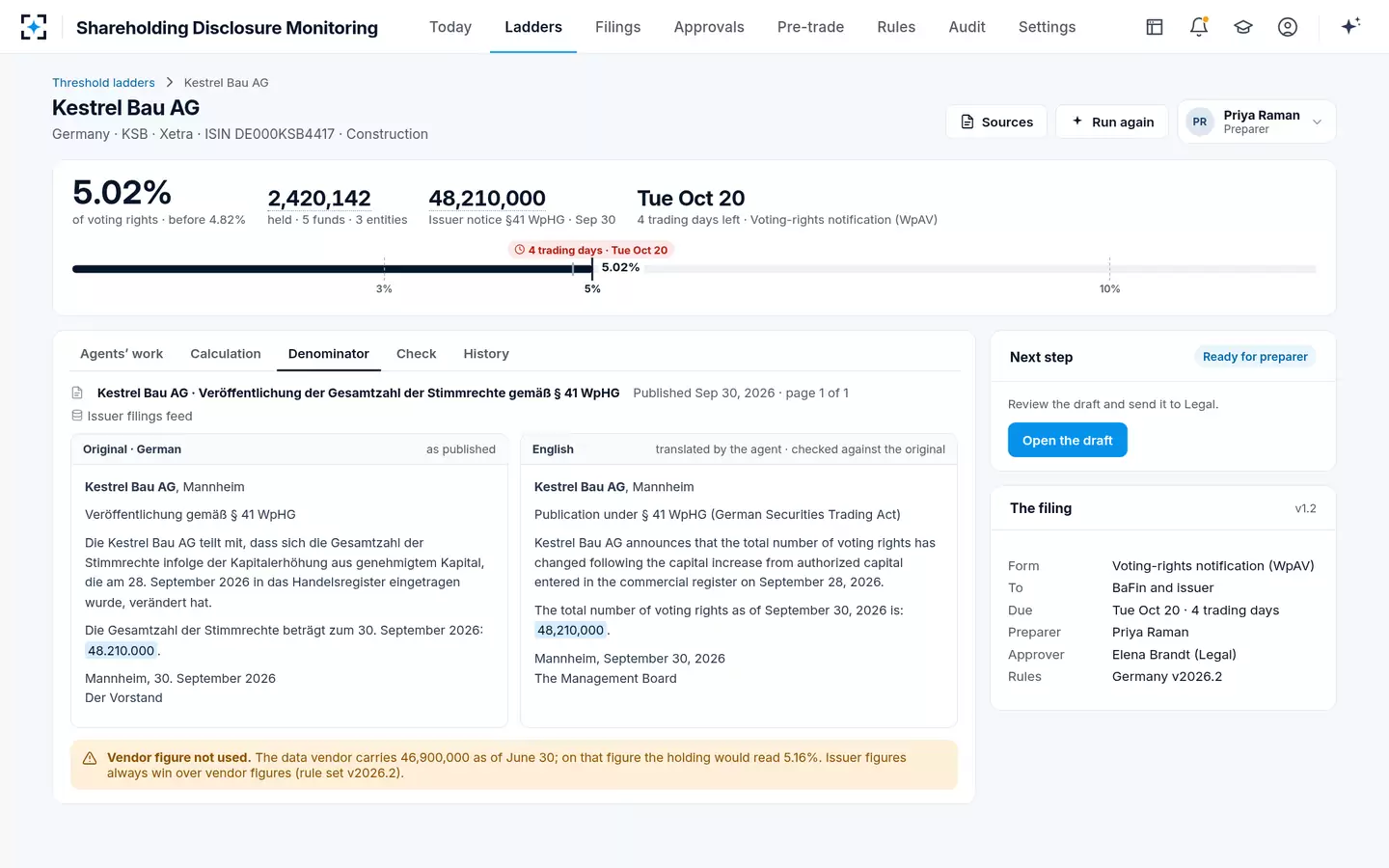
The numerator gets the same treatment. The Aggregation agent counts every entity, fund and mandate under each rule and keeps the US view beside the local one; the Check agent recomputes every crossing from custodian records on a separate model, blind to the first result, and a difference of more than 0.0001 points stops drafting and sends both workings to an analyst. The draft then carries each number with its source, so the approver signs a percentage whose two halves can each be traced. The month-end and quarter-end clocks that consume the number are covered in the four Schedule 13G amendment clocks; the solution is at Shareholding Disclosure Monitoring.
Questions people ask
What is beneficial ownership under Rule 13d-3?
Having or sharing, directly or indirectly, the power to vote or direct the vote of a security, or the power to dispose of it or direct its disposition. Either power alone is enough, all forms of ownership of the class are added together, and a right to acquire shares within 60 days counts.
What does rule 13d-3(d)(1) say?
That a person is deemed to own shares it has the right to acquire within 60 days, through options, warrants, conversion or revocation of a trust or account, and immediately if the right was acquired with a control purpose. Those shares are added to the outstanding class when computing that person's percentage, but not anyone else's.
Do shares on loan count toward beneficial ownership?
It depends on the terms. Rule 13d-3 turns on voting or investment power, so the question is whether the lender keeps or can recall either power under the loan agreement. Non-US regimes may treat them differently: under the German rule in the solution's sample, 41,000 shares on loan with a recall right are reported as an instrument, not as voting rights. Either way the treatment is a legal decision that should be recorded.
Can I use the shares outstanding from a data vendor?
Rule 13d-1(j) lets a filer rely on the issuer's most recent quarterly or annual report and any later current report, not on a vendor. A vendor figure can be a useful cross-check, but when it differs from the issuer's latest filing the filing wins.
Is beneficial ownership for Section 16 the same as for 13D?
Only for deciding whether someone is a more-than-10% owner, and even then certain institutions' ordinary-course client holdings are excluded. What a Section 16 insider then reports on Forms 3, 4 and 5 is pecuniary interest, a different test.
Does a group need a written agreement?
No. Rule 13d-5(b) speaks of persons who agree to act together, and an agreement can be informal. The evidence is what members agreed to do with their shares, not whether they signed anything.