A major shareholding notification is the notice a shareholder must send to a listed company, and usually its regulator, when the voting rights it holds or controls reach, exceed or fall below a set percentage. In the UK it is the TR-1 form under the FCA's Disclosure Guidance and Transparency Rules; in the EU it is each country's notification under the Transparency Directive; the US and Japan run their own 5% regimes. The thresholds differ, and so does what is counted: a fund manager's 3.4% of a German company must be notified, while 3.4% of a UK company held for clients need not be. The forms are short. The count, the denominator and the clock are where notifications go wrong, which is the work Botminds' Shareholding Disclosure Monitoring takes on: it aggregates a manager's holdings by each country's rule every morning, reads each issuer's own voting-rights figure and drafts the notification in the regulator's form and language.
Sources are the FCA Handbook, the Transparency Directive, ESMA's practical guide to national rules, Japan's Financial Services Agency and the SEC's rules. Product examples use the solution's fictional sample manager.
One 5.2% stake, held for clients by an asset manager: what each market requires
UK-incorporated issuer
Notices owedOne TR-1, at 5%. Below 5% the managed holding is disregarded, so the 3% and 4% rungs pass silently.
ClockTwo trading days after learning; a party to the trade is deemed to know within two trading days of it
German issuer
Notices owedTwo notifications: at 3% and at 5% of voting rights.
ClockIn practice generally four trading days in total
Dutch issuer
Notices owedTwo notifications to the AFM: at 3% and at 5%.
ClockFour trading days after learning
French issuer
Notices owedOne notification, at 5%.
ClockFour trading days after learning
US issuer
Notices owedOne Schedule 13G as a qualified institution, at more than 5%.
Clock45 days after the calendar quarter of the crossing
Japanese issuer
Notices owedOne large shareholding report, at more than 5%; then a change report for each move of 1% or more.
ClockFive business days, or within five business days of a twice-monthly reference date for eligible institutions
What is a major shareholding notification?
It is a holder's disclosure of its stake to the issuer, which then publishes it, so that the market knows who controls the votes. The EU's Transparency Directive sets the model: a shareholder must notify the issuer when its proportion of voting rights "reaches, exceeds or falls below the thresholds of 5 %, 10 %, 15 %, 20 %, 25 %, 30 %, 50 % and 75 %" (Directive 2004/109/EC, Article 9(1)), and must do so "promptly, but not later than four trading days" after the date it learned of the change (Article 12(2)). Member states may set stricter rules, and many do.
Three features distinguish these regimes from the US one. They count voting rights, attributing to a holder the votes it can exercise at its discretion, rather than voting or investment power. They require a notice at every rung on the way up and on the way down. And they include financial instruments that give a right to acquire shares, or economic exposure to them, in a holding that is notified alongside the shares.
UK: the TR-1 and the FCA's thresholds
For a UK issuer the FCA's ladder is steeper than the Directive's. DTR 5.1.2R requires a notification when voting rights reach, exceed or fall below "3%, 4%, 5%, 6%, 7%, 8%, 9%, 10% and each 1% threshold thereafter up to 100%"; for a non-UK issuer on a UK market the thresholds are 5%, 10%, 15%, 20%, 25%, 30%, 50% and 75% (FCA DTR 5.1.2R). The notification goes on form TR-1 to the issuer and, for shares on a regulated market, to the FCA (DTR 5.8.10R).
The clock is short and has a deeming rule. DTR 5.8.3R requires the notice "as soon as possible, but not later than four trading days in the case of a non- UK issuer and two trading days in all other cases" after the holder learns of the acquisition or disposal, and a holder that was party to the transaction is deemed to know of it no later than two trading days after it (FCA DTR 5.8.3R). Percentages are rounded down to the next whole number before testing, so 4.97% is 4%. A UK issuer must publish the notice by the end of the trading day after it receives it.
Why an investment manager's UK threshold starts at 5%
DTR 5.1.5R changes the ladder for asset managers. Voting rights attached to shares that a person "lawfully manages under an agreement in, or evidenced in, writing", and those exercisable as the operator of an authorised unit trust, authorised contractual scheme, recognised scheme or UCITS scheme, or by an ICVC, are disregarded "except at the thresholds of 5% and 10% and above" (FCA DTR 5.1.5R). For a manager's client holdings in a UK company, the first notification is at 5%, the next at 10%, then each 1% above it.
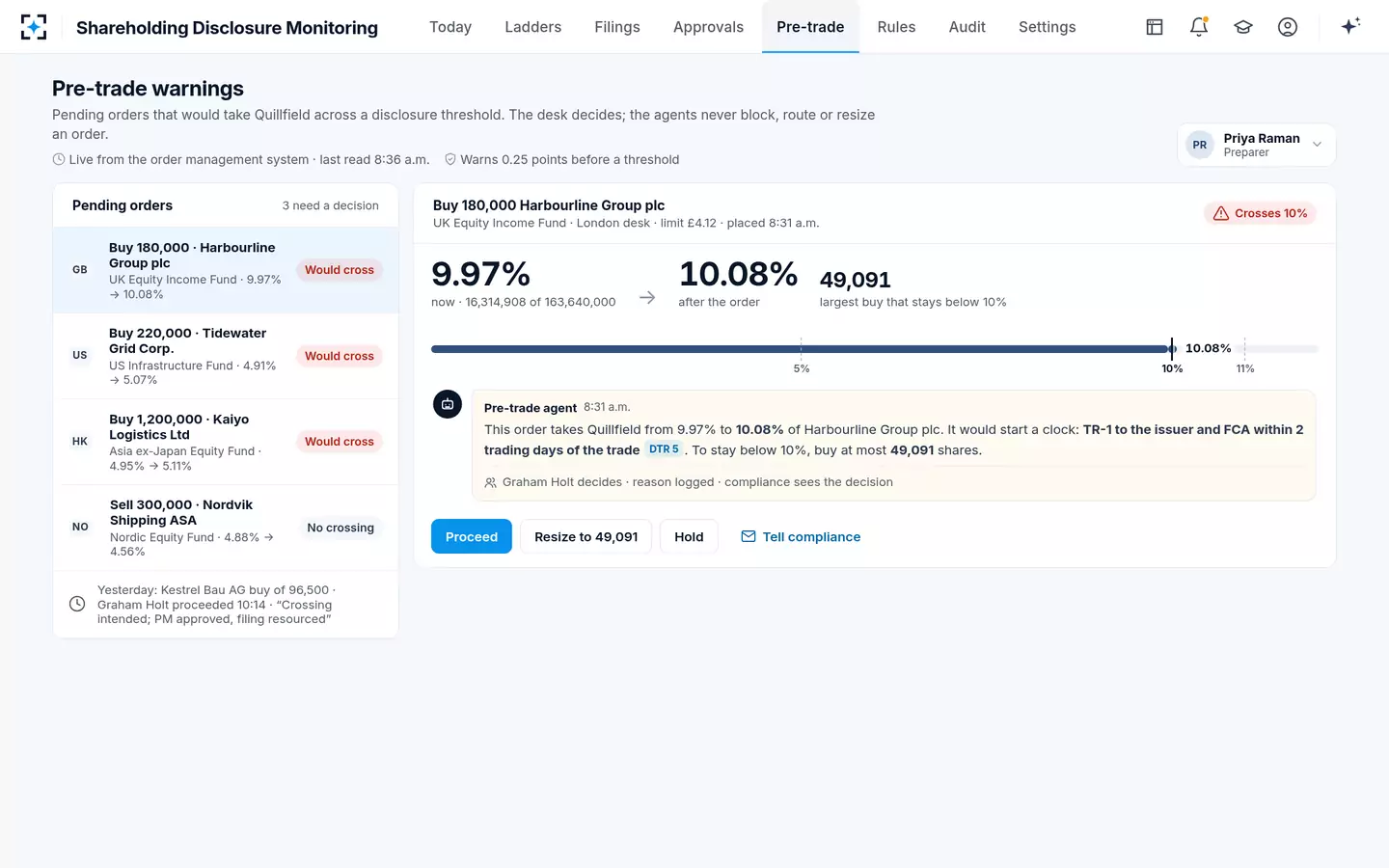
That is why a single "3% in the UK" setting in a monitoring system is wrong for most asset managers, and why the setting has to be per holding. A firm's own-account or proprietary holdings, or holdings it does not manage under a written agreement, still count from 3%; managed client holdings count from 5%. The solution's sample manager meets the rule at 10%: a pending order would take its UK equity fund from 9.97% to 10.08% of Harbourline Group's voting rights, which rounds down to 10% and starts a TR-1 clock.
A pre-trade warning: the order that would cross 10% of a UK issuer's voting rights
EU: the Transparency Directive floor and the national rungs
The Directive sets a floor that member states build on, and ESMA's practical guide shows how far they go. Of the 29 countries in its country-by-country summary, most use the Directive's 5% as the first rung, but several start lower: 3% in Germany, Spain, Italy (for issuers that are not SMEs), the Netherlands and for Irish issuers, and lower still, on a size-adjusted basis, in Czechia; in Austria a 3% rung applies only where an issuer has written it into its articles (ESMA Practical Guide, Table 1). Many add rungs above 30%, such as 40%, 60% or 90%.
Major shareholding notification thresholds and deadlines in eight EU markets
| Country | Thresholds (%) | Deadline to notify the issuer |
|---|---|---|
| Germany | 3, 5, 10, 15, 20, 25, 30, 50, 75 (3% for voting rights only) | Four trading days after learning; in practice generally four in total |
| France | 5, 10, 15, 20, 25, 30, ⅓, 50, ⅔, 90, 95 | Four trading days after learning |
| Netherlands | 3, 5, 10, 15, 20, 25, 30, 40, 50, 60, 75, 95 | Four trading days; the AFM informs the issuer |
| Italy | 3 (non-SME issuers), 5, 10, 15, 20, 25, 30, 50, ⅔, 90 | Four trading days after learning |
| Spain | 3, 5, 10, 15, 20, 25, 30, 35, 40, 45, 50, 60, 70, 75, 80, 90 | Four trading days after learning |
| Ireland, Irish issuers | 3 and each 1% to 100 | Two trading days after learning |
| Sweden | 5, 10, 15, 20, 25, 30, 50, ⅔, 90 (shares and votes) | Three trading days after learning |
| Luxembourg | 5, 10, 15, 20, 25, ⅓, 50, ⅔ | Four trading days after learning |
The deadlines differ as much as the thresholds, and they are counted in trading days on each market's calendar. ESMA's tables also show different triggering events: most countries start the clock on the trade date for on-exchange purchases, some on settlement, and for a passive crossing many start when the issuer publishes its new total of voting rights.
Germany: BaFin's 3% and the four-day practice
Germany is the market where asset managers most often notify below 5%. Its thresholds are 3, 5, 10, 15, 20, 25, 30, 50 and 75%, with the 3% rung applying only to voting rights, not to instruments or aggregated positions, and ESMA notes that the total time allowed, from the trade to learning of it and then notifying, is in practice generally four trading days, six only in very exceptional cases (ESMA Practical Guide, Tables 1, 5 and 7). The notification goes to BaFin and the issuer.
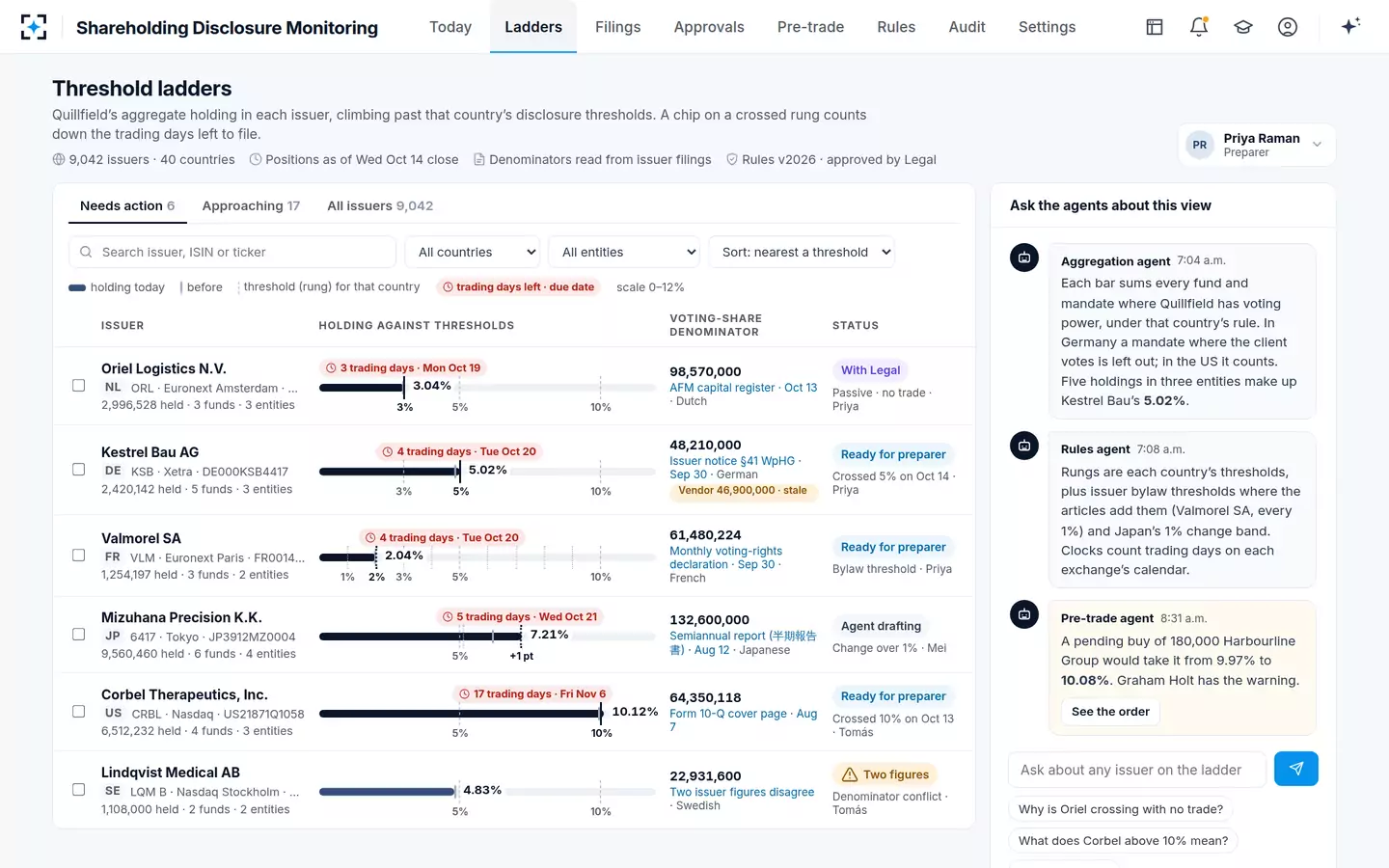
In the solution's sample data the German rule is the one that bites first. The sample manager's funds bought into Kestrel Bau AG and crossed 5% of voting rights on a Wednesday; counting four trading days on the Frankfurt calendar, the notification was due the following Tuesday. Five holdings were counted where the manager votes at its own discretion; a pension mandate where the client keeps the vote was left out under the German rule and kept in the US view; shares on loan were reported as instruments.
US and Japan: the other two 5% regimes
The US counts differently and files on a different clock. Schedule 13D or 13G is triggered by beneficial ownership of more than 5% of a registered voting class, counting voting or investment power. An asset manager that is a qualified institution, holding in the ordinary course without a control purpose, files Schedule 13G within 45 days after the calendar quarter in which it crossed, or within five business days after the month-end if it is above 10% (17 CFR 240.13d-1(b)). There are no further rungs; changes are reported as amendments, on the clocks set out in the four Schedule 13G amendment clocks.
Japan's large shareholding reporting rule starts above 5% and then reports every move of 1% or more. The FSA's FAQ says a holder whose ratio exceeds 5% "must submit a Large Shareholding Report within five business days", and that if the ratio "increases or decreases by 1% or more" afterwards it must submit a change report within five business days, both on EDINET (FSA, FAQ on the FIEA, section 5). Institutions that trade continuously may instead check twice a month on registered reference dates and report within five business days of each, provided they hold no more than 10% and do not intend an "act of material proposal" (FSA Q&As, August 2025). Holdings of joint holders are aggregated; since 1 May 2026 some agreements among institutional investors to vote together no longer make them joint holders, as collaborative engagement without becoming a group explains.
The UK and the EU Transparency Directive, rule by rule
UK (FCA DTR 5): 3% for UK issuers and every 1% above it; 5% for non-UK issuers.
EU (Directive 2004/109/EC): 5%, with member states free to set lower or extra thresholds.
UK (FCA DTR 5): Disregarded except at 5% and at 10% and above (DTR 5.1.5R).
EU (Directive 2004/109/EC): National rules on attribution and exemptions apply.
UK (FCA DTR 5): Two trading days after learning (four for non-UK issuers).
EU (Directive 2004/109/EC): Promptly, not later than four trading days after learning (Article 12(2)).
UK (FCA DTR 5): Issuer's most recent total voting rights disclosure, less treasury shares (DTR 5.8.8R).
EU (Directive 2004/109/EC): Information the issuer discloses under Article 15 on its total voting rights.
UK (FCA DTR 5): Rounded down to the next whole number before testing (DTR 5.1.1R(6)).
EU (Directive 2004/109/EC): As set nationally.
UK (FCA DTR 5): TR-1, to the issuer and the FCA.
EU (Directive 2004/109/EC): Forms and channels set by each national authority.
Which denominator? The issuer's last total voting rights figure
Every regime divides by the issuer's own published number, not a data vendor's. In the UK, the number of voting rights to test against is "the number of voting rights in existence according to the issuer's most recent disclosure", disregarding treasury shares (DTR 5.8.8R). The Directive ties passive crossings to the information the issuer discloses about its total voting rights. In the US, Rule 13d-1(j) lets a holder rely on the issuer's latest periodic report. The denominator for the US case is traced through one filing in Rule 13d-3 beneficial ownership and the denominator.
Issuers publish those figures in their own languages and formats: a German total voting rights notice, a Dutch register entry, a French monthly declaration, a Japanese semiannual report. A vendor's field may lag them by months. In the sample, the German issuer's own notice gave 48,210,000 voting rights after a capital increase, where the vendor still carried 46,900,000; on the vendor's number the stake would have read 5.16% instead of 5.02%.
Passive crossings: when the issuer moves and you do not
A holder can cross a threshold without trading. A buyback that cancels shares raises every holder's percentage; a capital increase lowers it. The UK and the Directive both require notification when a threshold is crossed "as a result of events changing the breakdown of voting rights", on the basis of what the issuer has disclosed (DTR 5.1.2R(2); Directive Article 9(2)), and ESMA's tables show most countries start that clock from the issuer's publication or the registration of the capital change.
Passive crossings are the notifications a trade-based alert never sees. In the sample data a Dutch logistics company cancelled shares and the manager crossed 3% with no trade; the notice was due four trading days after the issuer's publication. The US treats the same event differently: Rule 13d-2(b) needs no Schedule 13G amendment for a change caused solely by the number of shares outstanding.
The EU's rungs below 5%, by ESMA's count
29
EEA countries in ESMA's country-by-country summary
7
list a rung below 5%, some only for certain issuers or on conditions
4trading days
the most common deadline to notify the issuer after learning
3%
Germany's first rung, for voting rights only
The hard part is the count: managed holdings, instruments and lent shares
The forms take minutes; the count takes judgment. A manager must decide, issuer by issuer and rule by rule, which holdings are attributed to it: funds where it votes at its discretion, mandates where the client keeps the vote, holdings in other group entities, shares lent with a right of recall, and instruments such as options or swaps that each regime counts differently. The UK disregards managed holdings below 5%; Germany counts voting rights and lists instruments separately; the US counts investment power as well as votes.
Each of those choices should be written down once, approved and then applied the same way every day. In the solution they are versioned rules that Legal approves; the Aggregation agent applies them and keeps the US view beside each local one, and when a judgment is needed, such as two issuer figures that disagree, the agents stop and ask an analyst.
How Shareholding Disclosure Monitoring runs every ladder at once
The threshold ladder is the solution's central screen: each issuer's aggregate holding as a bar against its own country's rungs, with a chip on each crossed rung counting the trading days left and the denominator's source beside it. In the sample, 9,042 issuers across 40 countries were tested each morning; five thresholds were crossed and 17 issuers sat within half a point of a rung.
Threshold ladders in Shareholding Disclosure Monitoring: every issuer against its own country's rungs
For each crossing the Drafting agent prepares the notification in the regulator's form and language, with English beside it: the German voting-rights notification, the UK TR-1, the AFM substantial holding notification, Japan's large shareholding and change reports. The regulatory reporting manager prepares, Legal approves with a reason code, and nothing is filed unseen. What to automate and what to keep across all of these is set out in what shareholding disclosure software should automate; the solution is at Shareholding Disclosure Monitoring.
Questions people ask
What are the TR-1 notification thresholds?
For a UK issuer, 3%, 4%, 5%, 6%, 7%, 8%, 9%, 10% and each 1% above that, up and down; for a non-UK issuer on a UK market, 5%, 10%, 15%, 20%, 25%, 30%, 50% and 75%. Holdings an investment manager manages for clients are disregarded except at 5% and at 10% and above.
How long do you have to file a TR-1 with the FCA?
As soon as possible and no later than two trading days after learning of the change for a UK issuer, or four for a non-UK issuer. A holder that was a party to the trade is deemed to know of it within two trading days of the transaction.
What does ESMA publish on major shareholding notifications?
A practical guide summarising each EEA country's rules under the Transparency Directive, with tables comparing thresholds, triggering events, deadlines, filing channels and publication. It is a summary, not law, and ESMA's last revision in September 2025 updated only its links.
What is the BaFin major shareholding disclosure threshold?
3% of voting rights, then 5, 10, 15, 20, 25, 30, 50 and 75%. The 3% rung does not apply to positions in instruments or to aggregated positions, and in practice the total time to notify is generally four trading days.
Do I need to notify when my holding falls below a threshold?
Yes in the UK and under the Transparency Directive, which require notification when a threshold is reached, exceeded or fallen below. In the US a Schedule 13G filer reports a fall to 5% or less in an amendment, after which no further filings are needed unless it crosses again.
Is a UK major shareholding notification the same as a Schedule 13G?
No. The TR-1 counts voting rights, is triggered at each rung from 3% (or 5% for managed holdings) and is due within two trading days. Schedule 13G counts voting or investment power above 5%, has no further rungs, and for a qualified institution is due 45 days after the quarter.