The Schedule 13D filing deadline is five business days after the date of the acquisition that takes a holder above 5% of a class of registered voting equity, and the filing counts for that day if its EDGAR transmission starts by 10 p.m. Eastern Time. The clock starts on the trade date, whether or not anyone has noticed the crossing yet: Saturdays, Sundays and federal holidays are skipped, nothing else is. Five business days sounds generous until it is spent confirming the share count, finding every account that counts and deciding whether the holder may use the short-form Schedule 13G at all. Botminds' Shareholding Disclosure Monitoring aggregates a manager's positions across entities each morning, recomputes each holding on the issuer's own count and drafts the filing the day a threshold is crossed, so that week starts on day one.
The case below is fictional: Fenwick Hollow Capital, a registered investment adviser, its compliance analyst Daria Velasco-Hune, its portfolio manager Ellery Moss and the issuer, Quarrington Systems Inc., are invented. The rules, dates and SEC figures are real and linked where they appear.
Eight calendar days, five business days: the clock from a Thursday trade
- Thu 2trade
- Fri 3holiday
- Sat–Sunweekend
- Mon 6BD 1
- Tue 7–Thu 9BD 2–4: count, decide, draft
- Fri 10filed
What is the Schedule 13D filing deadline?
Five business days. Rule 13d-1(a) requires anyone who becomes the beneficial owner of more than 5% of a covered class to file a Schedule 13D "within five business days after the date of the acquisition" (17 CFR 240.13d-1(a)). Until 5 February 2024 the deadline was ten calendar days, a period set when Congress added Section 13(d) in 1968; the SEC shortened it in its October 2023 release, citing filers' ability to compile data and file electronically (Release 33-11253).
The time of day is set separately. Since the same amendments, Regulation S-T deems a Schedule 13D or 13D/A filed on the same business day if its direct transmission begins on or before 10 p.m. Eastern Time (17 CFR 232.13(a)(4)). Most other EDGAR filings keep a 5:30 p.m. cut-off. The temporary hardship exemption for technical difficulties no longer covers Schedules 13D and 13G; a filer whose submission fails at 9:50 p.m. on day five can only ask the SEC to adjust the filing date under Rule 13(b), which is discretionary.
Thursday 2 July, 4:05 pm: the trade that nobody saw cross
Fenwick Hollow's main fund had been building a position in Quarrington Systems, a Nasdaq-listed maker of industrial control software, since March. At 4:05 pm on Thursday 2 July, after the close, the desk bought a block of 210,000 shares from a selling holder through a broker. Including a separately managed account Fenwick runs for a public pension plan, with full discretion and the vote, the firm now held 2,090,000 shares.
The firm's alert fired on nothing. It counted only the fund, 2,030,000 shares, and divided by the share count in its market-data feed, 42,350,000, taken from Quarrington's annual report. On those numbers the position was 4.79%. On Fenwick's real numbers it was 5.02%: the pension account added 60,000 shares, and Quarrington's latest 10-Q, filed in May after a buyback, reported 41,600,000 shares outstanding. Two small errors, one in each half of the fraction, hid a crossing.
When does the 13D clock start?
On the date of the acquisition, which for a purchase is the trade date, not settlement and not the morning someone reads a report. Rule 13d-1(i)(2) defines a business day for Regulation 13D-G as running "from 12 a.m. to 11:59 p.m., Eastern Time", and the SEC chose that full-day definition in 2023 precisely so that an obligation incurred late in the evening falls on that day (Release 33-11253, note 134). A trade at 4:05 pm on Thursday is a Thursday acquisition; Thursday is day zero and the five business days start on the next one.
Holdings that were not bought count too. Beneficial ownership is voting or investment power under Rule 13d-3, aggregated across every account a firm controls, including options and other rights to acquire shares within 60 days. A crossing can be caused by a sleeve, an affiliate or a warrant as easily as by the trade that triggered the alert. How that count is built, account by account, is the subject of Rule 13d-3 beneficial ownership and its denominator.
Friday 3 July: the holiday that buys one day
Independence Day 2026 falls on a Saturday, so the federal holiday is observed on Friday 3 July. That day does not count, nor do the weekend days after it. The five business days are Monday 6, Tuesday 7, Wednesday 8, Thursday 9 and Friday 10 July. A trade on Thursday 9 July, with no holiday in its window, would have been due Thursday 16 July, seven calendar days later; the holiday stretched this one to eight.
Holiday arithmetic is where hand-built calendars slip. The rule follows the federal calendar, not the exchange calendar: Good Friday, a market holiday but not a federal one, is a business day for this purpose, while Columbus Day and Veterans Day, when US markets open, are not.
Monday 6 July: the aggregation finds 5.02%
Daria runs a weekly aggregation each Monday that adds the separately managed accounts to the funds, because the morning alert does not. At 9:20 am it showed Quarrington at 5.02% as of Thursday's close. She checked the trade blotter, confirmed the block and wrote to the general counsel at 9:41: crossed 5% on Thursday 2 July, filing due Friday 10 July, four business days left after today.
Day one had been spent before anyone knew it had started, which is the norm rather than the exception. A crossing found by a weekly or quarterly process usually reaches the compliance team with part of the clock already used. The only defence is a calculation that runs on every account, every day, on the right share count.
Tuesday 7 July: whose share count?
The percentage needs a denominator, and the rules say which one a holder may use. Under Rule 13d-1(j) a filer may take the class size from the issuer's latest 10-Q or 10-K, or any later 8-K, unless it "knows or has reason to believe" that information is wrong (17 CFR 240.13d-1(j)). Quarrington's 10-Q for the quarter to March, filed in May, gave 41,600,000 shares on its cover page; there was no later 8-K reporting a change.
Daria rebuilt the number from that filing, not from the feed, and recorded the source: 2,090,000 ÷ 41,600,000 = 5.024%. Before the block, the firm held 1,880,000 shares, 4.519%. The feed's 42,350,000 was a pre-buyback figure that would have put the firm at 4.94%, under the line. A holder that relies on a vendor's count rather than the issuer's filing has no Rule 13d-1(j) reliance to point to if the vendor is wrong.
Wednesday 8 July: 13D or 13G, and is there a group?
Fenwick is a registered investment adviser, so on its face it could file the short-form Schedule 13G as a qualified institution, due 45 days after the end of the quarter in which it crossed: Monday 16 November, since the crossing fell in the third quarter. That route is open only to a holder that bought in the ordinary course of business and has no aim, and causes no effect, of changing or influencing control of the issuer (Rule 13d-1(b)(1)(i)). On 18 June Ellery Moss had written to Quarrington's board urging the sale of its industrial controls division and asking to discuss a board seat. Counsel's view was that the letter put the position on the control side of the line, and Schedule 13D was the only option.
The same meeting asked whether Fenwick had formed a group. Ellery had discussed Quarrington with a portfolio manager at another firm in May. A group forms when holders agree to act together in acquiring, holding, voting or disposing of the shares, and its members' holdings are then counted together. The notes showed views exchanged and no agreement, so counsel concluded there was no group and recorded why. Where conversations stop and agreement starts, in the US and in Japan, is worked through in collaborative engagement without becoming a group.
One question did not apply. Rule 13d-1(e)(2) bars a holder switching from Schedule 13G to 13D from voting or buying until ten days after the 13D is filed; Fenwick had never filed a 13G, so the desk was free to keep trading. It bought 95,000 more shares on Wednesday, which would have to be reported in the filing.
Thursday 9 July: what the Schedule 13D has to say
The draft took a day because the form asks for judgment as well as numbers. Item 4, "Purpose of Transaction", required the firm to describe its plans, including the June letter. Item 5 required the aggregate number and percentage, which the instruction says "may be based on the number of securities outstanding as contained in the most recently available filing with the Commission by the issuer unless the filing person has reason to believe such information is not current" (17 CFR 240.13d-101, Item 5), and every transaction in the past sixty days, with date, amount, price and where it was done. Item 6 required any contracts or arrangements on the securities, including derivatives.
The sixty-day schedule carried the most rows: Fenwick's purchases since early May, including Thursday's block and Wednesday's 95,000 shares, with the total at 2,185,000 shares, 5.25%. Since 18 December 2024 Schedules 13D and 13G have had to be filed in a structured, machine-readable data language, so each reported number can be read by machine and set beside the issuer's own filings.
What to confirm before a first Schedule 13D goes to EDGAR
- The acquisition date of the crossing trade
Day zero; the five business days start the next business day.
- Every account counted
Funds, separately managed accounts, affiliates and rights to acquire within 60 days, by voting or investment power.
- The issuer's own share count, with its source
Most recent 10-Q or 10-K and any later current report, under Rule 13d-1(j).
- The filing basis, decided by counsel
Control purpose rules out Schedule 13G; record the reasoning.
- Any group, and the evidence for or against
An agreement to act together aggregates every member's shares.
- The sixty-day transaction schedule
Item 5(c): who traded, when, how many, at what price and where.
- Derivatives and arrangements
Item 6 covers options, swaps, cash-settled instruments and voting arrangements.
- Who can submit, and by 10 p.m. Eastern
Under EDGAR Next each person filing needs individual Login.gov credentials and multifactor authentication.
Friday 10 July, 6:40 pm: filed before the 10 p.m. cut-off
The general counsel signed at 5:55 pm; Daria submitted at 6:40 pm and kept the acceptance message with the file. Since 15 September 2025 every EDGAR submission has had to be made by an individual using personal Login.gov credentials and multifactor authentication, and each filer must name at least two account administrators (SEC, EDGAR Next). Fenwick had set that up in the spring; a firm that had not would have learned it on day five.
The filing was on time by just over three hours. With one more surprise, a second missed account or a disputed share count, it would not have been.
What is the 13D amendment deadline?
Two business days after any material change. Rule 13d-2(a) requires an amendment "within two business days after the date of such change", and deems an acquisition or disposition of 1% or more of the class material, while smaller changes may be material on the facts (17 CFR 240.13d-2(a)). For Fenwick, 1% of 41,600,000 is 416,000 shares. A plan to buy another 450,000 shares, or a new letter proposing a slate of directors, would start a two-business-day clock.
The amendment clock is the one that runs fastest in practice, because an active holder can trigger it repeatedly. The change in purpose matters as much as the change in numbers: an Item 4 that described a request for a board seat is out of date once the firm nominates directors, whatever its holding.
What the old ten-day window shows about the new five days
The evidence on the old deadline is a warning about the new one. A study in the Journal of Corporation Law of about 2,000 Schedule 13D filings by activist hedge funds between 1994 and 2007 found that roughly one in ten was filed after the ten-day window, and that buying was concentrated around the crossing.
Even when activists wait the full ten days to disclose their stakes, their purchases seem to be disproportionately concentrated on the day they cross the threshold and the next day.
Bebchuk, Brav, Jackson and Jiang, 'Pre-Disclosure Accumulations by Activist Investors', 39 Journal of Corporation Law 1 (2013)
The SEC's own count is more recent. Looking at initial Schedule 13D filings made in 2022, staff found that about 71% were filed within the ten-day window, about 34% on the last permitted day, and about 29% late once weekends and holidays were taken into account. About 29% of all initial filings would also have met the new five-business-day deadline. Most filers used most of the time they had, and many used more.
Initial Schedule 13D filings in 2022, measured against the old ten-day deadline
71%
filed within the ten-day window
34%
filed on the last permitted day
29%
filed late, after weekends and holidays are allowed for
29%
filed within what is now the five-business-day deadline
Where Shareholding Disclosure Monitoring changes the week
Fenwick lost Thursday and most of the margin on Friday to two things a machine can do every morning: count every account, and use the issuer's own share count. In Shareholding Disclosure Monitoring the Intake agent reads end-of-day positions from every legal entity, fund and mandate and reconciles them before any threshold is tested. The Aggregation agent sums each issuer under the US rule, and the Denominator agent reads the share count from the issuer's latest filing, a 10-Q cover page in the US, and flags a market-data figure that disagrees.
Shareholding Disclosure Monitoring: each issuer on its threshold ladder, with the denominator's source
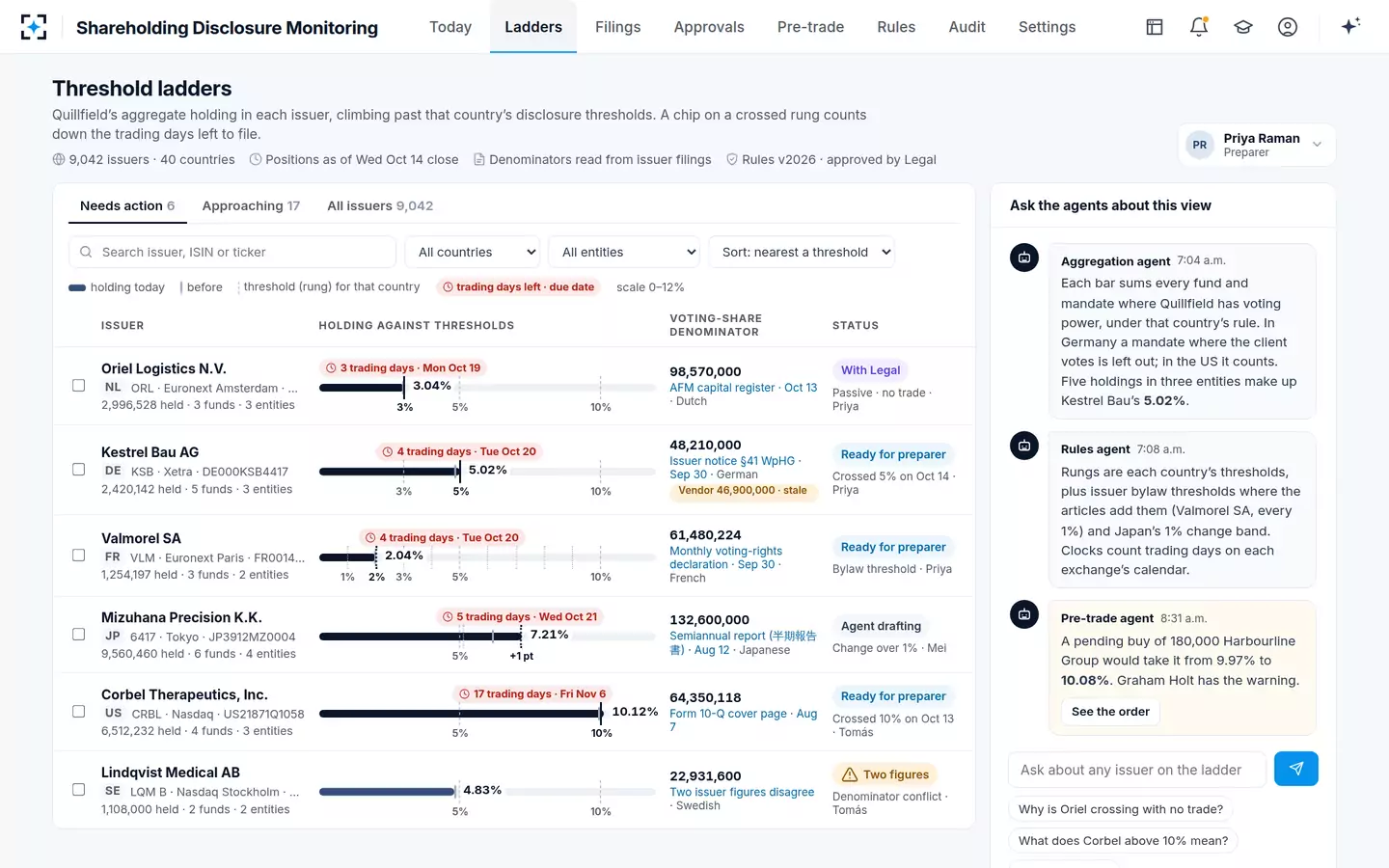
A Check agent then recomputes every crossing from custodian records without seeing the first result, on a separate model, and a difference stops the draft. Only then does the Drafting agent prepare the form, every field cited to its source. The judgment Fenwick's counsel made on Wednesday, whether a letter to the board is a control purpose, stays with Legal: the agents never decide it, and the preparer can never approve their own filing.
One issuer's crossing, step by step: positions, aggregation, the issuer's count and an independent recompute
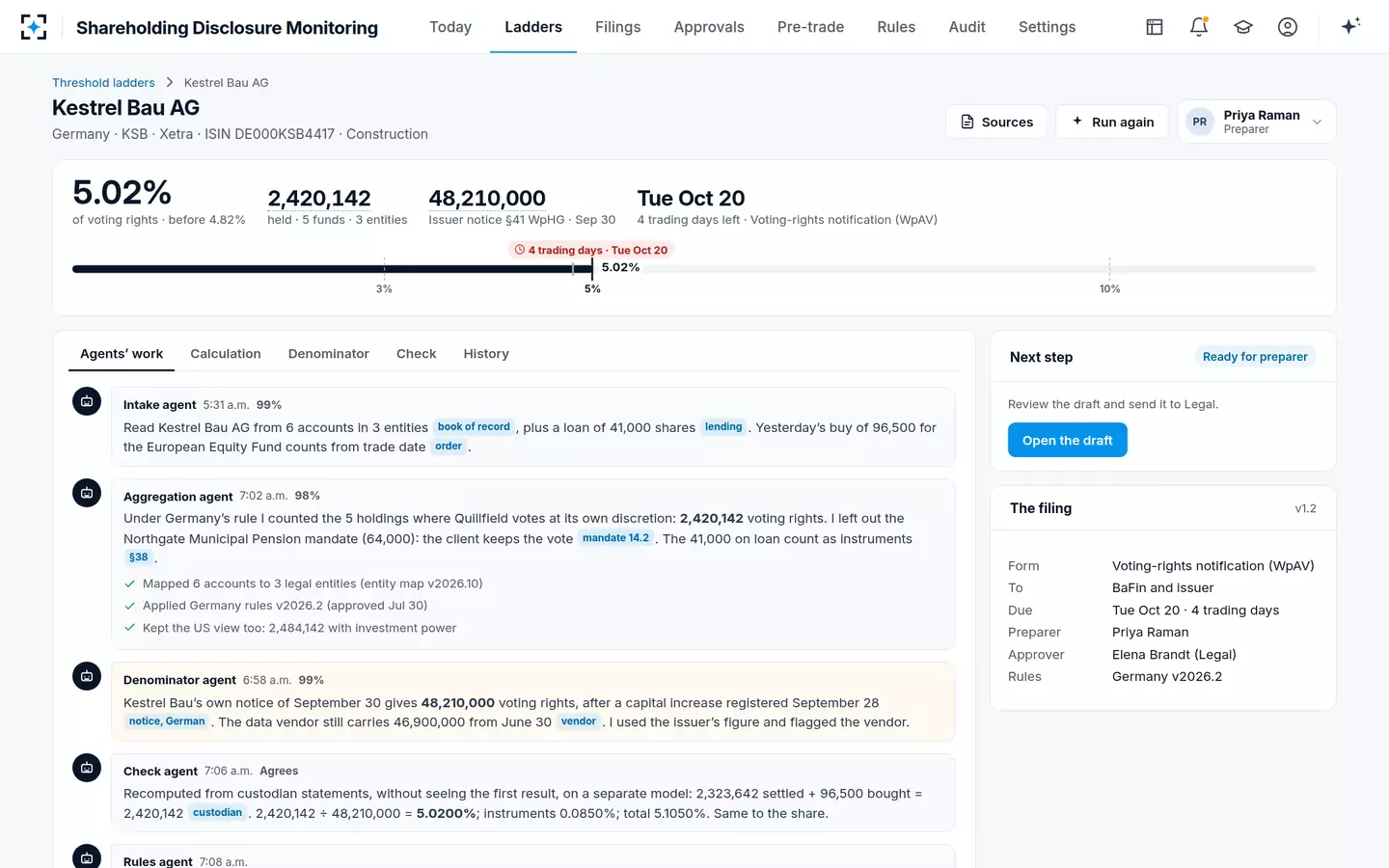
The solution's design target is a checked draft on the day of the crossing, by 4 p.m. local time in its default settings: on Fenwick's facts, from the next morning's run rather than from Monday's spreadsheet. That leaves the five business days for what only people can do. The same arithmetic, applied to UK, EU and Japanese clocks on the same holding, is set out in major shareholding notification across three regimes. To see the week run on your own positions, start from Shareholding Disclosure Monitoring.
Questions people ask
Is the 13D filing deadline five days or five business days?
Five business days. Weekends and federal holidays are skipped, so a crossing on a Thursday before a Friday holiday is due on the Friday of the following week. Before 5 February 2024 the deadline was ten calendar days.
What is the 13D filing deadline time?
10 p.m. Eastern Time on the fifth business day. Regulation S-T Rule 13(a)(4) deems a Schedule 13D filed that day if its transmission starts by 10 p.m.; a submission starting later is deemed filed the next business day, which would be late.
Does the 13D deadline run from the trade date or settlement?
From the date of the acquisition, which for a purchase is the trade date. The SEC defines a business day for Regulation 13D-G as the full day from 12 a.m. to 11:59 p.m. Eastern Time, so a trade after the market closes still falls on that day.
Can you keep buying shares before the 13D is filed?
A first-time Schedule 13D filer is not barred from buying during the five business days, but every purchase in the sixty days before filing goes on the schedule. A holder switching from Schedule 13G to 13D is different: under Rule 13d-1(e)(2) it may not vote or buy until ten days after the 13D is filed.
Which share count should a 13D percentage use?
The issuer's own figure from its most recent 10-Q or 10-K, or a later current report, unless the filer has reason to believe it is wrong. A data vendor's count is not a filing the rule lets a holder rely on.
What is the 13D amendment deadline?
Two business days after a material change. An acquisition or disposition of 1% or more of the class is deemed material, and so can a change in purpose, such as moving from a request for a meeting to nominating directors.