A transfer of mortgage servicing rights moves the right to service a pool of loans, and the fee that pays for it, from one servicer to another; the loans' owner does not change. What also moves, unpriced in most bids, is every defect in the seller's records: balances, escrow payees, payment histories and, most expensively, workouts the seller agreed with borrowers that never reached its data tape. The buyer becomes responsible for honoring those workouts from the transfer date, and the public record shows what failing to do so costs. Botminds' Servicing Transfer Reconciliation is built for that inheritance: it compares every transferred loan with its signed documents and the seller's servicing notes, so the defects bought with the rights are found in the first weeks, ranked by harm, rather than in complaints.
Industry figures below come from regulators, Congress's research service and the Mortgage Bankers Association, linked where used. Product figures come from a fictional sample acquisition: Copperline Loan Servicing buying 4,812 loans from Ashgrove Home Loans.
The fee, the cost and the bill for getting a transfer wrong
25bp
typical annual servicing fee on the balance, about $250 per $100,000
$1,573
average cost to service a non-performing loan in 2024, against $176 for a performing one
$48M
restitution one servicer paid, with a $15M penalty, partly for not honoring transferred modifications
40,000+
borrowers owed about $73M of redress in a 2020 settlement that covered transfer failures
What is a mortgage servicing rights sale?
A mortgage servicing rights sale is the sale of the contractual right to service loans, separate from the loans themselves. The servicer collects payments, pays taxes and insurance from escrow, works out delinquent loans and handles foreclosure for the owner, and is paid a fee from each payment. The Congressional Research Service puts that fee at a reported average of 25 basis points of the balance a year, and describes how the market works: "Prospective servicing firms typically place bids on MSAs at auctions," often financing the purchase against the servicing cash flows (CRS R48713).
The market has shifted toward buyers who are not banks. The Financial Stability Oversight Council reported that "nonbanks serviced 59 percent of outstanding mortgages as of the second quarter of 2025 compared with just 20 percent in 2013" (FSOC 2025 Annual Report). Each of those portfolios was built, at least in part, by boarding loans someone else had serviced.
What is an MSR sale vs a subservicing transfer?
In an MSR sale the buyer owns the servicing rights and the fee; in a subservicing transfer the owner keeps the rights and hires a different company to do the work. For the borrower the two can look identical, and for the data they are the same problem: Regulation X defines the transferee for its transfer-of-information duty as "a servicer, including a master servicer or a subservicer." A new subservicing client brings a tape, image bundles and notes exactly as a bulk purchase does.
The difference shows up in who bears the cost of a defect. The MSR owner bears remediation and investor exposure; a subservicer bears its contract terms and its regulator. Both are in the line of fire when a borrower's modification is not honored, and both are expected by the CFPB to test the data on arrival.
What does a bad servicing transfer cost? The public record
A bad servicing transfer costs far more in redress to borrowers than in penalties, and the public cases show the ratio. Green Tree paid $48 million in restitution and a $15 million penalty in 2015; Nationstar paid about $73 million in redress and a $1.5 million CFPB penalty in 2020. In both cases transferred-loan failures sat beside other servicing failures, so the totals are not transfer costs alone; the ratio between redress and penalty is the useful number.
Redress dwarfs the penalty in the two largest public cases involving transferred loans
The Green Tree order is the most specific about transfers. According to the CFPB, Green Tree "failed to honor modifications for loans transferred from other servicers," and when "homeowners in distress had their mortgages transferred to Green Tree, their previous foreclosure relief plans were not maintained." The order required "a detailed data integrity program that tests, identifies, and corrects errors in loans transferred to Green Tree," and barred transfers of loans in loss mitigation, in or out, "unless all account-level documents and data relating to loss mitigation are provided to the new servicer by the date of transfer" (CFPB, April 2015).
Which enforcement actions involved servicing transfers?
Three public CFPB matters turn on transfers: Green Tree in 2015, Ocwen in 2017 as alleged, and Nationstar in 2020. Each names a different side of the problem: the buyer that did not honor inherited plans, the seller that allegedly sent incomplete data, and a servicer ordered to improve how it moves information in both directions.
Public CFPB matters involving servicing transfers
| Matter | Side of the transfer | What the CFPB said | Outcome |
|---|---|---|---|
| Green Tree Servicing, 2015 (with the FTC) | Buyer | Failed to honor modifications on loans transferred from other servicers; insisted on the old, higher payment | $48M restitution, $15M penalty; data integrity program for transferred loans |
| Ocwen Financial, 2017 (lawsuit) | Seller | Allegedly "failed to include complete and accurate borrower information when it sold its rights," which "hampered the new servicers’ efforts to comply" | Allegations; outcome not stated here |
| Nationstar (Mr. Cooper), 2020 (with states) | Both | Ordered to improve "transferring information during servicing transfers," alongside escrow and other failures | About $73M redress to 40,000+ borrowers; $1.5M CFPB penalty |
A buyer reading this record in 2026 should not assume the risk has receded with federal enforcement. The rules are unchanged, private litigation under RESPA continues, states now supervise most nonbank servicers, and the CFPB's July 2026 servicing examination procedures still open with a module on servicing and ownership transfers. The cost of an inherited error lands on the buyer whoever finds it.
Does FHFA approve MSR transfers? Significant Transfers and nine risk factors
FHFA reviews large transfers of servicing on Fannie Mae and Freddie Mac loans, called Significant Transfers, and has delegated the rest to the Enterprises. Its 2014 guidelines set nine factors for the review, including "operational risks associated with the transferor and the transferee" and the "capacity of the transferee to absorb the transaction," according to FHFA's Inspector General (FHFA OIG, COM-2018-001).
When an Enterprise MSR transfer goes to FHFA for review
| Test | Threshold |
|---|---|
| Any transfer to a non-bank servicer | Servicing rights on 100,000 or more loans |
| Any transfer to any acquiring servicer | 25,000 or more loans, if it would raise the buyer’s seriously delinquent Enterprise portfolio by at least 25% and at least 500 of the loans are 90 or more days past due |
| Before May 2016 | 25,000 or more loans, whatever their status |
| Review outcome, June 2016 to June 2017 | Six Significant Transfers approved, five of them with risk-mitigating conditions |
The thresholds tell a buyer where scrutiny concentrates: non-bank buyers and transfers heavy with delinquent loans, "since servicing responsibilities and risks are higher for delinquent loans than for non-delinquent loans," as the Inspector General summarised FHFA's reasoning. They are also exactly the transfers in which workouts are in flight and data defects are most expensive. A buyer that can show, loan by loan, what it checked after boarding has a better answer to an operational-capacity question than a staffing plan.
A transfer error is a notice of error waiting to be filed
Regulation X lists eleven errors a borrower can assert in writing, and one of them is the transfer itself: "failure to transfer accurately and timely information relating to the servicing of a borrower's mortgage loan account to a transferee servicer" (12 CFR 1024.35(b)(8)). The others that follow a bad boarding are close behind: failure to credit a payment as of its date of receipt, failure to pay taxes or insurance on time from escrow, and a fee the servicer "lacks a reasonable basis to impose."
Each notice of error has its own clock and investigation duty, and RESPA adds private liability: actual damages and, for a pattern or practice of noncompliance, additional damages of up to $2,000 per borrower, with class damages capped at the lesser of $1,000,000 or 1 percent of the servicer's net worth (12 U.S.C. 2605(f)). A defect in a field shared by hundreds of loans is, by its nature, a pattern.
What an inherited defect costs, written as a sum
Redress
affected borrowers × (fees reversed + interest + harm)
Late fees, the extra interest accrued while a plan was not honored, credit reporting corrections.
Servicing and compliance
Servicing cost
loans pushed delinquent × ($1,573 − $176) a year
A borrower billed in full off a trial plan can become a non-performing loan; MBA 2024 averages.
Finance
Notice-of-error handling
notices × investigation hours
Each written dispute about a transfer error carries a response clock and an investigation.
Customer care
Exposure
pattern-or-practice damages + investor remedies
Up to $2,000 per borrower in RESPA additional damages; investor compensatory fees and repurchase.
Legal
Pricing the data risk into the bid
Price the data risk by the tranche's composition, not its size. A pool of current, fixed-rate loans from a seller with a stable tape layout carries little; a pool with delinquent loans, active trial plans, adjustable-rate products and a recent system change at the seller carries a great deal. The MBA's cost study gives the reason in one comparison: servicing costs of non-performing loans "averaged $1,573 per loan in 2024," against $176 for performing loans (MBA NewsLink). A boarding error that turns a performing trial borrower into a delinquent one changes which column the loan sits in.
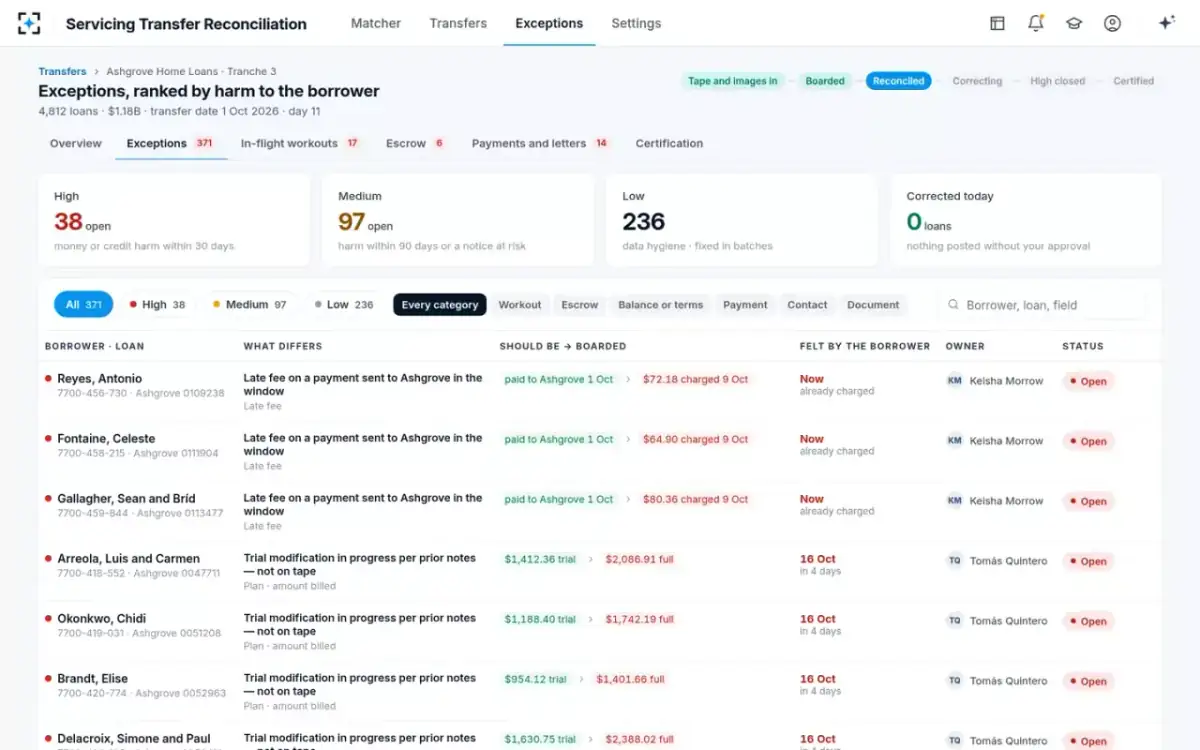
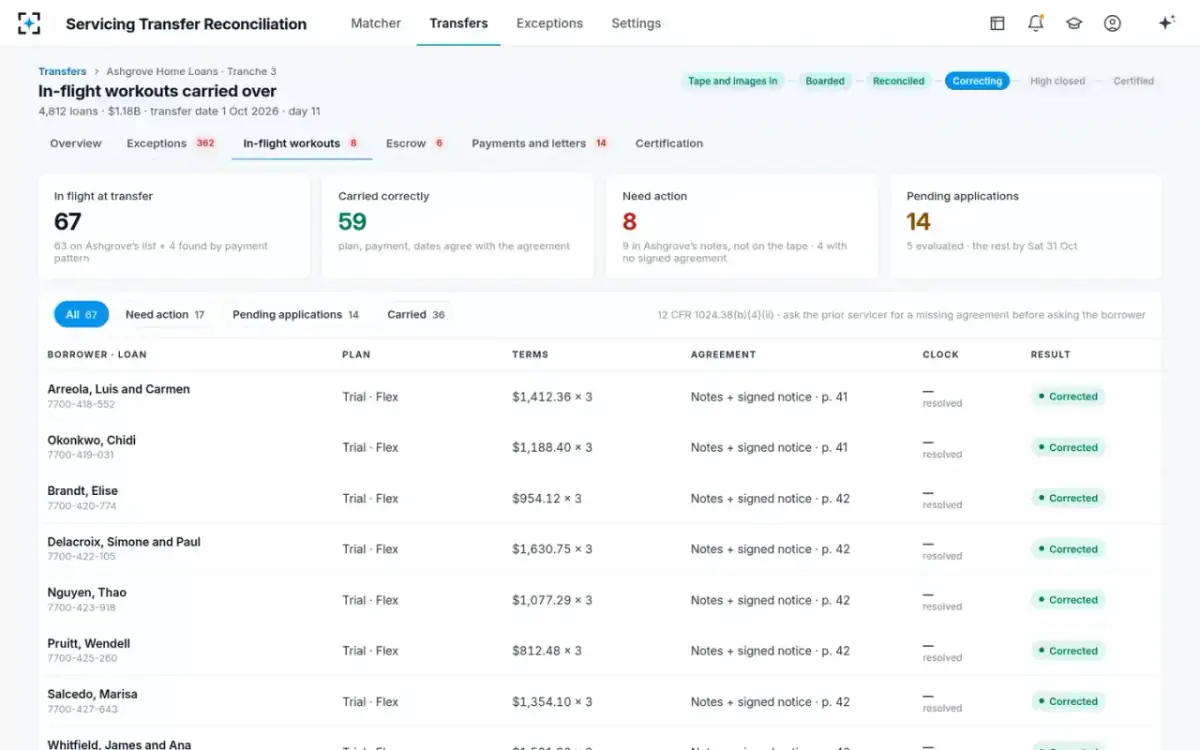
In the sample acquisition the numbers are small and specific. Of 4,812 loans, nine borrowers on Flex trial plans were billed in full from the tape; three borrowers were charged late fees totalling $217.44 on payments the seller received on time; eleven autopay enrolments were missing before the next draft. None of that is visible in a bid tape summary. All of it is visible in the seller's notes, enrolment files and signed documents, which is where diligence on a servicing acquisition should look.
Exceptions in Servicing Transfer Reconciliation, ranked by harm to the borrower
Where Servicing Transfer Reconciliation fits in an MSR acquisition
The solution works on what a buyer receives: the tape, image bundles, the seller's servicing notes and payment history, the seller's loss mitigation list and the boarded records. Where a seller gives access to loan files before the transfer, the same comparison can run as part of pre-close diligence on the real tranche, and its findings can shape the transfer plan or the representations negotiated. After boarding it runs on every loan and feeds corrections, each approved by a person, and the post-transfer certification compliance signs.
It does not value servicing rights, model prepayments or replace the purchase agreement's representations and warranties. It also does not settle disputes with the seller: it drafts the request for a missing agreement and records the answer. Its job is to turn "data defects" from a line in a risk memo into a list of loans, causes and dates. For how the rules behind those dates work, see the mortgage servicing transfer rules; for the inherited workouts specifically, the plan in the old notes. The solution itself is at Servicing Transfer Reconciliation.
Every inherited workout, matched to its agreement
Questions people ask
How are mortgage servicing rights valued?
As the present value of the servicing fee and other income, less the expected cost of servicing, over the expected life of the loans. Prepayment and default assumptions drive the value; CRS notes that rising defaults raise servicing costs and that MSR values fall when prepayments or defaults rise unexpectedly. Data defects add a cost most models do not carry.
Does the borrower have to agree to a transfer of servicing?
No. The borrower's consent is not needed, but both servicers must notify the borrower, generally at least 15 days before and within 15 days after the effective date, and a payment sent to the old servicer on time cannot be treated as late for 60 days. The loan's terms do not change because servicing moved.
Who pays when the seller's data was wrong?
Toward the borrower, the servicer that is servicing the loan answers for honoring the workout and correcting the account. Between the servicers, the purchase agreement decides, through representations, warranties and indemnities. Finding defects early, with the seller's own documents as evidence, is what makes those clauses usable.
What is a significant transfer?
It is FHFA's term for a transfer of Enterprise servicing rights large or risky enough to need the agency's review: 100,000 or more loans to a non-bank, or 25,000 or more loans that would add at least 25% to the buyer's seriously delinquent Enterprise portfolio, with at least 500 seriously delinquent loans. Smaller transfers are reviewed by Fannie Mae or Freddie Mac.
Can a buyer refuse loans with active workouts?
The purchase agreement can exclude loans, and the CFPB has encouraged splitting a transfer into smaller batches when the transferee cannot comply for every loan at once. Once a loan with a workout transfers, though, the new servicer must honor the borrower's protections, including an offer still open for acceptance.