When a mortgage is transferred to a new servicer during a workout, the new servicer must honor what the borrower already has: a completed modification, a trial plan the borrower is paying, an offer still open for acceptance, and a loss mitigation application in progress, which it must handle on the old servicer's timeline or, if the application was complete, within 30 days of the transfer date. The hard part is knowing the workout exists. A trial plan approved in the old servicer's notes while its systems lagged can arrive with blank plan fields on the data tape, so the new servicer bills the full payment and holds the trial payment aside as short. Botminds' Servicing Transfer Reconciliation reads the old servicer's notes and payment history alongside the tape, so every inherited workout is matched to its agreement, including the ones the seller never listed.
The examples follow a fictional sample transfer: 4,812 loans moving from Ashgrove Home Loans to Copperline Loan Servicing on 1 October, with its loss mitigation lead, Tomás Quintero. Rules and findings are quoted from the CFPB and Regulation X.
Where 67 inherited workouts were found, and what the 13 that needed action looked like
Workouts in flight at transfer · 67
- On the seller’s list · 63 · 94%
- Found by payments · 4 · 6%
Needing action at boarding · 13
- Plan in the notes, blank on the tape · 9 · 69%
- Payments, no signed agreement · 4 · 31%
Complete applications pending · 14
- Evaluated by day 11 · 5 · 36%
- In evaluation, due 31 Oct · 9 · 64%
Does a loan modification transfer to a new servicer?
Yes. A completed modification changed the loan's terms, and a servicing transfer does not change the loan; the new servicer must service it on the modified terms. A trial modification the borrower is performing under, a forbearance or a repayment plan carries over too, because Regulation X keeps "all rights and protections" a borrower had under the loss mitigation rule before the transfer (12 CFR 1024.41(k)(1)), and because the CFPB has treated failing to honor them as unfair.
The record on this is long. The CFPB's 2014 transfer bulletin reported examinations in which transferees refused to honor modification offers they could not independently confirm, re-underwrote borrowers and sometimes foreclosed; its 2016 servicing edition described a transferee that did honor trial plans but made borrowers who had completed their trial payments wait for the permanent modification. The Bureau found substantial injury, "as trial payments were less than the amounts required by the promissory note, and consumers continuing to make trial payments while waiting for the permanent modification accrued interest on the unpaid principal balance" (CFPB Supervisory Highlights, 2016).
What happens to a trial plan when the loan is sold?
The trial plan continues. The borrower keeps paying the trial amount on the trial dates, to the new servicer once the switch date passes, and the new servicer must convert the plan to a permanent modification on the investor's terms once the trial is completed. If the trial offer was still open when the loan transferred, the borrower keeps the rest of the time to accept: "the transferee servicer must allow the borrower to accept or reject the offer during the unexpired balance of the applicable time period" (1024.41(k)(5)).
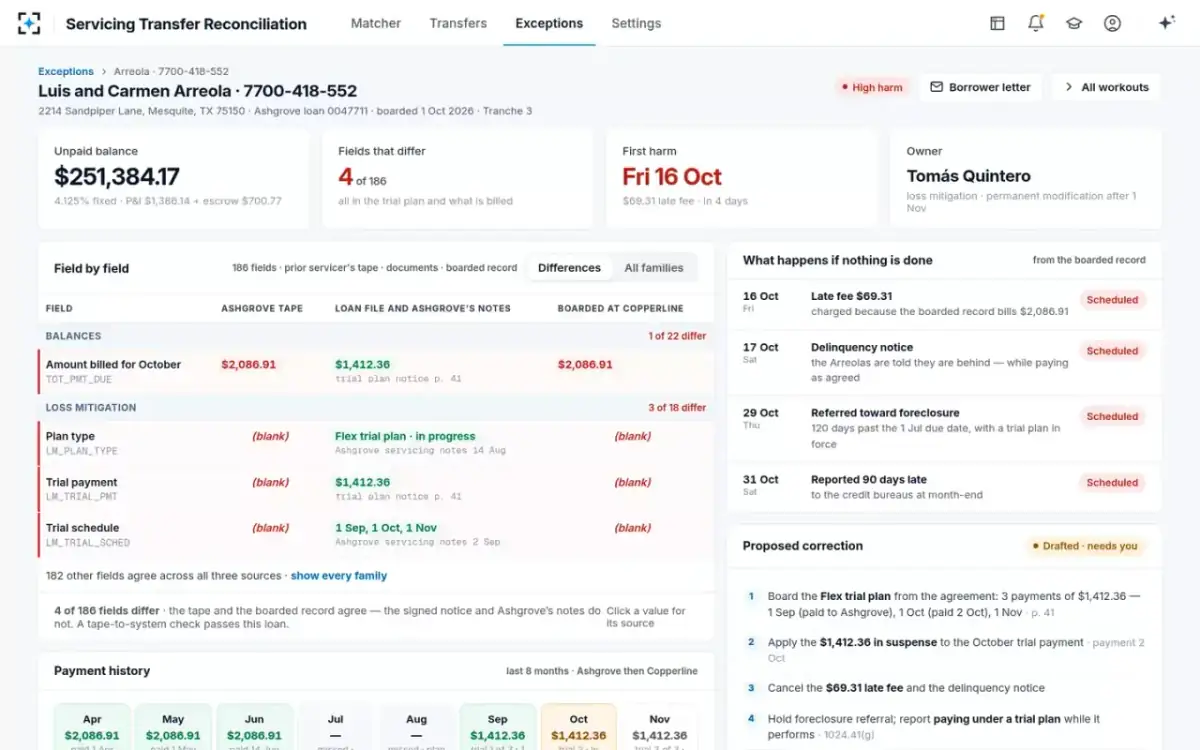
What breaks is the data. The sample borrowers Luis and Carmen Arreola were approved for a Flex trial plan of three payments of $1,412.36, due 1 September, 1 October and 1 November; the old servicer's note of 14 August records it and the signed notice is page 41 of their file. On the data tape the plan fields were blank and October was billed at the full $2,086.91. They paid September to the old servicer and October to the new one, exactly as agreed, and the new servicer's system read October as a short payment.
One borrower mid-workout: the tape, the notes and the boarded record side by side
Why a workout lives in the old notes and not on the tape
Because people agree workouts faster than systems record them. A loss mitigation team approves a trial plan, mails the notice and writes it in the servicing notes the same day; the field in the workout module is filled when that module catches up. In the sample transfer the seller's note says it outright: "Plan set up in notes; workout module update pending." When the tape was cut from the system of record, the plan was not in it.
The same gap opens at the end of every seller's tenure. Plans agreed in the last weeks before a sale, applications completed after the tape was cut, documents a borrower sends to the old servicer after the transfer date: each lives outside the tape. The CFPB's 2014 guidance asked sellers to close the gap at source, "specifically flagging all loans with pending loss mitigation applications (complete and incomplete), as well as approved loss mitigation plans (including trial modification plans)," and buyers to require "a detailed list" of them (CFPB Bulletin 2014-01). A list helps. It is still a list of what the seller's systems knew.
"Supervision observed that transferee(s) still failed to recognize modifications not registered by the transferor or not otherwise in the databases and could benefit from conducting a post-transfer review for in-flight loss mitigation."
CFPB Supervisory Highlights, mortgage servicing special edition, 2016
What the CFPB found when buyers used reconciliation tools
The 2016 finding is the clearest statement of the problem from a regulator. Directed to identify in-flight modifications, transferees began using industry databases "to reconcile loan data during transfer," and found more of them; but modifications the transferor had not registered, or that were not in the databases, were still missed. The Bureau also found that "incompatibilities between servicer platforms led, in part, to transferees failing to identify and honor in-place loss mitigation after receiving the loans," and cited the practice as unfair.
The lesson for a new servicer is that reconciling the tape against any database, however good, inherits the database's blind spot. The documents that prove a workout are the signed agreement, the servicer's notes and the borrower's payments. A post-transfer review that reads those three finds the workouts a seller forgot to register.
Why is my trial payment in suspense after a transfer?
Because the new servicer's system believes the borrower owes the full payment, so a trial payment looks like a partial payment and is held in a suspense or unapplied funds account. Regulation Z allows a servicer to hold a partial payment, but it must show the amount on the periodic statement and, "on accumulation of sufficient funds to cover a periodic payment," treat them as a payment received (12 CFR 1026.36(c)(1)(ii)). Under a trial plan the periodic payment is the trial amount, so the money should never have been in suspense.
Suspense is the earliest visible symptom of a missing workout, and the CFPB told transferees to watch for it: its 2014 bulletin lists, as a practice examiners may credit, "monitoring newly transferred loans and determining if partial payments received are actually payments pursuant to trial or permanent modification agreements." In the sample transfer, applying held trial payments was part of the fix: $8,154.39 moved from suspense on six loans when the nine plans were boarded.
How long does the new servicer have to evaluate an application?
Thirty days from the transfer date for an application that was complete when the loan transferred; otherwise, the timeframes that applied to the old servicer, counted from when the old servicer received the application. Acknowledgment notices still due at transfer must go out within 10 business days of the transfer date, and an appeal the old servicer had not decided must be decided within 30 days of the transfer or of the appeal, whichever is later.
Each kind of inherited workout: what must reach the new servicer, and what to check
| Status at transfer | What must transfer | What the new servicer must do | Check on boarding |
|---|---|---|---|
| Permanent modification | The executed agreement and modified terms | Service on the modified terms | Rate, payment, balance and maturity against the agreement, not the original note |
| Trial plan being performed | The trial notice and payment schedule | Accept trial payments; convert on completion | Plan fields, trial amount and dates against the notice and notes |
| Offer made, not yet accepted | The offer and its deadline | Allow acceptance for the rest of the period | Offer date and deadline |
| Complete application pending | The application and documents, dates received | Evaluate within 30 days of the transfer date | Complete date and the 30-day deadline |
| Incomplete application | What was received and what is missing | Continue on the old servicer’s timeline; reasonable diligence | Missing documents asked of the seller first |
| Forbearance or repayment plan | Terms and status | Honor the plan | Plan amount and end date; no default steps while performing |
Finding the plans nobody listed
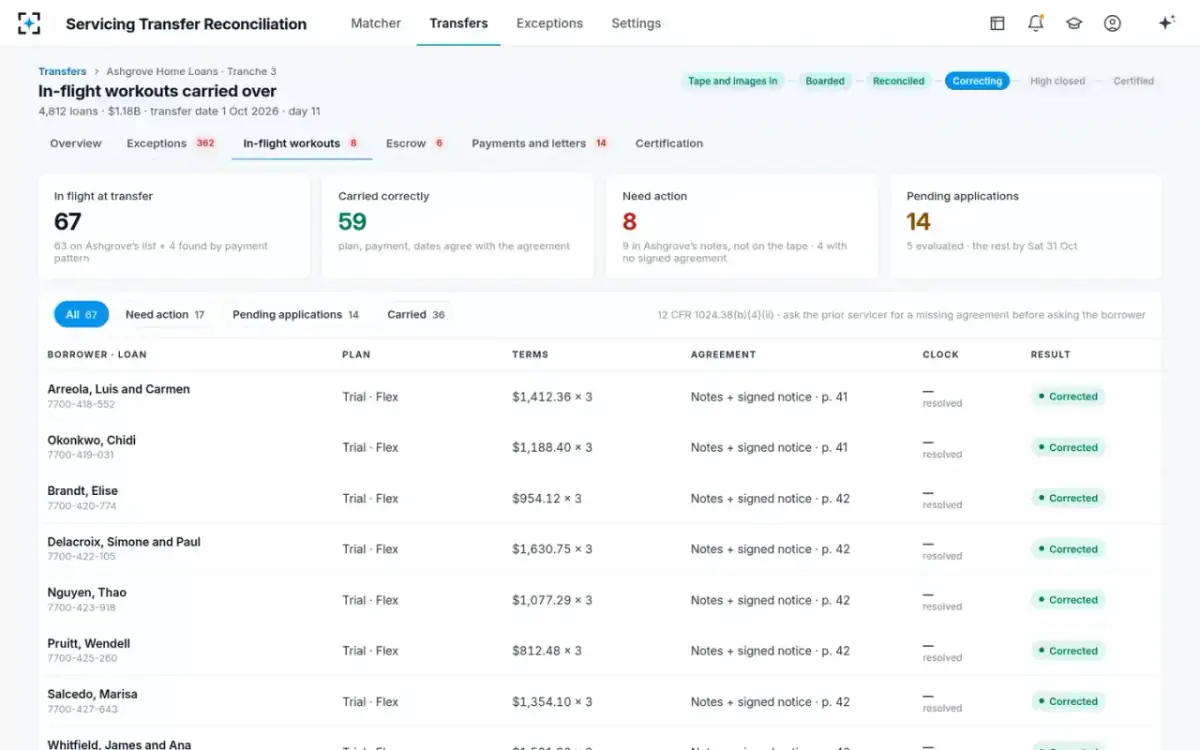
Two searches find a workout the seller did not list: read the notes for plan language, and read the payment history for payments that match a plan rather than the note. The first found the nine Flex plans in the sample transfer. The second found four more borrowers paying trial-sized amounts with no plan on the tape and no signed agreement in the file; for those, the agreement is requested from the seller before anyone contacts the borrower, which is the order Regulation X's commentary requires.
How Servicing Transfer Reconciliation carries an inherited workout across a transfer
Agent
Workout carry-over checkerReads 24 months of the old servicer’s notes and matches every plan, application, forbearance and modification to its agreement and to the boarded record.
Never: Changes a plan’s terms.
Agent
Payment pattern searchFinds payments that match a trial or modified amount on loans with no plan on the tape.
Never: Contacts the borrower before the seller.
Agent
Request to the sellerDrafts the request for a missing agreement to the seller’s transfer coordinator and tracks the answer.
Agent
Harm ranker and correction drafterRanks each workout break high, drafts the correction: board the plan, apply held funds, cancel fees and notices, hold any referral, letter to the borrower.
Never: Posts without approval.
A person decides
Transfer managerApproves the correction with the signed notice beside it; a fix across more than 25 loans needs a second approver.
A person decides
Loss mitigation leadOwns each plan from there: the permanent modification, the pending applications and their 30-day clock.
Every inherited workout, matched to its agreement and its clock
What the borrower should hear, and when
The borrower should hear, before anything goes wrong, that the plan continues: same amount, same dates, new address for payments. In the sample correction the drafted letter to the Arreolas said exactly that, and went for approval with the correction itself. A borrower who hears nothing and then receives a full bill has every reason to stop paying the trial amount, which is the one outcome that harms everyone.
The rest of the transfer story is told elsewhere: the six seats that carry it in the loan boarding specialist and the seats around a transfer, the payments side in the mortgage servicing transfer grace period, and what a missed workout costs at portfolio scale in the data defects that come with servicing rights. The solution is at Servicing Transfer Reconciliation.
Questions people ask
Must the new servicer honor a modification it would not have approved?
Yes. The CFPB has found it unfair for transferees to refuse to honor trial or permanent modifications unless they could independently confirm the prior servicer offered them properly. The new servicer can raise problems with the seller under their contract, but toward the borrower the agreement stands.
Do I have to reapply for loss mitigation after my loan is transferred?
No. Documents you gave the old servicer must be transferred, and the new servicer must use them before asking you again; the CFPB has said a transferee that makes borrowers resubmit materials is unlikely to meet the rule. If you send documents to the old servicer after the transfer, they count as received on the date it received them.
What if the new servicer says it has no record of my trial plan?
Send it the trial plan notice and proof of your payments, in writing, as a notice of error. The new servicer must try to obtain the agreement from the old servicer, and it must not treat your trial payments as late while it does. Keep paying the trial amount on the trial dates.
Can a foreclosure continue while my workout transfers?
The protections you had continue. A servicer may not make the first foreclosure filing while a complete application is pending or while you are performing under a loss mitigation agreement, and a transfer does not reset that. A foreclosure step triggered by a missing plan in the transferred data is an error you can raise.
How does a servicer know a workout was missed?
The early signs are trial-sized payments landing in suspense, a borrower calling about a full bill, and plan language in the old servicer's notes with no plan on the new system. A post-transfer review that reads the notes and searches payments finds them in days rather than when the fees start.