A mortgage goodbye letter is the notice a servicer must send a borrower when it transfers the servicing of the loan to another company. Under Regulation X, 12 CFR 1024.33, the old servicer must send it at least 15 days before the effective date of the transfer, and it must state six things: the effective date, contacts at both servicers, the dates payments switch, any effect on optional insurance, and that the loan's terms do not change. The new servicer's hello letter carries the same items and is due no more than 15 days after the transfer; the two may be combined into one letter sent at least 15 days before. Getting the letters right is mostly a data problem, because each is generated from boarded addresses and dates for thousands of loans at once. Botminds' Servicing Transfer Reconciliation compares those addresses and dates with the loan file and the old servicer's notes before the letters go out.
The annotated letter below is fictional, written for a sample transfer from Ashgrove Home Loans to Copperline Loan Servicing with an effective date of 1 October. The requirements are quoted from Regulation X as in force in October 2026.
A goodbye letter with every requirement marked
Ashgrove Home Loans · Loan 0047711 · 14 September 2026
Notice of Servicing Transfer
Dear Luis and Carmen Arreola,
The servicing of your mortgage loan is being transferred, effective 11 October 2026. This means that after this date, a new servicer will be collecting your mortgage loan payments from you. 6Nothing else about your mortgage loan will change.
Ashgrove Home Loans is now collecting your payments. 2Ashgrove will stop accepting payments received from you after 30 September 2026. Copperline Loan Servicing will start accepting payments received from you on 1 October 2026. Send all payments due on or after 1 October to Copperline at the address below.
If you have questions for either company about your loan or this transfer, contact them:
4Current servicer: Ashgrove Home Loans, Transfer Support, 1-800-555-0142, 410 Mill Road, Dayton OH
3New servicer: Copperline Loan Servicing, Customer Care, 1-800-555-0177, PO Box 2210, Plano TX
5Important note about insurance: your optional mortgage life insurance is not affected by this transfer. No action is needed.
7Under Federal law, during the 60-day period following the effective date of the transfer of the loan servicing, a loan payment received by your old servicer on or before its due date may not be treated by the new servicer as late, and a late fee may not be imposed on you.
- 1
Effective date of the transfer 1024.33(b)(4)(i)
The date the 60-day payment protection starts. It must match the date in the new servicer’s letter.
- 2
The two payment dates 1024.33(b)(4)(iv)
When the old servicer stops accepting payments and the new one starts. They must be the same day or consecutive days.
- 3
New servicer contact 1024.33(b)(4)(ii)
Name, address and a toll-free or collect-call number for someone who can answer transfer questions.
- 4
Old servicer contact 1024.33(b)(4)(iii)
The same for the transferor. A general switchboard that cannot answer transfer questions is a weak choice.
- 5
Optional insurance 1024.33(b)(4)(v)
Whether mortgage life, disability or other optional insurance is affected, and what the borrower must do to keep it.
- 6
Terms do not change 1024.33(b)(4)(vi)
A statement that the transfer does not affect any term of the loan other than terms directly related to servicing.
- 7
The 60-day statement Appendix MS-2
Not a listed element, but in the model form: an on-time payment to the old servicer is not late for 60 days.
What must a servicing transfer letter include?
A servicing transfer letter must include six items, the same for the goodbye and the hello letter: "the effective date of the transfer of servicing"; the name, address and a toll-free or collect-call number of someone at the new servicer who can answer transfer questions; the same for the old servicer; the date the old servicer will stop accepting payments and the date the new one will begin, which "shall either be the same or consecutive days"; whether the transfer affects mortgage life, disability or other optional insurance and what the borrower must do to keep it; and a statement that the transfer does not affect any term of the loan other than terms directly related to servicing (12 CFR 1024.33(b)(4)).
The six required items, and how each goes wrong in a bulk transfer
| Required item | Rule | Typical failure on a large transfer |
|---|---|---|
| Effective date of transfer | 1024.33(b)(4)(i) | Different dates on the goodbye and hello letters after a transfer is moved |
| New servicer’s contact for transfer questions | (b)(4)(ii) | A number that reaches a general queue with no record of the transfer |
| Old servicer’s contact for transfer questions | (b)(4)(iii) | A department that closes once the portfolio is sold |
| Date payments stop at the old servicer and start at the new | (b)(4)(iv) | A one-day gap that leaves payments with nowhere to go |
| Effect on optional insurance and what to do | (b)(4)(v) | Silence when a product will lapse because the new servicer does not offer it |
| No change to loan terms other than servicing | (b)(4)(vi) | Omitted from a custom welcome letter that replaced the model wording |
The letter must be clear and conspicuous, as all Regulation X disclosures must be, but its wording is the servicer's. The model in Appendix MS-2 is a safe harbour for form, not a requirement, and many servicers fold the hello letter into a welcome package. What cannot be dropped is any of the six items.
When must the goodbye letter be sent?
The goodbye letter must be sent "not less than 15 days before the effective date of the transfer of the servicing of the mortgage loan" (1024.33(b)(3)(i)). For a 1 October transfer that means by 16 September; the sample letter above went out on 14 September. Three exceptions apply. Notices given at settlement, separately or combined, satisfy the timing. And when the transfer follows termination of the servicing contract for cause, the servicer's bankruptcy, or an FDIC or NCUA conservatorship or receivership, the notice may be sent up to 30 days after the effective date.
The calendar of a pair of transfer letters
15days
before the effective date: the latest a goodbye letter, or a joint letter, may go out
15days
after the effective date: the latest a hello letter may go out
30days
after, when the transfer follows a for-cause termination, bankruptcy or receivership
30days
after the transfer for a new owner’s separate ownership notice under Regulation Z
What is a mortgage hello letter?
A mortgage hello letter is the new servicer's notice of servicing transfer, the other half of the hello and goodbye pair. It carries the same six items and must go out "not more than 15 days after the effective date of the transfer." Hello and goodbye letters are one rule seen from two ends: the borrower should receive matching dates, matching contacts and matching instructions from both companies.
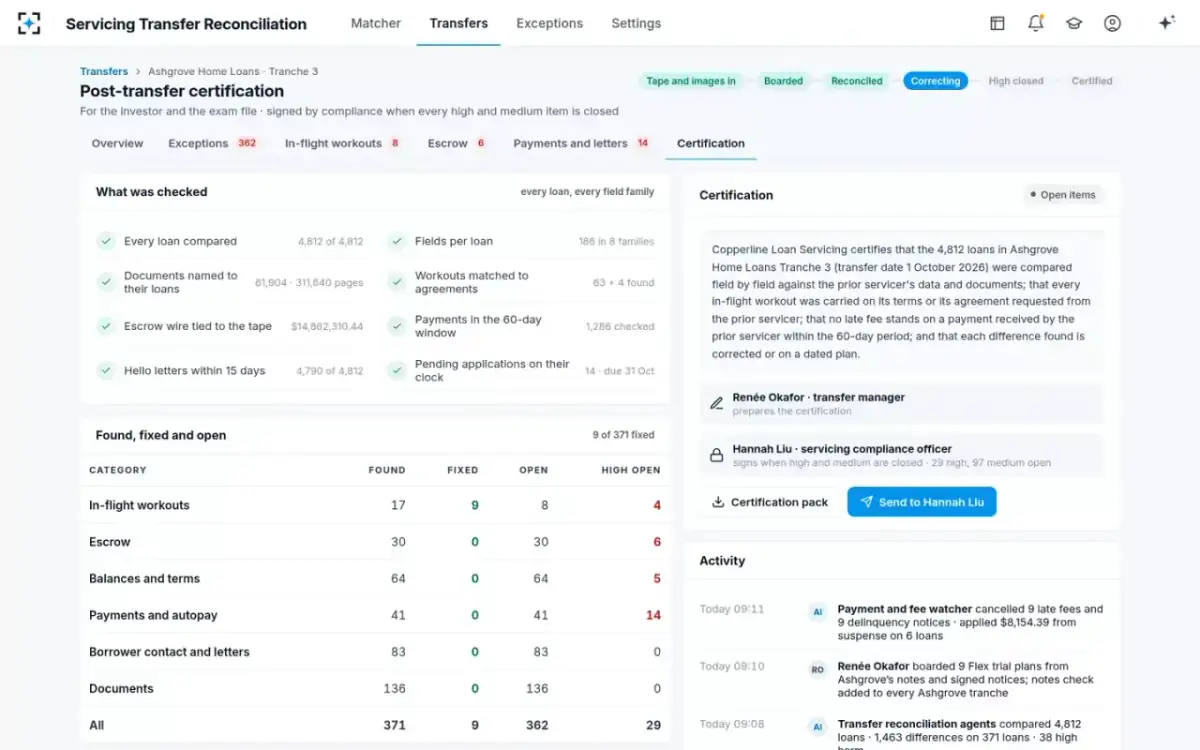
The hello letter is harder to get right than the goodbye letter, because it is generated from the new servicer's freshly boarded data. Every address that boarded wrong produces a hello letter to the wrong place, and an address newer in the old servicer's notes than on its tape produces a letter to a house the borrower has left. In the sample transfer, 4,790 of 4,812 hello letters had gone out by day 11, five days before the 16 October deadline.
Can the old and new servicer send one letter?
Yes. "The transferor and transferee servicers may provide a single notice, in which case the notice shall be provided not less than 15 days before the effective date of the transfer" (1024.33(b)(3)(i)). A joint letter gives the borrower one set of dates instead of two that might disagree, at the cost of finishing the new servicer's side, including its contact details and payment address, at least 15 days early.
A joint letter does not remove either servicer's responsibility. If it is wrong, both sent it. Servicers choosing a joint letter usually build it from the old servicer's address file and the new servicer's payment instructions, so the address check has to happen before the data is boarded, not after.
Is there a model servicing transfer notice? Appendix MS-2
Yes: Appendix MS-2 to Regulation X is the model Notice of Servicing Transfer. It opens plainly, "The servicing of your mortgage loan is being transferred, effective [Date]. This means that after this date, a new servicer will be collecting your mortgage loan payments from you. Nothing else about your mortgage loan will change," and closes with the 60-day protection in the borrower's terms: a payment "received by your old servicer on or before its due date may not be treated by the new servicer as late, and a late fee may not be imposed on you" (Appendix MS-2).
The 60-day sentence is not one of the six items the rule lists, but it is the one most borrowers act on, and servicers that rewrite the model often keep it for that reason. The insurance paragraph is marked in the model "Use this paragraph if appropriate; otherwise omit," which is the only part a servicer may drop when it does not apply.
Where must the letter be sent? The address rule
To the mailing address in the loan documents, unless the borrower has given a newer one under the servicer's change-of-address requirements. The official commentary says a servicer mailing the notice "must deliver the notice to the mailing address (or addresses) listed by the borrower in the mortgage loan documents, unless the borrower has notified the servicer of a new address" (comment 33(b)(3)-1).
That sentence makes address data a compliance item. A change of address recorded in the old servicer's notes, but not in the tape's address column, is a notice the borrower gave; a hello letter sent from the tape goes to the old address. In the sample transfer, borrower contact was the second-largest family of differences, 312 of 1,463 differences, almost all of it hygiene; but each address difference is a letter that could go astray.
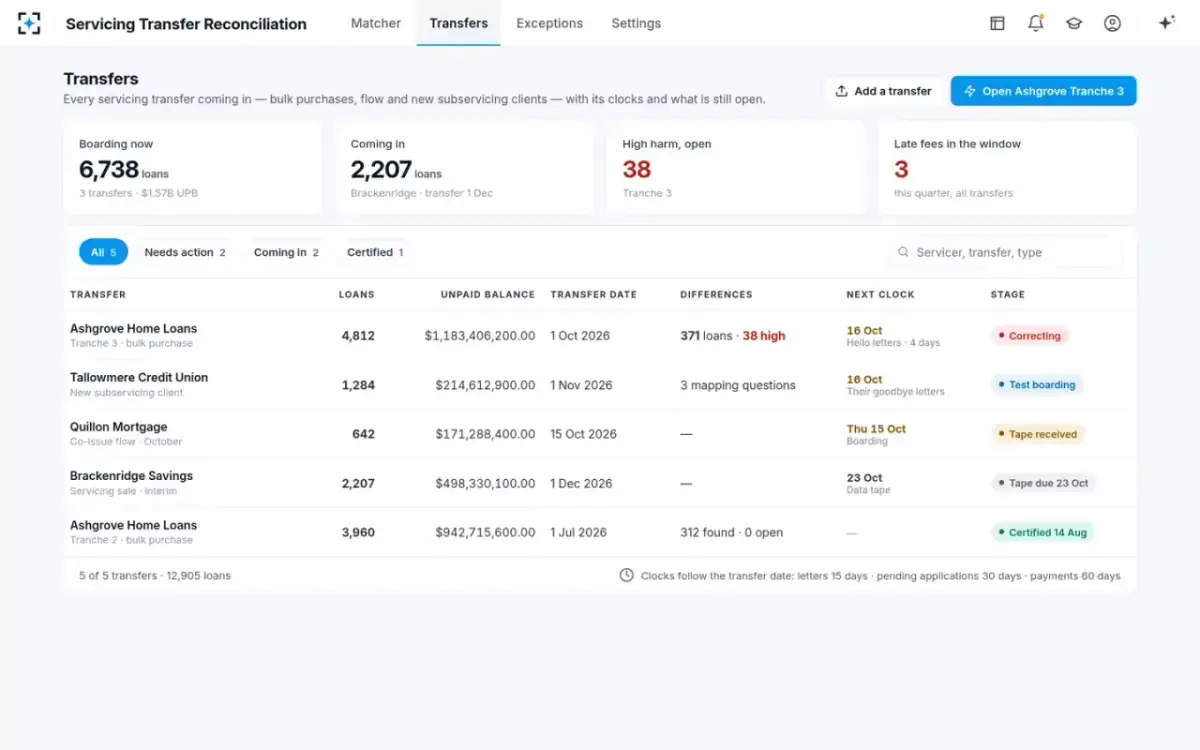
Every transfer coming in, with the next letter clock on each
Do state laws add transfer notice requirements?
Not to the borrower. Regulation X preempts them: "Any State law requiring notice to the borrower at the time of application or at the time of transfer of servicing of the loan is preempted, and there shall be no additional borrower disclosure requirements" (1024.33(d)). State requirements to notify others, "such as those requiring additional notices to insurance companies or taxing authorities," are not preempted, and that information may be added to the federal notice where state law allows.
The carve-out matters to the escrow seat more than the letter writer. Insurers and tax offices also need to know where to send renewal bills and who pays them; a borrower letter that is perfect does not stop a renewal going to the old servicer if those notices were not sent.
What examiners find in transfer letters
Missing letters are a recurring finding. In its Summer 2020 Supervisory Highlights the CFPB reported that "in the context of loan transfers, examiners identified violations of Regulation X requirements to provide servicing transfer notices," alongside failures to credit payments on the date received and to provide ownership transfer disclosures (Supervisory Highlights, Issue 22). A letter can only be as right as the data it is generated from, and the letters that go missing are usually the loans whose data did not board.
A pre-send check for a batch of hello or goodbye letters
- One effective date across both letters
Compare the goodbye letter’s date with the hello letter’s for every loan, not just the template.
- Consecutive payment dates
Stop and start dates must be the same day or the next day.
- Addresses checked against the notes, not just the tape
A change of address the borrower gave the old servicer still counts.
- Contacts that can answer transfer questions
Test the numbers; both must be toll-free or collect.
- Optional insurance identified loan by loan
Only loans with a product affected need the paragraph, but those loans must get it.
- Every loan has a letter
Count letters generated against loans transferred; investigate every gap before day 15.
- Ownership notice planned if the owner changed
Regulation Z’s notice is separate and has its own 30-day clock.
Checking letters against the loan file with Servicing Transfer Reconciliation
Servicing Transfer Reconciliation does not write or send transfer letters. Its part is the data the letters depend on: it compares every borrower's name, mailing address, contacts and payment details on the tape with the loan file and the old servicer's notes, flags differences before the letters are generated, tracks the 15-day clock per transfer, and lists the letters sent against the loans transferred in the post-transfer certification. A borrower letter correcting a specific error, such as a trial plan that continues with the new servicer, is drafted for a person to approve.
The letters are the borrower's first sight of a transfer; the rules that follow them are in the mortgage servicing transfer rules, and the 60-day promise in the last paragraph of the model letter is followed through cash management in the mortgage servicing transfer grace period. The solution is described in full at Servicing Transfer Reconciliation.
Hello letters counted in the post-transfer certification
Questions people ask
Does a goodbye letter have to be in writing?
Yes. Regulation X disclosures must be clear and conspicuous and in writing; they may be delivered electronically where the borrower has agreed under the E-Sign Act. A phone call or a website banner does not replace the notice.
Do affiliate transfers need hello and goodbye letters?
Not if nothing changes for the borrower. A transfer between affiliates, one caused by a merger, or one between master servicers without a change of subservicer is not a transfer for the notice rule when the payee, payment address, account number and payment amount all stay the same.
What is a servicing transfer PIF stop message?
It is not a term the regulations use; it is a status on a servicer's own system. A "paid in full" or stop message on the old servicer's account after the transfer date usually reflects that the account was closed out there when servicing moved, not that the loan was paid off. The new servicer's hello letter and statement show the real balance.
What if the borrower never got the letter?
The 60-day protection for on-time payments to the old servicer still applies, because it runs from the effective date, not from delivery. The borrower can raise the missing notice and any harm from it in writing as a notice of error to either servicer.
Can the hello letter go out before the transfer date?
Yes. The rule sets a latest date, 15 days after the effective date, not an earliest one. Sending it with or soon after the goodbye letter gives the borrower matching instructions while they are deciding where to send the next payment.