The loan boarding process is the sequence a servicer follows to take on transferred loans: plan the transfer, test the data map, board the tape, reconcile what boarded against what the loan really is, correct, certify and monitor. The cheapest way to test a new one is not on your next transfer but on one you closed last year. You already hold its tape, images, the seller's notes and your boarded records, and you know what went wrong afterwards from complaints, notices of error and fee reversals. Re-running that transfer through the new process shows, loan by loan, which of those problems it would have found and how early. Botminds offers Servicing Transfer Reconciliation on exactly that basis: a run on one of your own completed transfers, scored against what actually happened.
The product examples use a fictional sample servicer, Copperline Loan Servicing, and its purchases from Ashgrove Home Loans. The pilot plan and scorecard are our recommendation; the regulatory expectations are the CFPB's, linked where they appear.
Why last year's transfer is the right test bed
4–6mo
of post-transfer monitoring the CFPB recommends, so the outcomes are already on record
1year
the prior servicer keeps its records after a transfer, so missing files can still be asked for
12mo
the window examiners sample transferred loans from in the CFPB’s July 2026 procedures
What is the loan onboarding process in a servicing transfer?
The loan onboarding process in a servicing transfer runs in six stages, from the seller's tape arriving to a signed certification, and it is followed by months of monitoring. Most servicers have the first two and the last two in writing. The middle, reconciling every loan and correcting what is wrong before the borrower feels it, is where processes differ and where a pilot should look.
The six stages of boarding a transfer, and what each one must produce
| Stage | What happens | Who owns it | What it must produce |
|---|---|---|---|
| 1. Tape and images in | Tape, image bundles, notes, payment history and workout list received and named to loans | Boarding | Every loan matched to its documents; missing items requested |
| 2. Boarded | Map applied, loans loaded, test conversion reviewed | Boarding and IT | Boarded records for every loan |
| 3. Reconciled | Every field compared across tape, documents and boarded record | Boarding, with each seat | Differences ranked by harm, grouped by cause |
| 4. Correcting | Corrections drafted, approved and posted; letters sent | Transfer manager and owners | Each high-harm item closed before its date |
| 5. High closed | Everything that would hurt a borrower within 30 days fixed | Transfer manager | Medium items on dated plans |
| 6. Certified | Certification of what was checked, found, fixed and open | Compliance | A signed record for the investor and the exam file |
Why pilot on a closed transfer rather than the next one
A closed transfer has an answer key, and a live one does not. On your next transfer a new process will find things, and nobody will know whether the old process would have found them too, or whether it missed what neither found. On last year's transfer the borrowers have already told you what went wrong.
The CFPB described the failure a closed-transfer pilot is designed to expose. In Bulletin 2020-02 it reported "at least one servicer that did not engage in adequate post-transfer validation with its transferee," which "contributed to its failure to identify that it had not transmitted all the loss mitigation documents in its possession. Only after a borrower complained to the transferee did either servicer become aware that the transferor failed to send an executed loan modification agreement" (CFPB Bulletin 2020-02). A pilot asks one question of every such complaint: would the new process have found it first?
How to test a new loan boarding process in four weeks
Test it in four weeks: one to assemble the closed transfer's files, one to run the reconciliation, one to score its findings against what happened, and one to decide. The run itself takes hours; most of the calendar is gathering files and reading results with the people who lived through the transfer.
A four-week pilot on a closed transfer
- Assemble filesWeek 1
- Run the comparisonWeek 2
- Score against outcomesWeek 3
- DecideWeek 4
Choose the transfer deliberately. The best candidate closed six to twelve months ago, carried delinquent loans and active workouts, and produced at least a handful of complaints or notices of error. A clean flow of current loans will show the new process agreeing with the old, which proves nothing. A transfer more than a year old risks the prior servicer no longer holding the records you need, since Regulation X only requires it to keep them "until one year after" the transfer (12 CFR 1024.38(c)(1)).
What data is needed for a pilot?
A pilot needs the same inputs as a live transfer, as they stood on the transfer date, plus the record of what happened afterwards. Most of it already sits in your boarding folders and your complaints system.
What to bring to a pilot on a closed transfer
- The prior servicer’s data tape as received, with its layout
The original file, not a corrected one: the pilot must see the errors you boarded.
- The loan image bundles
Notes, security instruments, modification and trial plan agreements, escrow analyses, letters.
- The prior servicer’s servicing notes
Where workouts agreed in the last months before transfer most often live.
- Payment history and the forwarded payments
Including what the old servicer received in the 60 days after the transfer.
- The seller’s loss mitigation list
So the pilot can show what was on it and what was not.
- Your boarded records as of the transfer date
A snapshot from your servicing system, not today’s corrected data.
- What happened next
Complaints, notices of error, fee reversals, remediation lists and any exam findings for the tranche, with dates.
- Your transfer rules
Field set, tolerances, harm thresholds and approvers, so the run reflects your policy, not ours.
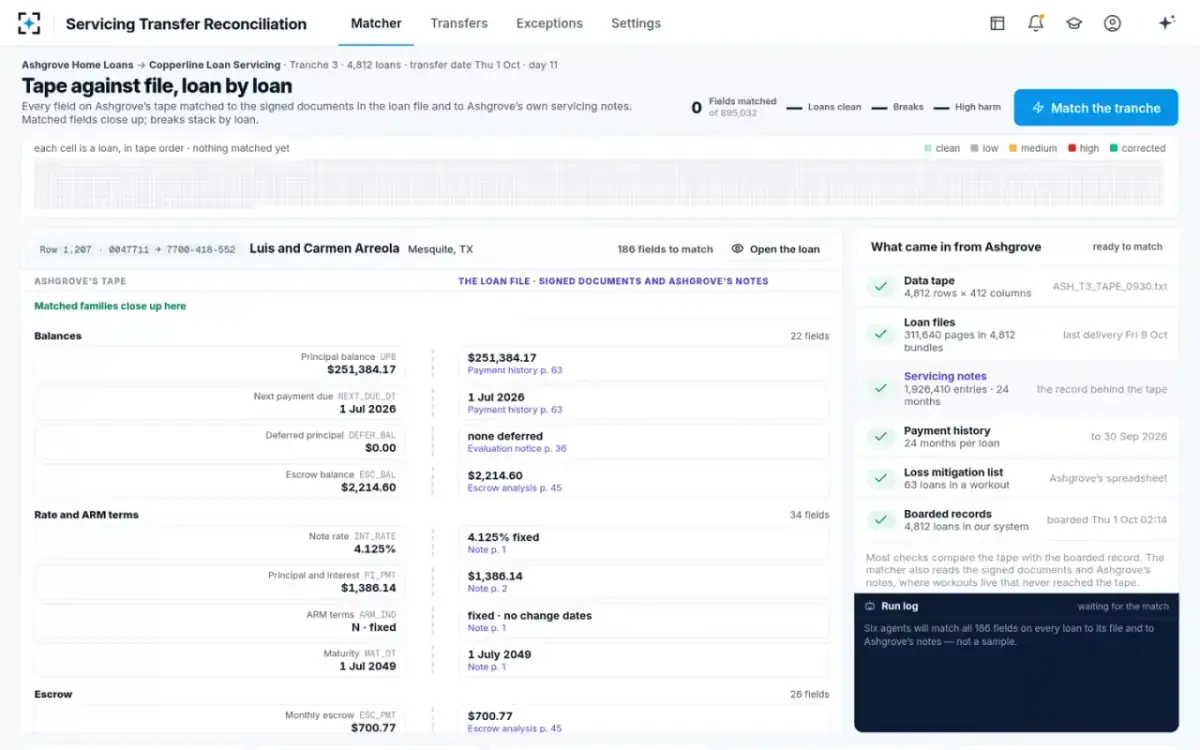
Everything one transfer delivered, ready to match
How long should a servicer monitor loans after transfer?
The CFPB's answer is at least four to six months. Bulletin 2020-02 lists, among practices that support compliant transfers, "monitoring consumer complaints and loss mitigation performance metrics including borrower engagement rate, approvals of trial modifications, repayment plans, non-home retention options, and completed workouts for at least four to six months post-transfer," and monitoring delinquencies, foreclosures and bankruptcies for month-to-month increases after transfer.
That window is what makes a closed-transfer pilot possible. A transfer that closed six months ago has passed through it, so its complaints, the notices of error it drew and the movements in its delinquency are known. If your monitoring was lighter than the bulletin describes, the pilot is also a chance to rebuild it: the outcomes you collect for scoring are the same series the bulletin asks you to watch.
What metrics show a transfer went well?
A transfer went well when borrowers in workouts kept their plans, no one was charged for paying the old servicer on time, escrow bills were paid when due, and the complaints that arrived were about things nobody could have known. The metrics below turn that into numbers a pilot can compare.
Measuring a transfer: what the old process reports, and what a pilot can show
Usually reported: Exceptions found in a sample of boarded loans.
What the pilot adds: Differences on every loan, by harm, with the cause behind each group.
Usually reported: Plans on the seller’s list, boarded or not.
What the pilot adds: Plans in the notes and payments that were never on the list, and when each was found.
Usually reported: Reversals made after a borrower called.
What the pilot adds: Fees that would have been stopped before they were charged.
Usually reported: Disbursements missed, found when a policy lapsed or a tax bill went unpaid.
What the pilot adds: Disbursements due in the look-ahead with nothing scheduled, on the day of boarding.
Usually reported: Count and themes over four to six months.
What the pilot adds: Each one matched to a finding: found first, found later, or not found.
Usually reported: Signed from a sample and a list of fixes.
What the pilot adds: Signed from a record of every loan checked, found, fixed and open.
How to pilot transfer reconciliation software: the scorecard
Score every problem that surfaced after the closed transfer into one of three columns: found by the new process before the borrower would have felt it, found but too late, or not found. Then score the reverse: every high-harm item the new process found that never surfaced, which tells you about harm that went unreported.
A pilot scorecard for a closed servicing transfer
| Measure | How it is counted | What a good result looks like |
|---|---|---|
| Known problems found first | Complaints, notices of error and reversals matched to a finding dated before the harm | Most workout, fee and escrow problems; contact and hygiene complaints matter less |
| Known problems missed | Matched to nothing | Each one explained: an input the pilot did not have, or a field outside the set |
| Unreported harm | High-harm findings with no complaint attached | Reviewed by compliance for remediation |
| Causes | Findings grouped by the mapping, file or column behind them | A short list, each with a one-time fix |
| Noise | Low-harm findings per high-harm finding | Workable by the team in the time a real transfer allows |
| Effort | Hours from files in to certification, against the original transfer | A large fall in reading and comparing; decisions stay with people |
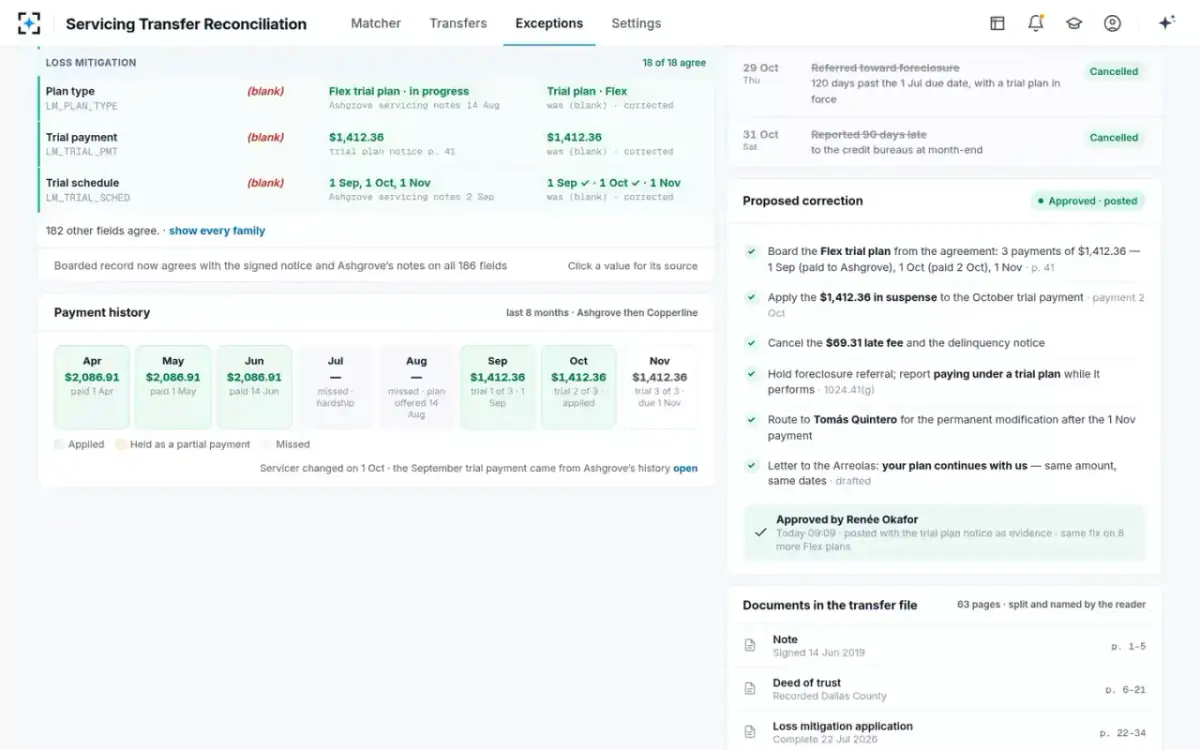
The fictional sample servicer shows the kind of record a pilot leaves behind. Its previous purchase from the same seller, 3,960 loans with a 1 July transfer date, was certified on 14 August with 312 differences found and none open. Its current tranche of 4,812 loans was matched on day 11, with 371 loans showing a difference and 38 ranked high harm, and nine of those closed in one approved batch the same morning. Those are sample results, not a customer's; your pilot's numbers are the ones that count.
A correction approved, with its evidence and the harm it cancelled
What examiners sample, and why the pilot covers it
The CFPB's July 2026 examination procedures tell examiners to "review policies and procedures and obtain a sample of servicing records, for loans transferred within the previous year," and to review "copies of the electronic and paper documents transferred from the prior servicer" (CFPB Mortgage Servicing Examination Procedures, July 2026). The same module asks whether a servicer that receives transfers "complies with the terms of loss mitigation agreements entered into by the borrower and the prior servicer."
A pilot on a transfer from the past year therefore works on the population an examiner would sample. If it finds an inherited trial plan that was never honored, the servicer has learned it before the examiner and can remediate on its own terms. That is a stronger reason to run the pilot than any time saving, and the reason compliance should help choose the transfer.
Where Servicing Transfer Reconciliation fits, and what a pilot cannot show
A pilot shows whether the solution finds the problems your transfers actually produce, how early, and how much noise comes with them. It cannot show how your team works the queue under a live clock, or how quickly the prior servicer answers requests for missing agreements, because on a closed transfer both have already happened. Plan to measure those on the first live transfer, with the pilot's scorecard as the baseline.
The solution's place in the process is stages three to six: reconciling every loan, drafting corrections for people to approve, and building the certification. Conversion and loading stay with your existing tools. What the reconciliation checks, and what it never decides, is set out in what a loan onboarding system must check; who does what in a transfer is in the six seats around a servicing transfer. To arrange a run on one of your own transfers, start from Servicing Transfer Reconciliation.
Questions people ask
Can we pilot without the prior servicer's servicing notes?
Yes, but expect to miss the workouts that lived only there, which are often the most harmful findings. If the notes were not part of the original transfer, ask for them; the prior servicer must keep its records for a year after the transfer, and under Regulation X you must try to obtain missing information from it before asking borrowers.
How many loans does a pilot need?
All of the closed transfer's loans, because the point is to compare against every complaint and correction that followed. A tranche of a few thousand loans is enough; in the sample transfer, 4,812 loans and 186 fields each made 895,032 comparisons, run in minutes.
Who should be in the room when results are scored?
The transfer manager, the loss mitigation lead, cash management, escrow and compliance, the same seats that lived through the original transfer. They know which complaints were real transfer errors, and they will run the process if it is adopted.
What if the pilot finds harm that was never reported?
Treat it as a finding, not an embarrassment. Compliance should review it for remediation; it is exactly the kind of issue an examiner sampling last year's transferred loans could find. Finding it yourself puts the servicer in control of the response.
Does a pilot need our production systems?
No. It needs read-only extracts: the original tape and images, the notes and payment history, and a snapshot of your boarded records as of the transfer date. Nothing is posted back to the servicing system during a pilot.