The mortgage servicing transfer grace period is the 60 days, beginning on the effective date of a servicing transfer, during which a payment the old servicer receives on or before its due date, including the loan's own grace period, may not be treated as late for any purpose. It comes from RESPA section 6(d) and Regulation X, 12 CFR 1024.33(c). It sounds like a borrower notice, and it is printed in every model transfer letter, but for the new servicer it is a matching problem: every payment that reached the old servicer has to be found, dated by when the old servicer received it, and kept away from late fees, delinquency counters and credit reports. Botminds' Servicing Transfer Reconciliation watches the window for each transfer, comparing forwarded payments, fees, suspense balances and autopay enrolments against the rule, and puts every fix to a person.
The examples come from a fictional sample transfer of 4,812 loans from Ashgrove Home Loans to Copperline Loan Servicing, effective Thursday 1 October. The rule text is quoted from Regulation X and its official commentary as in force in October 2026.
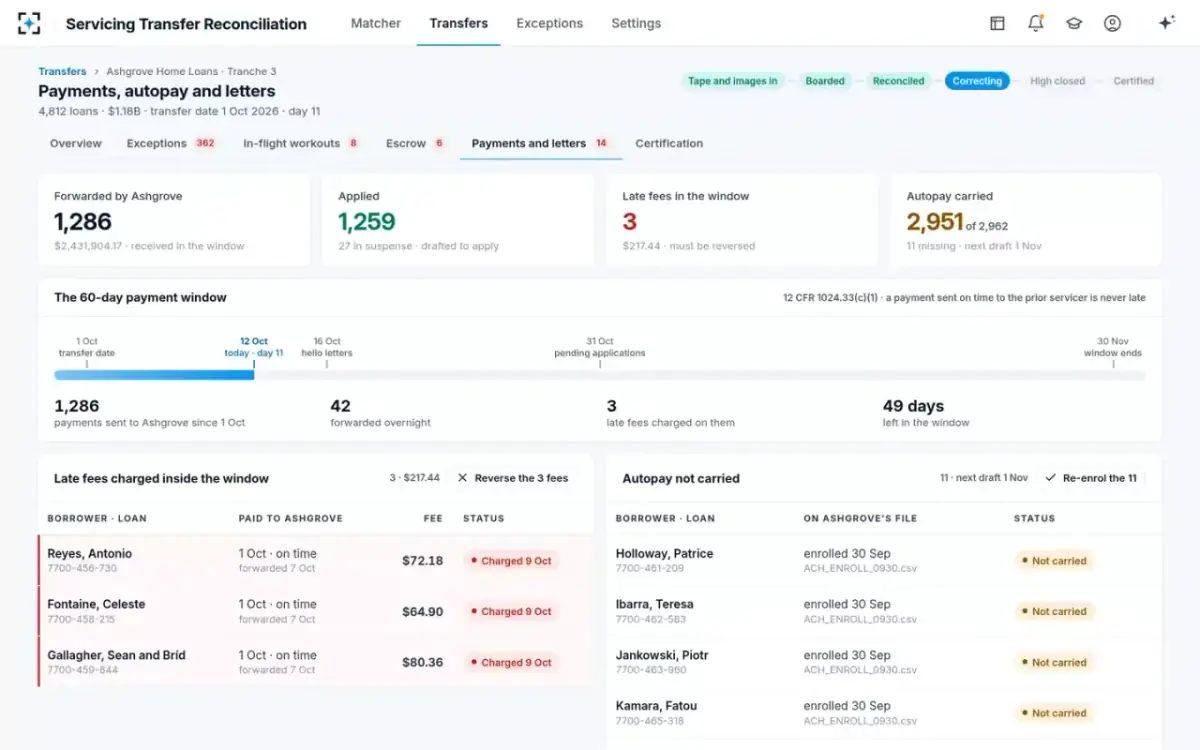
One transfer's 60-day window on day 11
1,286
payments the old servicer received and forwarded, $2,431,904.17 in all
27
of them held in suspense rather than applied
3
late fees, $217.44 in all, charged on payments the old servicer received on the due date
11
autopay enrolments made the day before transfer that never loaded
What is the mortgage servicing transfer grace period?
It is a 60-day protection, not a grace period in the usual sense. The rule reads: "During the 60-day period beginning on the effective date of transfer of the servicing of any mortgage loan, if the transferor servicer (rather than the transferee servicer that should properly receive payment on the loan) receives payment on or before the applicable due date (including any grace period allowed under the mortgage loan instruments), a payment may not be treated as late for any purpose" (12 CFR 1024.33(c)(1)).
Two grace periods therefore meet in the rule. The loan's own grace period, often the days after the due date before a late charge applies, still counts: a payment the old servicer receives inside it is on time. The 60-day window is the span during which a payment sent to the wrong company is protected at all. After 60 days, a payment sent to the old servicer gets no special treatment.
The loan's grace period and the transfer's 60-day window are different things
The loan's grace period: The note or security instrument.
The transfer's 60-day window: RESPA section 6(d) and Regulation X 1024.33(c).
The loan's grace period: A payment made a few days after the due date, from a late charge.
The transfer's 60-day window: A payment made on time but to the old servicer, from being treated as late for any purpose.
The loan's grace period: Set by the loan; commonly about two weeks.
The transfer's 60-day window: 60 days from the effective date of transfer.
The loan's grace period: Counts inside the 60 days: on time includes the grace period.
The transfer's 60-day window: Only payments the old servicer received by the due date plus grace are protected.
The servicing transfer 60 day rule, phrase by phrase
Each phrase of the 60-day rule decides a field the new servicer must have right. Read as an operations specification, it says what data cash management needs for every forwarded payment.
Reading 1024.33(c)(1) as a data requirement
| Phrase in the rule | What it means in practice | Data the new servicer needs |
|---|---|---|
| "60-day period beginning on the effective date of transfer" | Day 1 is the effective date in the transfer notices | Effective date per loan; the window’s last day |
| "the transferor servicer ... receives payment" | The date that counts is the old servicer’s receipt, not the forwarding date | Receipt date at the old servicer for every forwarded payment |
| "on or before the applicable due date" | The due date of that installment under the loan | Next due date as boarded, checked against the payment history |
| "including any grace period allowed under the mortgage loan instruments" | The loan’s grace days extend on time | Grace period from the note, not a system default |
| "may not be treated as late for any purpose" | No fee, no delinquency count, no late report, no default step based on it | Every downstream use of days-past-due for the loan |
What happens to payments sent to the old servicer?
The old servicer must deal with them promptly, one of two ways. "Beginning on the effective date of transfer," for payments received by the old servicer instead of the new one, "the transferor servicer shall promptly either: (i) Transfer the payment to the transferee servicer for application to a borrower's mortgage loan account, or (ii) Return the payment to the person that made the payment and notify such person of the proper recipient of the payment" (12 CFR 1024.33(c)(2)).
Forwarding is the norm in bulk transfers, usually in daily or batch files, and each file is a reconciliation. In the sample transfer the old servicer forwarded 1,286 payments in the first 11 days, 42 of them overnight before day 11. Three sample borrowers paid the old servicer on 1 October, the due date; the old servicer forwarded those payments on 7 October; the new servicer's system charged late fees on 9 October, because it saw the money arrive after the due date and grace and knew nothing of where it had been.
The 60-day window in Servicing Transfer Reconciliation: forwarded payments, fees and autopay
Can a late fee be charged during the 60 days?
Only on a payment that really was late. A payment the old servicer received after its due date and grace is not protected and can carry a late charge under the loan, transfer or no transfer. A payment it received on time cannot, and the official commentary reads the rule as prohibiting a late fee on any such payment. The three sample fees, $72.18, $64.90 and $80.36, were all charged on payments the old servicer received on the due date; the correction reverses them and corrects the payment records behind them.
The pattern is worth naming because it is systematic, not random. A new servicer's late-fee routine sees a payment's posting date, not its receipt date at another company. Unless the forwarded file carries the old servicer's receipt date and the posting logic uses it, every forwarded payment that arrived near the due date is at risk. That is a mapping decision, made once, which is why the fix belongs in the forwarding file's map as well as on the three loans.
Does the 60-day rule stop credit reporting and collection?
It stops them for protected payments. "Any purpose" covers reporting a protected payment as late to a credit bureau, counting it toward days delinquent, sending delinquency notices about it, and any default step that depends on it. It does not suspend servicing for a borrower who really is behind: the commentary says that a new servicer's compliance with the early intervention rule during the 60 days "does not constitute treating a payment as late for purposes of § 1024.33(c)(1)" (comment 33(c)(1)-2).
The practical test is whether the delinquency is real on the old servicer's records too. A borrower who was 45 days behind before the transfer is still behind and must be contacted; a borrower who paid the old servicer on time is current, whatever the new system's days-past-due field shows until the forwarded payment is matched.
When is a payment credited after transfer?
As of the date the servicer receives it, under the general crediting rule in Regulation Z, unless a delay causes no charge and no negative report (12 CFR 1026.36(c)(1)). For a payment that went to the old servicer within the 60 days, the new servicer must in any case make sure the delay of forwarding does not make it late: the money may post on the day it arrives, but the account must be treated as paid on time.
Following one payment through the window in Servicing Transfer Reconciliation
Agent
Payment and fee watcherReads each forwarded payment with the old servicer’s receipt date, and the due date and grace period from the loan file.
Never: Charges or reverses a fee itself.
Agent
Match to the boarded accountFinds payments applied late, held in suspense, or followed by a late fee or delinquency notice.
Never: Reports to a credit bureau.
Agent
Harm ranker and correction drafterRanks a fee already charged as high, drafts the reversal, the corrected payment record and any letter.
A person decides
Cash managementOwns the reversal and the posting.
A person decides
Transfer managerApproves the batch; nothing posts before approval.
What happens to autopay after a servicing transfer?
It depends on how it was set up. Automatic payments the borrower set up through their own bank keep paying the old servicer until the borrower changes them; the 60-day window protects those payments while the old servicer forwards them. Autopay set up with the old servicer has to be carried over by the servicers, and the CFPB's July 2026 examination procedures ask examiners to "determine whether the servicer takes steps to facilitate the transfer of the consumer's automated clearing house (ACH) payments," so that consumers "do not inadvertently fail to make a timely mortgage payment or make a double mortgage payment following the transfer" (CFPB examination procedures, July 2026).
In the sample transfer 2,951 of 2,962 enrolments carried. The other 11 had been made on 30 September and sat in a file that arrived at 18:40, after the 17:00 conversion cut-off, so they never loaded. With the next draft due 1 November, those borrowers would have seen no draft and a missed payment; one approved action re-enrolled them. The cause, a file after a cut-off, is the kind no field-level check on the tape can see.
Escrow runs through the same window
Taxes and insurance do not wait for a transfer to settle. The CFPB has stressed that "servicing functions continue on an uninterrupted basis during servicing transfers-such as the payment of taxes and insurance from escrow accounts" (CFPB Bulletin 2020-02). In the 60 days the new servicer must tie the escrow funds the old servicer sends to the balances on the tape, and schedule every disbursement coming due.
Escrow carried over: the wire tied to the tape, and bills due with nothing scheduled
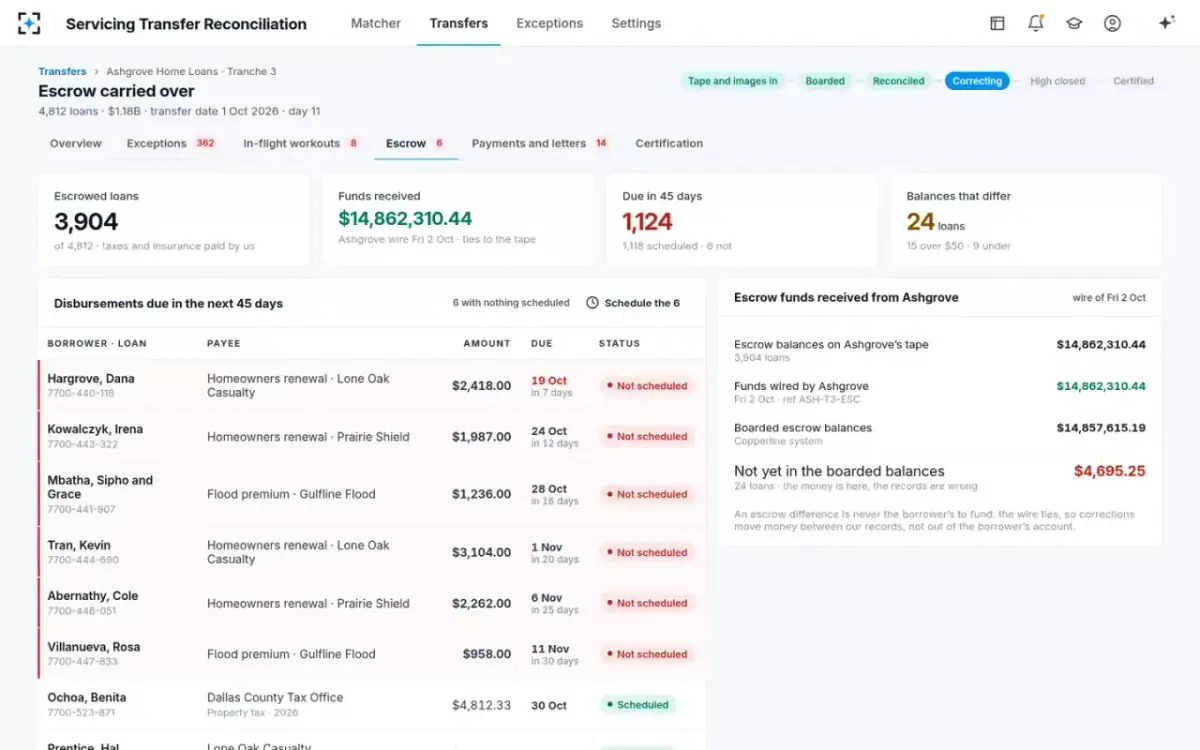
The two checks answer different questions. Tying the wire to the tape shows whether the money arrived; comparing boarded balances shows whether it was put on the right loans. In the sample the wire tied to the cent and the boarded balances were $4,695.25 short across 24 loans, so the fix moves money between records, not out of any borrower's account. The six unscheduled premiums, by contrast, would have meant lapsed coverage, and in time force-placed insurance, if left alone.
Why the 60 days are a reconciliation job, not a notice
A notice tells the borrower about the window; only matching proves the servicer kept it. Every forwarded payment, every fee charged in the window, every suspense balance, every autopay enrolment and every escrow disbursement due has to be checked against what the old servicer received and what the loan file says. On a transfer of a few thousand loans that is thousands of items in the weeks when the team is busiest.
That is the part Servicing Transfer Reconciliation takes: it reads the forwarded payments and the old servicer's files, finds the items that break the rule or will break it, ranks them by when the borrower would feel it, and drafts each fix for cash management and the transfer manager to approve. It never charges or reverses a fee, posts a payment or reports to a credit bureau itself. The borrower's side of the same window is in what to do if your credit score dropped after a transfer; the full set of transfer clocks is in the mortgage servicing transfer rules; the solution is at Servicing Transfer Reconciliation.
Questions people ask
Does the 60-day period apply if I never got a transfer notice?
Yes. It runs from the effective date of transfer, whether or not the notice arrived. A missing notice is itself an error the borrower can raise in writing with either servicer, and makes it more likely that payments went to the old company.
What if I paid the old servicer after the 60 days?
The special protection no longer applies, so the payment's timing depends on when it reaches the new servicer. The old servicer must still promptly forward it or return it with the name of the right company. Change your payee as soon as the hello letter arrives to avoid the problem.
Does the 60-day rule apply to a subservicer change?
Yes, when it is a transfer for Regulation X purposes, that is, when the payee, payment address, account number or payment amount changes. A change of subservicer that the borrower never sees, with payments going to the same place, is not a transfer for the notice and 60-day rules.
Can the new servicer refuse a payment the old servicer forwarded?
It must apply a forwarded payment to the borrower's account; the rule's purpose is that the borrower is not penalised for paying the wrong company during the window. If a forwarded amount is less than a full periodic payment, it may be held in suspense, and must be applied once enough funds accumulate to cover a payment.
How long does the old servicer have to forward a payment?
The rule says "promptly" and sets no number of days. In practice transfer agreements set a forwarding schedule, often daily; whatever it is, the delay must not make the payment late, which is why the old servicer's receipt date has to travel with every forwarded payment.