If your mortgage was sold to another company and your credit score dropped, the most likely cause is not the sale itself but a payment that was reported as late during the handover: a payment sent to the old company that was not credited in time, an autopay that did not move, or a payment plan the new company never received. A transfer of servicing does not change the terms of your loan, and federal law says that for 60 days a payment the old servicer received on time cannot be treated as late for any purpose. If you were reported late anyway, you can dispute it in writing with the servicer, which then may not report adverse information about that payment for 60 days while it investigates. On the servicer's side, Botminds' Servicing Transfer Reconciliation checks every transferred loan against its documents and the old company's notes so that these errors are found before they become a late fee or a credit report.
This page is general information about federal rules, not legal advice; state law and your loan documents may add protections. The borrower examples are fictional, taken from a sample transfer run through the solution.
In the 60 days after a servicing transfer: what the new servicer may and may not do
May: Receive it from the old servicer, which must promptly forward it or return it to you.
May not: Treat it as late for any purpose if the old servicer received it by the due date or grace period.
May: Charge a fee on a payment that really was late, wherever it was sent.
May not: Charge a late fee on a payment the old servicer received on time.
May: Report the account accurately.
May not: Report a payment the old servicer received on time as late.
May: Change how and where you pay.
May not: Change the rate, balance or other terms of the loan because servicing moved.
May: Ask the old servicer for the agreement if it was not sent.
May not: Ignore a plan the old servicer agreed with you; your protections carry over.
My mortgage was sold to another company: what changed and what did not
What changed is who collects your payments, where you send them and possibly your account number. What did not change is your loan: the transfer notice the servicers must send you has to state that the transfer does not affect any term or condition of the mortgage other than those directly related to servicing. Your interest rate, balance, payment amount and maturity stay as they were.
Two letters should have reached you. The old servicer's "goodbye" letter, at least 15 days before the transfer, and the new servicer's "hello" letter, within 15 days after; sometimes they come as one letter. Each names the date the old company stops accepting payments and the new one starts. If the owner of the loan also changed, a separate notice from the new owner arrives within 30 days. The CFPB's own guidance to borrowers is practical: send payments to the new servicer after the switch date, update any automatic payment set up through your bank, and check your statements to confirm payments were credited (CFPB, Ask CFPB).
Can a servicer report me late after a transfer?
Not for a payment the old servicer received on time within the first 60 days. RESPA says that during the 60-day period beginning on the effective date of transfer, "a late fee may not be imposed on the borrower with respect to any payment on such loan and no such payment may be treated as late for any other purposes, if the payment is received by the transferor servicer (rather than the transferee servicer who should properly receive payment) before the due date" (12 U.S.C. 2605(d)). Reporting a payment as late to a credit bureau is treating it as late.
Outside that protection, a servicer may report a payment that was truly late, and the transfer does not excuse a payment that was never made. That is why the details matter: when the old servicer received the payment, what the due date and grace period were, and whether you were on a plan that set a lower payment.
Can my new servicer charge a late fee?
Only on a payment that was actually late. Within the 60 days, a payment received on time by the old servicer cannot carry a late fee, even though it reached the new servicer later after being forwarded. In the sample transfer three borrowers were charged late fees, $217.44 in all, on payments the old servicer received on 1 October, the due date; the new servicer's check found the three fees and queued them for reversal before any of the borrowers called.
Regulation Z adds a general rule that applies whoever services the loan: a servicer must credit a periodic payment "as of the date of receipt, except when a delay in crediting does not result in any charge to the consumer or in the reporting of negative information to a consumer reporting agency" (12 CFR 1026.36(c)(1)). A late fee or a late report caused by slow crediting breaks both rules at once.
The numbers that protect a borrower after a transfer
60days
in which an on-time payment to the old servicer cannot be treated as late
60days
without adverse credit reporting on a disputed payment after a written notice of error
30days
for the servicer to answer most notices of error, extendable once by 15
1year
after the transfer to send a notice of error to the old servicer
What if I paid the old servicer?
If you paid the old servicer on time during the 60 days, the payment counts as on time. The old servicer must promptly either forward it to the new servicer for your account or return it to you with the name of the company you should pay. Keep proof of the date the old servicer received it: a bank record, a cleared check, an online confirmation.
The window is generous, but it is not permanent and it does not cover everything. After 60 days, payments must go to the new servicer. A payment sent to the old servicer after the borrower was told of the transfer may take time to be credited, which is why the CFPB tells borrowers to switch their payee and any automatic payments as soon as the hello letter arrives.
Why a payment plan or autopay can go missing in a transfer
Because the old servicer's data file does not always carry them. Servicers move loans as a data tape and a set of scanned documents; a payment plan agreed in the last weeks before a sale can be recorded in the old servicer's notes and the signed letter without reaching the column the new system reads. Autopay enrolments travel in yet another file, and if it arrives late it may not load.
Take Luis and Carmen Arreola, a fictional sample borrower. Their old servicer approved a three-month trial modification in August at $1,412.36 a month. The data tape sent to the new servicer had the plan fields blank and billed the full $2,086.91. Their October trial payment arrived and was held aside as a partial payment, and the new servicer's system scheduled a $69.31 late fee for 16 October, a delinquency notice the next day, and a foreclosure referral and adverse credit report before the month was out, all while they were paying exactly as agreed.
One sample borrower's October: what the data error scheduled, and what checking the file stopped
- Transfer 1 Oct; trial payment held aside1–15 Oct
- Late fee 16 Oct, notice 17 Oct, then referral and credit report16–31 Oct
- Transfer to day 111–12 Oct
- Plan boarded, fee and notice cancelled, letter sentfrom 12 Oct
How do I dispute a transfer error?
Write to the servicer at the address it designates for errors and say what is wrong: the payment you made, when and to whom, and what was reported or charged. Failure to transfer your information accurately and on time is one of the errors Regulation X lists, as are failure to credit a payment on the date received and charging a fee without a reasonable basis. The servicer must acknowledge your letter within five business days and correct the error or explain, after a reasonable investigation, why it found none, generally within 30 business days.
The most useful protection for a credit score is the reporting freeze. "After receipt of a notice of error, a servicer may not, for 60 days, furnish adverse information to any consumer reporting agency regarding any payment that is the subject of the notice of error" (12 CFR 1024.35(i)(1)). You can also dispute the entry directly with each credit bureau that shows it; under the Fair Credit Reporting Act a bureau must reinvestigate, generally within 30 days of receiving the dispute (15 U.S.C. 1681i).
If your score dropped after your mortgage was transferred
- Find the two transfer letters
Note the date the old servicer stopped taking payments and the new one started. That date starts your 60 days.
- Gather proof of each payment
Bank statements or confirmations showing when the old or new servicer received it.
- Pull your credit reports
Find which month was reported late and by which company.
- Write a notice of error to the servicer that reported it
Use its designated address. Say what happened and attach proof. Keep a copy and the mailing date.
- Write to the old servicer too, if the problem started there
You have up to a year after the transfer.
- Dispute with each credit bureau that shows the late payment
Include the same proof; the bureau must reinvestigate.
- If you were on a payment plan, say so and send the agreement
The new servicer must honor protections you had before the transfer.
- Keep paying while you wait
Pay the amount your plan or statement requires, to the new servicer, and keep records.
How long do I have to dispute a transfer error?
With the new servicer, there is no fixed deadline while it services your loan. With the old servicer, you have one year: a notice of error delivered more than a year after servicing was transferred away from it is treated as untimely, and it need not investigate. The old servicer must also keep its records of your account for a year after the transfer, so asking early means the evidence is still there.
Credit reporting has its own clock. Disputes with the credit bureaus can be made at any time, but a late payment left uncorrected stays on a report for years, and lenders reading it will not know it came from a transfer. The sooner the servicer corrects what it furnished, the sooner the bureaus' records follow.
One loan, three sources, and what happens if nothing is done
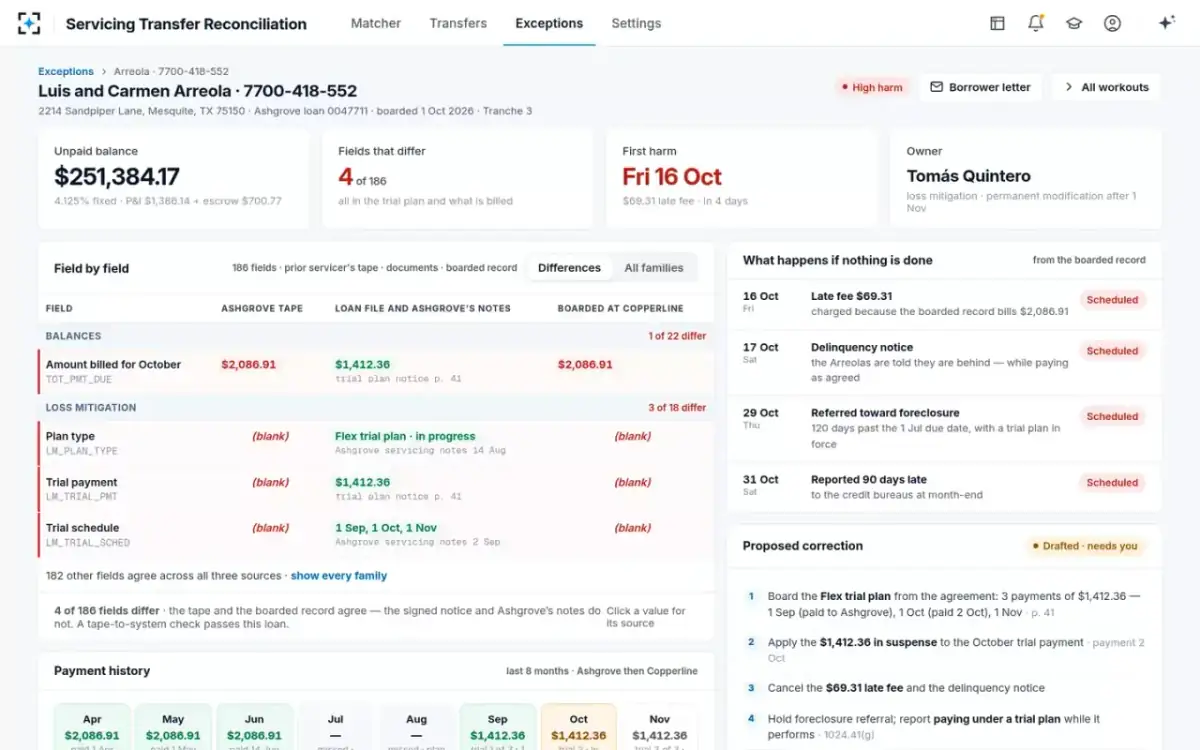
What a customer service representative should check on the call
When a borrower calls about a late mark after a transfer, the representative's job is to find which of four causes applies, because each has a different fix. The table is a starting point for a call script.
Four causes of a late mark after a transfer, and where to look
| Cause | Where to look | Usual fix |
|---|---|---|
| Paid the old servicer on time within 60 days | Date the old servicer received it; forwarded payments list | Credit as on time, reverse any fee, correct the bureau report |
| Payment received but credited late | Receipt date against posting date | Back-date the credit; reverse any fee and report caused by the delay |
| On a plan the new system did not show | Old servicer’s notes and signed agreement; ask the old servicer before the borrower | Board the plan, apply held funds, cancel fees and notices |
| Autopay did not move | Old servicer’s enrolment file; your autopay records | Re-enrol, treat any missed draft caused by the transfer as the servicer’s error |
The better answer is not to need the call. Servicers that compare every transferred loan with its signed documents and the old servicer's notes in the first days find the missing plans, the late-fee errors and the autopay gaps before the borrower does; how that works is in the mortgage servicing transfer grace period and what happens to a plan mid-transfer. Botminds' Servicing Transfer Reconciliation is one such tool for servicers; it never charges a fee or reports to a credit bureau itself.
Questions people ask
Does a servicing transfer affect my credit score?
The transfer itself is not late-payment information, and your loan's terms do not change. What can lower a score is a payment reported as late during the handover. If that happened on a payment the old servicer received on time within the first 60 days, it should not have been reported, and you can dispute it with the servicer and the credit bureaus.
Do I have to keep paying while my dispute is open?
Yes. A notice of error does not suspend your obligation to pay, and except for certain foreclosure errors it does not stop a servicer from pursuing its other remedies. Keep paying the amount your statement or payment plan requires, to the current servicer, and keep records.
Why did my mortgage get sold without my permission?
Loan documents allow the servicing, and the loan itself, to be transferred, and federal law does not require the borrower's consent. It requires notice: the goodbye and hello letters, and a notice from any new owner within 30 days. The protections are about how payments and errors are handled, not whether the sale can happen.
My escrow payment changed after the transfer. Is that an error?
Not necessarily. Escrow payments change when taxes or insurance premiums change, and a new servicer may run its own escrow analysis. But a jump right after a transfer is worth questioning in writing, because a missing tax or insurance record in the transferred data is a common cause, and an escrow payment the servicer failed to make on time is itself an error you can raise.
Who do I complain to if the servicer does not fix it?
You can submit a complaint to the CFPB online or by phone at (855) 411-2372, and to your state's financial regulator, which licenses most non-bank servicers. Keep copies of your notice of error and the servicer's answers; they show what you raised and when.