Loan boarding is setting up transferred loans on the new servicer's system, and its accuracy can only be measured by testing the check that is supposed to catch errors. The method that works is a seeded test: take a copy of a real tranche, plant a known number of known errors of each type, in the tape, the field map, the documents and the old servicer's notes, and count how many the boarding check finds. It matters because a check that has never been tested reports "no exceptions" whether the loans are clean or not, and servicing transfers fail in places a quiet check cannot see. Botminds' Servicing Transfer Reconciliation compares every loan's tape with its signed documents, the prior servicer's notes and the boarded record, and a seeded test is the way to hold it, or any alternative, to account.
The figures for the solution come from a fictional sample transfer of 4,812 loans from Ashgrove Home Loans to Copperline Loan Servicing. The test plan is our own design, offered for a servicer to run on its own data.
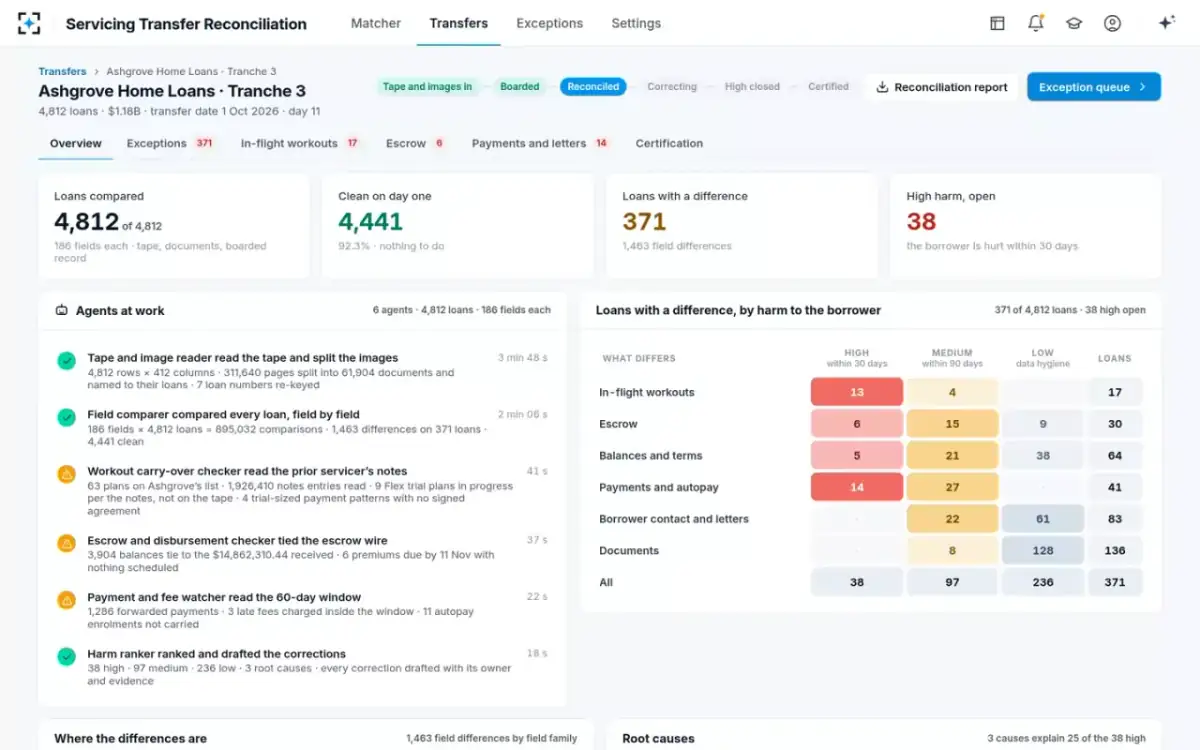
Most differences in a transferred tranche are hygiene; one in ten would hurt a borrower within a month
Loans with a difference, by harm
- High · 38 · 10.2%
- Medium · 97 · 26.1%
- Low · 236 · 63.6%
All 4,812 loans
- Clean on day one · 4,441 · 92.3%
- 371 with a difference · 7.7%
Loan boarding accuracy is measured, not assumed
A boarding check that reports few exceptions has told you one of two things: the loans are clean, or the check cannot see the errors. Without a test the two are indistinguishable. The seeded test separates them by giving the check errors whose number and location you know in advance, so its catch rate, and its false alarms, become numbers rather than impressions.
The idea is old in software testing and rare in servicing operations, where boarding QC is usually judged by the complaints that do not arrive. That is a lagging measure with a long lag. In the sample transfer, the first harm on the worst loan was a late fee four days away, and the first complaint would have come after it.
What are common loan boarding errors?
The common loan boarding errors fall into a handful of families: balances and suspense, rates and adjustable-rate terms, escrow payees and due dates, payment history and autopay, insurance dates, investor and custody codes, borrower contacts, and loss mitigation status. Most of them are mapping decisions repeated on every loan; the most harmful are workouts that never reached the tape at all.
Where 1,463 differences fell in one tranche, by field family
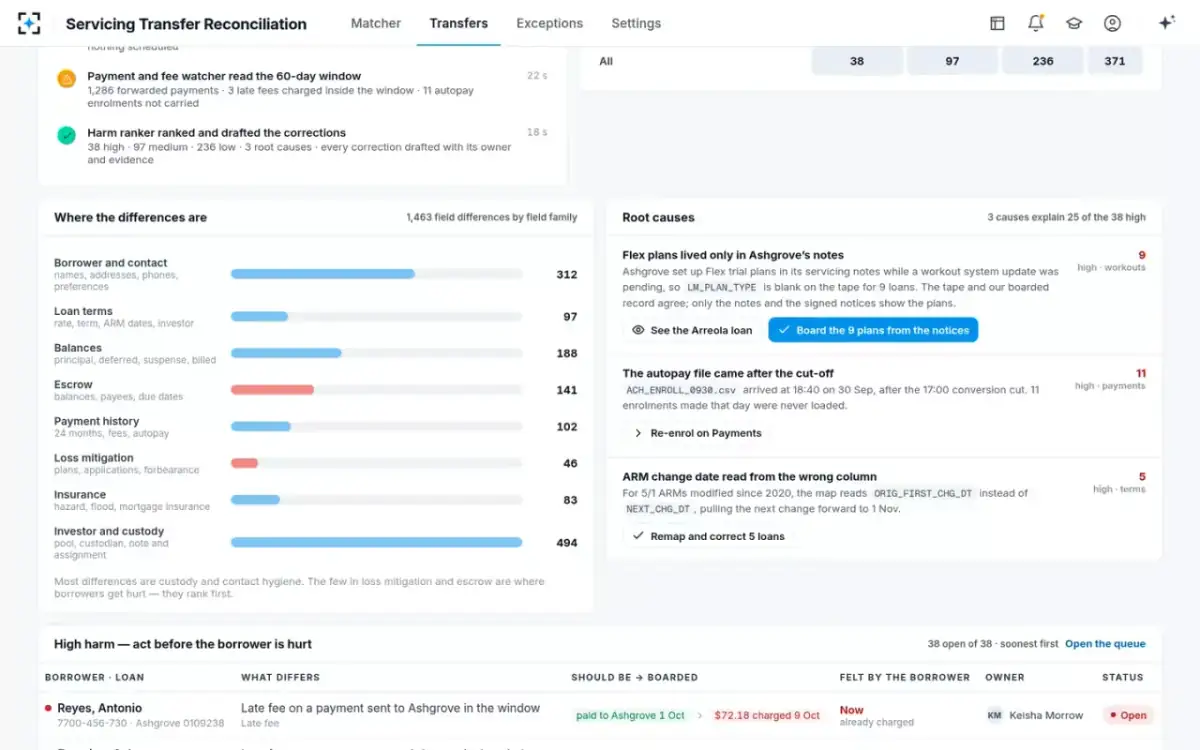
The count and the harm point in opposite directions, which is the first thing a test must respect. A boarding QC tuned to the biggest bars spends its time on custody codes. The 46 loss mitigation differences include nine trial plans being billed in full; the 141 escrow differences include six insurance premiums due with nothing scheduled. A seeded test should weight its planted errors toward the families that hurt borrowers, not toward the families that are common.
Why a tape-to-system QC meets the bulletin's words and misses its point
The CFPB's transfer guidance asks for two kinds of testing. Before the transfer, "using tailored testing protocols to evaluate the compatibility of the transferred data with the transferee servicer's systems and data mapping protocols." After it, "engaging in quality control work after a transfer of preliminary data to validate that the data on the transferee's system matches the data submitted by the transferor," with mapping errors from de-boarding or on-boarding prioritised for resolution (CFPB Bulletin 2020-02).
Read literally, the second sentence describes a two-way check: the transferee's system against the transferor's submission. A servicer can perform it perfectly and still board every error that was already in the submission. The same guidance, and the rule behind it, expects more: the transferee must identify information that "may not have been transferred," and the bulletin's own list of data to receive includes "the terms of any loss mitigation that was offered to a borrower under which the borrower is performing." A test plan should therefore include errors that a faithful copy of the tape cannot reveal, because those are the ones the rule was written for.
How to test loan boarding accuracy: plant 50 known errors
Plant 50 errors of ten types in a copy of a real tranche, five of each, spread across the four places errors come from: the tape, the field map, the loan documents and the old servicer's notes. Then run the boarding check unchanged and count, by type, what it found, what it missed and what it raised that you did not plant.
A 50-error seeded test for a servicing transfer boarding check
| Error planted (5 of each) | Where it is planted | Seen by tape-to-system | Seen by a three-source check |
|---|---|---|---|
| Trial plan approved in the notes, blank on the tape | Notes and signed notice only | No | Yes, if notes and documents are read |
| Trial-sized payments with no plan anywhere on file | Payment history only | No | Yes, if payments are searched for plan-sized amounts |
| ARM next change date mapped from the first-change column | Field map | No: both agree | Yes: the note disagrees |
| Escrow payee or due date missing for an insurance renewal | Tape | No | Yes: the policy or escrow analysis disagrees |
| Suspense balance dropped in conversion | Conversion | Yes | Yes |
| Principal balance off by more than tolerance | Conversion | Yes | Yes |
| Autopay enrolment made the day before transfer, not loaded | Separate enrolment file | No | Yes, if the enrolment file is in scope |
| Mortgage insurance termination date missing | Tape | No | Yes: the note date and amortisation disagree |
| Mailing address newer in the notes than on the tape | Notes | No | Yes |
| Loan number changed between tape and image bundle | Image index | No: no image to compare | Yes, if images are re-keyed to loans |
Three rules keep the test honest. Plant errors in a copy, never in production. Have someone outside the boarding team plant them and hold the answer key until the run is done. And count false alarms as carefully as catches: a check that flags 2,000 loans to find 50 has moved the work, not done it. In the sample tranche the comparison flagged 371 loans of 4,812 and closed the other 4,441, which is the ratio a team can actually work.
Differences grouped by the cause behind them
How to validate a transfer data tape before the transfer date
Validate the tape before the transfer by boarding it into a test environment and running the same three-source comparison on the documents and notes you already have. The 2014 transfer bulletin describes a transferor that gave buyers "advance access to a web portal containing loan documentation" 45 to 60 days before transfer; where that access exists, the test can run on the real tranche weeks before a borrower is affected (CFPB Bulletin 2014-01).
The pre-transfer run catches mapping errors cheaply, because a wrong column is fixed in the map once. It cannot catch what the seller sends late. The same bulletin warned that examiners would "carefully scrutinize the policies and procedures of any institution that regularly waits until after loan boarding to transfer information that it had in its possession prior to boarding." A test plan should therefore run twice: on the preliminary tape and documents before transfer, and on the final file, notes and boarded records after.
How many loans should be tested after a transfer?
Enough to have a real chance of seeing a rare pattern, which for the errors that matter is far more than most samples. If a defect affects nine loans in 4,812, a random sample of 100 loans misses all nine about 83% of the time. To be 95% sure of seeing at least one, you need a sample of about 1,400 loans, more than a quarter of the tranche.
Chance a random sample sees at least one loan from a rare pattern, in a tranche of 4,812
| Loans affected | Sample of 100 | Sample of 400 | Sample of 1,600 | Every loan |
|---|---|---|---|---|
| 5 (0.10%) | 10% | 35% | 87% | 100% |
| 9 (0.19%) | 17% | 54% | 97% | 100% |
| 25 (0.52%) | 41% | 89% | over 99% | 100% |
| 100 (2.1%) | 88% | over 99% | over 99% | 100% |
The table is the argument for comparing every loan. Sampling works for errors that are common and evenly spread, such as a rounding rule. It fails for the errors a transfer actually produces: a handful of plans set up in notes, one late file, one product's change date. That is why the solution's design target is every loan and every field, not a sample.
What errors do transferees miss? The regulators' list
The CFPB's examination record names the misses. In its 2014 bulletin it reported that in "a number of examinations" servicers "had failed to properly identify loans that were in a trial or permanent modification with the prior servicer at time of transfer," and that some "failed to honor trial or permanent modification offers unless they could independently confirm that the prior servicer properly offered a modification" (CFPB Bulletin 2014-01). Borrowers were asked to resubmit paperwork; some received modifications on worse terms; in some cases the servicer "actually conducted a foreclosure sale."
The Congressional Research Service put the history in one line in 2025: during the foreclosure crisis, "information about troubled borrowers' circumstances was frequently lost during transfers to specialty servicers," delaying loss mitigation and disrupting state foreclosure processes (CRS R48713). A seeded test that does not include workouts, payment patterns and late documents is testing the errors that were never the problem.
The tranche, by category and by harm
Reading the results: catch rate by type, and what to do with a miss
Report the result as a catch rate by error type, not one number. Five of five trial plans and nought of five autopay enrolments is a different finding from fifty of fifty on balances, and it points at a specific gap: an input the check does not read. A miss is fixed by adding the source, not by adding reviewers.
Running a seeded loan boarding test
- Pick a recent tranche with workouts in it
A clean flow of current loans will not exercise the checks that matter.
- Have someone outside boarding plant the errors
Five of each of ten types; the answer key stays sealed until the run is scored.
- Plant in all four places
Tape, field map, documents and the old servicer’s notes. Errors only in the tape test half the problem.
- Run the check exactly as in production
Same tolerances, same field set, same reviewers. A tuned test proves the tuning.
- Score catch rate, cause and harm rank
Was each error found, was its cause named, and was it ranked ahead of hygiene items?
- Count the false alarms
Flags per real error is the cost of the check; report it beside the catch rate.
- Repeat after every map change
A new seller layout or a system upgrade is a new check.
The test also serves the second line. Internal audit and compliance can rerun it without knowing how the check works, and the result goes into the post-transfer certification as evidence that the review was capable of finding what it certifies was absent. For the full comparison of approaches see what a loan onboarding system must check; for a test on real outcomes rather than planted errors, see piloting on a transfer you already closed. Botminds runs this kind of test on Servicing Transfer Reconciliation with a servicer's own tranche.
Questions people ask
What is a post-transfer QC review?
It is the check after boarding that the new servicer's records match what the prior servicer had, and that nothing needed was left behind. The CFPB recommends it in Bulletin 2020-02 alongside a post-transfer review of whether the transfer plan worked, and monitoring of complaints and loss mitigation results for at least four to six months.
What is a good loan boarding error rate?
No regulator publishes a target, and a raw error rate says little because most differences are hygiene. In the sample tranche 7.7% of loans had a difference but 0.8% had one that would hurt the borrower within 30 days. Track the harmful rate and its causes, and drive it toward zero before the first statement goes out.
Should we test the old servicer's data or our own boarding?
Both, because the rule splits the duty. The transferor must send information in a form that ensures its accuracy; the transferee must identify what was not sent and obtain it. A seeded test that plants errors in the tape and the notes tests your ability to find the transferor's mistakes, which is the half most checks skip.
How often should the boarding check be tested?
At least whenever the inputs change: a new seller, a new tape layout, a system conversion or a change to the field map. Each of those creates new places for an error to hide, and a check that passed on last quarter's layout has not been tested on this one.
Can a seeded test be run on live loans?
Not safely. Plant errors only in a copy of the tape, documents and boarded records in a test environment. The point is to measure the check, and a planted error that leaked into production would become the borrower harm the test exists to prevent.