A loan onboarding system for mortgage servicing transfers is software that loads a prior servicer's loans into the new servicer's system and proves each one arrived correctly. The test of a good one is simple: it must compare the prior servicer's data tape not only with the boarded record but with the signed documents and the old servicer's notes, because when the tape itself is wrong, tape and system agree and the loan passes. Buyers usually find this out on their first transfer with a workout pipeline. Botminds' Servicing Transfer Reconciliation was built for that comparison: six agents match every loan, field by field, across the tape, the governing document and the boarded record, rank each difference by harm to the borrower, and leave every correction to a person's approval.
The figures that illustrate the solution come from a fictional sample transfer, 4,812 loans moving from Ashgrove Home Loans to Copperline Loan Servicing on 1 October. The regulatory requirements are quoted from the CFPB and the eCFR.
Two sources or three: what a tape-to-system check passes and a file check does not
Tape against boarded record: Both sources blank: passes.
Tape against documents, notes and boarded record: The signed notice and the note disagree with both: a break, ranked high.
Tape against boarded record: The map moved the wrong value faithfully: passes.
Tape against documents, notes and boarded record: The note’s change date disagrees: a break on every loan of that product.
Tape against boarded record: Not on the tape, not in the system: passes.
Tape against documents, notes and boarded record: The enrolment file and the notes show it: a break before the next draft.
Tape against boarded record: Found: the classic boarding error.
Tape against documents, notes and boarded record: Found, with the document page that settles it.
Tape against boarded record: Nothing to compare: invisible.
Tape against documents, notes and boarded record: Expected and missing: raised, and asked of the prior servicer.
What is a loan onboarding system?
A loan onboarding system is whatever a servicer uses to set up loans on its servicing platform and confirm the set-up is correct. In practice it is three layers that are often bought separately: a conversion tool that maps and loads the tape, a document system that splits and indexes the image bundles, and a reconciliation step, frequently a set of spreadsheets, that checks the result.
The first two layers are mature. The third is where transfers fail, because it is usually built to answer one question: did the system load what the tape said? That is a good question about the conversion. It says nothing about whether the tape described the loan. A buyer evaluating a loan onboarding system for servicing transfers should therefore ask about the third layer first.
What should be checked when boarding a loan?
Everything a servicer needs to bill, collect, escrow, report and work out the loan should be checked when it is boarded. The CFPB's own list is the best starting point: Bulletin 2020-02 ends with an appendix of examples of information and documents to be transferred, grouped in nine areas, which the Bureau says it "intends to use to assess compliance with Regulation X" (CFPB Bulletin 2020-02).
The CFPB's nine areas of transfer data, and the boarding error each one invites
| Area in Bulletin 2020-02 | Examples the Bureau lists | A typical boarding error |
|---|---|---|
| Foundational loan information | Balances, next due date, suspense funds, interest rate and calculation method, ARM index, margin and next change date, fees owed | An ARM change date or a suspense balance read from the wrong column |
| Investor information | Investor name, reporting requirements, remittance type | A loan reported to the wrong pool or remittance type |
| Escrow accounts | Escrow payment, last analysis date, tax due dates, parcel numbers, insurer, historic escrow records | A renewal never scheduled because the payee or due date did not load |
| Private mortgage insurance | Cancellation request date, 78% termination date, midpoint date | Premiums charged past termination under the Homeowners Protection Act |
| FHA insurance | Premium amount and due date, partial claim amount, case number date | A partial claim lien missing from the balance |
| Hazard and flood insurance | Policy numbers, renewal dates, coverage, open claims and loss drafts held | Lapsed coverage, then force-placed insurance the borrower did not need |
| Loss mitigation | Status of discussions, agreements, applications complete and incomplete, plan terms and dates | A trial plan boarded as an ordinary loan and billed in full |
| Foreclosure | Status, referral date, attorney, scheduled sale date | A sale date that ignores a pending complete application |
| Bankruptcy | Chapter, filing date, proof of claim date, pre- and post-petition due dates | Collection activity during an automatic stay |
The bulletin singles out two areas as carrying "heightened compliance risk": private mortgage insurance dates, whose loss "may contribute to violations of the Homeowners Protection Act", and loss mitigation documents, "including incomplete applications and executed modification agreements". A system that checks balances and rates perfectly and treats loss mitigation as a free-text field has tested the safe part of the loan.
How to reconcile a servicing transfer data tape against three sources
To reconcile a servicing transfer data tape, compare each field three ways: the tape's value, the governing source's value and the boarded value, with a tolerance set per field. The governing source is the document or entry that controls the field: the note for the rate and maturity, the modification agreement for modified terms, the trial plan notice for a trial payment, the escrow analysis for the escrow payment, the payment history for the next due date.
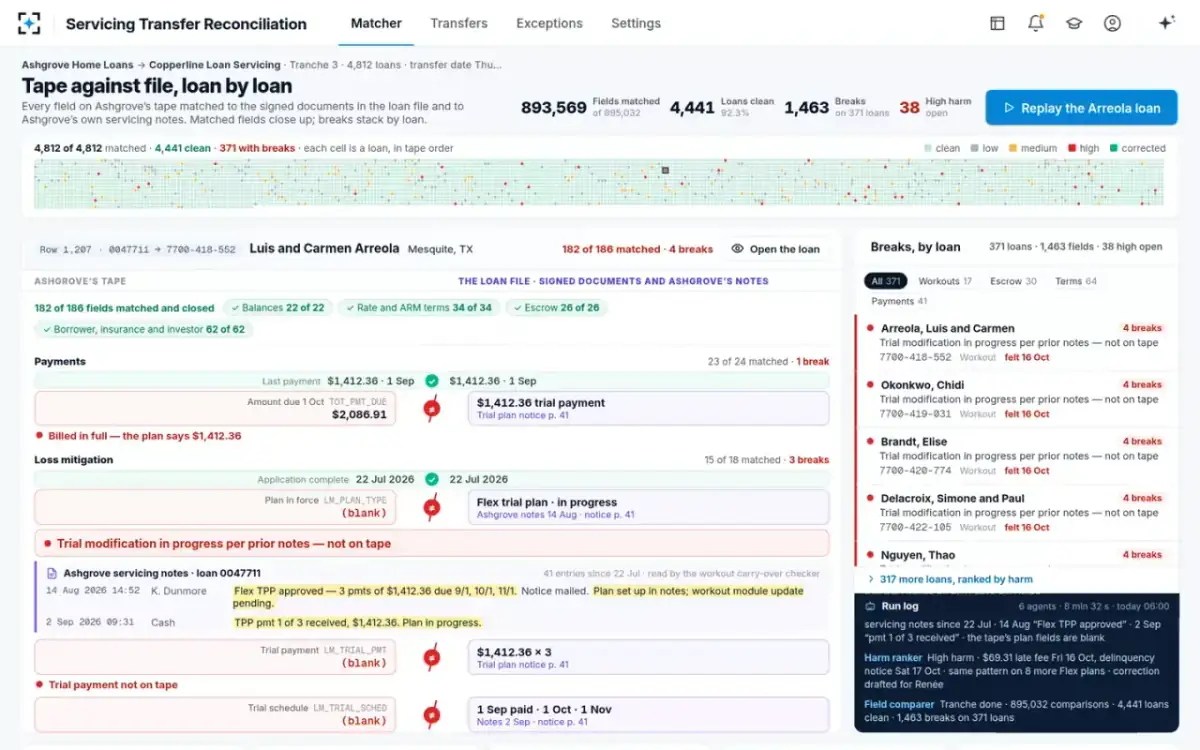
Three values give four outcomes, and each means something different. All three agree: close the field. Tape and system agree, document disagrees: the tape is wrong, and so is the loan as boarded. Tape and document agree, system disagrees: a mapping or conversion error, usually shared by many loans. All three disagree: a question for a person. A two-way check can only see the third outcome, which is why it misses the errors that hurt borrowers most.
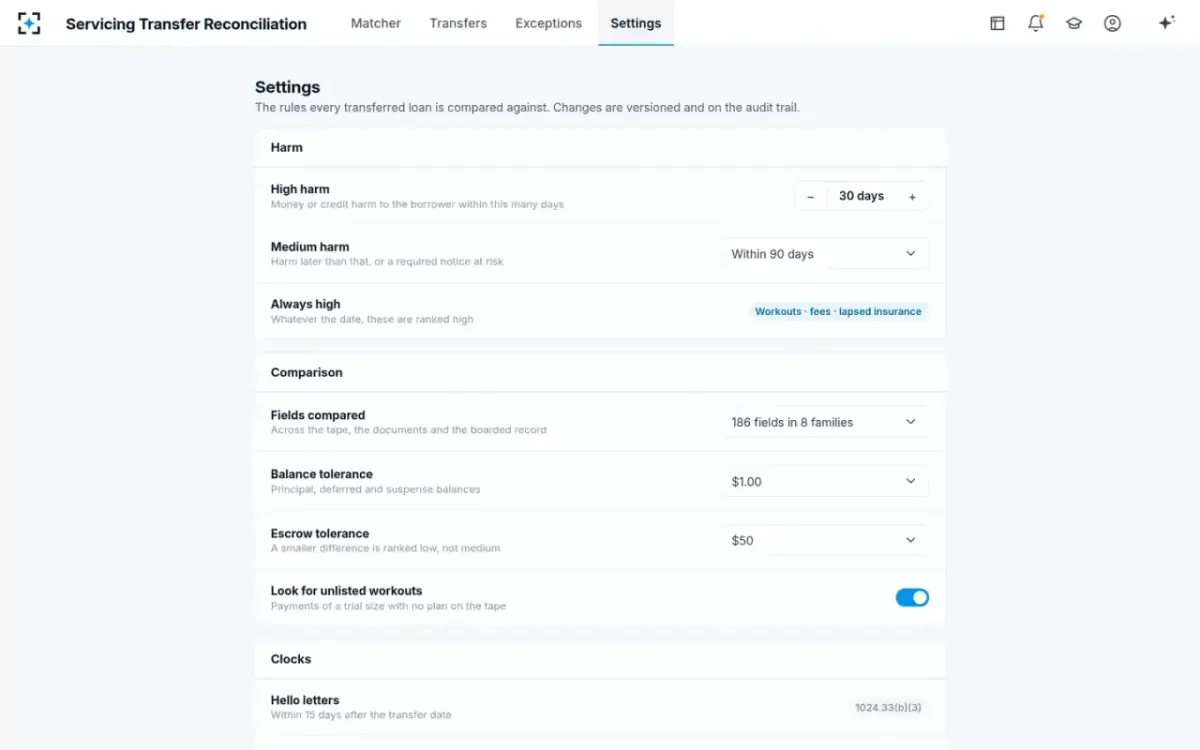
Tolerances matter as much as fields. In the sample transfer balances are compared to $1.00 and escrow balances to $50, below which a difference is ranked low rather than medium; both are settings a servicer chooses. Too tight, and a tranche produces thousands of rounding breaks that hide the real ones. Too loose, and a misapplied payment disappears.
One loan in Servicing Transfer Reconciliation: the tape on the left, its proof on the right
Can software decide which document is correct?
No, and a loan onboarding system should not try. When two documents disagree, say a modification agreement and a later note that records a different payment, the answer depends on facts outside the file: which was signed, which the investor approved, what the borrower was told. The system's job is to find the disagreement, show both sources, and route it to the person who can settle it.
The regulators' record shows why this matters. In its 2016 servicing edition of Supervisory Highlights, the CFPB described transferees whose delays in honoring in-flight modifications came from "their dependence on the information technology department to manually override data fields whenever the servicing platform rejected transferor data"; giving override authority to loss mitigation staff shortened the delay (CFPB Supervisory Highlights, 2016). The lesson cuts both ways. Decisions about a borrower's plan belong with the people who own the plan, not with a system rule and not with whoever can edit the field.
Six agents, and what each may never do
Servicing Transfer Reconciliation divides the work among six agents, each with a narrow job and written limits. The person steps are where judgement and signatures stay.
How Servicing Transfer Reconciliation divides a transfer between agents and people
Agent
Tape and image readerReads the tape and splits image bundles into named documents, re-keying loans whose numbers differ between files.
Never: Edits the prior servicer’s tape or images.
Agent
Field comparerCompares 186 fields on every loan across tape, governing document and boarded record, with a tolerance per field.
Never: Decides between two documents that disagree.
Agent
Workout carry-over checkerReads the old notes, matches every plan and application to its agreement, and finds trial-sized payments with no plan on the tape.
Never: Changes a plan’s terms.
Agent
Escrow and payment checkersTie the escrow wire to the tape, find disbursements due with nothing scheduled, and watch the 60-day payment window, fees and autopay.
Never: Pays, charges a fee or reports to a credit bureau.
Agent
Harm ranker and correction drafterRanks every difference by harm and date, groups shared causes, and drafts each correction with its owner and letter.
Never: Posts a correction without approval.
A person decides
Transfer manager, and a second approver for batchesApproves each correction with its evidence beside it; a fix touching more than 25 loans needs the second approver.
A person decides
Compliance officerSigns the post-transfer certification when every high and medium item is closed.
The limits are Regulation X's commentary, written as rules
Each limit above answers a sentence in the rule or the CFPB's guidance. The clearest is the commentary to 1024.38(b)(4)(ii), which requires a transferee's procedures to address "obtaining any such missing information or documents from a transferor servicer before attempting to obtain such information from a borrower" (Supplement I to Part 1024). The same comment describes exactly the pattern the workout checker looks for: a servicer that receives information "indicating that a borrower has made payments consistent with a trial or permanent loan modification but has not received information about the existence of a trial or permanent loan modification agreement" must have procedures "to identify whether any such loan modification agreement exists with the transferor servicer and to obtain any such agreement."
Each agent limit, and the requirement it serves
| Limit | Why | Where it comes from |
|---|---|---|
| Asks the prior servicer for a missing agreement before the borrower | The rule sets the order of asking | Comment 38(b)(4)(ii)-1, Regulation X |
| Searches payments for trial-sized amounts with no plan on the tape | A payment pattern is evidence of an agreement the tape does not show | Comment 38(b)(4)(ii)-1, Regulation X |
| Never edits the prior servicer’s tape or images | The transferred file is the evidence of what was sent | 1024.38(b)(4)(i): the transferor answers for accuracy |
| Records all three values and their sources for every difference | A correction must show what it rests on | 1024.38(c)(2): servicing file, notes and data fields |
| Never changes a plan’s terms; never charges or reverses a fee | Money and terms are decisions with owners | Our design rule, consistent with 1024.41(k) carry-over |
| Nothing posted without a person’s approval | The servicer, not its tools, is responsible | Our design rule |
What does CFPB Bulletin 2020-02 recommend for data mapping?
Bulletin 2020-02 recommends planning, testing and post-transfer checks of the data map, and it goes one step further than most guidance: it encourages a shared data standard. "Use of a uniform data standard like the Mortgage Industry Standards Maintenance Organization (MISMO) standard would increase data compatibility," the Bureau wrote, and it "encourages servicers to adopt a common data standard and data dictionary" (CFPB Bulletin 2020-02).
For a buyer, that sentence is a practical test. A loan onboarding system should hold its field map as a dictionary: every tape column named, typed, tied to a field in your system and, where one exists, to its standard data point. When a tape arrives with 412 columns, as the sample tape does, the dictionary is what lets a team see on day one which columns are new, which are unmapped and which changed meaning since the last tranche. The bulletin is non-binding guidance, but it is the yardstick examiners carry, and it was not among the CFPB guidance documents withdrawn in May 2025.
Your transfer rules, as settings
What to ask a loan onboarding system vendor
The questions below separate a conversion tool from a reconciliation. Ask them of any vendor, including us, and ask to see each answer on a tranche of your own.
Questions for any loan onboarding system used on servicing transfers
- Does it compare the tape with the documents, or only with the boarded record?
A two-way check passes every error that starts on the tape.
- Does it read the prior servicer’s servicing notes?
Workouts agreed while a system update was pending live there and nowhere else.
- Does it find workouts the seller did not list?
Ask how: in the sample transfer, trial-sized payments found 4 loans beyond the seller’s list of 63.
- Does it check every loan, or a sample?
A random sample of 100 loans out of 4,812 misses all nine loans of a nine-loan pattern about 83% of the time (our arithmetic).
- How does it rank what it finds?
By harm to the borrower and the date it lands, or by field? A late fee due in four days outranks a phone number.
- Does it group differences that share a cause?
One wrong column is one fix, not 25 tickets.
- Who approves corrections, and is the approval recorded with its evidence?
Look for an approver per correction and a second approver for batch fixes.
- What does it never do?
Paying, charging fees, reporting to bureaus and changing plan terms should all be on the list.
- What can compliance sign at the end?
A certification of what was checked, found, fixed and open, from the same record.
Where Servicing Transfer Reconciliation fits, and where it does not
The solution is the reconciliation layer. It does not convert tapes into your servicing system or replace the conversion tool you already use; it reads the tape, the images, the notes and your boarded records and tells you what is wrong. It does not post anything on its own: corrections go to your servicing system only after the transfer manager approves them. And it does not replace the call with the seller's transfer coordinator; it drafts the request and tracks the answer.
It fits best where the risk is concentrated: bulk purchases with delinquent and in-workout loans, new subservicing clients whose data you have never seen, and any transfer where the seller's tape layout changed. On a flow of current loans from a seller you know well, a disciplined tape-to-system check may be enough. The first job of a pilot is connecting it to an extract of your boarded records; piloting it on a transfer you already closed shows what it would have found. The full picture is on the Servicing Transfer Reconciliation page, and the error-planting test is in how to test loan boarding accuracy.
Questions people ask
Is a loan onboarding system the same as a loan servicing system?
No. The servicing system holds the loan and runs billing, payments, escrow and reporting. The onboarding layer gets loans into it and proves they are right; it can be part of the servicing platform, a separate conversion tool or a reconciliation solution that sits beside both.
Do small servicers need transfer policies?
Small servicers as defined in Regulation Z are exempt from the policies and procedures requirements of 1024.38, including the transfer objectives, as Bulletin 2020-02 notes. They are still bound by the transfer notices and the 60-day payment protection in 1024.33, and by error resolution.
How many fields should be compared on each loan?
As many as the servicer relies on to bill, collect, escrow, report and work out the loan. The sample transfer compares 186 fields in 8 families on every loan, 895,032 comparisons for 4,812 loans; a narrower agency set of 142 fields is another option. The right number is the one that covers every area in the CFPB's appendix that applies to your book.
Can the system fix the tape itself?
It should not. The prior servicer's tape and images are the evidence of what was transferred, and the transferor answers for their accuracy. Corrections belong in your boarded record, approved by a person and tied to the document that justifies them.
What is data mapping in a servicing transfer?
It is the set of rules that says which tape column fills which field in the new system, how codes translate and what a blank means. Because one mapping rule applies to every loan, a single mistake in it is a portfolio-wide error, which is why the CFPB asks for mapping to be tested before the transfer and checked after it.