The federal mortgage servicing transfer rules sit mainly in Regulation X, 12 CFR 1024.33, with companions in 1024.38, 1024.41 and Regulation Z. They come down to four numbers. The old servicer must send its notice of transfer at least 15 days before the effective date and the new servicer within 15 days after. For 60 days a payment the old servicer receives on time cannot be treated as late for any purpose. A complete loss mitigation application pending at transfer must be evaluated within 30 days of the transfer date. And the old servicer must still answer notices of error for a year after the transfer. The rules are easy to state and hard to meet on thousands of loans at once, because each clock depends on data the new servicer has only just received. Botminds' Servicing Transfer Reconciliation tracks those clocks per transfer and checks the loan data each one depends on.
The rule text below is quoted from the eCFR as in force in October 2026; none of these sections has been amended since 2016. Examples use a fictional sample transfer with a transfer date of Thursday 1 October.
The four numbers in the mortgage servicing transfer rules
15days
before the transfer for the old servicer’s notice; after it for the new one’s
60days
in which a payment received on time by the old servicer cannot be late
30days
to evaluate a complete loss mitigation application pending at transfer
1year
in which the old servicer must still answer a notice of error
What are the servicing transfer notice requirements?
Each servicer, old and new, must give the borrower a notice of transfer for "any assignment, sale, or transfer of the servicing of the mortgage loan" (12 CFR 1024.33(b)(1)). The transferor sends its notice not less than 15 days before the effective date; the transferee sends its notice not more than 15 days after. They may instead send one joint notice, which must go out at least 15 days before the effective date.
Two exceptions change the timing. When the transfer follows termination of the servicing contract for cause, the servicer's bankruptcy, or an FDIC or NCUA conservatorship or receivership, either servicer may send the notice up to 30 days after the effective date. And notices given at settlement satisfy the timing in full. The content of the notice, six required items, is annotated line by line in the mortgage goodbye letter requirements.
What does RESPA require for servicing transfers, and which transfers are exempt?
RESPA section 6 (12 U.S.C. 2605(b) to (d)) sets the notices and the 60-day protection, and Regulation X 1024.33 implements them. Not every change counts. A transfer between affiliates, one resulting from a merger or acquisition of servicers or subservicers, or one between master servicers without changing the subservicer is not a transfer for the notice rule "if there is no change in the payee, address to which payment must be delivered, account number, or amount of payment due" (1024.33(b)(2)). FHA need not send a notice when an insured loan is assigned to it.
The test is practical: if the borrower must do anything differently, pay someone else, send to another address or use a new account number, the borrower gets the notices. A subservicer change that alters where payments go is a transfer for this purpose even though the owner of the servicing rights has not changed.
One transfer date, four clocks: where each starts and how long it runs
- Goodbye letter by here−15 to 0
- Hello letter by here0 to +15
- Before transfer
- Not late for any purpose0 to +60
- Before transfer
- Evaluate and notify0 to +30
- Before transfer
- Ownership notice0 to +30
The 60-day rule: on time to the old servicer is on time
For the 60 days beginning on the effective date of transfer, a payment that the old servicer receives on or before its due date, including any grace period in the loan documents, may not be treated as late for any purpose. The official commentary spells out the first consequence: the rule "would prohibit a late fee from being imposed on the borrower with respect to any payment on the mortgage loan" (comment 33(c)(1)-1). The same section tells the old servicer what to do with such a payment: promptly forward it to the new servicer, or return it to the payer with the name of the proper recipient.
"Any purpose" reaches further than fees: delinquency counts, credit reporting, collection and default steps. That is why the rule is less a notice than a reconciliation job, and why it has a guide of its own: the mortgage servicing transfer grace period follows forwarded payments through the window.
What happens to a loss mitigation application on transfer?
It transfers with its protections and, mostly, with its clock. The new servicer must handle a pending application "within the timeframes that were applicable to the transferor servicer based on the date the transferor servicer received the loss mitigation application," and all the borrower's rights under 1024.41(c) to (h) continue (12 CFR 1024.41(k)(1)(i)). Three situations get their own timing.
Loss mitigation at transfer: which clock the new servicer inherits
| Status on the transfer date | What the new servicer must do | Deadline |
|---|---|---|
| Application received, acknowledgment not yet sent and still due | Send the notice saying whether the application is complete or incomplete | 10 days, excluding weekends and holidays, from the transfer date (1024.41(k)(2)) |
| Complete application pending | Evaluate for all options and send the decision notice | 30 days from the transfer date (1024.41(k)(3)) |
| Appeal pending or filed after transfer | Decide the appeal, or treat it as a pending complete application | 30 days from the transfer date or the appeal, whichever is later (1024.41(k)(4)) |
| Offer made, acceptance period still running | Let the borrower accept or reject for the rest of the period | The unexpired balance of the period (1024.41(k)(5)) |
| Documents sent to the old servicer after transfer | Obtain them from the old servicer; they count as received when it received them | Comment 41(k)(1)(i)-2 |
The definition of the transfer date matters on the day it differs from the effective date. For 1024.41(k), the transfer date is "the date on which the transferee servicer will begin accepting payments relating to the mortgage loan," and the commentary adds that it "is not necessarily the same date as either the effective date of the transfer of servicing" or "the sale date identified in a servicing transfer agreement." Most transfers set the three on one day; a servicer that does not should run its 30-day and 60-day clocks from different dates.
What is the difference between a transfer notice and an ownership transfer notice?
A servicing transfer notice tells the borrower who will collect payments; an ownership transfer notice tells the borrower who owns the debt. They come from different regulations, are triggered by different events and can arrive in the same month or years apart.
Servicing transfer notice and ownership transfer notice, side by side
Notice of servicing transfer (Regulation X 1024.33): A change in who services the loan: the payee, payment address, account number or payment.
Mortgage transfer disclosure (Regulation Z 1026.39): A new owner acquiring legal title to the debt, if it acquires more than one mortgage loan in 12 months.
Notice of servicing transfer (Regulation X 1024.33): Both the old and the new servicer, or jointly.
Mortgage transfer disclosure (Regulation Z 1026.39): The new owner (the covered person).
Notice of servicing transfer (Regulation X 1024.33): At least 15 days before the effective date (old); within 15 days after (new).
Mortgage transfer disclosure (Regulation Z 1026.39): On or before the 30th calendar day after the date of transfer.
Notice of servicing transfer (Regulation X 1024.33): Effective date, contacts at both servicers, when payments switch, optional insurance, no change to loan terms.
Mortgage transfer disclosure (Regulation Z 1026.39): New owner’s name and contacts, date of transfer, who can resolve payment issues, recording, partial payment policy.
Notice of servicing transfer (Regulation X 1024.33): 60 days in which an on-time payment to the old servicer is not late.
Mortgage transfer disclosure (Regulation Z 1026.39): Knowing whom to contact about rescission and payments.
The Regulation Z notice is due "on or before the 30th calendar day following the date of transfer" (12 CFR 1026.39(b)), and a buyer that resells within 30 days need not send one. Two other Regulation Z duties bite in the same weeks: a payoff statement within seven business days of a written request, and crediting each periodic payment as of the date of receipt (12 CFR 1026.36(c)). A boarding error in the payment history breaks both.
What must each servicer do with the loan's information?
Regulation X splits the duty between the two servicers. The old servicer's policies must transfer all information and documents it holds "in a form and manner that ensures the accuracy" of what is sent; the new servicer's must find what may not have been sent and obtain it from the old servicer (1024.38(b)(4)). The commentary adds that missing loss mitigation documents must be sought from the old servicer before the borrower is asked.
The old servicer's duties outlast the transfer. It must keep records of actions on the account until one year after the transfer, and it must respond to a notice of error about its own servicing unless the notice arrives more than one year after servicing was transferred, at which point the notice is "untimely" (12 CFR 1024.35(g)(1)(iii)). A borrower who discovers a transfer mistake in month eleven can still write to both servicers.
Was the CFPB servicing transfer bulletin withdrawn?
No. On 12 May 2025 the CFPB withdrew 67 guidance documents, but its transfer guidance, Bulletin 2020-02 on handling information and documents during servicing transfers, is not among them (90 FR 20084). The "Bulletin 2014-01" on the withdrawal list is a different document, on furnishers' duties under the Fair Credit Reporting Act. The two servicing items withdrawn were the 2014 bulletin on surviving family members and the 2017 policy on early compliance with the 2016 amendments; the successor-in-interest rules themselves still stand.
The rules are also unchanged. Regulation X's transfer sections were last amended in 2013 and 2016, and the CFPB's July 2026 servicing examination procedures still begin with a module on servicing and ownership transfers. Federal supervision has narrowed since 2025, but state regulators and investors apply the same rules, and borrowers can enforce several of them in court.
The transfer clocks as settings in Servicing Transfer Reconciliation
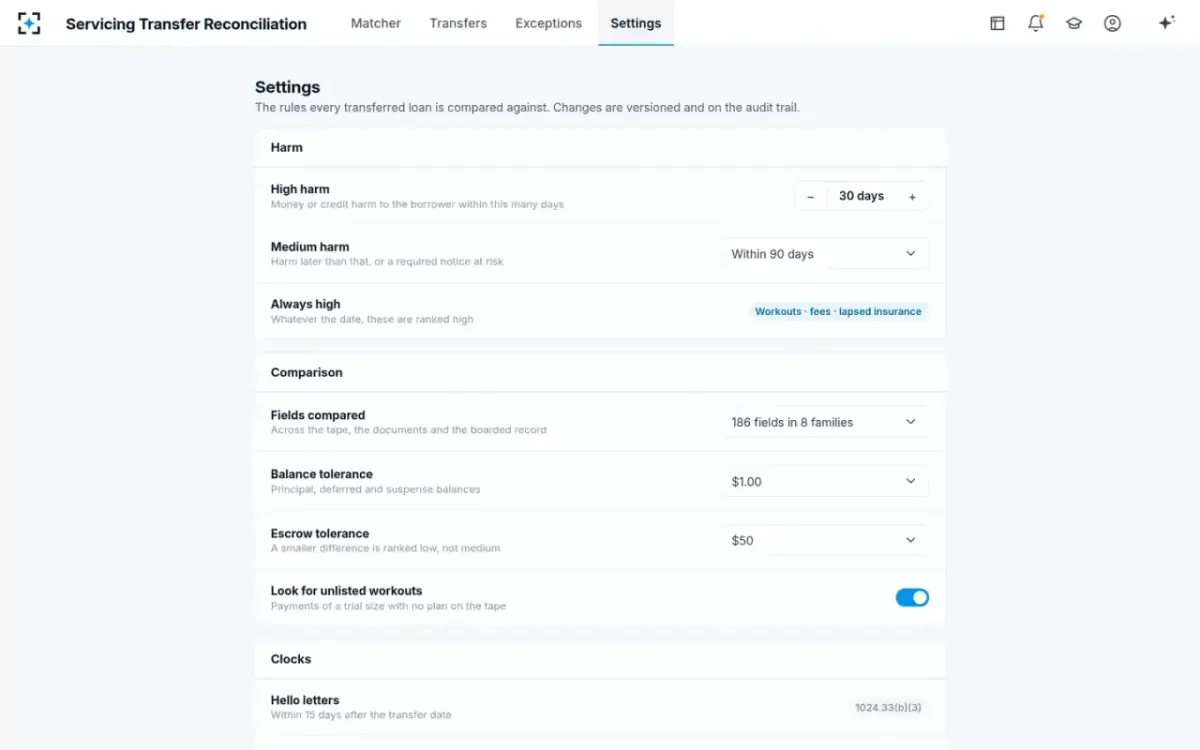
Turning the rules into a transfer calendar with Servicing Transfer Reconciliation
A rule that runs from the transfer date becomes a list of dates the moment a transfer is scheduled, and the work is making sure each date has the right data behind it. In the sample transfer, the hello letters were due 16 October, and by day 11 4,790 of 4,812 had gone out. Fourteen complete applications were pending on 1 October, so each had to be decided by 31 October; five were done by day 11. Three late fees had been charged on payments the seller received on time, and were queued for reversal.
The solution's part is to hold those clocks per transfer and to check, loan by loan, that the data each one depends on is right: addresses for the letters, due dates and grace periods for the 60-day window, application status for the 30-day clock. It does not send letters, decide applications or reverse fees; people do, with the evidence in front of them. More on how it works is on the Servicing Transfer Reconciliation page.
Questions people ask
What does 1024.33 cover?
Section 1024.33 of Regulation X covers the servicing disclosure statement, now required only for reverse mortgage applications; the notices of servicing transfer, their timing, content and exceptions; the 60-day treatment of payments sent to the old servicer; and preemption of state laws that require transfer notices.
Do the transfer rules apply to small servicers?
The notices and the 60-day protection in 1024.33 apply to all servicers. Small servicers are exempt from the policies and procedures in 1024.38, including the transfer-of-information objectives, and from most of 1024.41, though not from the 120-day foreclosure bar or the ban on foreclosing while a borrower performs under a loss mitigation agreement.
Is the hello letter the same as the welcome letter?
In practice the new servicer's notice of transfer is often combined with a welcome letter. The welcome letter can carry account details, payment options and autopay instructions; the notice must still contain every item 1024.33(b)(4) requires and arrive within 15 days after the effective date.
Can a servicer start collection calls during the 60 days?
Early intervention for a borrower who is actually delinquent continues; the official commentary says that complying with the early intervention rule during the 60 days is not treating a payment as late. What it cannot do is treat an on-time payment to the old servicer as late, so the delinquency must be real on the old servicer's records too.
When does the 60-day period start?
On the effective date of the transfer of servicing, the date stated in the notices. The 30-day clock for pending complete applications runs instead from the transfer date, the day the new servicer begins accepting payments, which is usually but not always the same day.