A loan boarding specialist is the person who takes a prior servicer's data tape and loan images and loads them into the new servicer's system, maps each field, and checks that what boarded matches what was sent. In mortgage servicing the job sits inside a larger one: when servicing rights are sold, a transfer team of five or six seats inherits every loan at once, with federal clocks that start on the transfer date. It is hard because the tape is never the whole loan. Trial plans, promises and payment arrangements often live in the old servicer's notes, not in a column. Botminds' Servicing Transfer Reconciliation exists for that gap: its agents compare every loan on the tape with its signed documents and the old servicer's notes, so each seat starts with a list of what is wrong, ranked by harm to the borrower.
The examples below follow a fictional sample transfer as it runs through the solution: Copperline Loan Servicing buying the servicing of 4,812 loans from Ashgrove Home Loans, transfer date Thursday 1 October. The rules and findings come from the regulators, linked where they appear.
What one bulk transfer hands the boarding desk
4,812
loans arriving on one transfer date, $1.18 billion of unpaid balance
412
columns on the prior servicer’s data tape, one row per loan
311,640
pages of loan images, delivered as one bundle per loan
1.93M
servicing notes entries over 24 months, where workouts often live
What is a loan boarding specialist?
A loan boarding specialist is the operations analyst who moves loans from a seller's records into the buyer's servicing system and proves they arrived intact. In a servicing transfer that means three jobs: mapping the prior servicer's fields to the new system's fields, running the conversion, and checking the result before the first statement or payment goes out under the new name.
The mapping is where most errors are born. A tape of a few hundred columns has to land in a system with its own field names, codes and rules for what a blank means. A trial plan field left blank on the tape boards as "no plan". An adjustable-rate field read from the wrong column boards a change date that is wrong for every loan of that product. The specialist rarely makes these errors by hand; they are decisions taken once, in the map, and repeated on every loan.
The title varies by firm: boarding analyst, conversion analyst, transfer coordinator, onboarding specialist. Job postings for it ask for the same things: reading tape layouts, reconciling balances, chasing missing documents and working to a transfer calendar that a business sold months earlier.
What does loan boarding mean in mortgage servicing?
Loan boarding means setting up a loan on a servicing system so that it can be billed, paid, escrowed and reported. It happens at origination, when a new loan moves from the lender's platform to servicing, and at every servicing transfer, when an existing loan moves between companies. The second kind is harder because the loan has a history: balances, missed payments, escrow disbursements, workouts and letters the new servicer never saw.
The law treats both the same way at the edges. The CFPB's mortgage servicing examination procedures apply "whether the servicer obtained the servicing rights from another entity or the servicing responsibility is transferred within a company from the origination platform to the servicing platform" (CFPB examination procedures, July 2026). What changes in a transfer is how much has to be reconstructed, and how many people depend on it being right.
Who is involved in a servicing transfer? Six seats and their clocks
Six seats carry a transfer at the receiving servicer, and four of them run on a clock that starts on the transfer date. The boarding specialist feeds all of them; each of them finds the boarding errors that touch their own work, usually later than they would like.
Six seats in one servicing transfer, before and after the comparison is done for them
Today
Maps the tape, runs the conversion and samples loans against the boarded record in spreadsheets.
With agents
Starts from every loan compared, field by field, against its tape row, signed documents and the old notes, with breaks grouped by cause.
Still theirs: The field map, and the fix when one column is wrong for a whole product.
Today
Finds an inherited trial plan when a borrower’s correct payment lands in suspense.
With agents
Gets every workout matched to its agreement and payments, each pending application on its 30-day clock.
Still theirs: Every decision on a plan or an application.
Today
Applies forwarded payments as they arrive and hears about late fees from the borrower.
With agents
Sees every payment received by the old servicer in the 60-day window, and every fee charged on one.
Still theirs: Reversals and the posting of money.
Today
Learns a homeowners renewal was never scheduled when the policy lapses.
With agents
Sees every disbursement due in the next 45 days with nothing scheduled, and the escrow wire tied to the tape.
Still theirs: Every payment to a tax office or insurer.
Today
Sends hello letters from the boarded address file and answers the calls that follow.
With agents
Sends them from addresses and contacts already compared with the file, and sees which borrowers have a break.
Still theirs: What is said to the borrower.
Today
Certifies the transfer from a sample and a spreadsheet of fixes.
With agents
Signs from a record of every loan checked, what was found, fixed and still open, with owners.
Still theirs: The signature.
The clocks are what make the seats interdependent. The prior servicer's goodbye letter is due at least 15 days before the transfer and the new servicer's hello letter no more than 15 days after (12 CFR 1024.33(b)(3)). Payments the old servicer receives on time cannot be treated as late for 60 days. A complete loss mitigation application pending on the transfer date must be evaluated within 30 days of it (1024.41(k)(3)). Each of those dates is owned by a different seat, and each depends on the boarding desk having loaded the right address, payment history or application status.
Which seat owns which clock in a servicing transfer, and what boarding must get right first
| Seat | Clock from the transfer date | The rule | What boarding must have right |
|---|---|---|---|
| Customer service and letters | Hello letter within 15 days | 12 CFR 1024.33(b)(3) | Mailing address, borrower names, contact details |
| Cash management | 60 days in which an on-time payment to the old servicer is not late | 12 CFR 1024.33(c)(1) | Due dates, grace periods, payment amounts, autopay enrolments |
| Loss mitigation | 30 days to evaluate a complete application pending at transfer | 12 CFR 1024.41(k)(3) | Application status and date, plan terms, trial schedules |
| Default and collections | Delinquent borrowers need assigned personnel from boarding | 12 CFR 1024.40; CFPB Bulletin 2014-01 | Days delinquent, foreclosure and bankruptcy status |
| Escrow | Taxes and insurance due in the weeks after transfer | 12 CFR 1024.17 and 1024.34 | Payees, due dates, balances, policy renewal dates |
| Compliance | Records kept one year after transfer (by the old servicer) | 12 CFR 1024.38(c)(1) | A record of what was checked and fixed |
What must a transferee servicer do under Regulation X?
A transferee servicer must keep policies and procedures reasonably designed to "identify necessary documents or information that may not have been transferred by a transferor servicer and obtain such documents from the transferor servicer" (12 CFR 1024.38(b)(4)(ii)). It is an unusual duty: the rule makes the receiving servicer responsible for noticing an absence. A boarding check that only compares what arrived with what boarded can never meet it, because a missing document produces no row to compare.
The same section tells the boarding desk what a servicing file must contain. Each loan's documents and data must be kept so they can be compiled into a servicing file within five days, including a schedule of all transactions, the security instrument, "any notes created by servicer personnel reflecting communications with the borrower about the mortgage loan account" and a report of the system's data fields (1024.38(c)(2)). The old servicer's notes are therefore part of the loan, not an optional extra, and they are often where a workout was agreed before the system caught up.
The CFPB's 2014 transfer bulletin turned the duty into practice for the receiving side. Among the procedures examiners may credit, it lists a post-transfer process for validating data, "effectively organizing and labeling incoming information," and "conducting regularly scheduled calls with transferor servicers to identify any loan level issues and to research and resolve those issues within a few days of them being raised" (CFPB Bulletin 2014-01). For delinquent loans it adds a seat-level expectation: identify borrowers 45 days or more delinquent at transfer and make sure personnel are available to them from boarding.
Where the seats lose each other: notes, not columns
The seats lose each other where the tape stops. A tape carries what the old system had a column for; a servicing note carries what a person did that day. When a workout is approved while the old servicer's loss mitigation module is waiting on an update, the agreement is real, the borrower is paying it, and the tape still says nothing.
Take the sample transfer's loan 1,207, Luis and Carmen Arreola. Ashgrove's tape leaves the plan fields blank and bills $2,086.91 for October. Ashgrove's note of 14 August reads "Flex TPP approved — 3 pmts of $1,412.36 due 9/1, 10/1, 11/1", and the signed trial plan notice is page 41 of the loan file. The boarded record copied the tape. A boarding check comparing tape with system passes the loan; the loss mitigation lead would have found it when the borrower's $1,412.36 landed in suspense, and the borrower would have found it on 16 October as a $69.31 late fee.
In the sample tranche nine Flex trial plans had this shape, and a tenth seat would not have helped: the boarding desk had no column to check, cash management saw only a short payment, and the plan never reached the system loss mitigation works from. The case is told from the loss mitigation side in the plan in the old notes.
How long does loan boarding take?
Loading the data takes hours; proving it is right takes weeks. A bulk transfer of a few thousand loans typically spends most of its boarding effort on splitting and naming image bundles, comparing sources and chasing workouts the tape missed, and the comparison is usually done on a sample because there is no time to do it on every loan.
Where a bulk transfer's boarding weeks go, by hand and with the comparison automated
| Task | By hand, with spreadsheets and samples | With Servicing Transfer Reconciliation | What stays with people |
|---|---|---|---|
| Splitting and naming image bundles | 5 days | Half a day | Checking documents the reader could not name |
| Comparing tape, documents and boarded record | 6 days, on a sample | Half a day, on every loan | Deciding what each difference means |
| Finding workouts the tape missed | 4 days | Half a day | Owning every plan and application |
| Escrow, payments and fee checks | 3 days | 1 day | Paying, reversing and posting |
| Corrections, approvals and borrower letters | 4 days | 2 days | Approving each correction and letter |
| Assembling the post-transfer certification | 2 days | Half a day | Signing it |
| Total | About 24 working days | About 5 working days |
The estimate matters less for its total than for its shape. The tasks that shrink are the mechanical ones, reading and comparing. The ones that stay are corrections, borrower letters and the certification, because each of them is a decision a person signs. A boarding manager who wants to measure this on a real transfer rather than trust an estimate can pilot it on a transfer already closed.
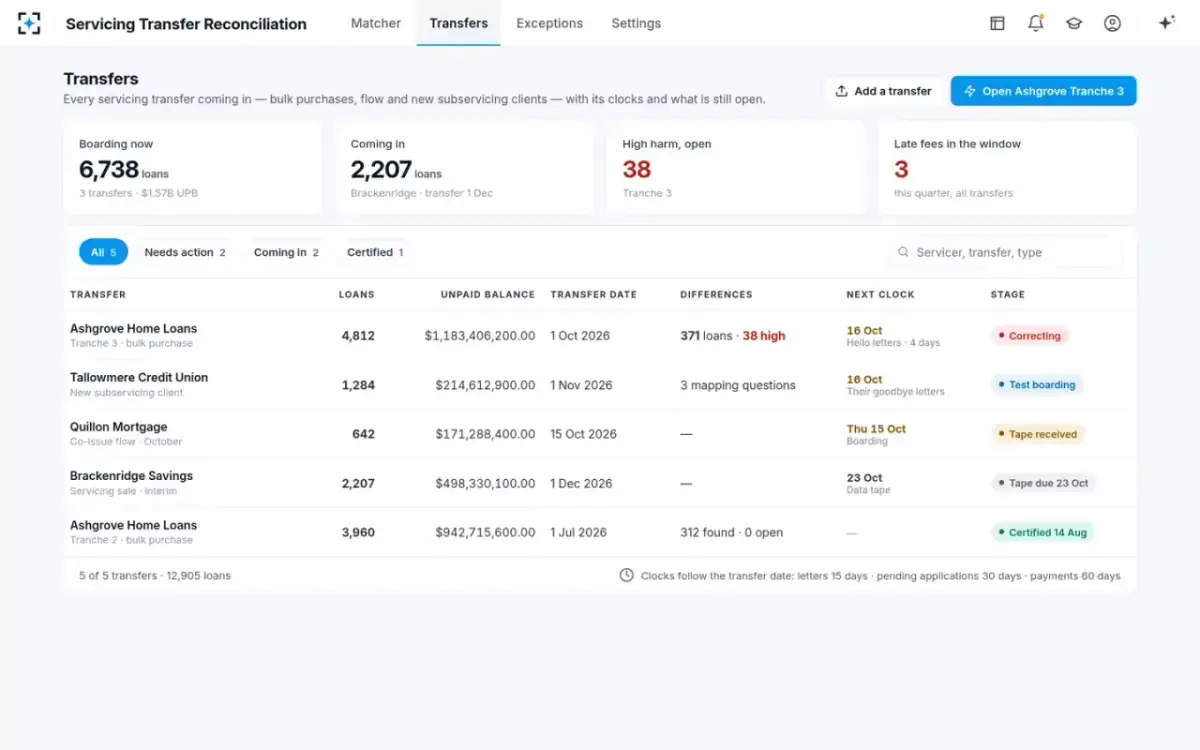
Every transfer coming in, each on its own clocks
The job description, rewritten seat by seat
Read against the rule, a boarding specialist's job has a part that is checking and a part that is judgement. Checking is comparing 186 fields on 4,812 loans with three sources each: in the sample transfer, 895,032 comparisons. Judgement is deciding what a difference means, whom to ask, and whether the map or the loan is wrong.
In the sample run the checking produced 1,463 differences on 371 loans, and three causes explained 25 of the 38 that would hurt a borrower within 30 days: the nine Flex plans that lived only in Ashgrove's notes, an autopay file that arrived after the conversion cut-off, and an adjustable-rate change date read from the wrong column. Each cause is a boarding decision, and each is fixed once in the map or the file rather than 25 times by hand. That is the work the specialist should be spending time on, and the reason the solution groups differences that share a cause.
The other seats change in the same direction. The loss mitigation lead receives a list of 67 workouts in flight, not 63, because four more were found by trial-sized payments. Cash management receives three late fees charged on payments Ashgrove received on time, to reverse before anyone calls. The escrow specialist sees six homeowners and flood premiums due in the next 45 days with nothing scheduled. None of them is asked to trust the agents' reading: every difference shows the tape column, the document page or note, and the boarded field side by side.
What the compliance seat signs, and what stays with people in Servicing Transfer Reconciliation
The compliance officer signs a post-transfer certification, and the question every examiner asks of it is what it rests on. A certification built from a sample says the sample was clean. One built from the comparison of every loan says what was checked, what was found and fixed, and what is still open with an owner and a date.
The post-transfer certification, built from the same record
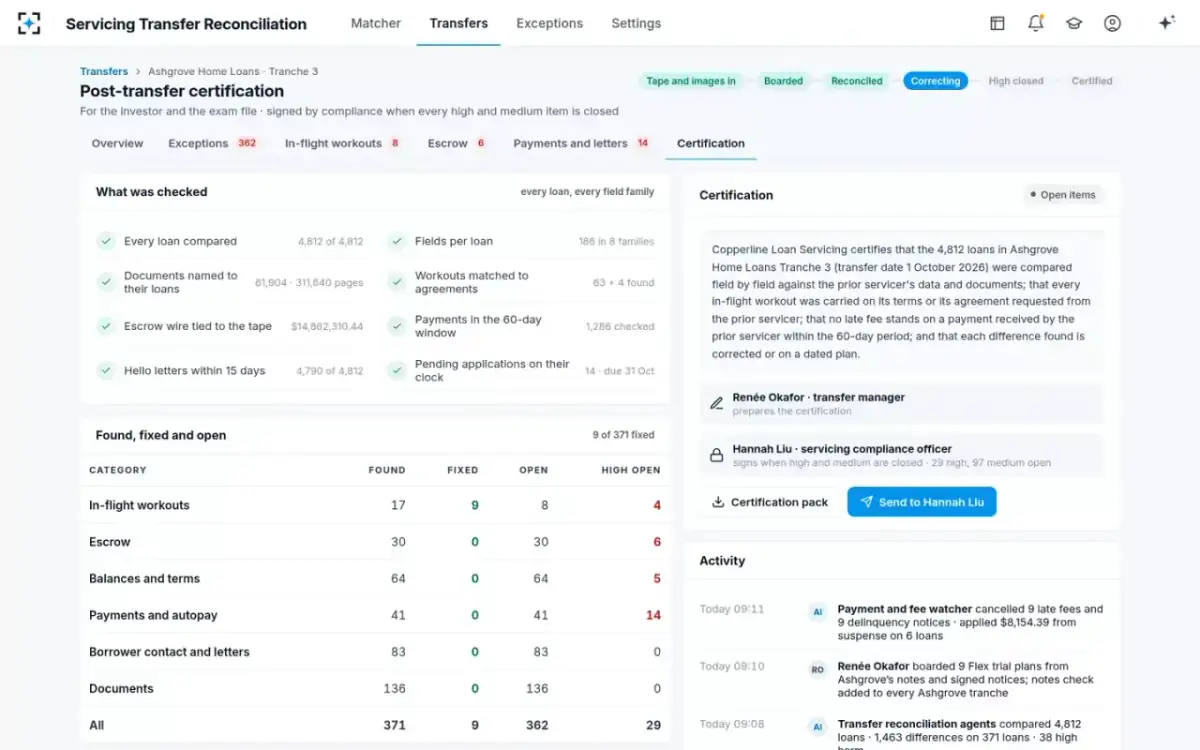
Some things stay with people by design. The agents never post a correction without the transfer manager's approval, and a fix touching more than 25 loans needs a second approver. They never pay a tax bill, charge or reverse a fee, report to a credit bureau or change a plan's terms. When a document is missing, they draft the request to the prior servicer before anyone asks the borrower, which is the order the rule's commentary requires. What a buyer should ask of any system in this seat is set out in what a loan onboarding system must check; the whole solution is at Servicing Transfer Reconciliation.
Questions people ask
What does a loan boarding specialist earn?
The Bureau of Labor Statistics does not track the title separately. The closest occupation it measures, loan interviewers and clerks (43-4131), had 164,790 people employed and a median wage of $50,020 a year in May 2025, according to its Occupational Employment and Wage Statistics. Specialists who lead conversions or own transfer data quality are usually paid above that line.
What is the difference between loan boarding and loan onboarding?
In mortgage servicing the two words are used for the same thing: setting up a loan on the servicing system. "Onboarding" is more common for new loans arriving from origination and for new subservicing clients; "boarding" is the older term on transfer desks. The rule does not use either word; it speaks of transferring information and documents.
Does the old servicer have to help after the transfer date?
Yes. Its own policies must transfer all information and documents "in a form and manner that ensures the accuracy" of what is sent (1024.38(b)(4)(i)). It must keep its records for one year after the transfer, and it must still answer a borrower's notice of error about its own servicing for a year.
Is a subservicer onboarding the same as a servicing transfer?
For this duty, yes. Regulation X defines the transferee for 1024.38(b)(4) as "a servicer, including a master servicer or a subservicer," so a subservicer taking on a new client has the same obligation to find what was not sent. Whether the borrower gets hello and goodbye letters depends on whether the payee, address, account number or payment changes.
How many people does a transfer need?
No regulator sets a number. What the CFPB has said is that transfers should be split into smaller batches when the transferee cannot comply for every loan in one, and that delinquent borrowers need assigned personnel from the day of boarding. Staffing follows the share of delinquent and in-workout loans more than the total count.