UCC tracking software monitors a lender's UCC financing statements, their filing offices, file numbers and five-year lapse dates, and prompts a continuation in the six months before each one lapses, because a statement not continued in that window stops perfecting the lender's security interest. On an SBA 7(a) loan the lien is only one of the duties that lapse quietly: insurance renews and cancels on the insurer's schedule, a missed payment starts a 60-day site-visit clock, and a request to release collateral may need SBA's consent. Each generation of tools, from core ticklers to dedicated UCC and insurance trackers, has watched one of those well and left the joins to people. Botminds' SBA Loan Servicing Compliance belongs to a fourth generation: agents that read each loan's own documents, raise every duty with its source, and draft the work for an officer to sign.
The UCC rule is Article 9 as published by the Legal Information Institute; SBA's rules are from SOP 50 57 4. The examples come from the solution's fictional sample lender, Tallgrass Commerce Bank.
Four generations of SBA servicing control, and the join each one left to people
1 · Core system ticklers
What it tracksDates keyed into loan fields: maturity, review, insurance expiry
How a duty is raisedA date field reaches its value
What it leaves to peopleReading the document behind the date; knowing what the date means for SBA
How it failsA renewal or amendment changes the real date and nobody re-keys it
2 · Spreadsheets and calendars
What it tracksWhatever the officer enters
How a duty is raisedSomeone opens the sheet
What it leaves to peopleEverything, including remembering to look
How it failsThe person who keeps it leaves, or the sheet forks
3 · Single-purpose trackers
What it tracksOne document type well: UCC filings from the filing office, or insurance certificates
How a duty is raisedA vendor alert for that one duty
What it leaves to peopleJoining the lapse to the loan's other clocks and SBA rules
How it failsAn alert arrives on a loan whose site-visit clock and consent request nobody connects to it
4 · Agents reading the loan's own terms
What it tracksEvery duty the loan's documents and SBA's rules create
How a duty is raisedThe document, payment or date that starts the clock, with its source
What it leaves to peopleDecisions and signatures
How it failsA duty outside the written list of what the agents cover
What is UCC tracking software?
UCC tracking software keeps a register of a lender's financing statements and tells someone when to act on them. At its simplest it holds the debtor's name, the filing office, the file number and the filing date, computes the lapse date, and raises an alert when the continuation window opens. Better products search the filing offices to confirm what is on record, track amendments and terminations, and watch for debtor name changes.
SBA makes the duty explicit for 7(a) lenders: "Lenders must monitor all UCC filings for 7(a) Loans and prepare and timely file any document needed to maintain the perfection and priority of the lien securing a 7(a) Loan. This includes, for example, the filing of a UCC-3 financing statement to continue an existing financing statement" (SOP 50 57 4, Ch. 3 E.3). It is one sentence in a monitoring section that also covers insurance, taxes, senior liens, the borrower's name and structure, and its financial condition.
What is a UCC continuation, and when can it be filed?
A continuation is a UCC-3 filing that extends a financing statement for another five years, and it can be filed only in the six months before the statement lapses. Under UCC § 9-515, "a filed financing statement is effective for a period of five years after the date of filing"; a continuation "may be filed only within six months before the expiration of the five-year period"; and on timely filing, effectiveness "continues for a period of five years commencing on the day on which the financing statement would have become ineffective" (UCC § 9-515(a), (d), (e)).
The UCC lapse rule in four numbers
5yrs
life of a filed financing statement from the date of filing
6mo
window before lapse in which a continuation may be filed; not earlier
+5yrs
added by each timely continuation, from the old lapse date
30yrs
life of a statement filed for a public-finance or manufactured-home transaction
The window cuts both ways. A continuation filed seven months early is not effective, so a tracker that alerts a year ahead invites a filing that does nothing; one that alerts a week before lapse leaves no room for a filing office backlog. The sample bank's setting raises the duty when the window opens and again at 90 and 30 days, and its lien agent never files a continuation before the window.
What happens if a UCC lapses on an SBA loan?
The security interest becomes unperfected, and against a buyer of the collateral for value it is treated as if it had never been perfected. The statute: "Upon lapse, a financing statement ceases to be effective and any security interest or agricultural lien that was perfected by the financing statement becomes unperfected, unless the security interest is perfected otherwise. If the security interest or agricultural lien becomes unperfected upon lapse, it is deemed never to have been perfected as against a purchaser of the collateral for value" (UCC § 9-515(c)). A new financing statement can be filed after a lapse, but it generally takes priority only from its new filing date.
On an SBA loan the loss reaches the guaranty. SOP 50 57 4 lists among the grounds for repair or denial a lender's failure "to obtain the required lien and lien position" on the collateral the loan's terms required, measured by "the aggregate Recoverable Value of the property" (SOP 50 57 4, Ch. 25 G.7), and its definition of when SBA is released from liability includes a failure to "service ... a loan in a prudent manner" (13 CFR 120.524(a)(2)). A lapsed statement on equipment that another creditor then takes, or that the borrower sells, is a loss SBA can attribute to the lender.
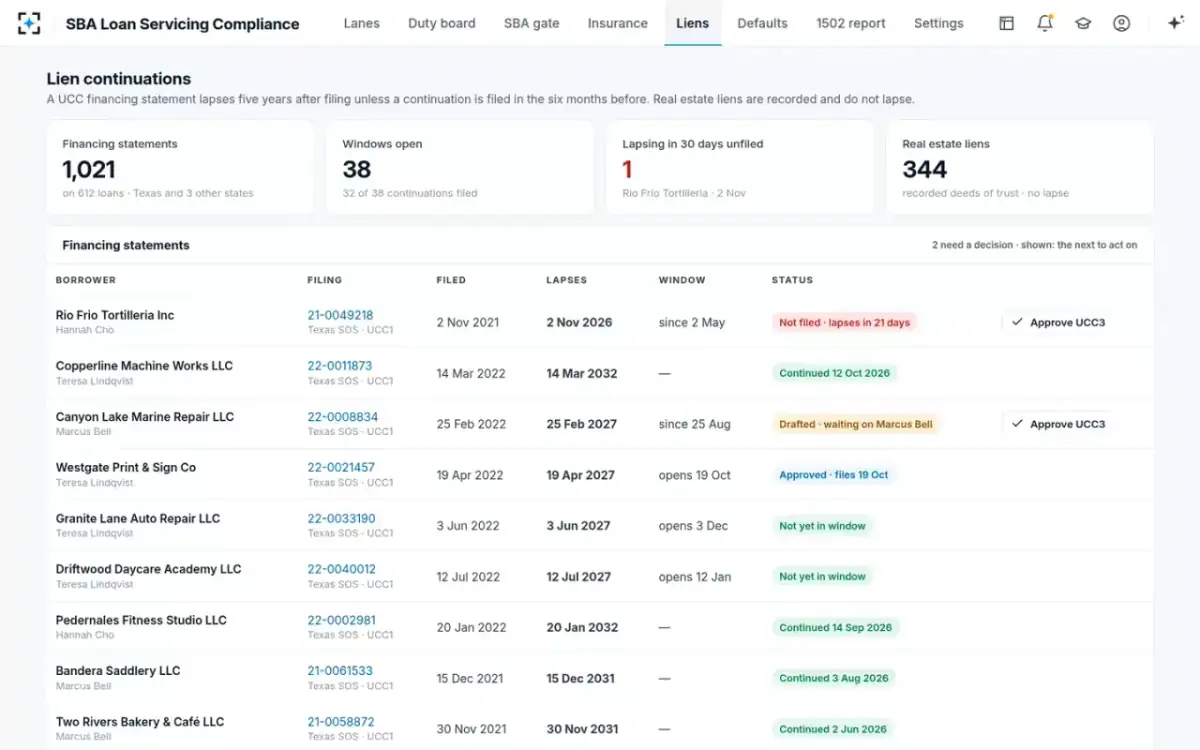
SBA Loan Servicing Compliance tracks every financing statement's lapse and window
How has loan servicing software evolved? Four generations
Loan servicing control has moved from dates in fields, to lists kept by people, to single-purpose trackers, to agents that read the loan's documents. Each step fixed the weakness of the last for one kind of duty. None, until the fourth, tried to hold all of a loan's duties in one place with the document behind each.
The first generation, the core system's tickler, is reliable about dates and blind to meaning: it fires when the insurance expiry field is reached, whether or not the policy was renewed last week, and it cannot tell a lapse that matters from one that does not. The second, the spreadsheet, adds meaning and loses reliability; its quality is the quality of whoever keeps it, and SBA's inspector general has warned that "most loan documents and data reside only with the participating lender" (SBA OIG Report 26-01), which on a small desk often means one person. The third, the dedicated tracker, is excellent at its one duty. A UCC tracking service that searches filing offices and a certificate-tracking service for insurance each solve a real problem better than a tickler ever did.
Why each generation left the joins to people
The joins are where one duty changes another, and single-purpose tools cannot see them. Three examples from SOP 50 57 4 show the pattern. When a borrower changes its name, the lender "should file a UCC 3 financing statement to reflect a name change and preserve the priority of personal property liens" (SOP 50 57 4, Ch. 3 E.1): the trigger sits in correspondence, the action in the lien file. When collateral is released or substituted, the financing statement needs an amendment, the insurance on the substitute collateral needs a mortgagee clause, and the memo needs the Recoverable Value before and after. When a loan defaults, the site-visit inventory should be checked against the collateral the financing statement actually covers.
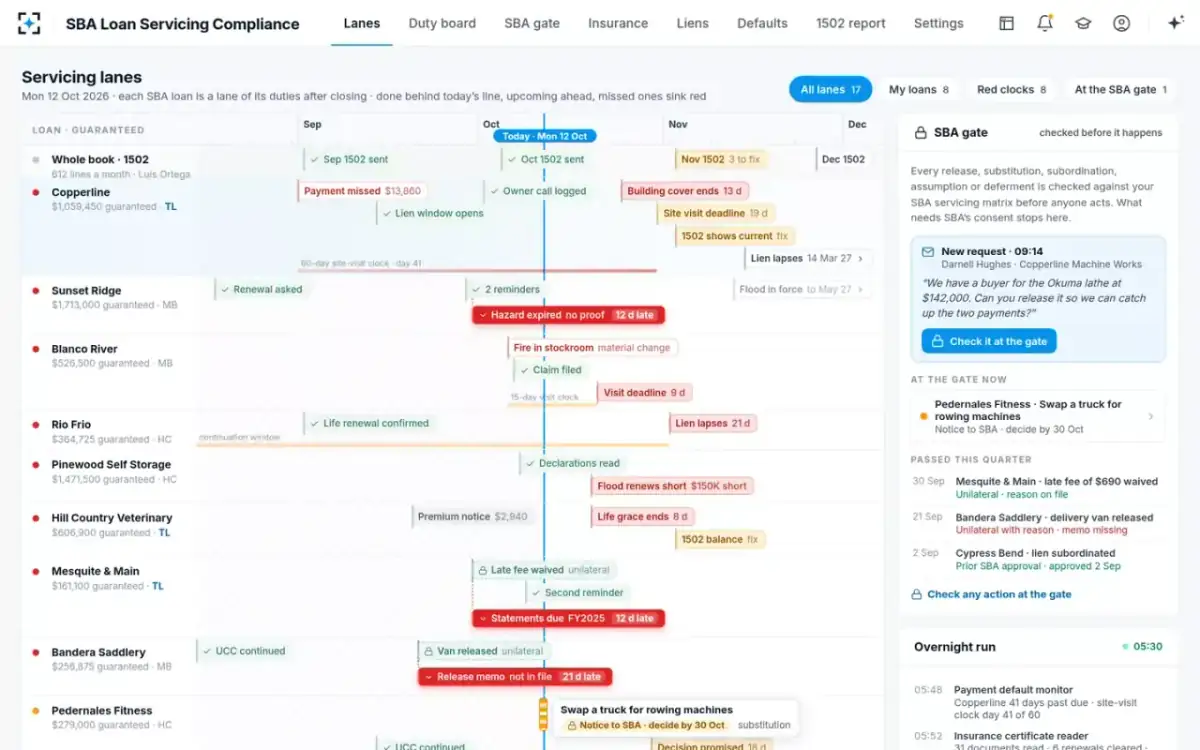
The sample loan Copperline Machine Works had four clocks running on one Monday: a missed payment that started the 60-day visit clock, an insurer's non-renewal of the building policy, a financing statement in its continuation window with nothing filed, and a 1502 draft that still showed the loan current. A UCC tracker would have flagged one of them, an insurance tracker another, and the core's delinquency flag, which had missed the bounced payment, none. The guaranty at stake on all four was the same $1,059,450.
A single-purpose tracker and agents that read the loan, on the same duty
UCC or insurance tracker: The filing office or the certificate, for its one document type.
Agents reading the loan's own documents: The same sources, plus the payment history, the loan's terms and conditions and the servicing file.
UCC or insurance tracker: This statement lapses on 14 March 2027.
Agents reading the loan's own documents: This statement lapses on 14 March 2027; the loan is 41 days past due, its building cover ends on 25 October and a release request is pending.
UCC or insurance tracker: Someone opens the lien file and prepares a filing.
Agents reading the loan's own documents: A drafted UCC-3, with the other duties drafted beside it, for the officer to approve together.
UCC or insurance tracker: None; the tool does not know the loan is SBA-guaranteed.
Agents reading the loan's own documents: The bank's servicing matrix, the loan's sale status and SBA's deadlines.
UCC or insurance tracker: Varies by vendor; some file on the lender's behalf.
Agents reading the loan's own documents: Files, submits or sends anything unsigned.
How do banks track insurance renewals on SBA loans?
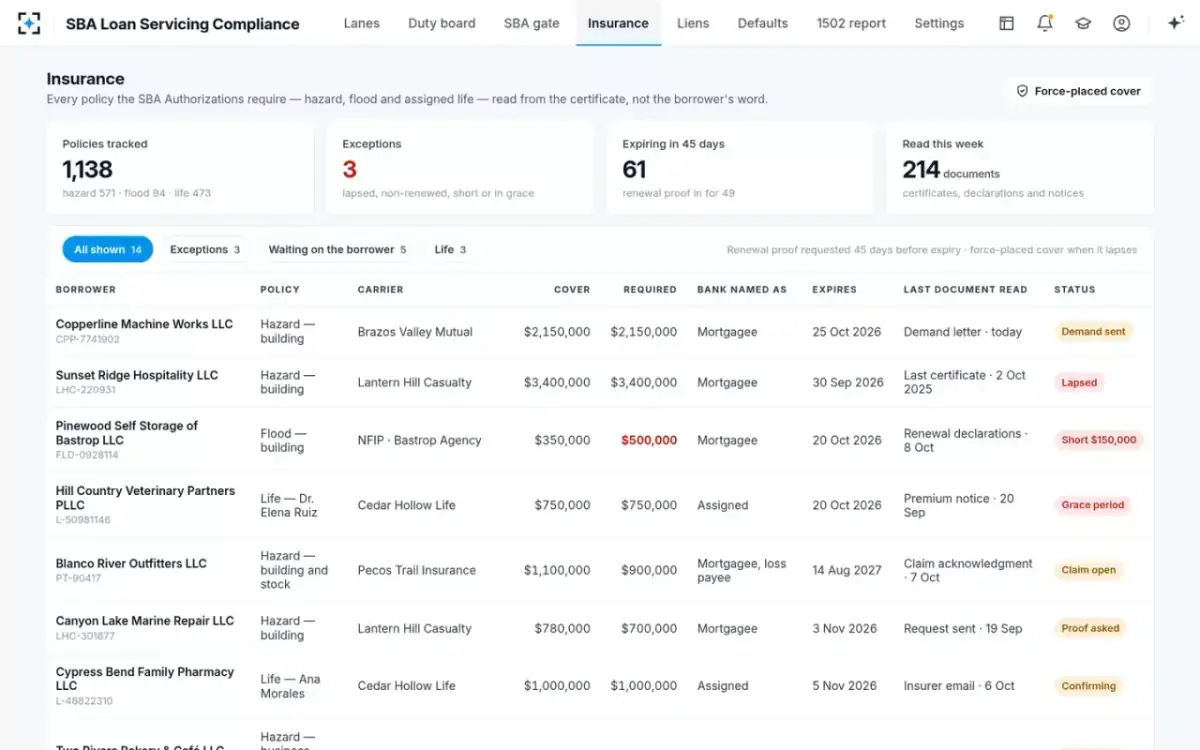
Most track the expiry date and wait for a renewal certificate; the better practice is to ask for proof before expiry and read every document the insurer sends. SBA's rule is that lenders "must monitor all 7(a) Loans to ensure that all required insurance coverage remains in force throughout the term of the Loan" (SOP 50 57 4, Ch. 3 E.5). For hazard cover, a lapse is to be met by force-placing insurance "on a case-by-case basis," the premium being a recoverable expense; for flood cover in a special flood hazard area the rule is firm: tell the borrower, and if it has not obtained adequate cover within 45 calendar days, buy it at the borrower's expense.
The documents carry more than the date. A certificate can show the bank named as loss payee when the loan requires mortgagee status, or a building insured for less than the amount required; a declarations page can show a flood limit $150,000 short, as one sample borrower's did. Life insurance, which SBA loans often require on a key owner, has its own trap: a premium notice in the grace period means the policy will lapse unless someone pays, and the SOP leaves it to the lender to decide, case by case, whether to keep it in force as a recoverable expense.
Insurance read from the certificate, not the borrower's word
What is a loan tickler system, and where does it stop?
A loan tickler system is a reminder list built into or beside the loan system: dates, owners and a prompt when each date arrives. It is the first generation, and for many SBA lenders still the main control. Its limit is that it knows dates, not documents or rules. It can remind an officer that a policy expires on 25 October; it cannot read the insurer's notice that the policy will not renew, or know that the borrower is also two payments behind and that SBA's 60-day site-visit clock started on 1 September.
A tickler also cannot tell whether a duty was done properly. A reminder marked complete says someone clicked; SBA, at purchase, wants the certificate, the UCC-3 acknowledgment, the visit report or the memo. Its lender rating looks at the same thing from the other side: SBA's qualitative factors include servicing that tracks and maintains "elements required by the Loan Authorization" (SOP 50 53 (2), Appendix 1).
What should UCC tracking software do?
At a minimum, prove each lien from the filing office's record and never let a window pass unseen; on SBA loans, also connect the lien to the loan's other duties. The checklist below is what we would ask of any product.
Nine things to ask of UCC tracking software on an SBA book
- Lapse dates from the filing office, not the closing checklist
Including amendments and continuations filed since closing.
- Alerts tied to the six-month window
When it opens, then at set points before lapse; no filing prompted before the window.
- Real estate liens kept apart
Recorded mortgages and deeds of trust do not lapse under § 9-515 and should not raise continuation duties.
- Debtor name and structure changes caught
From correspondence and filings, with a UCC-3 amendment drafted.
- Releases and substitutions reflected
Each partial release or substitution amends the collateral the statement covers.
- Collateral lists that a site visit can use
Items and serial numbers, so a post-default inventory can be checked against the lien.
- The loan's SBA status in view
Past due, in liquidation, sold or retained, with a consent request pending.
- Filings drafted, approved by a person
Who files, who approves, and the acknowledgment kept with the loan.
- Insurance alongside, from the documents
The second lapse-prone duty, read from certificates and notices.
One sample Monday's lien book: thousands of filings, a handful that need a person
Where SBA Loan Servicing Compliance sits beside a UCC tracker, and where it does not fit
SBA Loan Servicing Compliance replaces the joins, not the filing office or the core. It reads financing statements and filing records, insurance documents, payment history and each loan's terms; raises every duty with its clock and its source; and drafts the UCC-3, the insurance demand, the visit plan or the 1502 correction for an officer to approve. It does not file with a Secretary of State, bind insurance, post payments, submit the 1502 or move a loan to liquidation. Banks that already pay for a UCC search and filing service keep it; the agents use what it returns.
It is also not a fit for every book. A lender with a handful of SBA loans and one experienced officer may find a well-kept tickler enough, provided the officer reads the SOP's monitoring section once a year. The case for agents grows with the number of loans, documents and people: the sample bank's 612 loans carry 1,021 financing statements and 1,138 insurance policies. SBA's inspector general reported that two non-bank lenders' reviews kept finding the same kinds of failures, among them that lenders "did not obtain required lien positions" (SBA OIG Report 26-14), a reminder that lien control is checked by SBA, not only by the lender.
The data a system needs on day one is set out in what to load first; how a release changes the lien is in the consent check before the lien goes; and what a site visit should reconcile against it is in SBA site visit requirements. To see the lanes, the liens and the drafted filings on a sample of your own loans, start from SBA Loan Servicing Compliance.
Lien, insurance and default clocks on one lane per loan
Questions people ask
Can a UCC continuation be filed after the financing statement lapses?
No. A continuation is effective only if filed within the six months before lapse. After a lapse the lender must file a new financing statement, which generally takes priority only from its new filing date, so a creditor who filed in the meantime may rank ahead.
Do SBA real estate liens need continuations?
Generally not. Mortgages and deeds of trust are recorded in the land records and do not lapse under UCC § 9-515. Fixture filings and financing statements on equipment, inventory and receivables do.
Who files UCC continuations on SBA loans?
The lender. SOP 50 57 4 requires 7(a) lenders to monitor all UCC filings and "timely file" the documents that keep the lien perfected, including UCC-3 continuations; many lenders use a filing service, but the responsibility stays with them.
What is collateral tracking software?
It is a broader cousin of UCC tracking: software that keeps a register of collateral, its value, location, insurance and lien filings. For SBA loans the useful test is whether its collateral list can be checked against a post-default site-visit inventory item by item.
Does a debtor name change affect a UCC filing?
It can put the lien's priority at risk, so SBA tells lenders to file a UCC-3 reflecting the new name "to preserve the priority of personal property liens." A tracker should catch the change from correspondence or filings, not wait for the next lapse date.