Commercial loan servicing software is the system a lender uses after closing to post payments, accrue interest, manage escrow and produce statements for business loans; on SBA 7(a) loans it also has to carry the duties that keep SBA's guaranty valid, and that is where most systems run out. A commercial servicing system knows that a payment is late; it rarely knows that the lateness started a 60-day site-visit clock, that the loan's guaranty was sold so the next deferment needs an investor's consent, or that the borrower's request to swap collateral needs a memo citing its authority. Botminds' SBA Loan Servicing Compliance sits beside the core and supplies that half, but only if it is given the right data first. This guide is the loading order.
The examples are from the solution's fictional sample lender, Tallgrass Commerce Bank, and its 612 sample SBA loans. SBA's rules come from SOP 50 57 4 and the 7(a) Lender Matrix, version 18.
The SBA data a commercial servicing system needs, and the order to load it
Your servicing matrix and policy settings
Where it comes fromBank policy, built on SBA's 7(a) Lender Matrix
What it powersClassing every servicing request before anyone acts
LoadWeek 1
Loan list: SBA number, guaranty %, disbursement dates, delegated or not, sold or retained
Where it comes fromCore system and E-Tran
What it powersEarly default and 12-month ownership windows; investor consent on sold loans
LoadWeek 1
Payment history, transaction by transaction
Where it comes fromCore system
What it powersSite-visit clocks; the 1502 check
LoadWeek 1
Each loan's terms and conditions
Where it comes fromLoan Authorization or E-Tran Terms and Conditions
What it powersDated duties: insurance amounts, statements, conditions
LoadWeek 2
Insurance certificates, declarations and assignments
Where it comes fromLoan file, insurers and agents
What it powersCover against required, bank named, expiry
LoadWeek 2
UCC financing statements and recorded liens
Where it comes fromLoan file and filing offices
What it powersLapse dates and continuation windows
LoadWeek 2
Obligors, owners and their percentages
Where it comes fromLoan file and E-Tran
What it powersGuarantor releases, 20% owner rule, ownership changes
LoadWeek 3
Collateral lists with serial numbers
Where it comes fromClosing file, appraisals
What it powersRelease tests and the post-default inventory
LoadWeek 3
Recent 1502 reports and open servicing actions
Where it comes fromLoan operations and the loan file
What it powersBaseline differences and memo gaps
LoadWeek 3
What is commercial loan servicing software, and what does it miss on SBA loans?
Commercial loan servicing software, sometimes sold as a commercial loan management system, holds the money side of a business loan after closing: the payment schedule, interest accrual, fees, escrow, statements, collections queues and the general ledger entries. It is built for the obligations the lender owes itself and the borrower. An SBA 7(a) loan adds obligations the lender owes SBA, and those are not money fields.
SOP 50 57 4 lists them under the lender's monitoring duty: watch for name, address and legal structure changes; monitor creditworthiness and request financial statements; "monitor all UCC filings"; keep taxes and senior liens from eroding the collateral; and "monitor all 7(a) Loans to ensure that all required insurance coverage remains in force throughout the term of the Loan" (SOP 50 57 4, Ch. 3 E). Add the 1502 report, the servicing actions that need consent, and the post-default site visit, and the SBA half of servicing is a set of dated duties driven by documents the core system never reads.
That is why the loading order matters. Load balances first and you have a second copy of the core. Load the matrix, the terms and the documents first and you have the duties.
What data does SBA servicing software need?
It needs nine kinds of data: the bank's servicing matrix, a loan list with the SBA-specific fields, transaction-level payment history, each loan's terms and conditions, insurance documents, lien filings, obligors and ownership, collateral lists, and the recent 1502 reports and open servicing actions. The table above sets them in the order we load them; three of them decide whether the rest work.
The loan list needs fields a core system often lacks or holds loosely: the SBA loan number as well as the bank's, the guaranty percentage, the initial and final disbursement dates, whether the loan was approved under delegated authority, and whether the guaranteed portion has been sold. Each changes a rule. The disbursement dates set the 18-month early default window and the 12-month ownership window. The sale status decides whether an investor must consent. The delegated flag decides where a loan increase is approved.
What 612 sample SBA loans carry besides their balances
Load first: can the SBA servicing matrix be configured in software?
Yes, and it should be the first thing loaded, because every servicing request is classed against it. SBA's own matrix is a reference table, not a rule: its disclaimer says that if it conflicts with a Loan Program Requirement, "the Loan Program Requirement will prevail" (7(a) Lender Matrix, version 18). The bank's matrix is the policy that sits on top of it: SBA's classes, plus any line the bank chooses to draw more tightly.
Configured well, the matrix is a set of versioned rules, each with an action, the condition that triggers it, a class and the signatures it needs. The sample bank's revision 4 has ten rules, R1 to R10, and is stricter than SBA's in places: SBA lists releasing or substituting collateral as needing no notification, while the bank sends a release below fair value or during a payment default to SBA and asks for a notice on substitutions. Only its SBA servicing manager can change a rule, and each change is versioned. The SBA servicing action matrix goes through the classes action by action.
Version matters because SBA judges each action against the SOP in force on the day it was taken. A matrix loaded once and never revised quietly drifts from SBA's; the matrix itself was updated to version 18 on 18 December 2025, seven weeks after SOP 50 57 4 took effect.
Each loan's terms and conditions, turned into dated duties
Every SBA loan carries its own servicing conditions, and they live in the Loan Authorization or, for newer loans, the E-Tran Terms and Conditions. SBA's matrix notes that "Loan Authorizations are not required for Loans approved after 8/1/2023"; for those loans SBA relies on the terms and conditions held in E-Tran, and SOP 50 10 8.1 now calls them SBA Terms and Conditions. A servicing system has to read whichever the loan has.
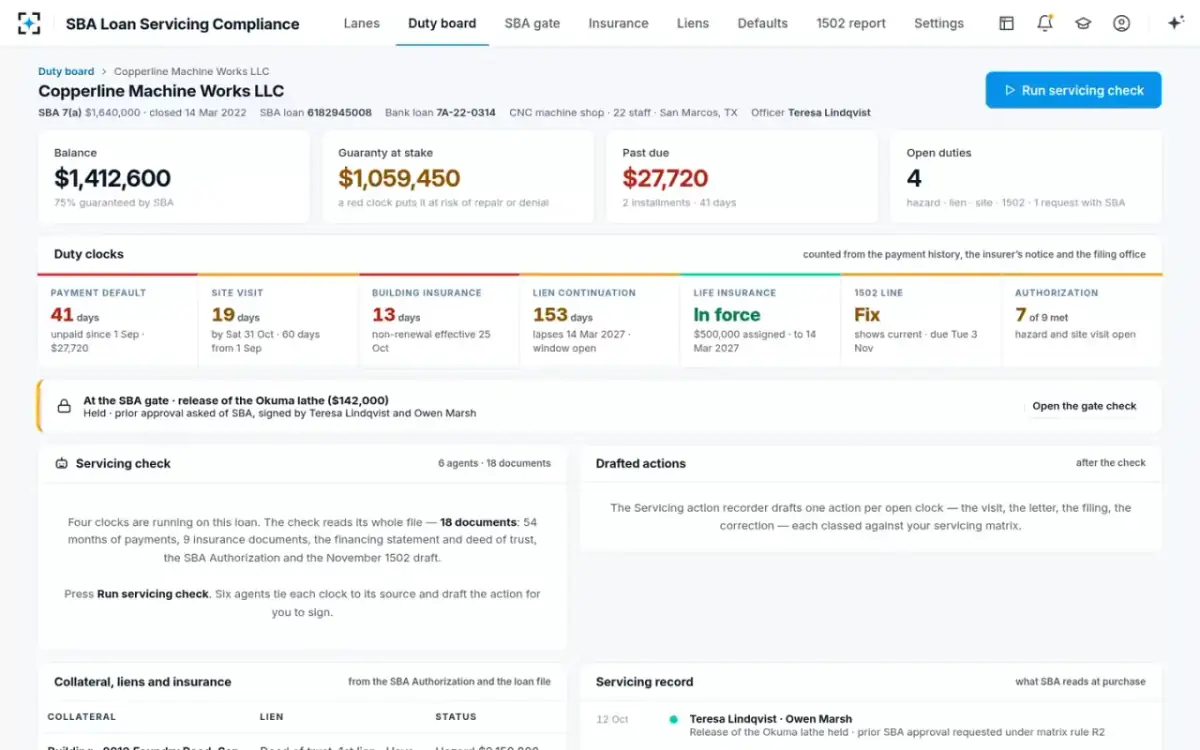
The conditions that turn into duties are concrete: hazard insurance on the building at full replacement cost naming the lender, life insurance assigned on the principal in the amount of the collateral shortfall, annual financial statements within a set period of the fiscal year end, flood cover in a special flood hazard area. The sample loan Copperline Machine Works has nine; on 12 October seven were met and two were open, hazard cover on the building and the site visit after default.
A loan's duties read from its own documents, with a clock on each
Payment history beats a status flag
Load transaction-level payment history, not the core's delinquency status. The two disagree more often than a system owner expects, and when they do, the history is right. In the sample book, the core's delinquency flag on Copperline was not updated after its 1 September payment bounced, so the November 1502 draft reported the loan as current; the same stale flag sat on Granite Lane Auto Repair.
The cost of trusting the flag is not only a wrong 1502 line. SBA's site-visit clock runs "within 60 calendar days of an uncured payment Default" (SOP 50 57 4, Ch. 16), and a clock started from a flag that never flipped never starts. Reading 54 months of Copperline's payments put its first unpaid due date at 1 September and its visit deadline at 31 October, whatever the core said.
Insurance and liens: the dates that lapse quietly
Insurance and lien filings are the two inputs that expire without anyone acting, so they need the documents, not just the dates. A UCC financing statement "is effective for a period of five years after the date of filing," and a continuation "may be filed only within six months before" that lapse (UCC § 9-515). A lapse makes the security interest unperfected and, against a purchaser for value, "deemed never to have been perfected."
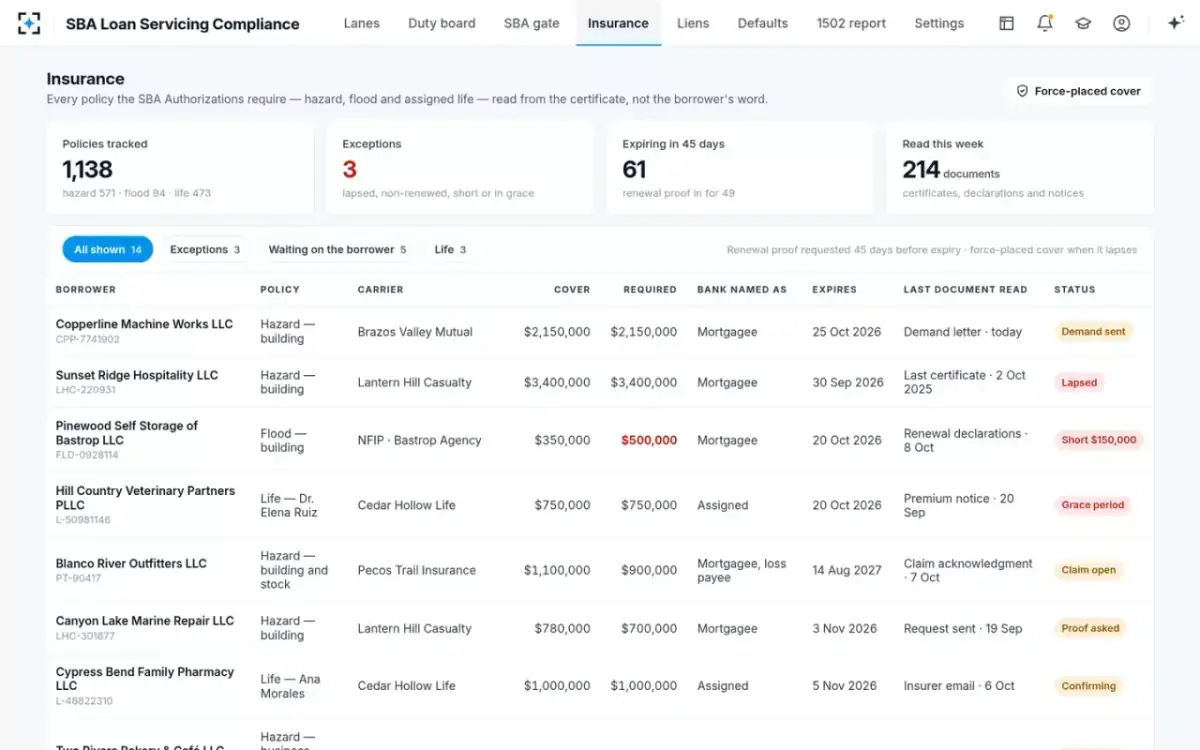
Insurance moves on its own schedule and through other people's documents: certificates from agents, declarations pages, renewal and non-renewal notices from insurers. SOP 50 57 4 asks lenders to force-place hazard cover where a lapse warrants it, "on a case-by-case basis," and is firmer on flood: if collateral in a special flood hazard area lacks adequate cover, the lender must tell the borrower to obtain it and, if the borrower fails to within 45 calendar days, "must purchase flood insurance on the Borrower's behalf" (SOP 50 57 4, Ch. 9).
Every policy read from the certificate: cover against required, and the bank's position
Load liens with their filing office, file number and filing date, and separate recorded real estate liens, which do not lapse, from UCC filings, which do. The sample book's 1,021 financing statements produced 38 open continuation windows on 12 October, 32 already filed and one, Rio Frio Tortilleria's, lapsing in 21 days with nothing filed. UCC tracking software and what came after it covers the lien half in depth.
What changes for SBA loans sold on the secondary market?
A sold loan brings a second party with consent rights, a monthly remittance clock and a prepayment notice rule, so the sale status has to be loaded with the loan list. Under the Secondary Participation Guaranty Agreement, SBA Form 1086, the repayment terms of a sold note may not change without the investor's written consent unless SBA or the lender has repurchased the guaranteed portion, apart from "a one-time deferment that does not exceed a continuous period of three monthly installments" (SOP 50 57 4, Ch. 7).
Four rules that apply only once the guaranty has been sold
3rd
day of the next month by which the guaranteed share of payments reaches the fiscal transfer agent, with the 1502
3mo
longest single deferment without the investor's written consent
20%
prepayment of the unpaid balance above which the agent must be told in writing
30days
investor silence after which a lender may ask SBA to let it repurchase
Those four rules change what the matrix returns. A deferment request on a retained loan is the lender's call for up to six months; on a sold loan the second request goes to the investor through the fiscal transfer agent. How a deferment can create an early default follows one such request through.
Disbursement dates and ownership: the windows that change the rules
Some SBA rules switch on and off with the loan's age, so dates loaded wrongly produce wrong answers months later. Three windows matter most. A default or a deferment of more than three consecutive payments within 18 months of disbursement (of final disbursement, if it came more than six months after the first) is an Early Default. A loan becomes "Seasoned" only after that period passes cleanly, and a guarantor can be released, with SBA's consent, only on a Seasoned loan. And any change in the borrower's ownership, "including a change in percentage of ownership," needs SBA's prior approval for 12 months after final disbursement.
Ownership data has to come with percentages, because SBA requires guaranties from anyone owning 20% or more and the release rules turn on them. The same data feeds a check SBA added for new obligors: in an assumption or a guarantor substitution, new obligors must meet the citizenship requirements of the SOP 50 10 in force at the time of the action.
How long does loan servicing software take to implement?
No regulator publishes a benchmark, and the honest answer is that it takes as long as the lender's documents take to reach the system. Our plan for SBA Loan Servicing Compliance runs in three weeks of loading on a sample of loans, then a period of nightly checks beside the bank's own process before anything depends on them. The table shows what we check before moving on.
Three weeks of loading, and the check that ends each one
| Week | What is loaded | Check before moving on |
|---|---|---|
| 1 | Matrix and policy settings; loan list with SBA fields; payment history | Every loan has a disbursement date, a guaranty percentage and a sale status; the payment history reconciles to the core's balances. |
| 2 | Terms and conditions; insurance documents; lien filings | Every loan's required insurance has a document behind it, or a named exception; every UCC filing has a lapse date. |
| 3 | Obligors and ownership; collateral lists; recent 1502 reports; open servicing actions | The first 1502 check runs against last month's submitted report, and the differences are explained. |
The slow part is almost never the software. It is finding the current certificate for a policy that renewed last spring, or the file number for a financing statement filed by a predecessor bank. A trial on a few dozen loans surfaces those gaps before they become a project plan.
Data traps to clear before go-live
Five traps account for most bad clocks, and each is cheaper to fix in the source than in the servicing system.
Five data traps that start the wrong SBA clock
- Delinquency flags instead of payment history
A flag that lags a bounced payment delays the site-visit clock and puts a wrong status on the 1502.
- One date for disbursement
SBA counts some windows from final disbursement if it came more than six months after the first; load both dates.
- Sale status missing on older loans
Without it, a second deferment on a sold loan looks like the lender's own call.
- Insurance dates without documents
An expiry date keyed from an email is not proof of cover; the borrower's own statement is not either.
- Lien dates from the closing checklist
Use the filing office's record. A financing statement amended after a name change or a release may not match the original.
The prize for clearing them is a book where every duty has a document behind it. SBA's inspector general has warned that "most loan documents and data reside only with the participating lender" (SBA OIG Report 26-01), and SBA reserves the right, under 13 CFR 120.524, to recover guaranty payments "at any time" if a servicing failure comes to light later. To load a sample of your own loans, start from SBA Loan Servicing Compliance.
Questions people ask
What is the difference between commercial loan management software and loan servicing software?
The terms overlap, and vendors use them loosely. Management software often spans origination, portfolio monitoring and servicing; servicing software focuses on the loan after closing. On SBA loans neither, by itself, usually covers the post-closing SBA duties: consent actions, site visits and the documented reason for each action.
Can the SBA data come straight from E-Tran?
Partly. E-Tran holds SBA's view of each loan, including the terms and conditions SBA relies on for loans approved after 1 August 2023, and lenders use E-Tran Servicing for many changes. Payment history, insurance and lien documents still come from the lender's own systems and files.
Do loans in liquidation belong in the servicing system?
Yes, until SBA purchases the guaranty they stay on the monthly 1502, and the post-default duties, from the site visit to the liquidation plan, are the most time-critical ones. After purchase, the lender reports each loan's status to SBA every six months until the wrap-up report.
What if a loan's documents cannot be found?
Record the gap as an open duty with an owner, not as a blank field. For insurance, ask the borrower's agent for a current certificate; for liens, search the filing office; a missing Loan Authorization can be read from the E-Tran terms and conditions SBA holds.
Does the servicing system need the 504 loans too?
The duties described here are for 7(a) loans under SOP 50 57. 504 loans are serviced by certified development companies under their own SOP and consent rules, such as SBA's prior consent for a CDC releasing collateral worth more than 10% of the debenture or $10,000, whichever is less.