An SBA loan deferment lets a 7(a) lender postpone a borrower's delinquent or future payments, in full or in part, for a stated period without accelerating the note or moving the loan to liquidation (13 CFR 120.530). On a loan the lender has kept, SOP 50 57 4 allows "payment deferments of up to six consecutive months," generally no more than six cumulative payments or 20% of the original loan, whichever is less; on a loan whose guaranty was sold, "only one payment deferment of up to three consecutive months without the prior written consent of the investor" (SOP 50 57 4, Ch. 12). The catch is the 18-month rule: a deferment of more than three consecutive scheduled payments in a loan's first 18 months is itself an Early Default. Botminds' SBA Loan Servicing Compliance reads the disbursement dates and the sale status before a deferment request reaches an officer, so the relief is granted knowing what it costs.
The loan followed below is illustrative arithmetic, not a sample or customer loan; the screens come from the solution's fictional sample lender, Tallgrass Commerce Bank.
One deferment request on an illustrative young loan, from request to purchase review
Agent
Reads the loan's age and sale statusA $600,000 loan, 75% guaranteed, fully disbursed 1 March 2026 and retained. On 7 December 2026 the borrower asks to defer four payments. The 18-month window runs to 1 September 2027.
Never: Grants or refuses the request.
Agent
Counts the consecutive paymentsFour consecutive deferred payments inside the window would make the loan an Early Default under SOP 50 57 4, Chapter 2; three would not. Interest keeps accruing and may not be capitalised.
Never: Rounds a partial deferment up or down; it reports both cases.
A person decides
Officer decides, and writes the memoFinds the cash flow problem temporary from current statements and a cash-flow plan, grants three months of interest-only payments with a catch-up schedule, and records the finding, the consideration, every obligor's consent and the authority.
Agent
Watches the borrower through the defermentTracks the reduced payments, the end date and the window; raises a review a month before the deferment ends.
Never: Extends the deferment.
A person decides
At the end: resume, restructure or liquidateIf the problem proves permanent and the loan is more than 60 days past due, the SOP points to liquidation rather than another deferment.
How long can an SBA loan payment be deferred?
On a 7(a) loan the lender has not sold, up to six consecutive months on the lender's own authority; beyond six months only with a written repayment strategy; and generally no more than six cumulative monthly payments or 20% of the original loan amount, whichever is less. On a sold loan, one deferment of up to three consecutive months without the investor's written consent, and nothing more without it.
SBA 7(a) deferment limits, retained and sold
| Rule | Loan the lender has kept | Loan whose guaranty was sold |
|---|---|---|
| Longest deferment on the lender's own authority | Six consecutive months | One deferment of up to three consecutive months |
| Beyond that | A documented loan repayment strategy to justify more than six months | The investor's prior written consent, through the fiscal transfer agent |
| General cumulative cap | Six monthly payments or 20% of the original loan, whichever is less | Same SOP guidance; SBA's matrix puts the investor line at deferments over 90 days cumulative |
| Notice | None required by SBA's matrix | SOP 50 57 4 asks lenders to notify the agent and the SBA loan center in writing |
| Payment frequency | May change, for example monthly to quarterly for a seasonal business | May not change |
| Interest during the deferment | Accrues; may not be capitalised | Accrues; may not be capitalised |
The SOP's starting point is diagnostic, not numerical: "A deferment is a temporary solution to a temporary problem." Used on a borrower whose problems are permanent, it warns, a deferment "can harm the Borrower, Lender and/or SBA," for example while "the Obligors deplete all their resources, including the money in their retirement accounts and the equity in their homes, in a futile attempt to turnaround a non-viable business."
When does a deferment run into the early-default window?
An Early Default is a default that happens within 18 months of a loan's initial disbursement, or of its final disbursement if that came more than six months after the first, unless the borrower cures it and then pays as scheduled for 12 months after the 18-month period. SOP 50 57 4 lists four kinds of default that count: a missed scheduled payment of principal and interest; using collateral sale proceeds rather than business cash flow to make a scheduled payment; "Lender deferment or Borrower curing of defaulted payments equal to more than three consecutive scheduled payments of principal and interest"; and any other default that requires the loan to be put in liquidation, such as bankruptcy (SOP 50 57 4, Ch. 2).
The four numbers that decide whether relief becomes an Early Default
18mo
from initial, or late final, disbursement: the Early Default window
More than 3
consecutive scheduled payments deferred inside the window
12mo
of scheduled payments after the window that cure an Early Default
6mo
after initial disbursement: a final disbursement later than this restarts the window
The 18 months are not arbitrary. SBA's inspector general runs a high-risk review program aimed at "high-dollar/early-defaulted 7(a) loans" (SBA OIG Report 19-22), and a peer-reviewed survival analysis of 7(a) loans finds default risk peaking in a loan's second year (Glennon and Nigro, 2005); SBA's site visit requirements shows how much post-default work falls in that same period.
Does a deferment trigger early default?
It does if the lender defers more than three consecutive scheduled payments of principal and interest inside the 18-month window. Three is safe; four is not. A deferment granted in month 20 of a loan's life cannot create an Early Default, however long it is, and one granted in month 9 can.
The wording leaves three practical questions, and they are where files go wrong. First, the test counts deferred payments, not deferment months, so a quarterly-pay loan reaches four payments far later than a monthly one. Second, the definition covers a borrower "curing of defaulted payments" equal to more than three consecutive payments, so a borrower who falls four payments behind and then catches up in a lump sum has created the same condition as a lender who deferred four. Third, an interest-only arrangement is still a deferment of principal; whether a partial deferment counts as deferring a "scheduled payment of principal and interest" is not defined in the SOP, and a careful lender documents its reading rather than assuming the favourable one.
A deferment that keeps a borrower alive in month nine can also change, years later, what SBA is entitled to presume about how the loan was made.
What happens at purchase on an early default?
On an Early Default, SBA's purchase review looks back past servicing to how the loan was made and closed, and several failures that would otherwise justify a repair justify a full denial. SOP 50 57 4 gives three examples: a full denial is justified if the lender's failure to make or close the loan prudently "contributed to or allowed an Early Default," unless the lender shows the business failed for unrelated reasons; if the lender cannot show it verified the borrower's financial information against IRS tax transcripts; and if it cannot document a required equity injection, which "raises a rebuttable presumption that the Early Default was caused by the absence of the required equity injection" (SOP 50 57 4, Ch. 25 G.3, G.4, G.6).
For a servicing desk, the point is not to relitigate the closing file but to know what a deferment does to it. The officer who grants a fourth consecutive payment in month nine has not made the loan worse, but has moved it into the category where SBA reads the origination file most closely. If that file is strong, the deferment costs little; if the equity injection was evidenced only by a gift letter, the deferment has turned a closing weakness into a likely denial should the borrower fail.
There is a second, quieter cost. A loan becomes "Seasoned" only if, across the 18 months and any cure period, the borrower "did not have more than three consecutive scheduled full payments deferred." A guarantor or co-borrower can be released on a loan in regular servicing only if it is Seasoned, and a limited guaranty from a partial change of ownership can be released only once the loan has been current, "not on deferral," for 12 consecutive months.
Can a sold SBA loan be deferred without investor consent?
Once, for up to three consecutive months. SOP 50 57 4: "For 7(a) Loans that Lenders have sold in the secondary market, Lenders may grant only one payment deferment of up to three consecutive months without the prior written consent of the investor," and lenders "must immediately notify the FTA and the appropriate SBA Loan Center in writing if they defer any payments" on such loans (SOP 50 57 4, Ch. 12 D.2). SBA's matrix states the investor line as deferments "over 90 days (cumulative)" and sends those requests to the fiscal transfer agent, with notice and evidence of the investor's approval to the Commercial Loan Service Center (matrix, footnote 6).
If the investor refuses, or does not answer within 30 calendar days, and the borrower's viability is at stake, the lender may ask SBA for authority to repurchase the guaranteed portion and restructure the loan itself, supported by current financial statements, the investor's refusal or the agent's statement, a statement that the change is solely for the borrower's benefit, and a certification that the lender will make it.
Sale status therefore belongs in the first check, not the last. A servicing system that treats a sold loan's second deferment like a retained loan's will grant relief the lender had no authority to give; what to load first in a servicing system puts sale status in week one for that reason.
What is the 20% deferment cap, and does interest accrue?
The cap is the lesser of six cumulative monthly payments or 20% of the original loan amount, and it binds on loans with large payments. Interest keeps accruing throughout, and the lender may not add it to principal.
The 20% cap on two illustrative loans of the same size
| Loan | Six monthly payments | 20% of the original amount | Which binds |
|---|---|---|---|
| $600,000 over 10 years, payment about $7,000 | About $42,000 | $120,000 | Six payments: about $42,000 |
| $600,000 working capital over 2 years, payment about $27,000 | About $162,000 | $120,000 | 20%: $120,000, about four and a half payments |
For the accrued interest, the SOP gives the lender four ways to collect it: during the deferment, as a lump sum at its end, through higher payments afterwards until the loan catches up with its original schedule, or by resuming the old payment, applying it to interest first, and extending the maturity by up to ten years. It rules out a fifth: "Lenders may not capitalize or add accrued interest to the principal balance of the Loan." Payments during the deferment are optional but preferred; "even a small payment, such as $1.00, will keep the Borrower in the habit of making payments."
When a deferment is the wrong tool
A deferment is wrong when the problem is permanent. The SOP is direct: "When a 7(a) Loan is more than 60 calendar days past due and the Borrower's problems appear to be permanent or long-term, Lenders should not grant a deferment," but should move the loan to liquidation and pursue a workout, collateral liquidation or a compromise (SOP 50 57 4, Ch. 12 C.2).
The distinction is a judgment, and it is the officer's. What software can do is put the evidence in front of the officer at the moment of the request: how long the loan has been past due, whether the site-visit clock is already running, whether payments have been funded from collateral sales, how the business's statements compare with last year's. A deferment granted on day 55 of a payment default, on a borrower whose stockroom burned, is a different decision from one granted on day 5 to a seasonal business with a full order book. For a borrower on active military duty, the SOP adds a further check: the Servicemembers Civil Relief Act may change what the lender can do.
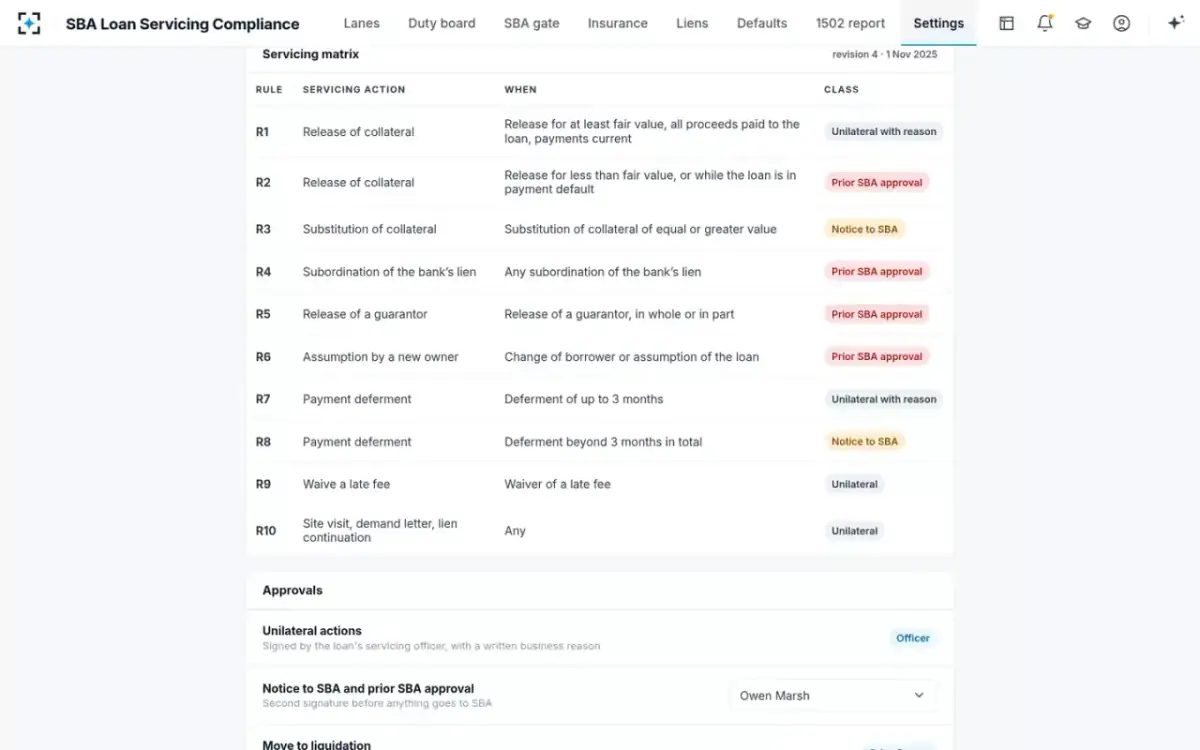
SBA Loan Servicing Compliance classes deferments against the bank's own matrix
What the deferment memo must show
A deferment is a unilateral Loan Action, so it needs the same written justification as any other, plus three items specific to it. SOP 50 57 4 makes consideration a condition of every loan action, and gives a deferment as its example: "adequate consideration for a routine Loan Action such as a temporary payment deferment can include requiring the Borrower to provide updated financial information" (SOP 50 57 4, Ch. 6).
A deferment memo SBA can accept at purchase
- The finding that the cash flow problem is temporary
With the financial statements reviewed and why the borrower is viable.
- The loan's age and the count of consecutive deferred payments
Whether the loan is inside its 18-month window, and whether this deferment takes it past three payments.
- Sale status, and the investor's consent where needed
With the written notice to the fiscal transfer agent and the SBA loan center on a sold loan.
- Consideration received
Updated financial information at the least; any cure of other defaults, such as lapsed insurance or late statements.
- Every obligor's written consent
Guarantors included, to protect the right to recover from them.
- How the accrued interest will be collected
One of the SOP's four methods; never capitalised.
- The repayment strategy, if over six months
Required before an additional deferment on a retained loan.
- The authority
SOP 50 57 4, Chapter 12, and 13 CFR 120.530.
Most of that list can be assembled before the officer opens the request: the dates, the count, the sale status, the obligors, the documents on file. The finding and the signature cannot. SBA does not need to approve a deferment, but under 13 CFR 120.524 it can later find that a loan was not serviced prudently, and the memo is the lender's answer. The SBA servicing action matrix sets deferments beside the other actions a lender takes alone; to see the window counted on a sample of your own loans, start from SBA Loan Servicing Compliance.
Questions people ask
Is an SBA deferment the same as forbearance?
In SBA's servicing SOP the term is deferment: postponing payments without accelerating the note or moving the loan to liquidation, under 13 CFR 120.530. A broader restructuring of a defaulted loan is a workout, which SOP 50 57 4 covers in its own chapter.
Does a deferment have to be reported on the 1502?
The 1502 reports each loan's status and balances; a properly granted deferment means the deferred payments are not past due. The lender should report the loan in line with the deferment agreement and keep the agreement on file, since SBA reads it at any later purchase.
Can a borrower get a second SBA deferment?
On a retained loan, yes, within the six-month limit, or beyond it with a documented repayment strategy. On a sold loan, any deferment after the first three-month one needs the investor's written consent through the fiscal transfer agent.
Do EIDL deferment rules apply to 7(a) loans?
No. COVID EIDL and disaster loans are direct SBA loans with their own relief programs; 7(a) loans are made and serviced by lenders under SOP 50 57 4, and their deferments are the lender's decision within its rules.
Can a lender charge a fee for granting a deferment?
SOP 50 57 4 does not list a deferment fee. Permitted fees, such as late fees and extraordinary servicing fees, are set by the SOP 50 10 in force when the loan was approved, and an extraordinary servicing fee under 13 CFR 120.221 needs SBA's prior approval.