SBA loan servicing requirements land on one seat at the lender, the servicing specialist, who keeps the lender's 7(a) loans in good standing after they close: the monthly Form 1502 report, the hazard, flood and life insurance the loan requires, the UCC continuations, the servicing actions that need SBA's consent, and a site visit within 60 days of an uncured payment default. The seat is hard because none of these duties arrives as a task. Each one is a date buried in the loan's documents, and SBA checks the work only when the loan defaults and the lender asks it to honour the guaranty. Botminds' SBA Loan Servicing Compliance exists for that gap: it puts a clock on every duty, has agents read the documents and draft the work, and leaves the decisions and signatures with the specialist and the manager.
The examples come from a fictional sample lender, Tallgrass Commerce Bank in Austin, as its 612 SBA 7(a) loans run through the solution on Monday 12 October 2026; every person and borrower named is invented. The rules are SBA's own, chiefly SOP 50 57 4, the 7(a) servicing and liquidation SOP in force since 1 November 2025, and they are linked where they appear.
Four seats on one SBA book, before and after agents
Today
Keeps 214 loans' duties in core ticklers and a spreadsheet, reads insurance certificates by eye, and learns of a lapsed policy when the borrower defaults.
With agents
Starts each day on lanes where every duty has a clock, opens the document behind any red one, and signs actions the agents drafted with their reasons.
Still theirs: Every servicing decision, and the signature on each action.
Today
Owns the policy and the SBA reviews, and has to prove after the fact that nothing slipped.
With agents
Second-signs every action that needs notice to SBA or its prior approval, and sees each action with its class, reason and signatures.
Still theirs: The servicing matrix itself, and the second signature.
Today
Builds the monthly 1502 from the core and trusts its delinquency flags.
With agents
Gets a draft checked line by line against the payment history, with each difference shown in both values.
Still theirs: Correcting and submitting the 1502.
Today
Hears about a default when the file lands on the desk, often weeks into the 60 days.
With agents
Sees every defaulted loan on its clock from the day the payment was missed, with free dates and what each visit must cover.
Still theirs: The visit, the inventory and the move to liquidation.
What does an SBA loan servicing specialist do?
An SBA loan servicing specialist watches each 7(a) loan for change, keeps the lien, the insurance and the reporting current, decides the borrower's requests within the authority SBA gives the lender, and writes down why. SOP 50 57 4 states the scope bluntly: lenders must service and liquidate "the entire debt owed on each 7(a) Loan—not just the Lender's portion—regardless of the guaranteed percentage or whether the guaranty has been purchased" (SOP 50 57 4, Ch. 3).
The SOP's monitoring paragraph reads like a job description. After closing, it says, "changes often occur that can impact the ability to administer or collect the Loan": a borrower's name change, a move, a merger, a weaker balance sheet, unpaid real estate taxes that become a senior lien. The specialist is expected to catch each one and act: file a UCC-3 when a name changes, require a new legal entity to assume the loan formally, collect the life insurance when an owner dies, and ask for IRS Form 4506-C or 8821 transcripts when a borrower's figures raise concerns.
Then come the clocks. Twelve duties recur on almost every SBA desk, and each has its own trigger and deadline. None of them is a quarterly review that can be batched; they fall due loan by loan, whenever a payment bounces, a policy renews or a filing turns five.
Twelve standing duties of an SBA servicing desk, and the clock on each
| Duty | Where the rule sits | The clock |
|---|---|---|
| Monthly 1502 report | SOP 50 57 4, Ch. 3 F.1 | Every month, through SBA's fiscal transfer agent |
| Guaranteed-portion remittance on sold loans | SOP 50 57 4, Ch. 4 C.1 | With the 1502, by the third day of the next month |
| Lender's annual service fee | 13 CFR 120.220; Info Notice 5000-881797 | 0.55% of the guaranteed balance, paid monthly with the 1502 |
| Required insurance in force | SOP 50 57 4, Ch. 3 E.5 and Ch. 9 | Life of the loan; flood cover force-placed if the borrower has not cured in 45 days |
| UCC continuation | SOP 50 57 4, Ch. 3 E.3; UCC 9-515 | Only in the six months before the five-year lapse |
| Taxes, assessments and senior liens | SOP 50 57 4, Ch. 3 E.4 and E.6 | As each falls due |
| Financial statements | SOP 50 57 4, Ch. 3 E.2 | As the loan documents require; reviewed "in a timely manner" |
| Servicing requests needing SBA consent | SOP 50 57 4, Ch. 6; 13 CFR 120.541 | SBA aims to answer in 15 business days; silence is not approval |
| Site visit after a payment default | SOP 50 57 4, Ch. 16 A.1 | Within 60 calendar days |
| Site visit after a non-payment default | SOP 50 57 4, Ch. 16 A.2 | Within 15 calendar days of the event that puts the loan in liquidation |
| Status report after SBA buys a sold loan | SOP 50 57 4, Ch. 3 F.3 | 15 business days, then every six months |
| Wrap-up report | SOP 50 57 4, Ch. 3 F.6 | 30 days after liquidation ends, and within 24 months of purchase |
The matrix of which actions the specialist may take alone, which need notice to SBA and which need SBA's prior written approval is a subject of its own; the SBA servicing action matrix divides it action by action.
The prudent servicing standard: what "no less diligently" asks of SBA loans
The standard is a comparison, not a checklist: SBA loans must be serviced at least as carefully as the lender's own loans. The regulation reads: "Lenders and CDCs must service 7(a) and 504 loans in their portfolio no less diligently than their non-SBA portfolio, and in a commercially reasonable manner, consistent with prudent lending standards, and in accordance with Loan Program Requirements" (13 CFR 120.535(a)). A lender with no non-SBA book must meet "the same prudent lending standards for loan servicing followed by commercial lenders on loans without a government guarantee."
Two other rules turn the standard into paperwork. Every action that does not need SBA's consent still needs a written reason: lenders "must document the justifications for their decisions and retain these and supporting documents in their file for future SBA review" (13 CFR 120.536(c)). And a lender that fails "to make, close, service, or liquidate a loan in a prudent manner" is one of the ten events that release SBA from its guaranty, in whole or in part (13 CFR 120.524(a)(2)).
The comparison has a practical edge. A specialist who would force-place hazard cover on a conventional commercial mortgage within days of a lapse, but lets an SBA borrower's lapse ride for a month, is servicing the SBA loan less diligently by the lender's own measure. SBA does not need a rule for each case; it needs the lender's own practice and the file.
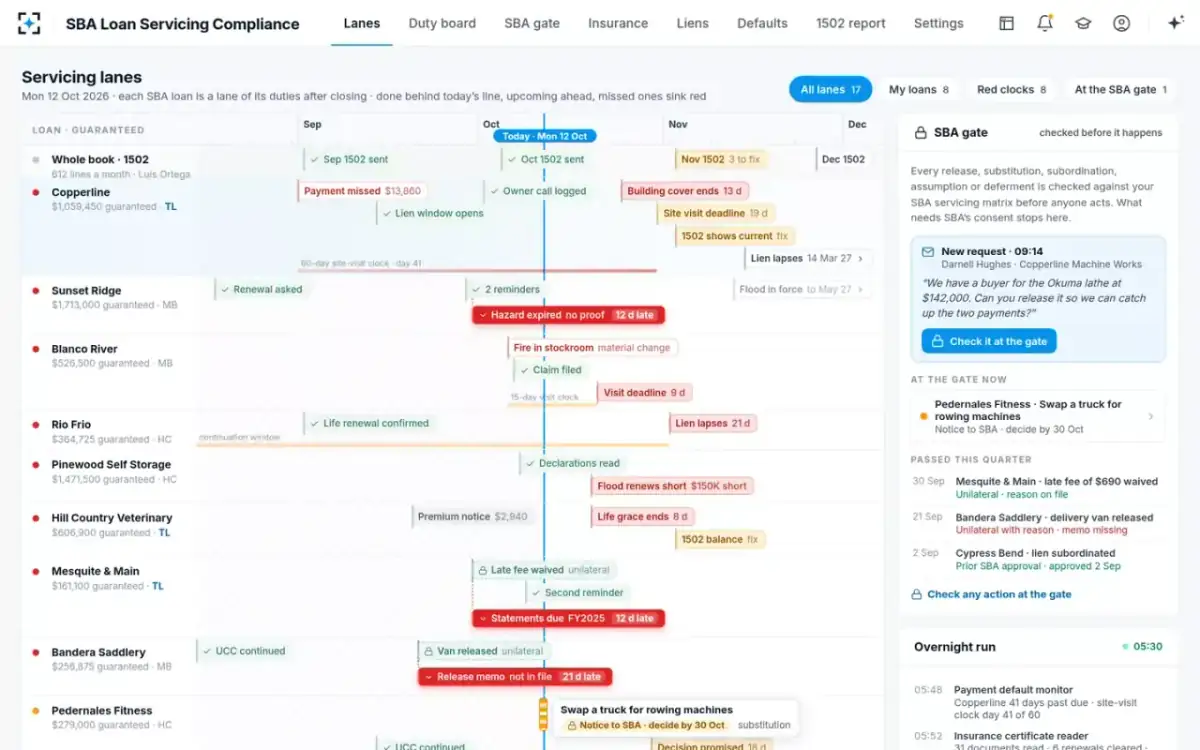
SBA Loan Servicing Compliance draws each loan as a lane of its duties
Who holds the SBA servicing seat at a lender?
There is no federal occupation called SBA loan servicing specialist. The Bureau of Labor Statistics files the work under its loan occupations, and none of O*NET's task statements for loan officers mentions SBA or small business lending (O*NET 13-2072.00). The seat is a bank title, filled by loan officers, credit analysts or loan administration staff depending on the lender.
The seat holds two kinds of work. Watching dates, chasing certificates and keying the 1502 is clerk's work; deciding whether a borrower is viable enough for a deferment, or whether a release price meets SBA's test, is a loan officer's. BLS expects technology to press on the first half: "the increased use of productivity-enhancing technology in loan processing" is expected to slow loan officer employment growth, and the same handbook says it will "limit demand" for loan interviewers and clerks (BLS).
Why most SBA lenders cannot staff a specialist desk
Most SBA lenders make too few loans to keep a specialist busy. In SBA's own loan file for fiscal year 2025, 1,336 distinct lender names approved 7(a) loans; 711 of them approved five or fewer, while the ten largest made 50.2% of all loans (SBA 7(a) FOIA data, our count from lender names, which may slightly overstate the number of distinct lenders).
For an occasional lender the duties are the same per loan, but the practice is thin. A banker who handles one post-default site visit a year will not remember that the inventory must list the serial number of every item worth $10,000 or more, or that a release of a co-borrower needs SBA's written consent. The knowledge sits in the SOP and in whoever last did it.
SBA's inspector general has named a related risk from the other side. In its fiscal 2026 report on management challenges it noted that "most loan documents and data reside only with the participating lender, which could be problematic if that lender dissolves or ceases to service the loan" (SBA OIG Report 26-01). The servicing file is the only place the work is proven, and for most lenders it is kept by very few people.
How many SBA loans can one servicing officer handle?
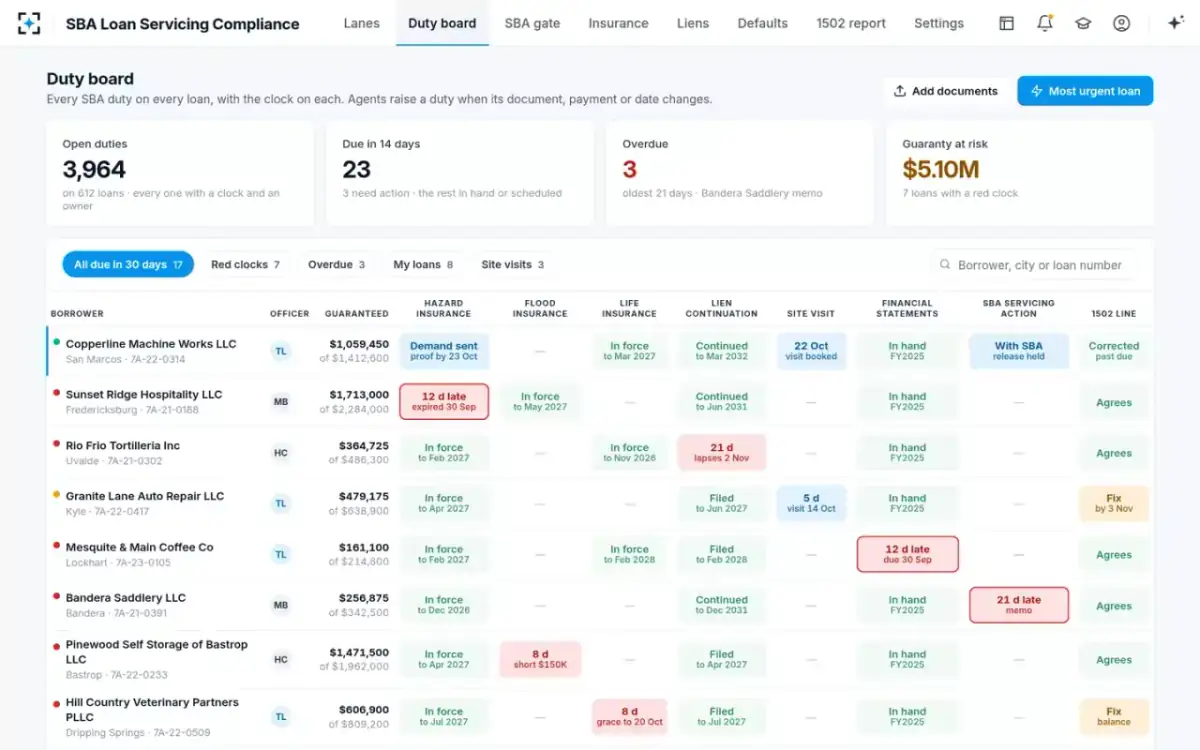
SBA publishes no ratio, and loan count is the wrong unit: the load is the number of open duties and how many of them need judgment. In the sample book, 612 loans carry 3,964 open duties, about six and a half per loan, each with a clock and an owner. Teresa Lindqvist, the senior servicing officer, holds 214 of the loans.
By our estimate for a book of about 200 SBA loans, an officer spends some 44 hours a month on the mechanical half of the job, and most of it is reading. The estimate is ours, built from the sample bank's volumes (1,138 policies, 1,021 financing statements, 612 report lines) and an assumed time per document; it is not a measured result.
Where an SBA servicing officer's month goes, by our estimate: reading, not deciding
The capacity question therefore splits. Watching, reading and drafting scale with software. Deciding does not, and the decisions per officer, not the loans per officer, are what a manager should size the team by. A book heavy with recent loans, construction draws or borrowers in deferment carries more decisions per loan than a seasoned real estate book of the same size.
The duty board: one row per loan, one column per duty
The team after agents: who watches, who decides, who signs
After agents, the servicing team divides into three jobs: software watches and drafts, the servicing officer decides and signs, and the manager co-signs anything that goes to SBA. Nothing in SBA's rules changes; what changes is which seat spends its hours on what.
In the solution, seven agents share the watching. A payment default monitor reads payment history every night and starts the 60-day site-visit clock on an uncured default. An insurance certificate reader checks each certificate, renewal and non-renewal against the loan's requirements. A lien continuation watcher tracks each financing statement's lapse date. A conditions tracker turns each loan's servicing conditions into dated duties. A 1502 report checker compares the draft report with the payment history from the 25th of each month. A consent checker classes every requested servicing action against the bank's matrix before anyone acts. And an action recorder drafts the visit, the letter, the filing or the memo, with its reason.
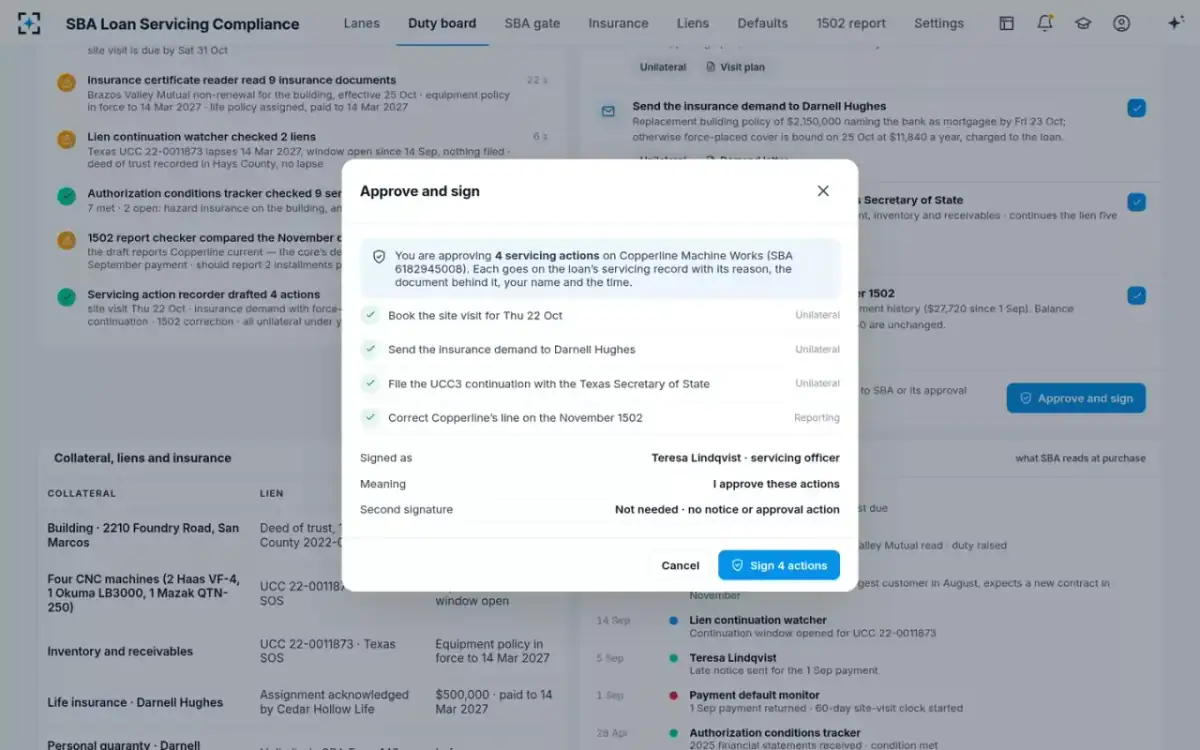
Each agent has a written limit. None files a UCC-3, submits a 1502, moves a loan to liquidation or sends anything to SBA or a borrower unsigned; a borrower's own statement never counts as proof of insurance. Those limits are what keep the signature meaningful. When Teresa signs the four actions drafted for Copperline Machine Works, a 22-person CNC shop two payments behind, the meaning is recorded with her name: "I approve these actions."
One officer signs four routine actions; nothing goes to SBA
How does AI change loan servicing teams?
AI changes where a servicing team's hours go, not who answers for the loan. The duties, the deadlines and the signature stay with the lender: SBA's rule is that "the Lender remains responsible for all loan servicing and liquidation actions until SBA honors its guarantee in full" (13 CFR 120.524(e)). SBA has issued no guidance on lenders' use of AI in servicing, so nothing a tool does can be presented to SBA as approved by it.
What moves is the reading. A specialist who used to spend a morning matching insurance certificates to loans now reviews the three exceptions the reader raised, each with the page it came from. A manager who used to sample memos at quarter end now sees that 46 of 47 actions since July have a memo on file, and which one does not. A special assets officer learns of a missed payment on day one of the 60, not day thirty.
Agents can watch every date in a loan book. Only a person can decide that a borrower is viable, and only a person's signature means anything to SBA.
The risk runs the other way too. A tool that watches most duties invites a team to stop watching the rest. The test of any servicing software is the duty it does not track, and the answer for a specialist is a written list of what the agents cover and what stays manual, reviewed when the SOP changes.
What the specialist still decides, and why SBA reads it
Judgment stays in the seat wherever the SOP says "should" rather than "must", and that is most of servicing. Force-placing hazard insurance is to be decided "based on Prudent Servicing practices on a case-by-case basis" (SOP 50 57 4, Ch. 9). A deferment needs a finding that the borrower's cash flow problem is temporary. Skipping a site visit needs a written reason why it was "neither necessary nor prudent." A release for value needs a view of the collateral's Recoverable Value.
Each of those decisions becomes what the SOP calls a Loan Action Record: the borrower and loan number, a description of the action, "the justification for the Loan Action including an analysis of any Supporting Documentation," and "a citation to the regulation or SOP provision that provides authority." An agent can assemble the documents and draft that memo. The finding inside it is the specialist's.
SBA reads those memos at the worst possible moment: when the loan has defaulted and the lender wants the guaranty paid. It applies the SOP 50 57 in effect when each servicing action was taken, and a missing or thin memo cannot be written afterwards without becoming a different kind of problem. What SBA looks for in a post-default site visit report shows how one of those memos is read at purchase.
What a missed duty costs at purchase
A missed duty costs the part of the guaranty SBA can tie to it, and sometimes all of it. SBA's usual remedy is a repair, "calculated by multiplying the dollar amount of the loss on a Loan by SBA's guaranty percentage", so a $50,000 loss on a 75% guaranty costs the lender $37,500 (SOP 50 57 4, Ch. 25). A failure that causes a total or near total loss supports a full denial.
The SOP's own examples read like a list of servicing duties. A repair or denial is justified when collateral "is either unavailable or declines in value due to the Lender's failure to conduct a timely post-Default site visit," when the lender failed to keep the required lien position, or when a servicing action gave the lender a preference over SBA. On the sample loan, Copperline's four running clocks sit on $1,059,450 of guaranty: a 75% share of a $1,412,600 balance.
The same work also feeds the lender's standing with SBA. SBA's lender rating weighs a 1502 reporting rate and a 24-month repair and denial rate among its measures, so servicing misses show up quarterly, not only at purchase; how PARRiS reads a servicing book follows those measures through. To see the lanes, the clocks and the signatures together, start from SBA Loan Servicing Compliance.
Questions people ask
Does an SBA servicing specialist have to be on the lender's staff?
No. Lenders may use Lender Service Providers for servicing work, and SBA's lender reviews look at how the lender oversees them. The responsibility does not move: under 13 CFR 120.524(e) the lender stays responsible for servicing and liquidation until SBA honours the guaranty in full.
Which SOP governs SBA 7(a) loan servicing?
SOP 50 57 4, effective 1 November 2025, which replaced SOP 50 57 3.1 of 1 December 2024. At guaranty purchase SBA applies the SOP 50 57 that was in effect when each servicing action was taken, so a long-lived loan can be judged against more than one version.
Who services the guaranteed portion after it is sold on the secondary market?
The lender still services the whole loan. SBA's fiscal transfer agent tracks payment histories, collects the lender's monthly remittance, pays investors and forwards servicing requests to them, but changes to a sold note's terms need the registered holder's written consent, apart from one deferment of up to three months.
How long must an SBA lender keep its servicing files?
Federally regulated lenders follow their own regulator's retention rules. SBA lending companies and lenders without a federal regulator must keep loan files for at least six years after the loan is paid in full or charged off (13 CFR 120.461), and anticipated litigation suspends routine destruction entirely.
What happens to servicing after SBA buys the guaranty?
The lender keeps servicing and liquidating the loan. It reports the loan's status every six months, remits SBA's share of any recovery through pay.gov within 15 business days, and must finish with an acceptable wrap-up report within 24 months of the purchase unless SBA extends the deadline.
Can SBA take a loan's servicing away from the lender?
Yes. SBA may take over the servicing, liquidation or litigation of any 7(a) loan in its sole discretion; the lender must then assign the loan documents to SBA, within 30 calendar days of notice under SOP 50 57 4, and help as asked.