SBA's lender risk rating system gives each 7(a) lender a quarterly Lender Risk Rating from 1 to 5, "with a risk rating of '1' generally reflective of lower risk to SBA, and '5' generally reflective of greater risk," built from the credit quality of the lender's SBA portfolio and other risk and program-integrity factors (SOP 50 53 (2), Ch. 2). Alongside it, SBA's Office of Credit Risk Management scores lenders with a method called PARRiS: Portfolio performance, Asset management, Regulatory compliance, Risk management and Special items. For a servicing team the system matters because several of its measures are servicing outcomes, the 1502 reporting rate and the 24-month repair and denial rate among them, and because the rating decides how closely SBA looks and whether the lender keeps its delegated authority. Botminds' SBA Loan Servicing Compliance keeps those duties on a clock, loan by loan, so the numbers SBA reads are the ones the bank already knows.
The rating rules come from SOP 50 53 (2), SBA's supervision and enforcement SOP, effective 1 January 2021, and 13 CFR Part 120; the screens show the solution's fictional sample lender, Tallgrass Commerce Bank.
PARRiS factors by the desk whose work moves them: servicing owns a large share
15 quantitative PARRiS factors
- Servicing and liquidation · 4 · 26.7%
- Portfolio outcomes · 5 · 33.3%
- Origination · 3 · 20%
- Bank condition · 3 · 20%
10 qualitative factors under Asset Management and Regulatory Compliance
- Servicing and liquidation · 4 · 40%
- Origination · 3 · 30%
- Program governance · 3 · 30%
What is the SBA lender risk rating?
The Lender Risk Rating is SBA's internal composite score for each 7(a) lender, from 1 (least risk) to 5 (most), updated quarterly and visible to the lender in SBA's Lender Portal. The regulation defines a Risk Rating as "an SBA internal composite rating assigned to individual SBA Lenders and Intermediaries that reflects the risk associated with the SBA Lender's or Intermediary's portfolio of SBA loans" (13 CFR 120.10). SBA's SOP adds that it rests on "SBA loan portfolio credit quality and other risk and program integrity related factors," and that SBA "may consider rapid growth that may skew metrics."
The rating is confidential. SOP 50 53 (2) bars lenders from disclosing their review reports, Lender Risk Ratings or other confidential information without SBA's written consent, except as the SOP allows, so a lender cannot advertise a 1 or be asked by a counterparty to show one. Its audience is SBA and the lender's own management.
What is an acceptable SBA risk rating?
A rating of 1, 2 or 3. The regulation defines an "Acceptable Risk Rating" as "an SBA-assigned Risk Rating, currently defined by SBA as '1', '2' or '3' on a scale of 1 to 5, which represents an acceptable level of risk as determined by SBA" (13 CFR 120.10). A 4 or a 5 is the SOP's own example of a lender "identified as high risk by SBA based on performance," next to a weak PARRiS score, high early default rates, rapid growth and "high 24-Month Repair/Denial Rate" (SOP 50 53 (2), Ch. 3).
SBA's lender rating system in four numbers
1–5
Lender Risk Rating, updated quarterly; 1 to 3 is acceptable
15
quantitative PARRiS factors, three under each of five components
3,100+
7(a) lenders, CDCs and microloan intermediaries SBA's credit risk office oversees
$10M
outstanding SBA loans above which lenders generally get in-depth reviews
What is a PARRiS score?
A PARRiS score is SBA's benchmarked risk score for a 7(a) lender: quantitative factors under five components are measured "against risk tolerance levels established by SBA to produce a risk score," and the lender can see its own figures, peer averages and portfolio averages for most metrics in the Lender Portal (SOP 50 53 (2), Ch. 2). The CDC equivalent is SMART.
The five PARRiS components and their quantitative factors
| Component | Quantitative factors | Qualitative factors a servicing desk feeds |
|---|---|---|
| P · Portfolio Performance | 5-Year Cumulative Net Yield; 12-Month Default Rate; 5-Year Default Rate | Changes in loan policies and practices; portfolio composition |
| A · Asset Management | High Risk Origination Rate; Early Problem Loan Rate; Stressed Loan Rate | Servicing (creditworthiness monitoring, tracking elements the Loan Authorization requires); liquidation and resolution risk (liquidation plans, timely wrap-up reports) |
| R · Regulatory Compliance | Loans in Default Status Over 3 Years Rate; 1502 Reporting Rate; 24-Month Repair/Denial Rate | Accurate and complete 1502 submissions; timely remittances including Form 172; Form 159 compliance; corrective actions |
| Ri · Risk Management | Forecasted Purchase Rate; regulator's total risk-based capital rate; non-performing asset ratio | Independent loan review; day-to-day SBA program management; oversight of lender service providers |
| S · Special Items | Average portfolio SBPS score (weighted); 5-Year Charge-Off Rate; public corrective action with a regulator | Loan participations and pledges; fraud, waste and abuse matters |
PARRiS also carries eleven "Indicators" that flag areas SBA watches without scoring them directly, among them the early default rate, the secondary market sale rate, rapid portfolio growth, the number of loan agents over five years and the share of loans to new businesses. A lender whose servicing grants deferments freely in a loan's first 18 months may see the effect there first, since a deferment of more than three consecutive payments in that window is itself an Early Default under SOP 50 57 4.
How often does SBA rate lenders?
The Lender Risk Rating is quarterly; reviews and examinations come on their own schedule, set by risk and size. SBA uses its Loan and Lender Monitoring System (L/LMS) for off-site monitoring, "as the primary means of reviewing lower dollar/risk SBA Lenders," and to plan in-depth reviews of the larger ones (SOP 50 53 (2), Ch. 2).
Size sets the intensity. SBA groups 7(a) lenders into peer groups by gross outstanding SBA loans, from $350 million or more down to $1 million to $4 million, with two groups below that split by whether the lender disbursed a loan in the past 12 months. Lenders above $10 million "receive monitoring conducted through in-depth reviews/examinations and performance monitoring"; those below get mostly desktop reviews, unless their risk calls for more. For federally regulated lenders the review ladder runs from Lender Portal monitoring and desktop reviews through targeted, limited-scope and full-scope reviews to delegated authority reviews.
What does an SBA lender review cover?
An SBA lender review covers management and operations, eligibility and credit administration, compliance with loan program requirements, and portfolio performance, and it asks for the servicing book in a form SBA can compare with its own data. SBA's paperwork notice describes the requests: credit and "servicing policies and procedures; loan sample files; independent loan reviews; underwriting, loan credit scoring, risk rating methodologies; and information on loans approved as exceptions to policy," and for portfolio performance "a listing of loans indicating those past due, those with servicing actions, individual risk ratings, and those in liquidation or purchased for SBA to compare with SBA data" (Federal Register 2025-16766).
The same notice says SBA may ask lenders to explain "risks identified (e.g., identified by higher risk metrics or PARRiS flags triggered)," and that the compliance section looks at fees charged by third-party vendors, the lender's fiscal transfer agent trust account for sold loans, and its use of SAM.gov to vet agents. SBA estimates the whole collection at 3,541 responses and 13,195 hours a year.
What to have ready before an SBA lender review reaches servicing
- Servicing policies and procedures, current
Including the servicing matrix the bank applies and the date of each revision.
- A loan list SBA can match to its own
Past due, with servicing actions, individual risk ratings, in liquidation and purchased, by SBA loan number.
- Every servicing action with its memo
Class, reason, authority, signatures and supporting documents; the missing ones named, not hidden.
- 1502 accuracy over recent months
Discrepancies the fiscal transfer agent raised, and how each was fixed.
- Explanations for any PARRiS flag
For example a rising early default rate or a high 24-month repair and denial rate, with the loans behind it.
- Oversight of service providers and agents
Agreements, fees, Form 159s and SAM.gov checks.
- Liquidation status
Site visits, liquidation plans, wrap-up reports and anything near the 24-month prudent liquidation deadline.
The servicing factors inside PARRiS, read one by one
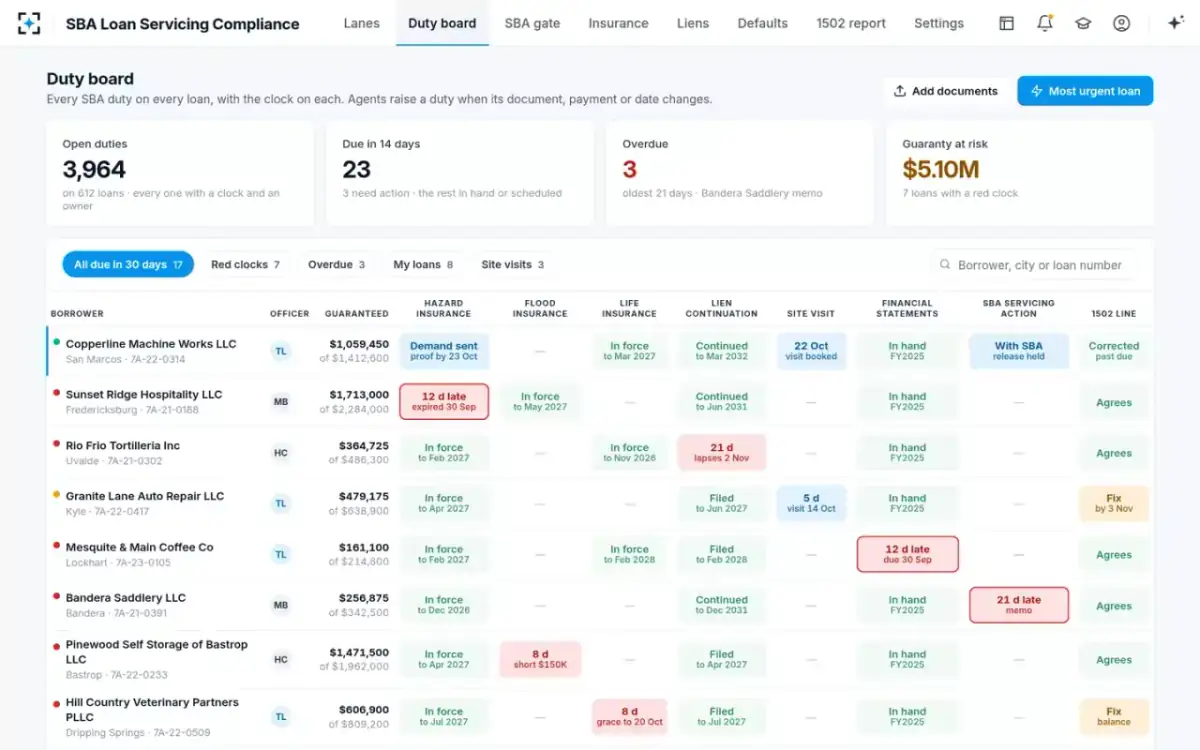
Four quantitative factors move most directly with servicing work. The 1502 Reporting Rate reflects whether the monthly report is complete and correct; it is built from the same lines a daily check compares, and SBA 1502 reporting requirements covers how errors start. The 24-Month Repair/Denial Rate reflects how often SBA repairs or denies the lender's purchased loans, and many repair grounds in SOP 50 57 4 are servicing failures: a late site visit, a lost lien position, a release that conferred a Preference. Loans in Default Status Over 3 Years tracks liquidations that drag. The Stressed Loan Rate reflects how much of the book is in trouble, which timely workouts and deferments, properly judged, can affect.
The qualitative factors are blunter about servicing. Under Asset Management, SBA looks at "Servicing (e.g., continued creditworthiness monitoring, tracking and maintaining elements required by the Loan Authorization, etc.)" and at "Liquidation and Resolution Risk (e.g., liquidation plans, timely submission of wrap-up reports, ensuring loans in active default are progressing toward final resolution, etc.)" (SOP 50 53 (2), Appendix 1). Tracking the elements a loan's authorization requires is, in plain terms, insurance, liens, financial statements and the other conditions with clocks.
SBA Loan Servicing Compliance shows the book the way a reviewer will ask for it
What a weak rating costs a lender
A weak rating costs attention first, then authority. The regulation makes "satisfactory SBA performance" a condition of continued participation and names the Risk Rating, "historical performance measures (like default rate, purchase rate and loss rate)" and review assessments among the factors (13 CFR 120.410(a)(2)). SBA's SOP lists what comes before enforcement: a rating downgrade, a secondary market sales evaluation in which SBA reviews loans before the lender may sell them and may charge for it, and a shortened renewal of delegated authority for a lender with "marginally acceptable underwriting, closing, servicing, or liquidation of SBA loans" (SOP 50 53 (2), Ch. 3).
Lender type matters to SBA's view of risk, and its inspector general has said so in numbers. As of 31 March 2025 the 7(a) portfolio of small business lending companies, the non-bank lenders SBA licenses, had a default rate of 14.97% against 9.79% for other lender types, and an early default rate of 5.38% against 2.62% (SBA OIG Report 26-14).
SBA's non-bank lenders default more often, and much more often early
The inspector general's broader concern points the same way. Its fiscal 2026 challenges report says SBA's credit risk office oversees about $163 billion of guaranteed loans and asks SBA to "Enhance its oversight of program lenders" and of "third-party service providers, including loan agents" (SBA OIG Report 26-01). Oversight tightening at the top tends to reach the servicing file at the bottom.
Can SBA revoke PLP status?
Yes. Among its formal enforcement actions SBA may suspend or revoke "an SBA Lender's delegated authority (including, but not limited to, PLP, SBA Express, or PCLP delegated authorities)," impose a cap on the dollars it will guarantee for the lender, suspend or revoke the lender from the program, suspend it immediately in defined cases, and debar individuals (13 CFR 120.1500). Civil money penalties go up to the published maximum, currently $306,652.
The grounds sit in 13 CFR 120.1400, which starts from a simple premise: by making SBA loans, lenders agree that "a violation of Loan Program Requirements constitutes default under their respective agreements with SBA" (13 CFR 120.1400). Servicing and liquidation conduct is expressly in scope: SOP 50 57 4 says the credit risk office may take informal or formal enforcement action "based on a Lender's servicing and/or liquidation actions or inactions" (SOP 50 57 4, Ch. 3 H). SBA does not publish a list of its enforcement actions.
What is the SBA lender oversight fee?
It is the fee SBA charges 7(a) lenders to cover the cost of reviews, examinations and monitoring. Where a cost is specific to one lender, such as a full review, SBA invoices that lender for the actual cost after the review; where it is not, such as off-site monitoring, SBA spreads it by each lender's share of SBA's guaranteed dollars and invoices yearly, with payment due no sooner than 30 days after the invoice (SOP 50 53 (2), Ch. 5).
Secondary market loan-by-loan reviews carry their own fee, payable "even if SBA does not approve the loan for sale," and each resubmission after a deficiency is charged again. Unpaid oversight fees draw interest and penalties and can lead to enforcement, including suspension or revocation of program eligibility.
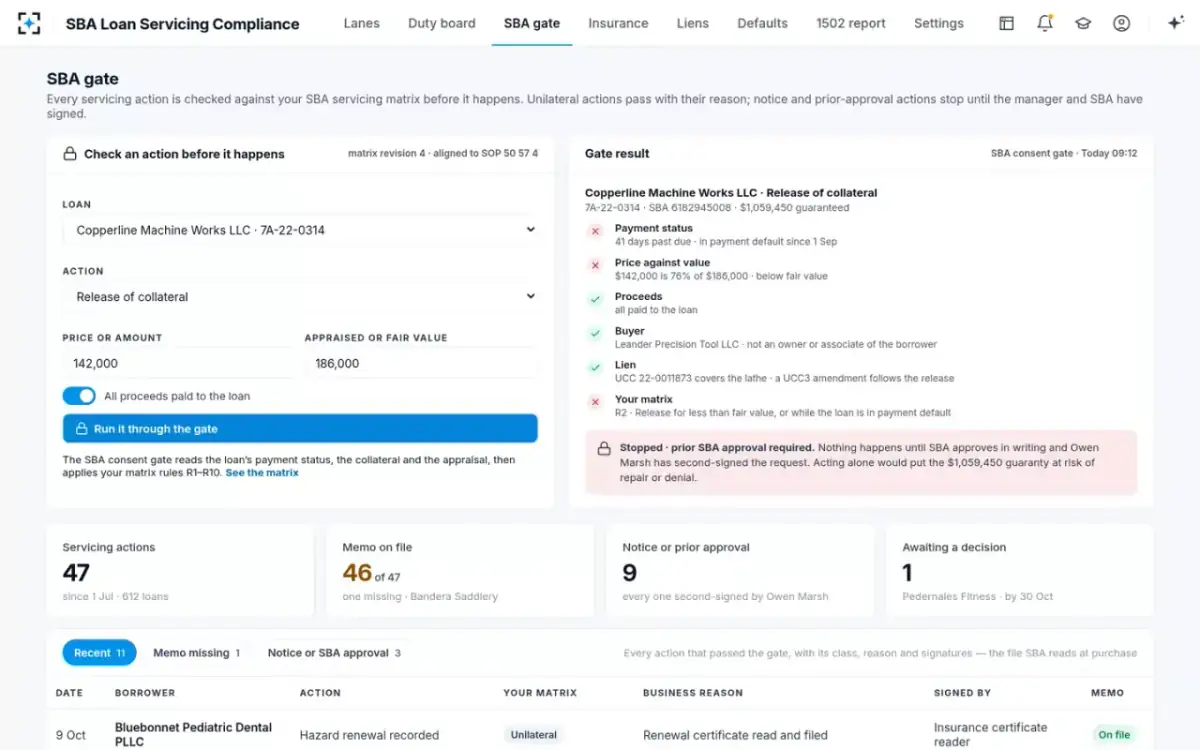
Every consent action second-signed, every memo accounted for
Reading your own book the way PARRiS does
A lender cannot compute its PARRiS score, because SBA sets the benchmarks and defines the factors in the Lender Portal, but it can watch the same things. Three habits do most of the work: reconcile the 1502 to the payment history before every submission, write the memo for every servicing action when it is taken, and treat each post-default duty, from the site visit to the wrap-up report, as a deadline with an owner. Those are the behaviours behind the 1502 reporting rate, the repair and denial rate and the liquidation factors.
The KPIs that follow from them, and how to put a value on moving them, are in SBA loan servicing software: the KPIs that show it pays; the people who own them are in the SBA loan servicing specialist. To see a servicing book laid out as SBA reads it, start from SBA Loan Servicing Compliance.
Questions people ask
Can a lender appeal its SBA risk rating?
SOP 50 53 (2) does not set out an appeal of the quarterly rating itself. SBA weighs a lender's willingness and speed in correcting weaknesses before deciding on increased supervision, and may consider factors such as rapid growth that skew a lender's metrics.
Is the SBA risk rating the same as a bank's CAMELS rating?
No. CAMELS is the bank regulators' rating of an institution's overall condition; SBA's rating covers only the lender's SBA operations. SBA does use outside information, such as regulator orders and call reports, and a regulator's capital measure is one PARRiS factor.
Does a lender's SBA rating affect secondary market sales?
It can. SBA may require loan-by-loan reviews before a lender under supervisory concern sells loans, may ask for financial assurances against repairs and denials, and can suspend secondary market authority for up to 120 days or revoke it for up to two years.
Where does a lender see its PARRiS data?
In SBA's Lender Portal, which shows the lender's own performance data, its quarterly risk rating and PARRiS score, and peer group and portfolio averages for most metrics. SBA defines each quantitative factor there.
Do small SBA lenders get reviewed?
Yes, though usually from a desk. Lenders with under $10 million of outstanding SBA loans are generally monitored through desktop reviews and performance data, and SBA may widen the scope if their risk characteristics call for it.