SBA's 1502 reporting requirements oblige every 7(a) lender to include "all 7(a) Loans in regular servicing status and all pre-guaranty purchase 7(a) Loans in liquidation status" on its SBA Form 1502 and to "submit the report to SBA monthly through the FTA," SBA's fiscal transfer agent (SOP 50 57 4, Ch. 3 F.1). Form 1502, the Guaranty Loan Status and Remittance Form, carries each loan's status and balances and the lender's annual service fee; on loans sold on the secondary market it travels with the remittance owed to investors. It is hard to get right because the report is assembled once a month from the core system's status fields, and those fields lag the payments they describe. Botminds' SBA Loan Servicing Compliance checks every line of the draft against the payment history each day from the 25th, so loan operations corrects the report before it goes.
The rules are quoted from SOP 50 57 4 and SOP 50 10 8.1; the examples come from the solution's fictional sample lender, Tallgrass Commerce Bank, and its 612 sample loans.
Checking the 1502 once a month, or every day before it goes
A monthly check of the draft: The core system's delinquency flag on the day the file is built.
A daily check against the payment history: Each loan's payment history, transaction by transaction; a flag never outranks a payment.
A monthly check of the draft: Whenever the flag is next corrected, possibly after the report has gone.
A daily check against the payment history: The next morning's check, with the unpaid date and amount.
A monthly check of the draft: A payment posted after the extract leaves a stale balance and guaranteed balance on the line.
A daily check against the payment history: The line is rechecked daily until the report is marked ready.
A monthly check of the draft: Coded from the payoff; transfers and revolving lines at zero can slip through.
A daily check against the payment history: Tested against why the balance reached zero, and on sold loans against the agent's confirmation.
A monthly check of the draft: A file to submit, and questions after the agent finds a discrepancy.
A daily check against the payment history: A short list of lines to fix, each in both values, days before the report is due.
What is SBA Form 1502?
SBA Form 1502 is the monthly guaranty loan status and remittance report a 7(a) lender sends to SBA, through the fiscal transfer agent, for every loan it services with an SBA guaranty that SBA has not yet purchased. SOP 50 10 8.1 calls it the "Guaranty Loan Status and Remittance Form" and makes it the channel for nearly everything SBA learns about a loan after approval: unless SBA asks otherwise, the lender "should not send SBA any other loan closing documentation, including disbursement information, except through the required periodic loan status reports using SBA Form 1502" (SOP 50 10 8.1).
The fiscal transfer agent sits between lenders, investors and SBA. Under the Secondary Market Improvements Act of 1984 it tracks payment histories on sold loans, collects the lender's single monthly payment for all of them, resolves "SBA Form 1502 reporting discrepancies with Lenders," pays investors, forwards servicing requests, and notifies SBA of delinquent loans (SOP 50 57 4, Ch. 3 A). SBA's paperwork notice files the 1502 with Form 1086, the secondary participation guaranty agreement, under one control number.
What are the SBA 1502 reporting requirements?
Report every loan you service with an unpurchased guaranty, every month, accurately, and pay what rides with the report. The SOP's coverage rule includes loans in liquidation until SBA buys the guaranty; after purchase, the lender reports instead through status reports to the SBA loan center every six months and remits SBA's share of recoveries through pay.gov.
What rides on the monthly 1502, and the rule behind each
| Item | The rule | Where it sits |
|---|---|---|
| Every loan in regular servicing | On the report each month, through the fiscal transfer agent | SOP 50 57 4, Ch. 3 F.1 |
| Loans in liquidation, before purchase | Still on the report until SBA purchases the guaranty | SOP 50 57 4, Ch. 3 F.1 |
| Lender's annual service fee | Paid monthly with the 1502; 0.55% of the guaranteed balance in FY2027; not chargeable to the borrower; late fees possible | SOP 50 10 8.1; Info Notice 5000-881797 |
| Guaranteed share of payments on sold loans | Remitted with the 1502 to the agent by the third day of the next month | SOP 50 57 4, Ch. 4 C.1 |
| First disbursement through escrow | Not reported as "disbursed" until all funds leave escrow, which may hold them up to 5 business days | SOP 50 10 8.1, Ch. 6 |
| Form 159 for agents and large fees | Uploaded with the 1502 within two reporting cycles of initial disbursement | SOP 50 10 8.1, Sec. A Ch. 4 |
| Paid in full | Only on a true payoff; on a sold loan, only after the agent verifies and receives the final payoff | SOP 50 57 4, Ch. 3 F.1 and Ch. 4 E |
Two of those rows are traps for a new loan. The escrow rule means a loan closed into escrow at month end is not yet "disbursed" for the 1502, and the guaranty fee may not be charged to the borrower until it is. The Form 159 rule means a fee agreement with a packager or broker on a loan disbursed in early September has to be uploaded by the second report after it, or the agent's privilege to deal with SBA is at risk.
When is the SBA 1502 due?
SOP 50 57 4 says the report is monthly and, for sold loans, that the guaranteed share of payments must reach the fiscal transfer agent with the 1502 "by the third day of the next month" (SOP 50 57 4, Ch. 4 C.1). It publishes no grace period. For reporting mechanics the SOP points lenders to the fiscal transfer agent's own reporting pages, and the agent's calendar is the schedule a lender should work to; this guide quotes no due date beyond the SOP's.
The useful question is not the deadline but how much time a lender leaves itself before it. The sample bank's checker starts on the 25th, which gives loan operations a week of daily comparisons before the report is built; the start date is a setting, from the 20th or every day.
What happens if a loan is reported paid in full by mistake?
The guaranty is cancelled. SBA's wording is flat: "When an SBA Loan is reported as 'paid in full,' it is automatically deleted from SBA's Computer Tracking System and the guaranty is cancelled" (SOP 50 57 4, Ch. 3 F.1). SBA may reinstate it, "in its sole discretion," on a written request.
The SOP names the two commonest mistakes. Lenders must not report a loan paid in full when they transfer it to another lender, or when a revolving SBA loan on which the borrower intends to keep drawing is paid down to zero. On a sold loan the lender must also wait until the fiscal transfer agent "verifies and receives the final payoff amount" before coding it paid in full, and may release the collateral only after the agent confirms.
What a request to reinstate a guaranty wrongly reported as paid in full must carry
- A reasonable explanation for the mistake
What happened, when, and why the line was coded paid in full.
- A certification that all guaranty fees are paid
Including the annual service fee for the months the loan was off the report.
- Confirmation that no obligor was released
No borrower or guarantor released without SBA's prior written approval in the meantime.
- A transcript of account
Showing the balance of the loan for reinstatement.
- Sent to the right SBA loan center
Reinstatement of a guaranty is itself an action that needs SBA's prior written approval.
The third item is the one that cannot be fixed after the fact. A lender that discovers the coding error months later, after releasing a guarantor on the strength of the loan appearing closed, has turned a clerical mistake into a guaranty problem.
Why a monthly report produces daily errors
The 1502 is built once a month, but each line is the sum of daily events, and the errors come from the gap between an event and the field that records it. A bounced payment is the classic case. A payment that posts after the morning extract is another. Neither is a reporting error when it happens; each becomes one when the file is built from a field that has not caught up.
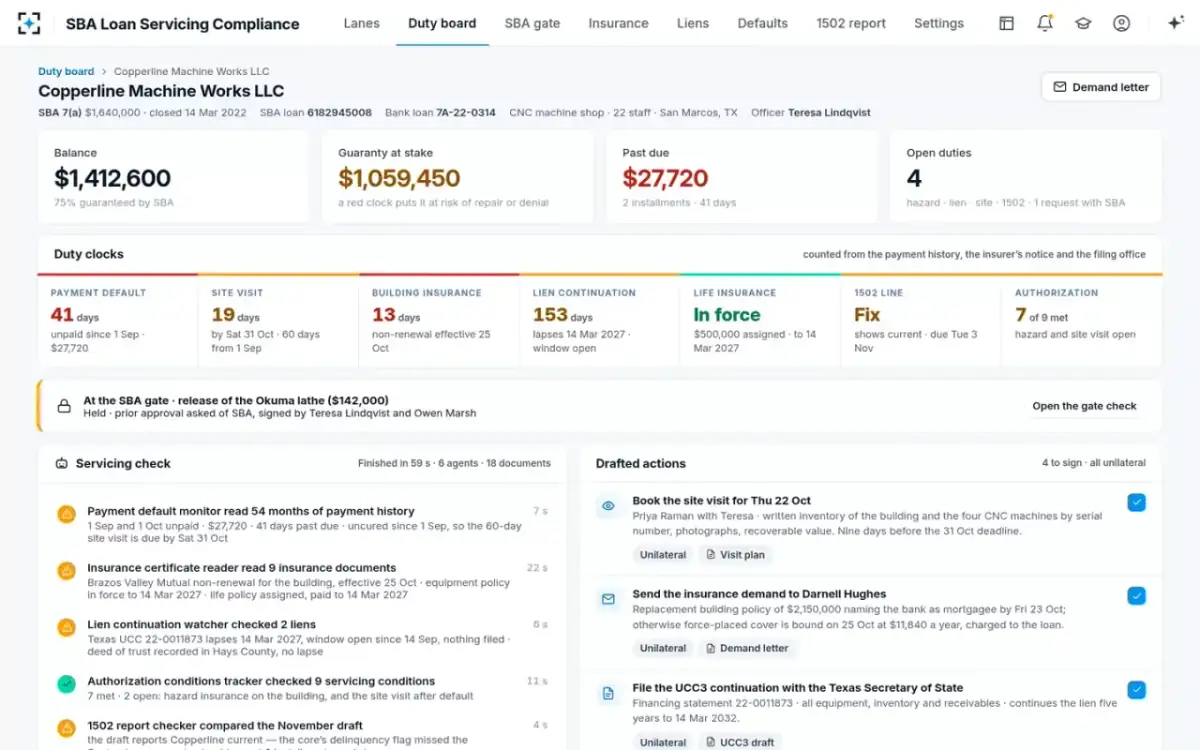
The sample book shows all three kinds on one report. Copperline Machine Works' 1 September payment bounced and the core's delinquency flag was never updated, so the November draft reported the loan as current when it was two installments, $27,720, past due. Granite Lane Auto Repair carried the same stale flag over unpaid installments from 18 August and 18 September. Hill Country Veterinary Partners' 9 October payment posted after the 06:00 extract, so its draft line showed a balance of $812,400 and a guaranteed balance of $609,300 where the payment history gave $809,200 and $606,900.
SBA Loan Servicing Compliance finds a 1502 line that disagrees with the payment history
How does SBA use 1502 reporting to rate lenders?
SBA watches the 1502 as part of its oversight of every 7(a) lender, and scores it. SBA's supervision SOP lists "Non-lending requirements (e.g., 1502 Reporting and resolution of receivables due the SBA)" among what its monitoring covers, and names "All 7(a) Lenders - SBA Form 1502 and SBA Form 172 reporting" as required reporting (SOP 50 53 (2), Ch. 2).
Within PARRiS, SBA's lender scoring method, the "Regulatory Compliance" component includes a quantitative "1502 Reporting Rate" and the qualitative factor "Accurate and Complete SBA Form 1502 submissions," next to timely remittances and Form 159 compliance (SOP 50 53 (2), Appendix 1). A desk that treats the 1502 as a back-office file is producing one of the numbers its lender rating is built on; how PARRiS reads a servicing book follows the rest.
The 1502 in four numbers
62,000h
SBA's yearly paperwork estimate for Forms 1502 and 1086 together
3rd
day of the next month for the sold-loan remittance that travels with the 1502
0.55%
annual service fee on the guaranteed balance, paid monthly with the report, FY2027
2
reporting cycles within which a Form 159 must be uploaded after first disbursement
How many hours does SBA 1502 reporting take?
SBA estimates 62,000 hours a year for Forms 1502 and 1086 together, on 4,000 annual responses, in its December 2024 paperwork notice (Federal Register 2024-30239). That is SBA's figure for producing the forms; it does not count the time a lender spends checking a draft, chasing discrepancies the agent raises, or reinstating a guaranty.
SBA's own yearly burden estimates: the 1502 is the heaviest form a 7(a) lender files
Per response, the 1502 is estimated at 15.5 hours, which says more about the work than the total: a monthly report that takes the better part of two working days is one assembled and reconciled by hand. That is the time a daily check moves earlier in the month rather than removes.
A daily 1502 check, line by line
A daily check compares five fields on each line of the draft with the payment history and the core: status, days past due, balance, guaranteed balance and interest paid-to date. Where they differ, the line is listed with both values and the cause; payment history outranks a status flag. In the sample bank, the first comparison found 609 of 612 lines in agreement and the three lines above to fix, and also confirmed that every loan in regular servicing was on the report, that loans in liquidation were reported as such, and that loans paid in full that month had been removed.
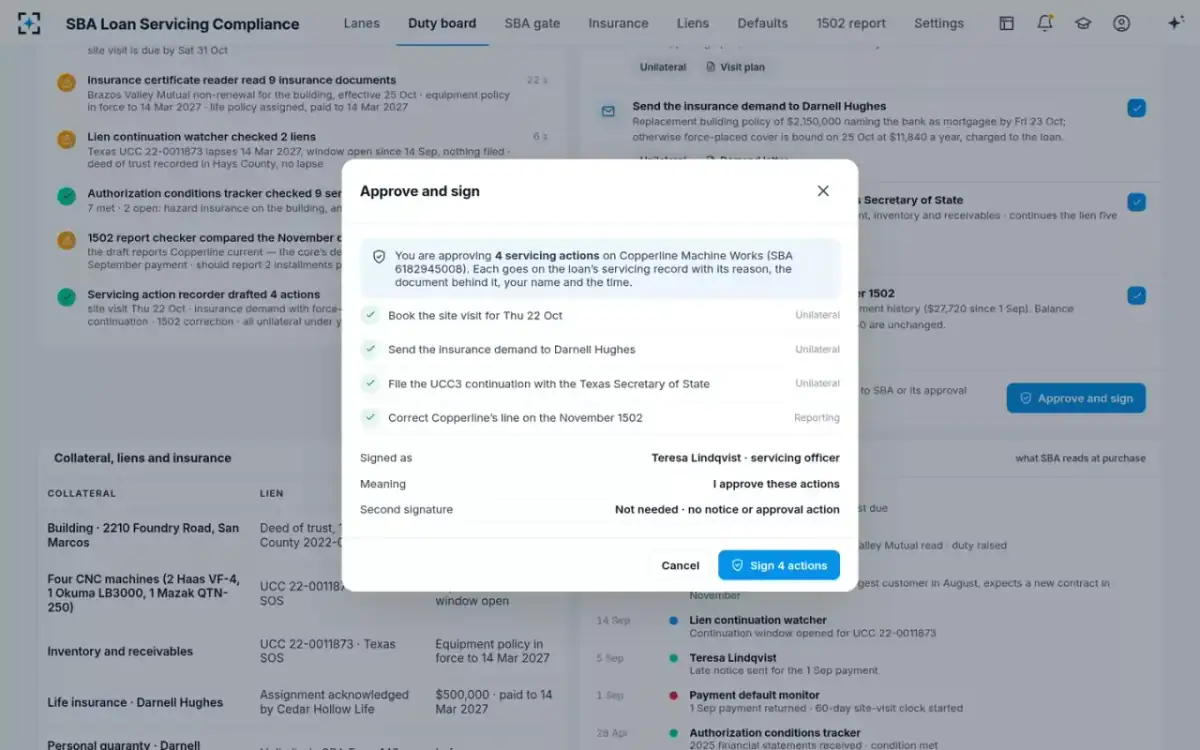
The checker never submits and never edits the report. Loan operations makes each correction in the core, or uses E-Tran where SBA allows it: the matrix notes that "Lenders may also use E-Tran to correct 1502 reporting errors" (7(a) Lender Matrix, version 18). The officer's correction is an action like any other, signed with its reason.
A 1502 correction signed as a reporting action, with three routine servicing actions
The same discipline fixes the dull cases that cause most discrepancies: a loan returned from liquidation to regular servicing, which the matrix asks lenders to report as regular servicing on later 1502s "to avoid overwriting the loan status in E-Tran"; a loan transferred to another lender; a line of credit drawn to zero. Each is a status change with a rule, and each can be tested before the report goes. For the KPIs that sit on top of the 1502, see SBA loan servicing software: the KPIs that show it pays; to see the check on a sample of your own loans, start from SBA Loan Servicing Compliance.
Questions people ask
What is the SBA fiscal transfer agent?
It is the contractor SBA uses to run the 7(a) secondary market and collect the monthly 1502. It tracks payment histories on sold loans, collects lenders' remittances, pays investors, resolves 1502 discrepancies, forwards servicing requests and forwards fee remittances to SBA's Denver Finance Center.
Do loans in liquidation stay on the 1502?
Yes, until SBA purchases the guaranty. SOP 50 57 4 requires "all pre-guaranty purchase 7(a) Loans in liquidation status" on the report; the lender must also move the loan to liquidation status in E-Tran before asking SBA to buy the guaranty.
Is the annual service fee paid on the 1502 for a loan in default?
The fee is due from initial disbursement until the loan is paid in full, the guaranty is terminated, or SBA purchases it. SBA's matrix adds that it runs until the lender cancels the guaranty or submits a complete purchase demand acceptable to SBA.
How do you report a prepayment on a sold SBA loan?
A borrower may prepay at any time, but if the prepayment exceeds 20% of the unpaid balance on a sold loan the lender must notify the fiscal transfer agent in writing under Form 1086. A loan with a maturity of 15 years or more may also owe a subsidy recoupment fee, paid to the agent with the prepayment.
Can a 1502 error be corrected after submission?
Yes. The fiscal transfer agent resolves reporting discrepancies with lenders, and SBA's matrix allows some corrections through E-Tran. A loan wrongly reported as paid in full is different: its guaranty is cancelled and needs a reinstatement request to the SBA loan center.