The SBA servicing action matrix, formally the Servicing and Liquidation Actions 7(a) Lender Matrix, is SBA's table of which servicing and liquidation actions a 7(a) lender may take unilaterally, which it must enter in E-Tran or report to an SBA loan center, and which need SBA's prior written approval. It matters because a lender that acts alone where SBA's consent was required, or acts alone without writing down why, gives SBA a reason to repair or deny the guaranty years later. Botminds' SBA Loan Servicing Compliance turns the matrix into settings: before any release, subordination, assumption or deferment happens, an agent classes it against the bank's matrix and drafts the work, and named people decide and sign.
The current version is version 18, effective 18 December 2025, read here alongside SOP 50 57 4. The examples come from a fictional sample lender, Tallgrass Commerce Bank, and its invented borrowers.
Seven common SBA servicing actions, divided three ways: agent, person, SBA
Release of collateral for value
SBA's classLender's own authority; no notice. Consideration must reach the lesser of Recoverable Value or the balance.
Agent draftsReads the request, the appraisal, the lien search and the payment status; tests the price; drafts the memo.
Person decidesOfficer decides the price test and signs.
SBA's partNothing, unless the bank's own matrix asks more.
Release of a guarantor or co-borrower
SBA's classPrior written approval, apart from two kinds of limited guaranty.
Agent draftsChecks the loan is Seasoned and the 20% owner rule; drafts the servicing request with its eight parts.
Person decidesOfficer recommends; manager co-signs before it leaves.
SBA's partCommercial Loan Service Center decides.
Subordination to the lender's own new loan
SBA's classA Preference: prior written approval.
Agent draftsFlags any other loan the bank holds to the same borrower.
Person decidesManager decides whether to ask at all.
SBA's partConsents, or the preference stands against the guaranty.
Payment deferment
SBA's classLender's authority; up to six months on an unsold loan. On a sold loan, over 90 days cumulative needs the investor.
Agent draftsCounts deferred payments against the 18-month early default window and the investor limit.
Person decidesOfficer finds the cash flow problem temporary and signs.
SBA's partNone; the investor, through the fiscal transfer agent, if sold.
Change of ownership, first 12 months after final disbursement
SBA's classPrior written approval, sent to the Loan Guaranty Processing Center.
Agent draftsDetects a change in the owners on file against the disbursement date.
Person decidesOfficer recommends.
SBA's partChecks loan limits, prior losses and citizenship of new owners.
Maturity extension
SBA's classE-Tran update on a loan in regular servicing; up to 10 years, before the guaranty expires.
Agent draftsDrafts the E-Tran change, and flags any additional guaranty fee, due within 30 days.
Person decidesOfficer approves; investor consent if sold.
SBA's partNone beyond the E-Tran entry.
Site visit, demand letter, UCC continuation
SBA's classRoutine; no notification.
Agent draftsRaises the duty on its clock and drafts the visit plan, letter or UCC-3.
Person decidesOfficer signs.
SBA's partNone.
What is the SBA servicing action matrix?
The matrix is a reference tool published by SBA's Office of Financial Program Operations; the binding rules sit in the regulation and the SOP. Its own disclaimer says so: "In the event of a conflict between a tool relied upon by a Lender and the applicable Loan Program Requirement, the Loan Program Requirement will prevail" (matrix, version 18). SBA posts it as a downloadable document with the 7(a) servicing SOP (SBA).
It sorts actions into four bands, not two. Some need SBA's prior approval. Some are unilateral but must be entered in E-Tran Servicing, such as a maturity extension on a loan in regular servicing or a change of the borrower's name. Some are unilateral but need a notice to the loan center, such as a change in the borrower's legal structure or the transfer of 90% or less of a loan. And the largest band needs no notification at all: releasing or substituting collateral, deferring payments, ordering an appraisal, paying real estate taxes, conducting a site visit.
That last band is where most servicing errors live, because "no notification" is easily read as "no paperwork." The matrix closes that reading in its own text: lenders "Must document the business reason and justification for their decisions and retain these and supporting documents in their Loan File for future SBA review."
What servicing actions need SBA prior written consent?
Seven kinds of action need SBA's prior written consent under the regulation, and SOP 50 57 4 expands them into 24 items. The regulation lists increases above the authorized principal, a Preference or conflict of interest, a compromise of principal, taking title in SBA's name, taking title to contaminated property, transferring more than 90% of a loan, and anything else a Loan Program Requirement reserves (13 CFR 120.536(a)).
The 24 actions SOP 50 57 4 reserves for SBA's prior written approval, by theme
| Theme | Items in Chapter 3, Paragraph C.3 | What the lender usually wants |
|---|---|---|
| Conflicts and preference | Exception to policy; Preference; conflict of interest; sale or lease of collateral to the lender, its associates, employees or their close relatives; sale or lease to an obligor or its associates on a loan in liquidation | To deal with a buyer it knows, or protect another loan it holds |
| Who owes the debt | Release of a co-borrower or guarantor; assumption with release of an obligor on a loan in payment default or liquidation; any change in ownership for 12 months after final disbursement | To let an owner leave, or a new owner in |
| Money and the guaranty | Compromise of principal (including a deed in lieu that extinguishes the deficiency); extraordinary servicing fee; a finding that a prepayment was involuntary; a higher guaranty percentage; a larger or smaller loan; reinstating the guaranty; disbursing beyond 48 months | To settle, re-size or repair a loan |
| Liquidation and litigation | Liquidation Plan for a CLP loan; missing the prudent liquidation deadline; a Litigation Plan, or fees more than 15% over an approved one, for non-routine litigation | More time or more legal spend |
| Property and environment | Title in SBA's name; title to contaminated property; running a business that handles hazardous substances or sits on contaminated property | To take over collateral |
| Secondary market | Emergency purchase from the secondary market; transfer or sale of more than 90% of the balance | To restructure a sold loan, or sell the loan |
Two items catch lenders more than the rest. The release of a guarantor needs consent even when the guarantor has sold out of the business, except for limited guaranties taken only to secure an owner's interest in collateral or given after a partial change of ownership. And the 12-month ownership rule applies "including a change in percentage of ownership," so a reshuffle between two existing owners in the first year after final disbursement still goes to SBA.
What can a lender do without SBA approval?
A lender may take "all routine actions to service and liquidate" its 7(a) loans on its own authority, provided they meet SBA's performance standards (SOP 50 57 4, Ch. 3 C.1). In practice that covers most modifications of the note: moving the payment date, changing the installment amount, changing the interest rate within program limits, converting a revolving loan to non-revolving, and extending the maturity by up to ten years if the extension is requested before the guaranty expires and will aid orderly repayment.
It also covers most collateral actions. Releasing a lien for value, substituting collateral of equal or greater Recoverable Value, subordinating to refinance a senior loan on better terms, and deferring payments for up to six months on an unsold loan are all the lender's call, under conditions set out in Chapters 7, 8 and 12. Each condition is a test the lender must pass and record: the borrower's credit history is satisfactory, the remaining collateral adequately secures the loan, the release documents do not impair foreclosure on what is left.
The numbers that bound a lender's own authority
24
actions SOP 50 57 4 reserves for SBA's prior written approval
10yrs
longest maturity extension a lender may grant on its own authority
6mo
longest deferment on an unsold loan without a written repayment strategy
90%
share of a loan above which a transfer or sale needs SBA's consent
"Without SBA approval" does not mean without anyone's approval. For a deferment, the early default rule turns a routine action into one that changes what SBA presumes at purchase. For a release, the price test is the lender's to apply and SBA's to second-guess later; the consent check before a lien goes works through it on one loan.
How do you document a unilateral servicing action?
A unilateral action is documented in a dated Loan Action Record kept in the loan file with every document it relied on. The regulation requires lenders to "document the justifications for their decisions and retain these and supporting documents in their file for future SBA review to determine if the actions taken by the Lender or CDC were prudent, commercially reasonable, and complied with all Loan Program Requirements" (13 CFR 120.536(c)).
What a Loan Action Record must hold for SBA to accept it later
- The borrower's name and the 7(a) loan number
So the memo can be matched to the loan at purchase without inference.
- The lender's name and a contact
SBA asks questions of a person, not a system.
- A reasonable description of the action
What was released, deferred or changed, with amounts and dates.
- The justification, with analysis of the supporting documents
The appraisal, the lien search, the financial statements: what each showed and why it supported the decision.
- The authority cited
The regulation or SOP paragraph that lets the lender act. A memo that cites nothing proves only that someone decided.
- The supporting documents themselves, dated
Appraisals, credit reports, environmental reports, and a copy of the matrix version relied on.
- Notes of calls and meetings
Date, time, place, who attended and what was said, in the file or the tracking system.
The sample bank shows how a gap looks in a live book. Of 47 servicing actions since July, 46 have a memo on file. The missing one is a delivery van released on 21 September for Bandera Saddlery: a unilateral action under the bank's matrix, signed and done, and 21 days later still without the reason that would let SBA judge it. The action was probably right. Without the memo, nobody can show it.
The second consent: the investor on a sold loan
When the guaranteed portion has been sold on the secondary market, a second party can say no. Under SBA Form 1086, the Secondary Participation Guaranty Agreement, changes to the terms of a sold note and to the payments due "require the prior written consent of the Registered Holder," apart from a single unilateral deferment option (SOP 50 57 4, Ch. 3 C.2). The request goes through SBA's fiscal transfer agent, which forwards it to the investor and the answer back.
SBA's consent and the investor's are tested on different things
SBA's prior written approval: The 24 actions of SOP 50 57 4, Ch. 3 C.3: preferences, releases of obligors, compromises, ownership changes in the first year.
The investor's consent on a sold loan: Any change to the repayment terms or payment amounts of the sold note, other than the one permitted deferment.
SBA's prior written approval: Not required; up to six months on the lender's authority.
The investor's consent on a sold loan: One deferment of up to three months without consent; the matrix footnote puts the line at deferments over 90 days cumulative.
SBA's prior written approval: Lender may move monthly to quarterly for a seasonal borrower.
The investor's consent on a sold loan: Not permitted on a sold loan.
SBA's prior written approval: The Commercial Loan Service Center, or the National Guaranty Purchase Center for most loans in liquidation.
The investor's consent on a sold loan: The registered holder, through the fiscal transfer agent; a pool can approve changes that leave the rate alone.
SBA's prior written approval: Reconsideration within 30 days with new facts, then appeal.
The investor's consent on a sold loan: The lender may ask SBA to let it repurchase the loan if the borrower's viability is at stake and the investor declined or did not answer in 30 days.
A servicing team that tracks only SBA's consent will grant a second deferment on a sold loan as freely as on a retained one. A matrix built as settings needs a column for the loan's sale status, and the agent classing an action has to read it before it reads anything else.
Re-dividing the matrix: agents draft, people decide, SBA consents
SBA's matrix answers who must consent; it does not say who in the bank does the work. Re-divided for agents, every action splits into the same three parts: an agent gathers the documents and classes the action, a person makes the finding and signs, and SBA consents only where its matrix says so.
The sample bank's matrix is stricter than SBA's in places, which is its right. Its rule R2 sends any release for less than fair value, or while the loan is in payment default, to SBA for prior approval; SBA's own matrix lists release of collateral as unilateral with no notification, subject to the SOP's price test. Its rule R3 asks for a notice on substitutions, and R8 for a notice on deferments beyond three months. A bank may set its own lines tighter than SBA's; it may not set them looser.
SBA Loan Servicing Compliance holds the matrix as versioned rules
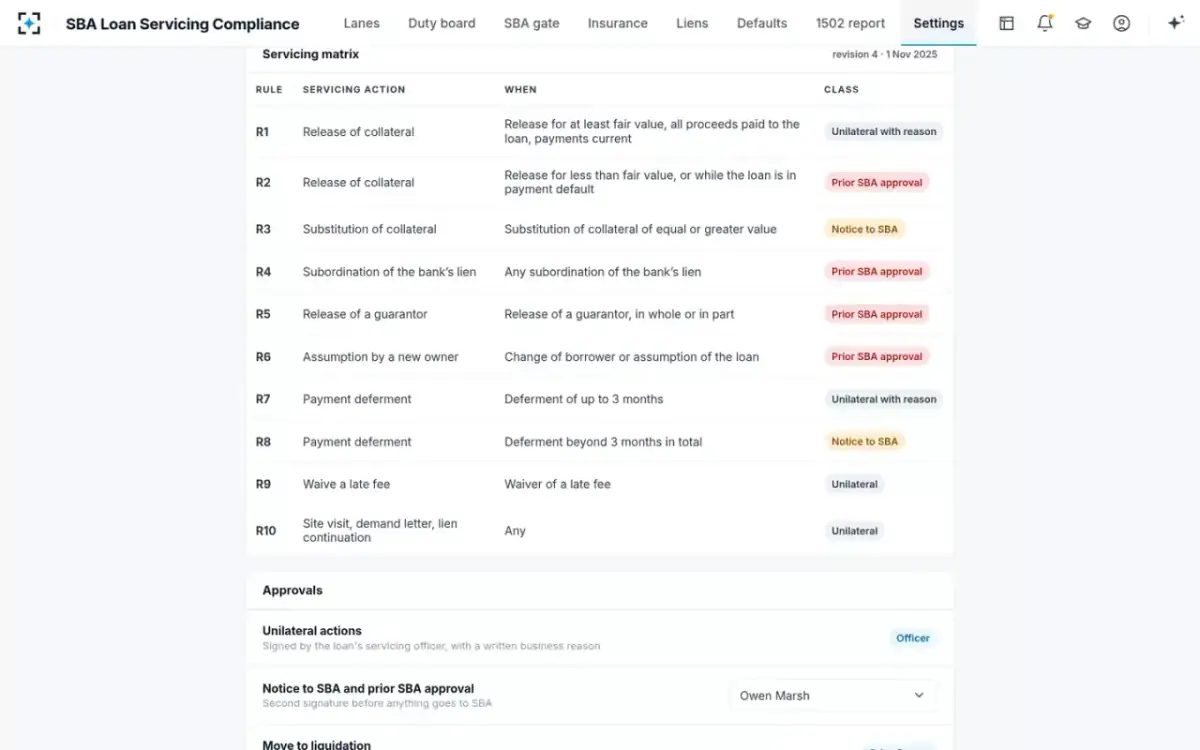
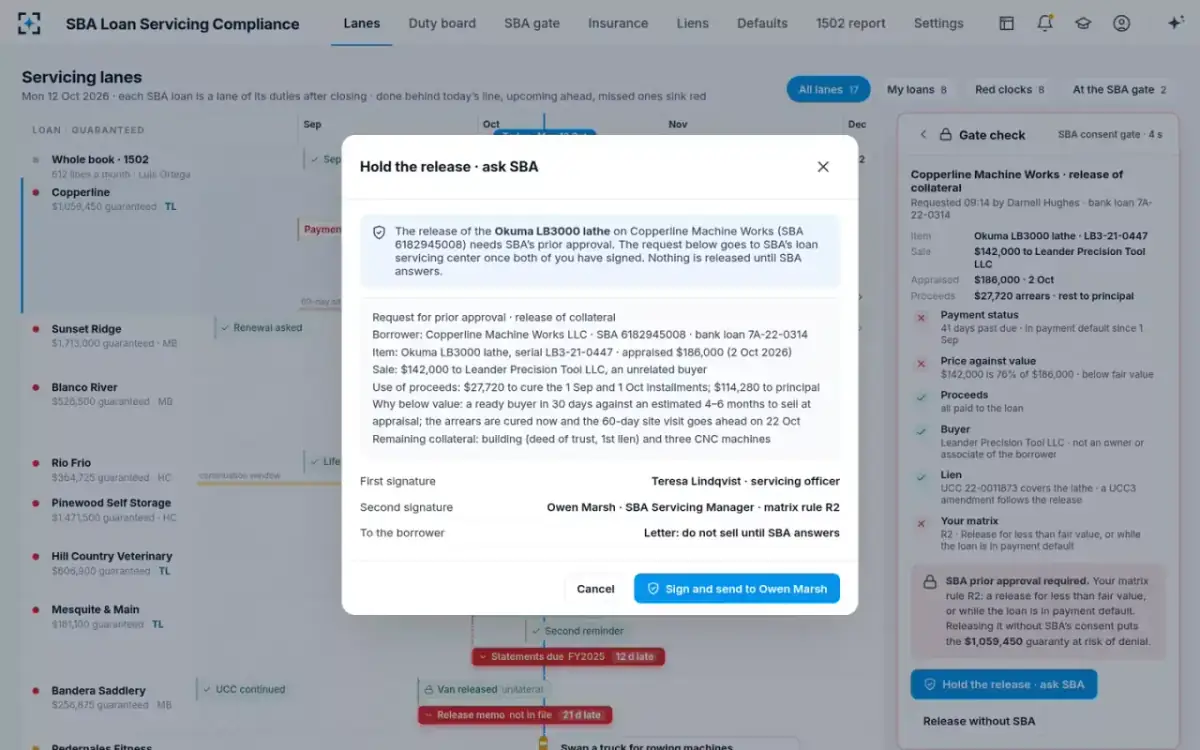
When a borrower asks for something, the consent checker reads the loan's payment status, sale status, collateral and appraisal, applies the rule, and returns the class with the facts that decided it. On the sample loan Copperline Machine Works, two payments behind, a request to sell a pledged lathe for $142,000 against a $186,000 appraisal came back in four seconds as needing SBA's prior approval under R2. The release was held, and the request to SBA was drafted for two signatures.
A release stopped for SBA's consent, with the request drafted for two signatures
How long does SBA take to answer a servicing request?
SBA aims to answer within 15 business days, and its silence is not consent. The SOP says SBA "will attempt to respond to a Lender's request for approval of a Servicing Request within 15 business days," and that failing to answer "does not imply that SBA has approved the Servicing Request" (SOP 50 57 4, Ch. 6 C.3). The regulation's 15-day clock formally covers liquidation and litigation plans and certain CDC actions, and only CLP liquidation plans are deemed approved if SBA misses its ten-day window (13 CFR 120.541).
A request that waits on SBA is a request the borrower is also waiting on, so the letter matters. The SOP asks for a clear, concise request built from the lender's own credit memo: the proposed action, its benefit to the borrower, the lender and SBA ("neither abundance nor lack of collateral alone is sufficient justification"), the loan's funding and status, the obligors' condition, mitigating factors, the collateral's Recoverable Value before and after, the lender's history with the borrower, whether the investor's consent is needed, and whether every obligor has consented. A refused request can be reconsidered within 30 calendar days, but only with new facts.
What is SOP 50 57 4, and which version of the matrix governs?
SOP 50 57 4 is SBA's standard operating procedure for 7(a) loan servicing and liquidation, effective 1 November 2025; it replaced SOP 50 57 3.1 of 1 December 2024 (SBA). It governs fully disbursed 7(a) loans in regular servicing or liquidation; before final disbursement, servicing requests follow SOP 50 10 and go to the Loan Guaranty Processing Center.
Which version governs a given action is fixed by its date. At guaranty purchase, SBA "will apply the requirements of SOP 50 57 in effect when the servicing action was taken" (SOP 50 57 4, Ch. 24). A loan that has lived through three versions of the SOP is judged action by action against each, which is why the SOP recommends keeping in the file the copy of the matrix "in effect at the time the Loan Action is taken, and that was relied on." The matrix itself is updated between SOPs: version 18 is dated 18 December 2025, seven weeks after the SOP it summarises.
Where servicing matrices go wrong
Matrices fail at the edges between rows, and the commonest edge is the Preference. SBA defines it as "any arrangement giving a Lender or a CDC a preferred position compared to SBA relating to the making, servicing, or liquidation of a business loan with respect to such things as repayment, collateral, guarantees, control" (13 CFR 120.10). A routine subordination becomes a Preference the moment the senior loan is the lender's own, and the SOP's examples of a justified repair include releasing 7(a) collateral to secure a non-SBA loan and applying 7(a) recoveries to the lender's other loans.
The second edge is the borrower's own sequence of requests. A substitution that passes the Recoverable Value test, followed a month later by a release of the substituted asset, can add up to a release no single row would have allowed. The third is the calendar: the 12-month ownership rule and the 18-month early default window turn routine actions into consent actions depending on when they happen. An agent that reads the whole loan history before classing each request catches what a table read row by row misses, and the servicing specialist keeps the judgment on what to do about it. To see the matrix, the checker and the signatures working together, start from SBA Loan Servicing Compliance.
Questions people ask
Where is the 7(a) servicing and liquidation actions matrix?
SBA publishes it as a document titled "Servicing and Liquidation Actions 7(a) Lender Matrix" alongside SOP 50 57. Version 18 is effective 18 December 2025, and the matrix itself tells lenders to check SBA's website for the latest version.
Does releasing collateral on an SBA loan need SBA's approval?
Usually not: SBA's matrix lists releasing or substituting collateral as unilateral with no notification. The SOP's tests still apply, including consideration at least equal to the lesser of the collateral's Recoverable Value or the loan balance, and a release that confers a Preference needs SBA's prior consent.
Do lenders have to tell SBA about a deferment?
SBA's matrix lists deferring payments as needing no notification. On a loan sold on the secondary market, SOP 50 57 4 asks the lender to notify the fiscal transfer agent and the SBA loan center in writing, and a deferment beyond the single three-month option needs the investor's consent.
Can a delegated lender approve its own loan increase?
For loans approved under delegated authority, the increase is entered in E-Tran, and the matrix treats that entry as SBA's prior consent. The additional guaranty fee is due within 30 days, and loans approved by the processing center need SBA's prior approval instead.
What happens if a lender takes a prior-approval action without consent?
The action is a failure to comply with a Loan Program Requirement, one of the events in 13 CFR 120.524 that release SBA from its guaranty in whole or in part. At purchase SBA may repair or deny, and it can recover money already paid "at any time" if it finds the event later.