SBA loan servicing software is worth buying if it reduces the misses SBA charges lenders for: late or wrong 1502 lines, lapsed insurance and liens, undocumented servicing actions, consent actions taken alone, and site visits after the deadline. The way to judge it is with the measures SBA already applies, because SBA's lender rating counts a 1502 reporting rate and a 24-month repair and denial rate, and its purchase review repairs or denies guaranties for exactly those misses. Botminds' SBA Loan Servicing Compliance is built for that half of the job: it sits beside the core loan system, puts a clock on every SBA duty, checks each servicing action against the bank's matrix before it happens, and has agents draft the work for officers to sign.
The KPIs below are shown on the solution's fictional sample lender, Tallgrass Commerce Bank, with 612 SBA 7(a) loans; its figures are sample data or design targets, never a customer's result. SBA's own figures are linked where they appear.
Seven KPIs for an SBA servicing desk, each tied to how SBA judges the lender
Duties past their deadline
What SBA judgesEvery missed duty is a candidate repair; SOP 50 57 4, Ch. 25
How to compute itOpen duties past due, and the guaranty on those loans
Sample book3 of 3,964 · $5.10M on 7 loans with a red clock
Target0, the design target
1502 lines that match the payment history
What SBA judgesPARRiS "1502 Reporting Rate"; accurate 1502 submissions
How to compute itLines agreeing before submission ÷ lines on the report
Sample book609 of 612 at the first check
TargetAll lines, before the report goes
Servicing actions with a memo on file
What SBA judges13 CFR 120.536(c) documentation duty
How to compute itActions with a dated memo citing its authority ÷ all actions
Sample book46 of 47 since 1 July
TargetEvery action
Site visits inside the deadline
What SBA judgesSOP 50 57 4, Ch. 16; repair ground Ch. 25 G.9
How to compute itVisits done or documented as unnecessary within 60 or 15 days ÷ visits due
Sample book0 past the deadline this year
TargetEvery visit
Insurance exceptions open
What SBA judgesInsurance in force for the life of the loan, Ch. 3 E.5 and Ch. 9
How to compute itLapsed, short or non-renewed policies without proof, and days open
Sample book3 of 1,138 policies
TargetNone older than the demand-letter period
Lien continuations not yet filed in an open window
What SBA judgesLien perfection, Ch. 3 E.3; repair ground Ch. 25 G.7
How to compute itStatements inside the six-month window and unfiled; any within 30 days of lapse
Sample book6 of 38 open windows; 1 lapsing within 30 days
TargetNone inside 30 days
Consent requests: time to decision
What SBA judgesSBA aims for 15 business days, Ch. 6 C.3
How to compute itBusiness days from request sent to SBA answer, and any acted on before the answer
Sample book1 awaiting a decision
TargetNone acted on early
What should SBA loan servicing software do?
SBA loan servicing software has two jobs that are often sold as one: servicing the money, and keeping the SBA duties. The first posts payments, accrues interest, produces statements and escrow analyses and holds the balance; every bank already runs a core or commercial loan system that does it. The second is specific to the guaranty: knowing which of a loan's dozen post-closing duties is next, which servicing actions need SBA's or an investor's consent, and whether each decision has the written reason SBA will ask for.
The second job is where SBA's rules bite. The regulation requires lenders to service SBA loans "no less diligently than their non-SBA portfolio," and to document every action that does not need SBA's consent "for future SBA review" (13 CFR 120.536(c)). A system that keeps perfect balances and no reasons meets the first sentence and fails the second.
A buyer should therefore ask, of any product, which duties it raises on its own, from which document, and what it produces when a duty is done. A tickler that reminds is not the same as a check that reads the certificate and finds the bank named as mortgagee for $350,000 when the loan requires $500,000.
What KPIs should an SBA servicing team track?
Track the misses SBA can charge you for, not activity. Each KPI in the table above ends in an action SBA can see: a 1502 line, a policy, a lien, a memo, a visit, a consent. Three of them deserve weekly attention because they compound: duties past deadline, because one lapsed policy becomes a force-placed premium and then a recoverable expense; open lien windows, because a missed continuation cannot be fixed after the lapse; and memos missing, because the reason has to be written when the decision is made.
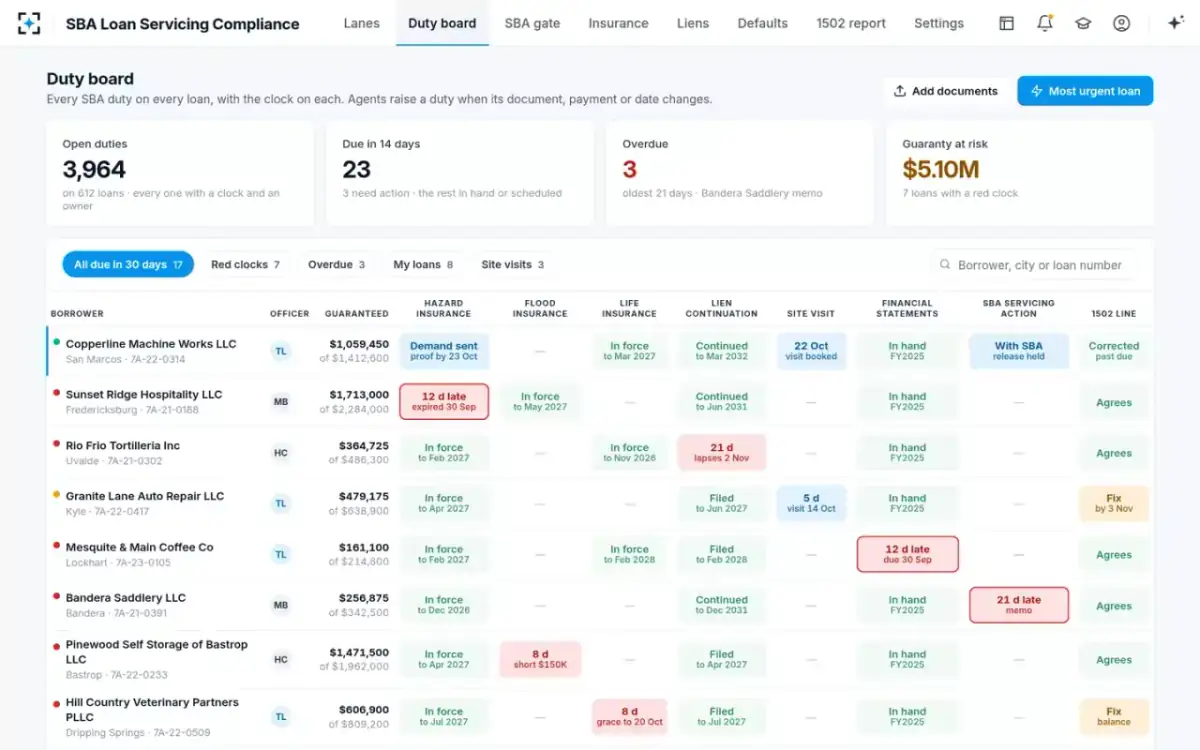
The KPI that most teams lack is the guaranty sitting on loans with a red clock. It converts a list of overdue tasks into money and ranks them. In the sample book, three overdue duties are not equal: Sunset Ridge's expired hazard policy sits on $1,713,000 of guaranty, while a late set of financial statements on a $161,100 guaranty can wait a day.
SBA Loan Servicing Compliance turns duties into a board with the guaranty at risk on top
SBA already scores you: the PARRiS measures behind the rating
SBA rates every 7(a) lender quarterly from 1 to 5, and the rating rests partly on servicing measures. Its PARRiS method groups quantitative factors under five components; under "Regulatory Compliance" sit a "1502 Reporting Rate" and a "24-Month Repair/Denial Rate," and under "Asset Management" the qualitative factors include "Servicing (e.g., continued creditworthiness monitoring, tracking and maintaining elements required by the Loan Authorization, etc.)" (SOP 50 53 (2), Appendix 1).
Those ratings carry consequences. The regulation says a lender's Risk Rating, with "historical performance measures (like default rate, purchase rate and loss rate)," is considered in deciding whether it maintains "satisfactory SBA performance" and may keep lending (13 CFR 120.410(a)(2)). The purchase rate a buyer asks about is one of them: how much of the lender's book ends with SBA buying the guaranty. Servicing software cannot change why borrowers default, but it can change how many purchases end in a repair. How PARRiS reads a servicing book goes through each factor.
What is the SBA 7(a) delinquency rate? The benchmark numbers
SBA's 7(a) delinquency rate averaged 1.15% in fiscal year 2025 to July, up from 0.88% in fiscal 2024, and the 12-month charge-off rate was 0.68% (SBA Agency Financial Report FY2025). These are program-wide figures; a lender sees its own against peers in SBA's Lender Portal.
The program-wide numbers an SBA servicing KPI sits against
1.15%
average 7(a) delinquency rate, FY2025 to July (FY2024: 0.88%)
0.68%
7(a) 12-month charge-off rate, July 2025
1.07%
improper payment rate on 7(a) guaranty purchases, FY2025 (FY2024: 5.34%)
$306,652
maximum civil money penalty SBA may impose on a lender per 13 CFR 120.1500
The improper payment figures say where SBA looks. Testing a sample of 240 purchased loans, SBA listed among the primary reasons for improper purchase payments "improper payment of expenses related to the care and preservation of collateral," alongside debt refinance eligibility and secondary market reconciliation (AFR FY2025). Care and preservation of collateral is servicing work: the visit, the insurance, the storage and the receipts.
What civil money penalties can SBA impose on lenders?
SBA may impose a civil money penalty up to the maximum it publishes, currently $306,652 under 13 CFR 120.1500, alongside a ladder of formal actions from a cap on the lender's guaranty dollars to suspension or revocation of delegated authority or of program participation (13 CFR 120.1500). SBA's supervision SOP names reporting failures and delays as a use for penalties, giving the example of "failure to timely submit complete purchase packages following SBA Secondary Market purchase."
Penalties are the tail risk, not the business case. A servicing desk's losses come mostly through repairs and denials at purchase, through the fee leakage of guaranties SBA cancels, and through the staff time spent rebuilding a file after the fact. The fee is worth remembering: the lender's annual service fee is 0.55% of the guaranteed balance in fiscal 2027, may not be passed to the borrower, and runs until payoff, termination or purchase (SBA Information Notice 5000-881797).
How do you show ROI on loan servicing software?
Show it as guaranty protected plus hours released, less cost, each term priced by the person who owns it. The formula below is a way to build the case on your own book; the numbers to put in it come from your repair history and your team's time.
A return on SBA servicing software, written as the four terms a CFO will ask about
Guaranty protected
Servicing-caused repairs a year × average repair
A repair is generally the loss times SBA's guaranty percentage: $80,000 of lost collateral on a 75% guaranty is $60,000.
SBA servicing manager, from the repair and denial history
Hours released
Officers × hours saved a month × 12 × loaded hourly cost
Our estimate for a 200-loan book is 44 hours a month falling to about 9.5.
Head of SBA lending
Fees and penalties avoided
Late-fee and reinstatement costs + expected penalties
Usually small; include only what the bank has actually paid.
Chief compliance officer
Cost
Subscription + set-up + time to review and sign
Review time does not vanish: every drafted action is still read and signed.
Operations and IT
Worked on a book like the sample bank's, with three officers: 34.5 hours a month saved each is about 1,240 hours a year. At the BLS median loan officer wage of $76,690 a year (BLS, May 2025), about $36.87 an hour before benefits, that is roughly $45,700 of capacity, real but not decisive. One avoided repair of $60,000 is larger than the whole hours term. The ROI on SBA servicing software is mostly the guaranty it protects, which is why the KPIs that predict repairs matter more than the ones that measure effort.
What is a missed duty worth? One loan, four clocks
A missed duty is worth the part of the guaranty SBA can attach to it. Take the sample loan Copperline Machine Works on 12 October: a $1,412,600 balance, 75% guaranteed, so $1,059,450 of guaranty, with four clocks running at once. Its building insurer had issued a non-renewal effective 25 October. Its financing statement on four CNC machines, inventory and receivables would lapse on 14 March 2027, with the continuation window open and nothing filed. Its site visit was due by 31 October. And the November 1502 draft still showed it current.
Any one of those, missed, maps to a named repair ground: collateral lost or devalued for want of a timely visit, a lien position not kept, an uninsured loss. None of them would show up until the loan reached purchase. The servicing check found all four in one run and drafted the visit booking, the insurance demand, the UCC-3 and the 1502 correction for the officer to sign; on the duty board, the guaranty on loans with a red clock fell from $6.16 million on eight loans to $5.10 million on seven.
What to look for in SBA loan servicing software
Look for software that proves each duty from a document and leaves every decision with a named person. The list below is what we would ask of any product, our own included.
Eight questions to ask any SBA loan servicing software before you buy
- Which SBA duties does it raise on its own?
1502, insurance, UCC, servicing conditions, consent actions, site visits, post-purchase reports: ask for the list and for what it does not cover.
- From which document does each clock start?
A site-visit clock should start from the payment history, not a status flag; an insurance clock from the certificate, not the borrower's word.
- Does it know your matrix and the loan's sale status?
SBA's consent and an investor's consent are tested on different things.
- Can it show the page behind every value?
An officer who signs must be able to check the source in one click.
- Who signs, and what does the signature mean?
Unilateral actions by the officer; notice and approval actions with a second signature; nothing to SBA or a borrower unsigned.
- What does it never do?
File a lien, submit a 1502, move a loan to liquidation, or send to SBA on its own.
- Does it keep the reason with the action?
A Loan Action Record with justification and authority, written when the decision is made.
- Will it run on a sample of your own loans first?
A trial on your own files shows what it catches that your team missed, and what it misses.
Where SBA Loan Servicing Compliance fits, and where it does not
SBA Loan Servicing Compliance is a compliance layer on top of the bank's existing loan servicing system, not a replacement for it. It needs the core's payment history and balances to start its clocks, and it gives the work back to people and systems that already own it.
The core loan system services the money; SBA Loan Servicing Compliance keeps the SBA duties
Your core or commercial loan system: Posts payments, accrues interest, holds balances and escrow.
SBA Loan Servicing Compliance: Reads the payment history every night; posts nothing.
Your core or commercial loan system: Produces the monthly draft; loan operations submits it.
SBA Loan Servicing Compliance: Checks each line against the payment history from the 25th and shows differences in both values; never submits.
Your core or commercial loan system: May hold expiry and lapse dates as fields.
SBA Loan Servicing Compliance: Reads the certificates and notices, drafts demands and UCC-3s; never files or binds cover.
Your core or commercial loan system: Records the change once made.
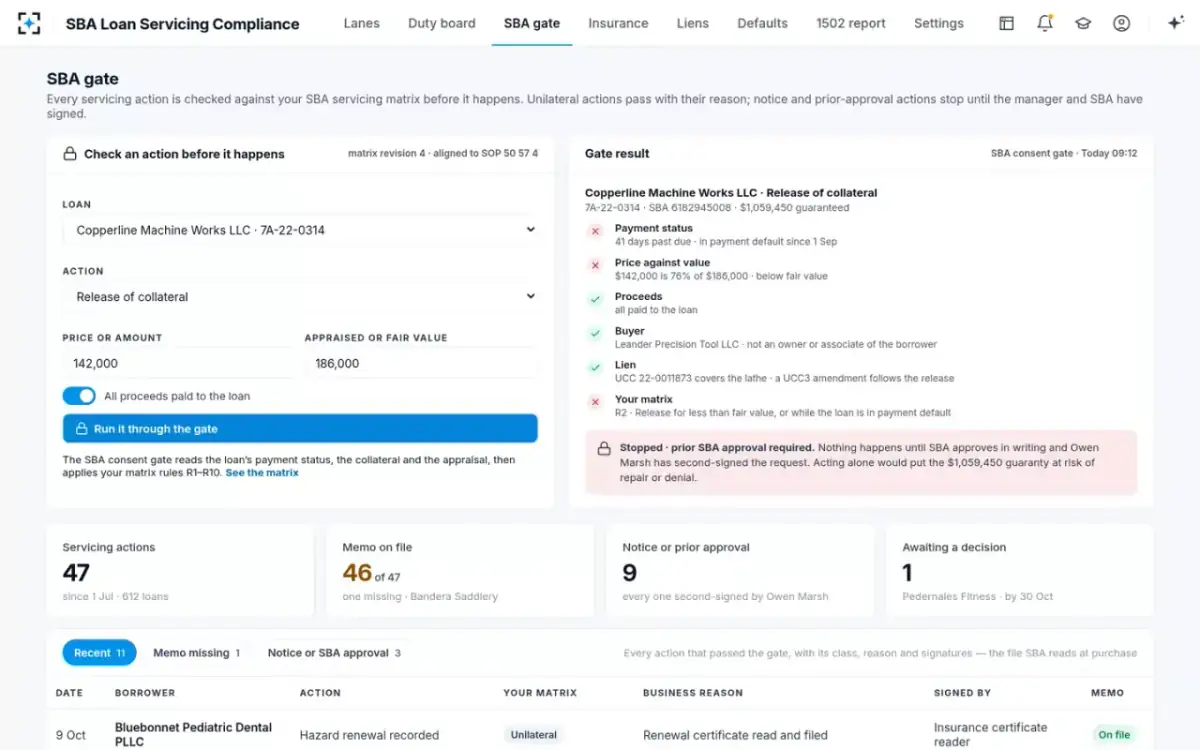
SBA Loan Servicing Compliance: Classes the request against the bank's matrix before anyone acts, and drafts the request to SBA.
Your core or commercial loan system: Flags delinquency; staff move loans to liquidation.
SBA Loan Servicing Compliance: Starts the site-visit clock from the first unpaid due date; never changes a loan's status.
Your core or commercial loan system: Liquidation accounting and recoveries.
SBA Loan Servicing Compliance: Not the purchase package or liquidation plan; it provides the servicing file those rest on.
The consent checker: every servicing action classed against the matrix before it happens
A 90-day measurement plan
Measure before you switch anything on, then compare the same KPIs on the same loans. The plan below is how we would structure a trial; the baseline is whatever your own files show today.
Measuring SBA servicing software in 90 days, on your own loans
| Weeks | What happens | What you measure |
|---|---|---|
| 1–2 | Load a sample of loans, their insurance and lien documents, the matrix and the last three 1502 reports. | Baseline: duties the agents find overdue that your trackers show as current. |
| 3–6 | Run the checks nightly beside your existing process; nothing changes in production. | 1502 differences found before submission; memo gaps; open lien windows; insurance exceptions. |
| 7–10 | Officers sign drafted actions for the sample loans. | Time from duty raised to action signed; actions rejected or edited by officers. |
| 11–13 | Compare with the baseline and with the officers' time logs. | The seven KPIs, before and after; guaranty on loans with a red clock. |
The trial also answers the question the scorecard cannot: what the agents miss on your loans. The data to load first, and in what order, is set out in what a commercial servicing system needs on SBA loans, and the 1502 check in SBA 1502 reporting requirements. To run the KPIs on a sample of your own book, start from SBA Loan Servicing Compliance.
Questions people ask
Is SBA loan servicing software the same as a loan origination system?
No. Origination systems carry a loan to closing and into E-Tran; servicing work starts at full disbursement under SOP 50 57 4. Some vendors sell both, but the post-closing SBA duties need their own tracking of insurance, liens, consent actions and site visits.
What is a lender's SBA purchase rate?
It is the share of a lender's SBA loans that end with SBA buying the guaranteed portion after default. 13 CFR 120.410 names purchase rate and loss rate among the measures SBA weighs in judging satisfactory performance, and PARRiS includes a forecasted purchase rate under risk management.
Does SBA certify or approve servicing software?
No. SBA publishes no list of approved servicing software and has issued no guidance on lenders' use of AI in servicing. The lender stays responsible for every servicing action, whatever tool it uses.
How many hours does SBA estimate for 1502 reporting?
SBA's latest paperwork estimate for Forms 1502 and 1086 together is 62,000 hours a year for 4,000 responses, published in the Federal Register in December 2024. It does not separate the time spent checking the report from the time spent producing it.
Can servicing software lower the annual service fee?
No; the fee is 0.55% of the guaranteed balance in fiscal 2027 and is set by SBA each year. Software can prevent paying it on a guaranty SBA later cancels, for instance after a loan is wrongly reported as paid in full.