An SBA collateral release on a 7(a) loan is usually within the lender's own authority: SBA's servicing matrix lists releasing or substituting collateral as a unilateral action needing no notification (7(a) Lender Matrix, version 18). But the authority comes with tests, and three kinds of release need SBA's prior written consent: a release that confers a Preference on the lender, a release of a guarantor or co-borrower, and a sale of collateral to the lender's insiders or, on a loan in liquidation, to an obligor or its associates. Releasing first and documenting later is how a routine favour becomes a repair at purchase. Botminds' SBA Loan Servicing Compliance puts a check in front of every release request: an agent reads the loan, the collateral and the buyer, applies the bank's matrix, and either drafts the memo for the officer or holds the release and drafts the request to SBA.
The worked example is a request from the solution's fictional sample lender, Tallgrass Commerce Bank; the rules are from SOP 50 57 4, Chapters 3, 6, 8 and 25.
Ten questions to answer before an SBA lien is released
- Is the loan current, in payment default, or in liquidation?
Liquidation status changes who may buy the collateral without SBA, and a borrower in default needs a closer look at where the money goes.
- Who is the buyer?
A sale to the lender, its associates, employees or their close relatives needs SBA's prior approval; so does a sale to an obligor or its associates on a loan in liquidation.
- Is the release for consideration, and how much?
Consideration must be at least the lesser of the collateral's Recoverable Value or the loan balance.
- Where do the proceeds go?
To the 7(a) loan, or, on a release without consideration, to business purposes only.
- Does any other loan of the lender benefit?
Releasing 7(a) collateral to secure a non-SBA loan is a Preference and needs SBA's consent.
- Is a guarantor or co-borrower released with it?
Prior approval, except for two kinds of limited guaranty.
- Does the remaining collateral still secure the loan?
Recoverable Value before and after, and no harm to the business's operation.
- Can the lender still foreclose on what is left?
Trade fixtures, the most valuable lots before an auction, and the wording of the release documents.
- Is the guaranty sold, and does the release change the note?
Changes to a sold note's payments need the investor's consent through the fiscal transfer agent.
- Is the memo written before the lien goes?
Justification, supporting documents and the authority cited, dated before the release.
Can a lender release SBA collateral without consent?
Yes, in most cases, provided the release passes SOP 50 57 4's tests and the lender documents why. The regulation reserves for SBA's prior written consent only a short list of actions, including any that "Confers a Preference on the Lender" and any compromise of principal (13 CFR 120.536(a)); everything else is the lender's, on condition that it "document the justifications for their decisions and retain these and supporting documents in their file for future SBA review."
The SOP sets separate tests for a release without consideration and one for consideration. Without consideration, before the loan is paid off, the borrower should use any proceeds for business purposes, must be able to repay the loan in full, and the release "must not materially interfere with the operation of the business or decrease the value of the other collateral"; the remaining collateral should adequately secure the loan, and the documents must not impair foreclosure on it (SOP 50 57 4, Ch. 8 G). For consideration, the price test applies.
Which collateral releases need SBA approval?
Five kinds of release need SBA's prior written approval: one that confers a Preference or creates a conflict of interest; a sale or lease of collateral to the lender, an associate, an employee or an employee's close relative; a sale or lease to an obligor or its close relatives or associates on a loan in liquidation; a release of a co-borrower or guarantor, outside two limited cases; and a release that amounts to a compromise of principal, such as a deed in lieu that extinguishes the deficiency (SOP 50 57 4, Ch. 3 C.3).
SBA collateral releases, type by type: what SOP 50 57 4 requires
| Release | The test | SBA consent |
|---|---|---|
| Lien released without consideration | Proceeds for business purposes; borrower can repay in full; no harm to operations or other collateral; remaining Recoverable Value adequate | No |
| Lien released for consideration | Consideration at least the lesser of Recoverable Value or the loan balance; recovery not jeopardised | No |
| Substitution of collateral | Similar or better collateral of equal or greater Recoverable Value by a current appraisal; old lien released only as the new one records, through escrow | No |
| Substitution of a residence | Sale proceeds go to the new home, escrow or the loan; equity in the new home at least equal | No |
| Condemnation proceeds, property not replaced | $5,000 or less may go to the borrower; above that, to principal (up to $5,000 may still be released) | No |
| Life insurance proceeds | Applied to principal, unless the death does not affect management and a release meets the release tests | No |
| Release that favours the lender's other loan | A Preference | Yes |
| Sale to the lender's insiders, or to an obligor on a loan in liquidation | Conflict of interest | Yes |
| Release of a co-borrower or guarantor | Loan Seasoned; required guaranties kept; no shift of risk to SBA | Yes, with two limited exceptions |
The matrix carries a reminder at both release rows: lenders should not "engage in any action that could create a Preference," and "Lender actions in connection with a non-monetary default on a non-SBA loan that adversely affect an SBA guaranteed Loan to the same Borrower can cause preference concerns" (matrix, footnote 3). A release is rarely just a release when the same bank holds another loan to the same borrower.
How much must a borrower pay to release SBA collateral?
At least the collateral's Recoverable Value or the loan balance, whichever is less. The SOP: "The amount of consideration received must be equal to or greater than the Recoverable Value of the collateral or the outstanding balance of the 7(a) Loan, whichever is less" (SOP 50 57 4, Ch. 8 H). Recoverable Value is not the appraised market value; it is what "a prudent lender could reasonably expect to recover by liquidating" the collateral, net of costs.
SBA's Recoverable Value, the floor for a release price, built term by term
Liquidation Value
What the item would fetch in a liquidation sale
From a liquidation value appraisal, not a going-concern or desk value.
Appraiser or auctioneer
Senior liens
− balance owed to lenders ahead of the 7(a) lien
Less any amount waived or subordinated by a loan document.
Servicing officer, from a lien search
Foreclosure expenses
− recoverable expenses of any lien foreclosure
The legal and sale costs SBA would share.
Servicing officer
Care and resale
− care, preservation and resale if the lender would take the collateral
Storage, insurance, transport, auctioneer.
Special assets
The arithmetic matters in both directions. A price below appraised value can pass SBA's test, because a liquidation sale would also fetch less than the appraisal; a price close to market value can fail it if the lender has not deducted a senior lien correctly. The SOP's practice tips add judgment: do not release the real estate lien where it also covers trade fixtures such as a gas station's pumps unless the fixtures are dealt with, and before a public auction of machinery do not release "the most valuable items" first, since that "may impair the ability to attract bidders for the remaining collateral."
The consent check, run on one release
Take a request as the sample bank received it on Monday 12 October 2026. Copperline Machine Works, a CNC shop in San Marcos, owes its 1 September and 1 October payments, $27,720; its loan balance is $1,412,600, 75% guaranteed. Its managing member has a buyer for one of four pledged CNC machines, an Okuma LB3000 lathe, at $142,000, against a desk appraisal of $186,000 taken on 2 October. He wants the lien released so the sale can close and the arrears can be paid.
SBA Loan Servicing Compliance checks the release against the bank's matrix in four seconds
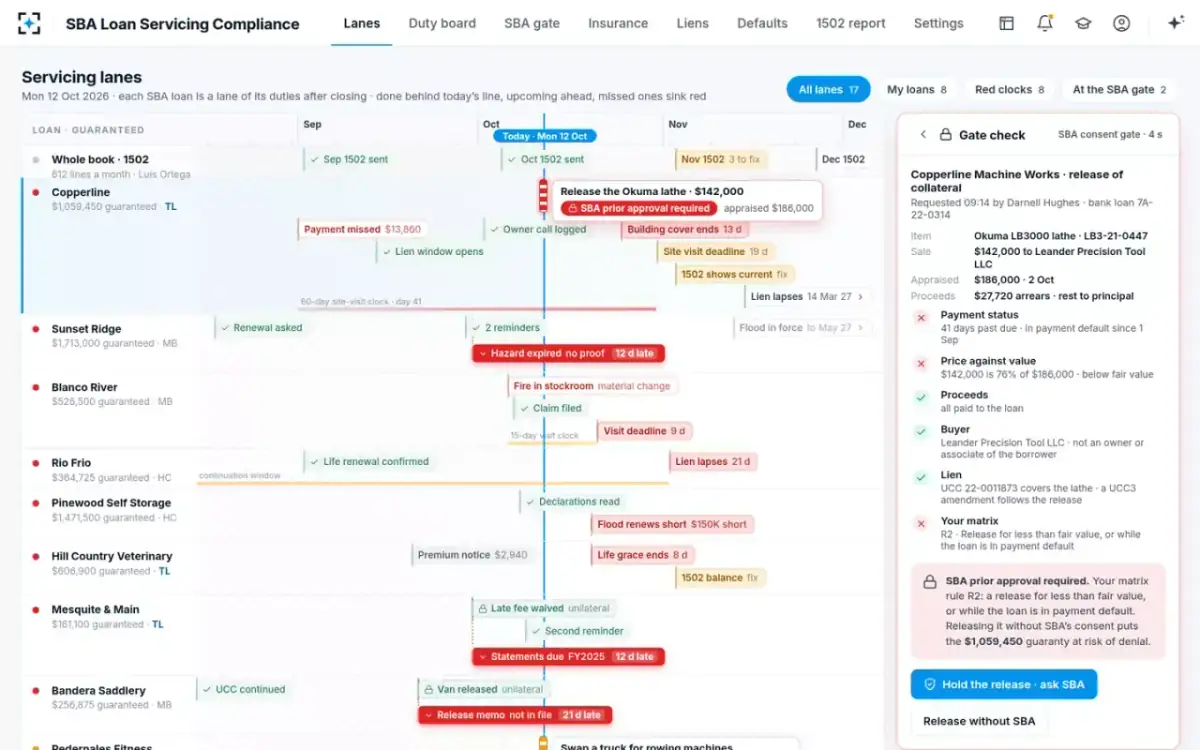
Read against SBA's own text, the request is not obviously a consent action. The buyer, Leander Precision Tool, is unrelated to the borrower; the loan is past due but not yet in liquidation; all proceeds go to the loan. Whether $142,000 passes SBA's price test depends on the lathe's Recoverable Value, which the desk appraisal does not give: a liquidation value, less storage and auction costs, may well sit below $142,000. A lender could document the release as unilateral.
The sample bank chose not to leave that call to each officer. Its matrix rule R2 sends any release below fair value, or while the loan is in payment default, to SBA for prior approval. So the checker held the release and drafted the request: the sale, the use of proceeds ($27,720 to cure the two installments, $114,280 to principal), the reason for the price (a ready buyer in 30 days against an estimated four to six months to sell at appraisal), and the collateral that remains, the building and three CNC machines. The officer signed, the servicing manager second-signed, and the borrower was told in writing not to sell until SBA answered.
The sample bank's release rule is stricter than SBA's text, and says so
SBA's rules: Allowed if the price is at least the lesser of Recoverable Value or the balance.
The sample bank's matrix rule R2: Prior SBA approval for any release below fair value.
SBA's rules: No separate consent rule for a release; the lender judges the effect on recovery.
The sample bank's matrix rule R2: Prior SBA approval while the loan is in payment default.
SBA's rules: Consent needed for a sale to an obligor or its associates.
The sample bank's matrix rule R2: Covered by the same rule.
SBA's rules: None listed in the servicing matrix for a release.
The sample bank's matrix rule R2: Request to SBA, signed by the officer and the manager.
Stricter is not free. SBA aims to answer servicing requests within 15 business days and does not treat silence as approval, so a bank that routes more releases to SBA asks borrowers to wait longer. The trade is deliberate: on a loan already two payments behind, the bank would rather wait than defend at purchase a below-appraisal sale it approved alone.
Can a guarantor be released on an SBA loan?
Only with SBA's prior written approval, apart from two kinds of limited guaranty. The SOP: "Lenders must not release Guarantors or co-Borrowers without SBA's prior written approval, except for limited guaranties taken to secure a property owner's interest in collateral for a 7(a) Loan and limited guaranties when the purpose of that guaranty is to provide a guaranty as a result of a partial change of ownership" (SOP 50 57 4, Ch. 8 I).
For a loan in regular servicing, SBA's conditions are that the loan "must be Seasoned," that the release must not conflict with rules requiring guaranties from specific people, such as "any Person who owns 20 percent or more of the small business Borrower," and that it must not "shift the risk of loss to SBA." On a loan in liquidation, the guarantor must pay at least what the lender could collect by enforcing the guaranty, and must supply the same documents as for an offer in compromise. Even the limited guaranty from a partial change of ownership may not be released until the later of two years after final disbursement or 12 consecutive months in which the loan has been current "and not on deferral." A collateral release negotiated with an owner who is leaving the business is often a guarantor release in disguise, and the check has to read both.
What is a preference under SBA rules?
A Preference is "any arrangement giving a Lender or a CDC a preferred position compared to SBA relating to the making, servicing, or liquidation of a business loan with respect to such things as repayment, collateral, guarantees, control, maintenance of a compensating balance, purchase of a Certificate of deposit or acceptance of a separate or companion loan, without SBA's consent" (13 CFR 120.10).
In releases, the SOP's examples are concrete. A lender confers a Preference if it subordinates its 7(a) lien to a new non-SBA loan it makes to the same borrower, or to a 7(a) loan with a lower guaranty percentage, or if it later renews or increases such a loan after subordinating. Among the grounds for repair or denial it lists a lender that "Releases the collateral for a 7(a) Loan in order to use it as security for a non-SBA loan" (SOP 50 57 4, Ch. 25 G.11). None of these needs bad intent; each needs only a second loan in the same bank.
A release is never judged alone. SBA reads it against every other loan the bank holds to the same borrower.
What happens if SBA collateral is released improperly?
SBA can repair or deny its guaranty, measured by what the release cost it, and can recover money already paid. Releasing collateral without consent where consent was required is a failure to comply with a Loan Program Requirement, one of the events in 13 CFR 120.524 that release SBA from liability "in whole or in part," and SBA may recover payments "at any time" if it finds the event after purchase.
The size of the hit follows the SOP's arithmetic. A repair is generally the loss times SBA's guaranty percentage; SBA uses Recoverable Value to measure losses on collateral, so a lathe released for $100,000 that would have recovered $130,000 in liquidation costs a 75%-guaranteed lender $22,500. A release that makes the loan a total or near total loss supports a full denial, and a release that conferred a Preference can justify either if it "caused, or could cause SBA to suffer a Material Loss on the Loan or adversely impacts the soundness or integrity of the 7(a) Loan program."
How do you document an SBA collateral release?
Write the Loan Action Record before the lien goes, attach what it relied on, and record the lien change in the public record. SOP 50 57 4's list of supporting documents for collateral actions is specific: current financial statements, the last two years of tax returns where credit is in question, a current appraisal of the collateral, a lien search (a title report for real estate, a UCC search for personal property), and evidence of the balance on any senior liens; for a sale, the executed purchase and sale agreement, escrow instructions and closing statement (SOP 50 57 4, Ch. 6).
The memo itself needs the borrower and loan number, a description of the release, the justification with an analysis of those documents, and "a citation to the regulation or SOP provision that provides authority." Then the paperwork must follow: a UCC-3 amendment releasing the item from the financing statement, or a partial release of a recorded lien, with the remaining collateral list updated so that a later site visit and liquidation can account for every item. A financing statement amended for one release still has its own lapse date, and the UCC continuation rules apply to what remains (UCC § 9-515).
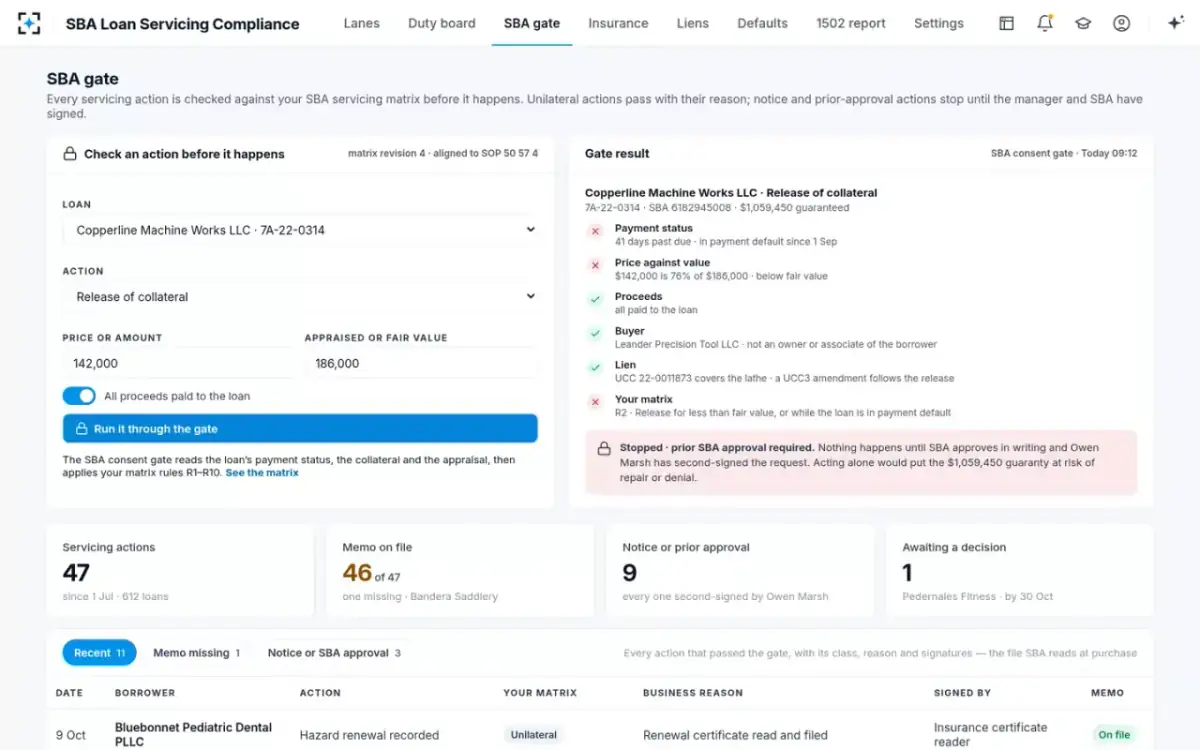
Every action that passed the check, with its class, reason and signatures
Releases at payoff
The last release on a loan has its own rule. When a sold loan is paid off early, the lender "must not report such Loans as paid in full on an SBA Form 1502 until the FTA verifies and receives the final payoff amount," and may cancel the note and release remaining collateral only after the agent confirms (SOP 50 57 4, Ch. 4 E). The SOP also warns that "many states impose significant penalties on creditors who fail to release collateral in accordance with state law," so the release that comes too late is a risk as well as the one that comes too early. The SBA servicing action matrix sets releases beside the other actions a lender takes alone; to run the release check on a sample of your own loans, start from SBA Loan Servicing Compliance.
Questions people ask
Does an SBA EIDL collateral release follow the same rules?
No. COVID EIDL and disaster loans are direct SBA loans, and requests to release their collateral go to SBA itself under its own servicing process. The rules here are for 7(a) loans made and serviced by lenders under SOP 50 57 4.
Can collateral be released when a borrower sells the business?
An asset sale usually means the loan is paid off or assumed. In an assumption the SOP says lenders should not release any collateral as part of the deal, and releasing an existing obligor on a loan in payment default or liquidation needs SBA's prior approval.
Can a lender substitute collateral without SBA approval?
Yes, if the new collateral is similar or better, has equal or greater Recoverable Value by a current appraisal, and the old lien is released only as the new one records, through an escrow signed by all parties. Substituted real estate needs environmental due diligence and insurance naming the lender.
Who signs a release request to SBA?
SBA's rules require the lender's request, built on its credit memo; who signs inside the bank is the lender's policy. The sample bank requires the servicing officer and the SBA servicing manager to sign every notice and prior-approval request before it leaves.
Does a 504 loan follow the same release rules?
No. For 504 loans, a CDC other than a PCLP CDC needs SBA's prior written consent to release collateral with a cumulative market value above 10% of the debenture or $10,000, whichever is less, under 13 CFR 120.536(b)(2).