SBA's site visit requirements say a 7(a) lender must visit a defaulted borrower's business within 60 calendar days of an uncured payment default, or within 15 calendar days of an adverse event that puts the loan in liquidation status, sooner if the collateral could be removed, lost or dissipated; the duty falls away only if the loan is unsecured or its collateral has an aggregate Recoverable Value below $10,000. A lender that does not visit must write down why a visit was "neither necessary nor prudent." The visit is hard to get right because the clock starts with a missed payment, not with the file reaching special assets, and because SBA judges the report years later, at guaranty purchase. Botminds' SBA Loan Servicing Compliance starts each clock from the payment history the night the payment is missed, and drafts the visit plan for the officer to sign.
The rules come from SOP 50 57 4, Chapters 3, 16 and 25. The loans and people named are from the solution's fictional sample lender, Tallgrass Commerce Bank.
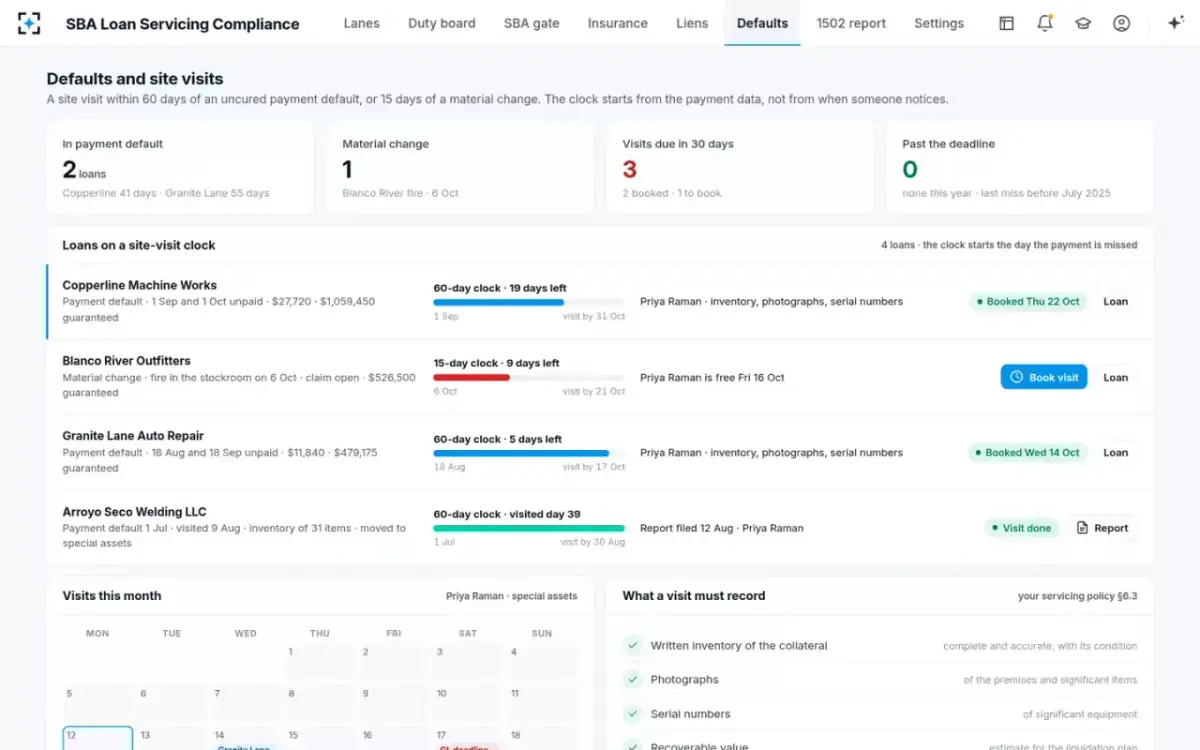
Three defaulted loans on the 60-day site-visit clock, and the 15-day one
- Elapsed to 12 Oct41 d
- To visit, 22 Oct10 d
- Spare to 31 Oct9 d
- Elapsed to 12 Oct55 d
- Left5 d
- To the visit, 9 Aug39 d
- Spare21 d
- From liquidation event15 d
When is an SBA site visit required?
A post-default site visit is required on every secured 7(a) loan whose collateral has an aggregate Recoverable Value of $10,000 or more, on one of two clocks. The SOP's words: "Payment Default—within 60 calendar days of an uncured payment Default, or sooner if the collateral could be removed, lost or dissipated. Non-payment Default—within 15 calendar days of the occurrence of an adverse event that causes the Loan to be classified in liquidation status, or sooner if the collateral could be removed, lost or dissipated" (SOP 50 57 4, Ch. 16 A).
Three exceptions narrow it. An unsecured loan needs no visit. A loan whose real and personal property collateral together has a Recoverable Value under $10,000 needs no visit; Recoverable Value is net of senior liens and the costs of foreclosure and resale, so collateral with an impressive appraisal can fall under the line once a first mortgage is deducted. And an Export Working Capital loan secured only by foreign receivables can have its visit waived with the written concurrence of SBA's export finance manager.
Outside those cases, the SOP still expects visits whenever prudent servicing warrants them, and asks lenders to write a Site Visit Report after every visit to a borrower's premises, "regardless of whether the Loan is in regular servicing or liquidation status." The post-default visit is the one with a deadline.
The four numbers in SBA's site visit rule
60days
from an uncured payment default to the visit
15days
from an adverse event that puts the loan in liquidation
$10,000
aggregate Recoverable Value below which no visit is required
$10,000
liquidation value of an item whose serial number the inventory must carry
How soon after default must a lender visit? Counting the 60 days
The 60 days run from the uncured payment default itself, the first scheduled payment that was missed and never made up, not from the day the loan was moved to special assets or the day the borrower stopped answering. A borrower who missed the 1 September installment and has not caught up must be visited by 31 October, whatever happened in between.
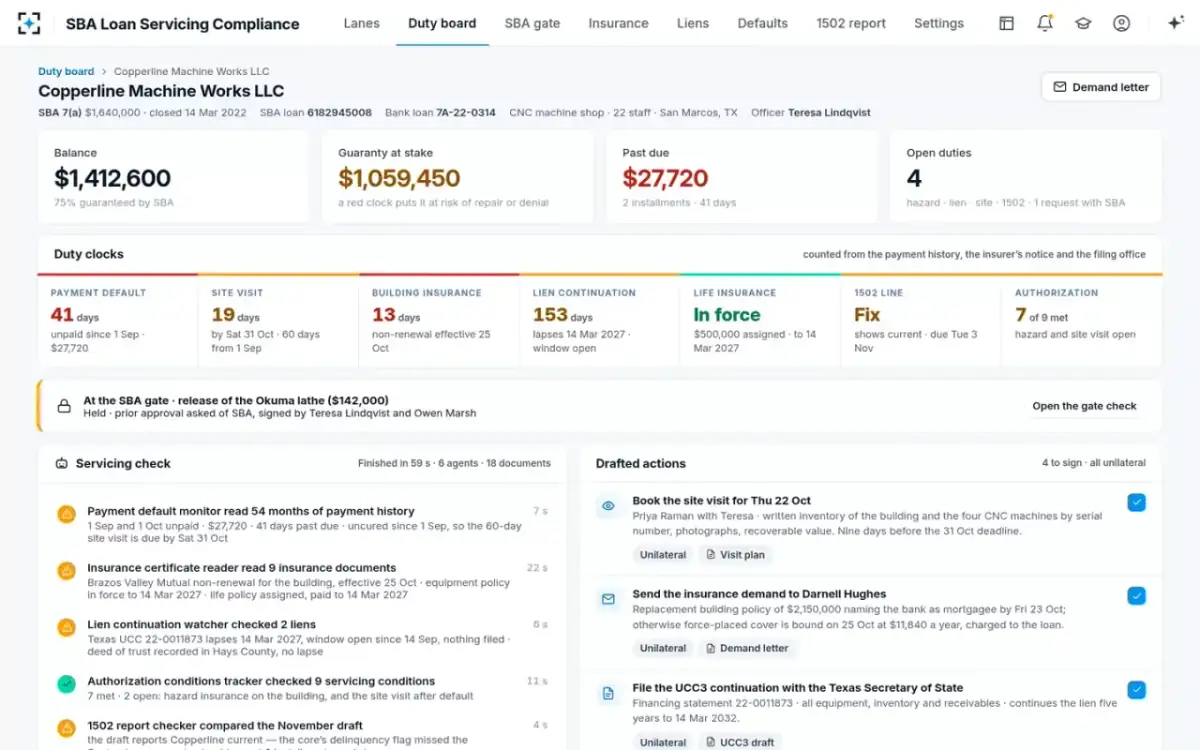
That is why the clock belongs to the payment data. In the sample bank, the payment default monitor reads the payment history every night and starts the clock on the first unpaid due date. Copperline Machine Works missed its 1 September and 1 October payments, $27,720 in all; on 12 October the clock read day 41, and the visit was booked for 22 October, nine days before the deadline, with a written inventory of the building and four CNC machines by serial number.
Granite Lane Auto Repair shows the other side. Its 18 August payment went unpaid, so its deadline is 17 October; its visit was booked for 14 October, day 57. Nothing is wrong with day 57. But the same book's November 1502 draft still reported Granite Lane as current, because the core system's delinquency flag had not caught the missed payments, and a clock started from that flag would not have started at all.
Every loan on a site-visit clock, from the day the payment was missed
The 15-day clock is about liquidation, not a missed payment
The shorter clock applies to a non-payment default serious enough to put the loan in liquidation status. SBA requires a loan to be classified in liquidation when the lender accelerates the note or learns the borrower has filed for bankruptcy (SOP 50 57 4, Ch. 15), so a bankruptcy filing, an abandoned business or an acceleration over a non-monetary default starts the 15 days.
Many events that worry a servicing officer do not. A fire, the loss of a key customer or late financial statements are reasons to look, and a prudent lender may well visit, but they start SBA's 15-day clock only if they lead to acceleration and liquidation status. The sample bank chose to treat a fire in Blanco River Outfitters' stockroom as starting a 15-day visit clock of its own; that is a policy stricter than SBA's, and it should be written down as such so that nobody later reads it as the SBA rule.
Can a lender skip an SBA site visit?
Yes, if the loan is unsecured, if the collateral's aggregate Recoverable Value is under $10,000, or if the lender documents why a visit was "neither necessary nor prudent." The SOP's words for the last case: lenders "that do not conduct a site visit must document their reasons for why a site visit was neither necessary nor prudent, keep a copy of this action in their Loan File, and include it in their final Wrap-up Report" (SOP 50 57 4, Ch. 3 F.5).
The reasons have to stand up at purchase. "The business closed and the equipment was gone" is a finding a visit would have established; written without one, it invites the question of when the equipment left. Better reasons are specific and evidenced: the only collateral is a residence covered by a senior mortgage with no equity, shown by a current appraisal and payoff; the equipment was sold through an approved release before default, with the proceeds applied. A skipped visit is a Loan Action like any other and needs the same memo.
What should a lender do before a site visit?
Before the visit, a lender should know exactly what collateral it is looking for and whether anyone else's claim now ranks ahead of it. The SOP lists five steps "when they are applicable and necessary" (SOP 50 57 4, Ch. 16 B).
Five steps before an SBA post-default site visit, and what each one prevents
| Step | What the SOP asks | What it prevents |
|---|---|---|
| 1. Review the loan documents | The Loan Authorization or E-Tran Terms and Conditions, security agreement, UCC filings and searches, landlord waiver, mortgage or deed of trust, title policy, any subordination or inter-creditor agreement. | Inventorying the wrong assets, or missing collateral that was required but never taken. |
| 2. Get a current lien search | A title report or UCC search to confirm the priority of the lien. | Discovering at liquidation that a later creditor or a lapsed filing changed the order. |
| 3. Call the landlord | Whether rent is past due on leased premises. | A landlord lock-out or lien that blocks an on-site sale. |
| 4. Call the taxing authorities | Delinquent real or personal property taxes that have, or will soon have, priority. | A tax lien that quietly outranks the 7(a) loan. |
| 5. Order an appraisal | A liquidation value appraisal by an auctioneer or other expert for personal property; a qualified appraiser for real property. | A Recoverable Value nobody can defend at purchase. |
The first step is also where a lien problem surfaces in time to fix it. If the financing statement covering the equipment lapsed last year, the visit is the moment to find out, not the auction. What happens when a UCC lapses on an SBA loan follows that thread.
What goes in an SBA site visit report?
A site visit report should show the collateral as it stood, what it is worth net of costs, who occupies the premises, and what the lender plans to do next. SOP 50 57 4 sets eight objectives for a post-default visit; the report is the evidence that each was met, or why it could not be.
What an SBA post-default site visit report should prove
- A written inventory of the collateral
Complete and accurate, with condition, photographs, and the serial number of every item with a liquidation value of $10,000 or more.
- The Recoverable Value
Net of what it will cost to care for, preserve and sell the collateral.
- Who occupies the real estate
Occupants entitled to notice, occupants to be evicted, and rent that can be collected against the loan.
- The environmental picture
The original environmental report re-read and the premises looked over for new problems.
- A liquidation strategy
For example, whether borrower and landlord will cooperate in an auction on the premises.
- Whether a workout is feasible
Financial records from cooperative obligors who have not filed for bankruptcy.
- Repossession, if it can be done peacefully
Self-help under UCC Article 9 without a breach of the peace; otherwise counsel and a replevin action.
- Care and preservation
Locks, a caretaker, utilities, storage, insurance and repairs, so the sale is commercially reasonable.
The sample bank's last completed visit shows the shape: Arroyo Seco Welding defaulted on 1 July, Priya Raman of special assets visited on 9 August, day 39, and the report carries an inventory of 31 items before the loan moved to special assets. That inventory is the list every later step is measured against.
What does SBA look for in the servicing file at purchase?
At purchase, SBA compares what the loan documents said the collateral was, what the visit found, and what the liquidation sold, and it charges the lender for any gap the lender caused. Failure to visit on time is a named ground: "A Repair or a full or partial Denial of Liability is justified if the collateral required by the Loan Authorization/E-Tran Terms and Conditions is either unavailable or declines in value due to the Lender's failure to conduct a timely post-Default site visit" (SOP 50 57 4, Ch. 25 G.9).
The measure is the money. SBA uses "the Recoverable Value of the required collateral that was either unavailable for liquidation, or the aggregate amount by which the required collateral declined in value," and a repair is generally that loss times SBA's guaranty percentage. On a 75% guaranty, $80,000 of machinery that walked away between day 30 and day 90 becomes a $60,000 deduction from what SBA pays.
A UCC sale conducted at the debtor's business premises where the machinery and equipment is set up, connected to an appropriate power source, and easily inspected and tested will usually produce a significantly higher recovery than a sale of the same collateral held off-site.
SBA SOP 50 57 4, Chapter 25
The report is also checked against both ends of the loan's life. SBA treats as grounds for repair a lender's failure "to account for items listed on the pre-closing collateral list that were not listed on the post-Default inventory and Appraisal," or items on that inventory that never reached the liquidation sale. A visit report that lists 31 items creates a duty to account for 31 items later. And the evidence of what the borrower bought with the loan can come from it too: the SOP lets lenders "rely on a post-Default Appraisal or Site Visit Report as evidence of the assets the Borrower was required to use the 7(a) Loan proceeds to acquire."
The servicing check ties the site-visit clock to its source and drafts the visit
Why the first two years carry most of the visits
Defaults on SBA loans bunch early, so the site-visit clock is busiest on young loans. In a peer-reviewed survival analysis of 7(a) loans, Glennon and Nigro found that "as a loan seasons, the likelihood of default increases initially, peaks in the second year, and declines thereafter" (Journal of Money, Credit and Banking, 2005).
That matters twice for the visit. A default within 18 months of disbursement is an Early Default under SOP 50 57 4, and at purchase SBA scrutinises how the loan was made and closed, not only how it was serviced. And on a young loan the collateral list from closing is still the best guide to what should be on the premises. A visit that reconciles the two answers the questions SBA will ask before it asks them; how a deferment can turn into an early default covers the other route into that category.
A visit calendar for a whole book
Across a book, site visits compete with every other special assets task, so the calendar has to be built from the deadlines backwards. The sample bank's special assets officer sees each defaulted loan with days left, her free dates, and the bank's own checklist of what the visit must record; three visits fall due in the next 30 days and none has been missed this year.
A book-level view also exposes the visits that are not needed. A loan whose only collateral sits behind a senior lien with no equity may fall under the $10,000 Recoverable Value line, and the right action is the memo that says so, with the appraisal and the payoff attached. Either way, the duty closes with a document SBA can read. To see the clocks, the visit plans and the memos together, start from SBA Loan Servicing Compliance.
Questions people ask
Is there an SBA site visit form?
SOP 50 57 4 does not prescribe a form for the post-default report; it sets the objectives the visit must meet, such as the inventory with photographs and serial numbers. Lenders use their own report format, and SBA's liquidation plan template asks for the site visit findings.
Does a lender have to visit before asking SBA to buy the guaranty?
The lender may demand purchase once the borrower has been in default for more than 60 days and business personal property has been liquidated (13 CFR 120.520). The report goes with the purchase package or the later wrap-up report, and a missing visit must be explained in writing.
Can the site visit be virtual?
SOP 50 57 4 speaks of physical visits to the borrower's premises and allows a waiver only for export working capital loans secured by foreign receivables. A virtual walk-through may support the file, but it cannot replace an inventory with condition, photographs and serial numbers taken on site.
Who should conduct an SBA site visit?
The lender is responsible, usually through its special assets or liquidation officer. The SOP recommends hiring an auctioneer or other expert to prepare a liquidation value appraisal of personal property and to help with the visit's goals, and a qualified appraiser for real estate.
What if the borrower refuses entry?
The SOP allows self-help repossession under UCC Article 9 only without a breach of the peace; otherwise the lender should consult counsel about a replevin action. The refusal, the date and the steps taken belong in the file, since SBA will ask why the collateral was not inspected.